
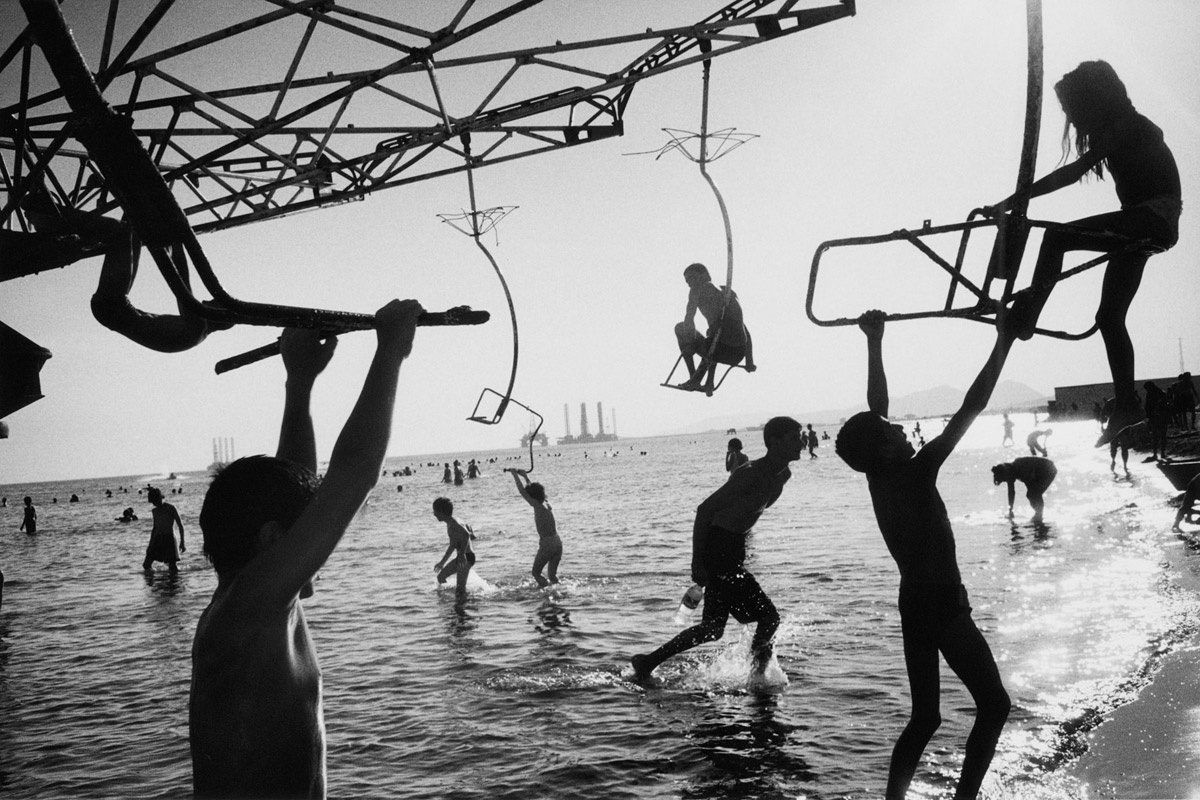
In 2003, for the first time in its history, the Leica Oskar Barnack Award went to a German photographer. Andrea Hoyer’s photo reportage, a long-term project launched in 1998, documents the longings, perspectives and moods of the Russian population of the post-Soviet era, in sensitively composed black and white photographs.
“I’ve always had this urge for languages and countries,” the photographer explains. Curiosity, a thirst for adventure and the willingness to get involved with other peoples and cultures, also characterize this series. Up until 2002, the photographer returned repeatedly to Kazakhstan, Uzbekistan, Russia and Ukraine. She always travelled alone, because, according to her particular approach: “I have to be in a certain state of mind to find what I am looking for.”
The pictures, also taken with a Leica M6, show representative elements of the former Soviet Union, such as monuments of Stalin and inside views of the Red Army. The wide expanses of Russia’s landscape, as well as towns and Black Sea beaches, are also featured. Hoyer, who lives in New York, focuses on people’s circumstances: their loneliness, alone or in groups, their lack of orientation, or the security of their circle of family and friends. The photographer does not aim for the bold drama of press photos, but uses her keen powers of observation to intensify moods and how they reflect on her own soul. The result is not a classic reportage, but a very personal view of the countries she visited. The people she portrays are always part of an overall composition: they are often truncated, the architecture and landscapes often correspond to the poses of those portrayed, and merge into complex picture compositions. “It was always composition that interested me,” she explains. Many things seem mysterious at first, no picture can be interpreted immediately; but this makes it all the more inviting to take a closer look.
The Leica Oskar Barnack Award was Hoyer’s first international recognition. Her success at the awards ceremony during the Rencontres d’Arles rewarded her courage and perseverance. For the first time, the festival also brought her work to the attention of a larger audience. Since 2012, Hoyer has begun sculpting and modelling the heads of imaginary persons in clay. She combines this side of her work with her interest in individual and collective memories, and adapts photographic principles to this other medium. “It tackles the same themes that I explored in photography: memory, identity and loss,” the artist explains.
Text from leica-oskar-barnack-award.com
This works because the beach stops feeling like leisure and starts looking like a machine: arms, rails, suspended bodies, and water all pulling in different directions. The tilt helps keep it unstable rather than picturesque. I’m not sure the right edge needs to be quite that heavy, but the backlit chaos gives the frame its bite.

What Survived the Walk | black and white street photography field note
5d 14h ago by lemmy.world/u/streetsoul in streetphotography

Any good tips for first time street photographers?
17d 13h ago by feddit.uk/u/mannycalavera in streetphotography


Five Scoops and a Witness — Ricoh GR IV Monochrome street frame
23d 4h ago by lemmy.world/u/streetsoul in streetphotography
The Face Before the City Explodes
26d 14h ago by lemmy.world/u/streetsoul in streetphotography


[OC] The audience became part of the painting
1mon 16d ago by lemmy.world/u/streetsoul in streetphotography


[OC] Palma — light doing what it can
1mon 20d ago by lemmy.world/u/streetsoul in streetphotography


Ice Cream?
2mon 25d ago by lemmy.world/u/then_three_more in streetphotography from pixelfed.social

Rainy evening in Osaka, Japan.
3mon 12d ago by piefed.jeena.net/u/jeena in streetphotography from piefed.jeena.net
Place of worship (Yerevan, Armenia, 2026)
4mon 5d ago by lemmy.world/u/Mordred_vat in streetphotography
Carousel (Yerevan, Armenia, 2026)
4mon 5d ago by lemmy.world/u/Mordred_vat in streetphotography