369
Yin and Yang (GLSL)
1y 10mon ago by lemmy.world/u/Waveform in artshare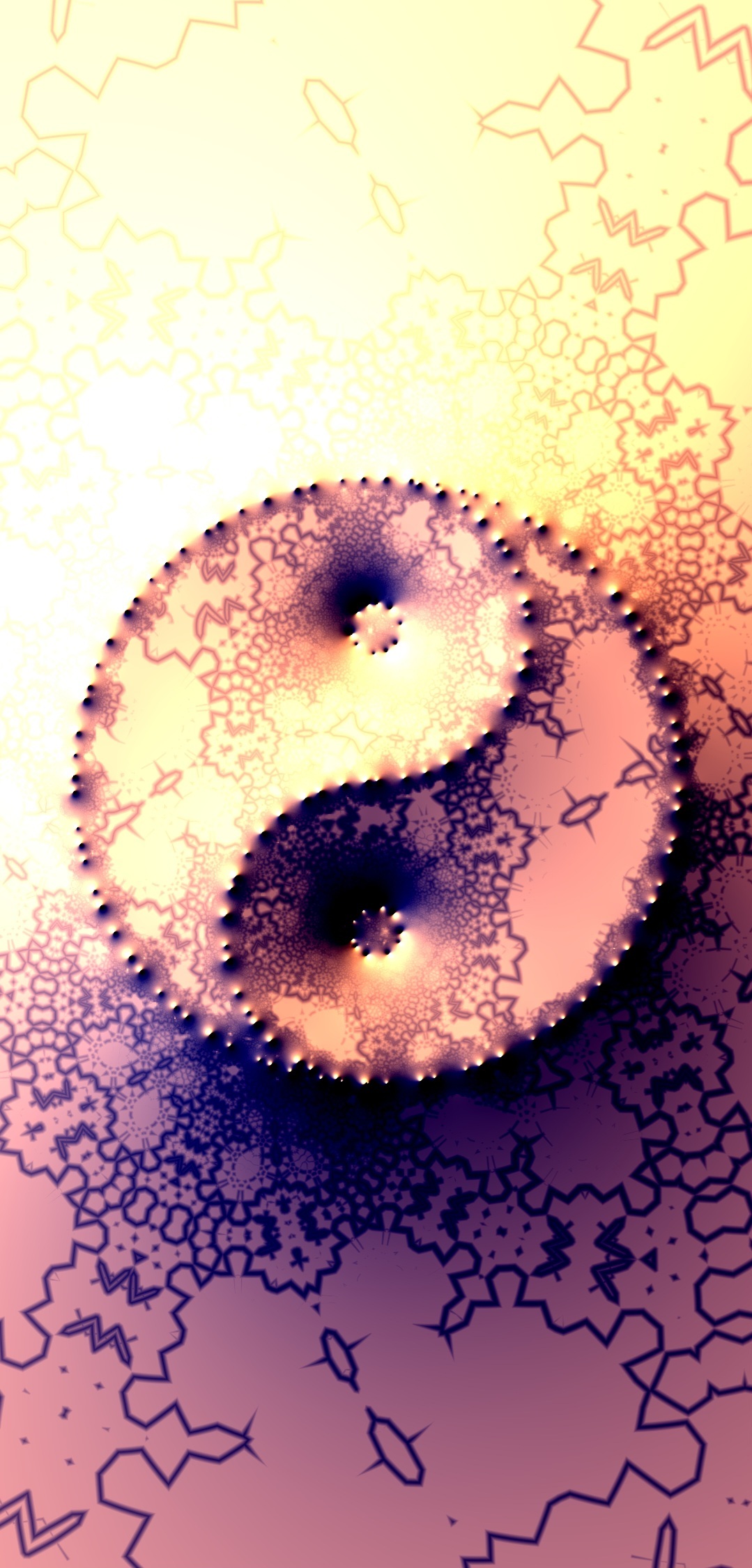
Made from summed inversions and a basic kaleidoscopic ifs.
Code in comments.
This is pretty 😊
Thank you!
The code (sorry, I can't combine a spoiler tag with a code block):
// 2024 Waveform
// Code adapted for Shader Editor (Android).

#extension GL_OES_standard_derivatives : enable

#ifdef GL_FRAGMENT_PRECISION_HIGH
precision highp float;
#else
precision mediump float;
#endif

uniform vec2 resolution;
uniform float time;

#define pi 3.14159

#define rotate(p, a) vec2(p.x*cos(a) - p.y*sin(a), p.x*sin(a) + p.y*cos(a))

// hash without sine
// https://www.shadertoy.com/view/4djSRW
#define MOD3 vec3(443.8975, 397.2973, 491.1871) // uv range
float hash11(float p) {
	vec3 p3  = fract(vec3(p) * MOD3);
	p3 += dot(p3, p3.yzx + 19.19);
	return fract((p3.x + p3.y) * p3.z);
}

vec2 c_inv(vec2 p, vec2 o, float r) {
	return (p-o) * r * r / dot(p-o, p-o) + o;
}

float grid(in vec2 p){ p = abs(fract(p+.5)-.5); return 2. * min(p.x, p.y); }

void invArc(in vec2 p, inout vec2 pg, float n, float arc, float rad, float seed) {
	for(float i=0.; i<n; i++) {
		float rnd = .65 * hash11(i+seed);
		pg +=
			c_inv(
				p,
				rad*vec2(
					sin(2.*arc*pi*(i+rnd)/n),
					cos(2.*arc*pi*(i+rnd)/n)
				),
				1.25-.5*hash11(i-seed)
			);
	}
}

void main(void) {
	vec2 res = resolution.xy;
	vec2 fc = gl_FragCoord.xy;
	vec2 p = (fc-res/2.) / res.y;
	vec3 o = vec3(-1., 0., 1.);
	float f;

	// zoom
	p *= 1.3;

	// building coords from summed-up circle inversions
	vec2 pg = vec2(0.);

	// dot number/density
	float N = 80.;

	// outer circle

	invArc(p, pg, N, 1., .25, 1.);

	// inner semicircles
	invArc(p-o.yx*.125, pg, N/4., -.5, .125, N);
	invArc(p-o.yz*.125, pg, N/4., -.5, -.125, -N);
	// dots
	pg *= -1.;
	invArc(p-o.yx*.125, pg, N/8., 1., 1./48., 2.*N);
	invArc(p-o.yz*.125, pg, N/8., 1., 1./48., -2.*N);
	pg *= -1.;

	// p's value is now summed inversions
	p = pg / 18.;

	// new time value
	float T = 10.;// + .15 * time;

	// fractalize
	vec2 p3 = p;
	for(float i=0.; i<14.; i++) {
		p3 += 1.7 * i * vec2(1., .77);
		p3 = rotate(p3, pi/1.55+.2*sin(.15*i-.1));
		p3 = abs(mod(p3, 10.)-5.);
	}

	// apply grid
	f = grid(p3+T);

	// give lines an even thickness
	f /= .05 * res.x * length(vec2(dFdx(p.x), dFdx(p.y)));

	// value adjustment
	f = min(1., f+.73);

	// trying to make a distinction between yin and yang
	f += .05 + .02 * (p.y-p.x);

	vec3 RGB = vec3(f);

	// faux lighting
	f += 1. * (.014 * length(p+15.) - .85);

	// final color
	RGB +=
		mix(
			vec3(.2, .1, .4),
			1.7*vec3(1., .5, .15),
			f
		)-.7;

	gl_FragColor = vec4(RGB, 1.);
}
its adorable that you think a page of source code is a spoiler
Lol, it's to hide it so it doesn't clutter up the thread, not to keep it secret ;)
awww thanks. i guess you could just link to it next time.
I will keep that in mind~
Shader art is underappreciated imo. I've dabbled in it a bit myself but I've never done anything this incredible. Awesome work!
Thank you. Yeah, shaders are great. Lots of awesome stuff over at the shadertoy website.