Framework’s first desktop is a strange—but unique—mini ITX gaming PC
1y 3mon ago by sopuli.xyz/u/misk in technology from arstechnica.com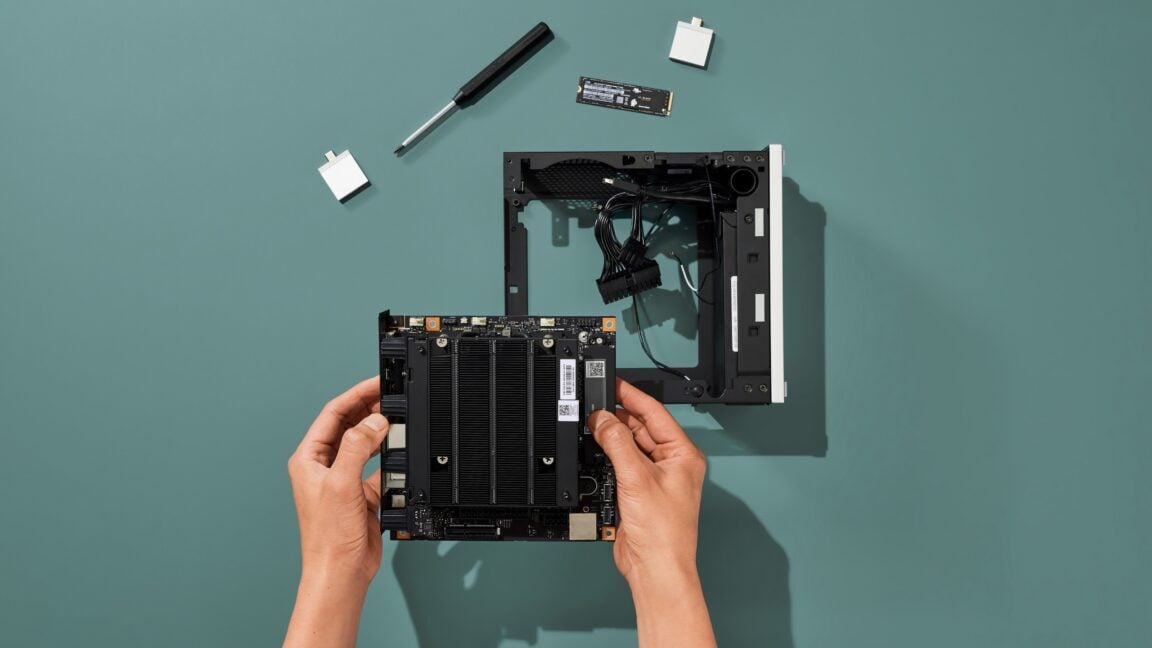
"To enable the massive 256GB/s memory bandwidth that Ryzen AI Max delivers, the LPDDR5x is soldered," writes Framework CEO Nirav Patel in a post about today's announcements. "We spent months working with AMD to explore ways around this but ultimately determined that it wasn’t technically feasible to land modular memory at high throughput with the 256-bit memory bus. Because the memory is non-upgradeable, we’re being deliberate in making memory pricing more reasonable than you might find with other brands."
😒🍎
Edit: to be clear, I was only trying to point out that "we’re being deliberate in making memory pricing more reasonable than you might find with other brands" is clearly targeting the Mac Mini, because Apple likes to price-gouge on RAM upgrades. ("Unamused face looking at Apple," get it? Maybe I emoji'd wrong.) My comment is not meant to be an opinion about the soldered RAM.
To be fair it starts with 32GB of RAM, which should be enough for most people. I know it's a bit ironic that Framework have a non-upgradeable part, but I can't see myself buying a 128GB machine and hoping to raise it any time in the future.
If you really need an upgradeable machine you wouldn't be buying a mini-PC anyways, seems like they're trying to capture a different market entirely.
My biggest gripe about non replaceable components is the chance that they'll fail. I've had pretty much every component die on me at some point. If it's replaceable it's fine because you just get a new component, but if it isn't you now have an expensive brick.
I will admit that I haven't had anything fail recently like in the past, I have a feeling the capacitor plague of the early 2000s influenced my opinion on replaceable parts.
I also don't fall in the category of people that need soldered components in order to meet their demands, I'm happy with raspberry pis and used business PCs.
You can get an MS-A1 barebones from minisforum right now for like 215 - BYO cpu, ddr5, and m2. But it’s got oculink on the back (the pcie dock is 100, but not mandatory if you’re not going to use it). I think it’s supposed to be on sale for another couple days.
According to the CEO in the LTT video about this thing it was a design choice made by AMD because otherwise they cannot get the ram speed they advertise.
Which is fine, but there was no obligation for Framework to use that chip either.
In the same video it's pointed out that this product wouldn't exist at all without the AMD chip. It's literally built around it.
Suppose the counter is that the market is chock full of modular options to build a system without framework.
In the laptop space, it's their unique hook in a market that is otherwise devoid of modularity. In the desktop space, even the mini itx space, framework doesn't really need to be serving that modularity requirement since it is so well served already. It might make it so I'm likely to ignore it completely, but I'm not going to be super bothered when I have so many other options
There's camm2, the new standard for high speed removable memory. Asus already has released a motherboard that uses it and it matches the 8000 mts of the Framework which won't be out until 3Q this year.
Framework chose non upgradable because it was easier/cheaper. That's fine except Framework's entire marketing has been built around upgradeable hardware.
seems like they're trying to capture a different market entirely.
Yes that's the problem.
That they want to sell cheap ai research machines to use for workstation?
That's a poor attempt to knowingly misrepresent my statement.
No, it is a question
The answer is that they're abandoning their principles to pursue some other market segment.
Although I guess it could be said to be like Porsche and Lamborghini selling SUVs to support the development of their sports cars...
I don't understand how that answers my question
To be fair, you didn't ask a question. You made a statement and ended it with a question mark, so I don't really understand exactly what it is that you were asking.
Yeah hugely disappointed by this tbh. They should have made a gaming capable steam machine in cooperation with valve instead :)
Yeah.
But that's AMD's fault, as they gimped the GPU so much on the lower end. There should be a "cheap" 8-core, 1-CCD part with close to the full 40 CUs... But there is not.
They still could; this seems aimed at the AI/ML research space TBH
This is an AI chip designed primarily for running AI workflows. The fact that it can game is secondary
Yeah exactly, its worthless... Even the big players already admit to the AI hype being over. This is the worst possible thing to launch for them, its like they have no idea who their customers are.
The AI hype being over doesn’t mean no one is working on AI anymore. LLMs and other trained models are here to stay whether you like it or not.
I mean, it's not. You can do aí workflows with this wonderful chip.
If you wanna game, go buy nvidia
Well, more specifically: why didn’t they try to go for LPCAMM?
From what I understand, they did try, but AMD couldn't get it to work because of signal integrity issues.
Because you’d get like half the memory bandwidth to a product where performance is most likely bandwidth limited. Signal integrity is a bitch.
I thought LPCAMM was designed specifically to address the bandwidth and connectivity issues that crop up around high-bandwidth + low-voltage RAM?
Would 256GB/s be too slow for large llms?
It runs on the gpu
Many LLM operations rely on fast memory and gpus seem to have that. Even though their memory is soldered and vbios is practically a black box that is tightly controlled. Nothing on a GPU is modular or repairable without soldering skills(and tools).
Huh?
Framework releasing a Mac Mini was certainly not on my bingo card for this year.
I wasn’t prepared. I’ve been eyeing a mini for a while and this thing kills it on value compared to what I would get in a similar price point.
What alternatives were you considering, and how does the product from Framework compare?
Mac mini and studio. The overall power comparison remains to be seen but cost to spec ratio I would have had to spend over 6k and couldn’t have 16tb of memory, frameworks was around 3200.
Ok, should I know who framework is? I've been a PC gamer since forever and I've never heard of this company.
They make repairable laptops.
repairable and upgradable*
I know it's an absolutely banal nitpick, but I think it's unfortunately a revelation in the current laptop market that ~90% of a laptop stays good for a really really long time, and the other 10% can be upgraded piecemeal as the need arises. Obviously this was never news to the Desktop world, but laptop manufacturers got away with claiming this was impossible for laptops in the name of efficiency and portability.
Lmao the news about this desktop is strangling their website to the point of needing a 45 minute waiting list
They did announce three major products today.
Yeah that touchscreen tablet convertible machine is what has me psyched. I'm not the target for it, and already own a 16, but I could see that thing selling well. I honestly think they came out with the desktop because they just kinda felt they needed a desktop.
I have a 16 and a 13, I thought I'd give away the 13 when I got the 16 but I keep using the 13 as well cause of how portable it is. Lot nicer to lounge about with the 13 than the 16.
I might get the 12 to replace my 13 and use it for drawing practice and web browsing. Performance wise it'd be a downgrade from my 1280p but I don't really need the performance.
Guilty. This thing came out at the perfect time and I was considering building my own or a Mac mini but this has 95% of what I’m looking for for less than a spec compromised Mac mini. So I preordered. And I kept hitting refresh lol.
I always think the Mac mini is just a bit too mini. It's a desktop so it's not exactly going to be moved around a lot so it doesn't need to be quite that tiny and this thing is a good compromise between still being small but without being so small that it offers no upgradability.
And I know Apple says otherwise but surely that thing must get thermally throttled at some point.
The Lemmy Lick strikes again!
I visited their website literally within about 10 minutes of them announcing the product and I had to wait 8 minutes to get in.
If framework has, or had, one problem, it was that the main appeal of their products was the repairability, the products themselves were only okay in terms of specs. Well now they have really decent specs as well.
I could absolutely see schools wanting to deploy these to their students.
Not really sure who this is for. With soldered RAM is less upgradeable than a regular PC.
AI nerds maybe? Sure got a lot of RAM in there potentially attached to a GPU.
But how capable is that really when compared to a 5090 or similar?
The 5090 is basically useless for AI dev/testing because it only has 32GB. Mind as well get an array of 3090s.
The AI Max is slower and finicky, but it will run things you'd normally need an A100 the price of a car to run.
But that aside, there are tons of workstations apps gated by nothing but VRAM capacity that this will blow open.
Useless is a strong term. I do a fair amount of research on a single 4090. Lots of problems can fit in <32 GB of VRAM. Even my 3060 is good enough to run small scale tests locally.
I'm in CV, and even with enterprise grade hardware, most folks I know are limited to 48GB (A40 and L40S, substantially cheaper and more accessible than A100/H100/H200). My advisor would always say that you should really try to set up a problem where you can iterate in a few days worth of time on a single GPU, and lots of problems are still approachable that way. Of course you're not going to make the next SOTA VLM on a 5090, but not every problem is that big.
Fair. True.
If your workload/test fits in 24GB, that's already a "solved" problem. If it fits in 48GB, it's possibly solved with your institution's workstation or whatever.
But if it takes 80GB, as many projects seem to require these days since the A100 is such a common baseline, you are likely using very expensive cloud GPU time. I really love the idea of being able to tinker with a "full" 80GB+ workload (even having to deal with ROCM) without having to pay per hour.
This is my use case exactly.
I do a lot of analysis locally, this is more than enough for my experiments and research. 64 to 96gb VRAM is exactly the window I need. There are analyses I've had to let run for 2 or 3 days and dealing with that on the cloud is annoying.
Plus this will replace GH Copilot for me. It'll run voice models. I have diffusion model experiments I plan to run but are totally inaccessible locally to me (not just image models). I've got workloads that take 2 or 3 days at 100% CPU/GPU that are annoying to run in the cloud.
This basically frees me from paying for any cloud stuff in my personal life for the foreseeable future. I'm trying to localize as much as I can.
I've got tons of ideas I'm free to try out risk free on this machine, and it's the most affordable "entry level" solution I've seen.
And even better, "testing" it. Maybe I'm sloppy, but I have failed runs, errors, hacks, hours of "tinkering," optimizing, or just trying to get something to launch that feels like an utter waste of an A100 mostly sitting idle... Hence I often don't do it at all.
One thing you should keep in mind is that the compute power of this thing is not like an A/H100, especially if you get a big slowdown with rocm, so what could take you 2-3 days could take over a week. It'd be nice if framework sold a cheap MI300A, but... shrug.
I don't mind that it's slower, I would rather wait than waste time on machines measured in multiple dollars per hour.
I've never locked up an A100 that long, I've used them for full work days and was glad I wasn't paying directly.
Yeah, I agree that it does help for some approaches that do require a lot of VRAM. If you're not on a tight schedule, this type of thing might be good enough to just get a model running.
I don't personally do anything that large; even the diffusion methods I've developed were able to fit on a 24GB card, but I know with the hype in multimodal stuff, VRAM needs can be pretty high.
I suspect this machine will be popular with hobbyists for running really large open weight LLMs.
I suspect this machine will be popular with hobbyists for running really large open weight LLMs.
Yeah.
It will probably spur a lot of development! I've seen a lot of bs=1 speedup "hacks" shelved because GPUs are fast enough, and memory efficiency is the real bottleneck. But suddenly all these devs are going to have a 48GB-96GB pool that's significantly slower than a 3090. And multimodal becomes much more viable.
Not to speak of better ROCM compatibility. AMD should have done this ages ago...
Exactly, 32 is plenty to develop on, and why would you need to upgrade ram? It was years ago I did that in any computer let alone a tensor workstation. I feel like they made pretty good choices for what it's for
… but only OpenCL workloads, right?
No, it runs off integrated graphics, which is a good thing because you can have a large capacity of ram dedicated to GPU loads
Not exactly. OpenCL as a compute framework is kinda dead.
What types of compute can you run on an AMD GPU today?
Most CUDA or PyTorch apps can be run through ROCM. Your performance/experience may vary. ZLUDA is also being revived as an alternate route to CUDA compat, as the vast majority of development/intertia is with CUDA.
Vulkan has become a popular “community” GPU agnostic API, all but supplanting OpenCL, even though it’s not built for that at all. Hardware support is just so much better, I suppose.
There are some other efforts trying to take off, like MLIR-based frameworks (with Mojo being a popular example), Apache TVM (with MLC-LLM being a prominent user), XLA or whatever Google is calling it now, but honestly getting away from CUDA is really hard. It doesn’t help that Intel’s unification effort is kinda failing because they keep dropping the ball on the hardware side.
Not really sure who this is for.
Second sentence in the linked article.
Holy moly this is awesome! I am in for the 128GB SKU.
That's 96GB of usable VRAM! And way more CPU bandwidth than any desktop Zen chip.
I know people are going to complain about non upgradable memory, but you can just replace the board, and in this case it’s so worth it for the speed/power efficiency. This isn’t artificial crippling, it physically has to be soldered, at least until LPCAMM catches on.
My only ask would be a full X16 (or at least a physical X16/electrical x8) PCIe slot or breakout ribbon. X4 would be a bit of a bottleneck for some GPUs/workloads… Does Strix Halo even support that?
I understand the memory constraints but it does feel weird for framework, is all I have to say. But that's also the general trajectory of computing from what it seems. I really want lpcamm to catch on!
Apparently Framework did try to get AMD to use LPCAMM, but it just didn't work from a signal integrity standpoint at the kind of speeds they need to run the memory at.
Sounds like it doesn't bode well for the future of DIMMs at all, TBH.
You have a DIMM view of the future.
My AM5 system doesn't post with 128GB of 5600 DDR5 at higher than 4400 at JEDEC timings and voltage. 2 DIMMs are fine. 4 DIMMs... rip. So I'd say the present of DIMMs is already a bit shaky. DIMMs are great for lots of cheap RAM. I paid a lot less than what I'd have to pay for the equivalent size of RAM in a Framework desktop.
Eventually most system RAM will have to be packaged anyway. Physics dictates that one pays a penalty going over pins and mobo traces, and it gets more severe with every advancement.
It's possible that external RAM will eventually evolve into a "2nd tier" of system memory, for background processes, spillover, inactive programs/data, things like that.
It's already fourth tier after L1, L2, L3 caches.
Maybe something like optane will make a comeback. Having 16gb of soldered RAM and 500gb of relatively slow, but inexpensive optane RAM would be great.
DRAM is so cheap and ubiquitous that they will probably keep using that, barring any massive breakthroughs. The "persistence after power-off" is nice to have, but not strictly needed.
That would be fine. But as long as it can use it as RAM and not just a staging ground.
Keep in mind that it would be pretty slow, as it doesn’t make sense to burn power and die area on a wide secondary bus.
What's a SKU? Google just says "Stock Keeping Unit", but I don't think that's correct in this context.
It's correct. A product with various options will have each combination of options under a different SKU. It's a singular number that identifies an exact version of a product.
In this context, SKU refers to a variant of this product. That is the correct acronym as I understand
its used to mean a new product that you specifically have to keep track of. e. g if you found framework desktops in a store, it wouldnt all be sold under 1 sku. all 3 ram capacities would be 3 different bar codes
a new product
not only new
As others said.
In this context it would be one of the CPU/Memory combinations framework offers: https://en.wikipedia.org/wiki/List_of_AMD_Ryzen_processors#Strix_Halo_(Zen_5/RDNA3.5/XDNA2_based)
Basically another word for 'Product Number' or 'P/N' for short.
How did you get from 128 GiB of RAM, as the reported specs, to 96 VRAM ?
“VRAM” has to be allocated to the integrated GPU in the BIOS, and reports (and previous platforms) suggest the max one can allocate is 96GB, or 3/4 of it.
but you can just replace the board
The board is like, the whole computer tho. The mobo, CPU, GPU and RAM are all the same component. It's everything Framework is supposed to oppose. That took them what, 4 years? to throw away their values?
They also announced three other products (one new, two refreshes) which are still being actively developed and are fully-modular devices at low cost. If they're "throwing away their values," they're not doing it very well.
It's never a single step process. These things happen slowly, bit by bit. It's the beginning of the end.
If this is it happening bit by bit, then why is most of the news about them doubling down on their principles? Why did they make clear what they were doing and why, and talk about their work to make it modular, instead of trying to hide it or sweep it under the rug?
This sort of doomerism and slippery slope purity test nonsense is exactly why niche companies that do what people value eventually go under, leaving us with just the awful ones. This isn't a betrayal of their values. This isn't the beginning of the end. It's just a choice they made, and all of the other choices they made confirm that they're still doing stuff the way they were.
Edit: I'm not saying you have to buy it, or that you shouldn't make clear to the company you don't think this comports with what you want them to value. But writing them off forever based on this one product seems so self-defeating.
If this is it happening bit by bit, then why is most of the news about them doubling down on their principles?
Its called marketing.
Why did they make clear what they were doing and why
...I don't understand the question. Why wouldn't they? Why does being clear about why they've abandoned their mission excuse anything?
exactly why niche companies that do what people value
That's the opposite of what's happening though.
Its called marketing.
They're actually building those devices. It's not marketing if you can buy them.
Why wouldn't they?
Because most companies do. They gloss over the shifts so that they can focus on other stuff.
Why does being clear about why they've abandoned their mission excuse anything?
Because it shows that they haven't. They talked about the work they put into trying to make it modular.
That's the opposite of what's happening though.
For this one product, maybe. But again, this was one of the four products they announced yesterday.
It's not marketing if you can buy them.
...yes? It is? Why would you market a product that no one can buy? LOL
Because most companies do.
And that means they should?
They talked about the work they put into trying to make it modular.
"Aw sorry, we really tried to make something" doesn't cut it. If you can't do it, don't do it. Simple as.
But again, this was one of the four products they announced yesterday.
How many products that are antithetical to their entire stated purpose do they need to make before you see that as a red flag?
...yes? It is?
Sorry. It's not just marketing if you can buy them.
And that means they should?
Of course not! What do you think I'm arguing for? I'm saying that if they were trying to make some kind of sneaky change, they wouldn't have taken five minutes to talk about it in their big event.
"Aw sorry, we really tried to make something" doesn't cut it. If you can't do it, don't do it. Simple as.
This ignores the realities of running a company. Once you've sunk development dollars into a project, you can't just walk away from it. You have to recoup your investments somehow, or you just end up hemorrhaging money and go out of business and can't do anything ever again.
How many products that are antithetical to their entire stated purpose do they need to make before you see that as a red flag?
Well it needs to not be a single component in a product that's a tiny minority of their business, for one thing.
I'm saying that if they were trying to make some kind of sneaky change, they wouldn't have taken five minutes to talk about it in their big event.
I'm not worried at all about them being "sneaky", I am worried about them abandoning their mission. Being upfront about why they're doing that changes nothing.
You're ignoring everything else I said because you don't agree with one semantic point of a partial response, so here it is again.
Most of the time, a company can't afford to just not release a product they worked on. They talked about why it didn't turn out the way they wanted to in the announcement stream (the laws of physics), but assuming they had already done the investment into the R&D to produce the box, they can't just decide "never mind." If they do it too much, they go out of business.
EDIT: also, you said "bit by bit" in your original message. You don't do things bit by bit if you're not trying to be sneaky.
you don't agree with one semantic point
This has nothing to do with semantics.
a company can't afford to just not release a product they worked on
I already addressed this above.
They talked about why it didn't turn out the way they wanted
And I talked about how I don't care why. And neither should you.
You don't do things bit by bit if you're not trying to be sneaky.
Yes? You do. Changing the entire direction of a company doesn't happen overnight, regardless of whether you want to be sneaky or not.
You really didn't address the sunk cost problem, but honestly I don't really care anymore. You think what you want.
It's what happens when you go through rounds of funding.
Soldered on ram and GPU. Strange for Framework.
Apparently AMD couldn’t make the signal integrity work out with socketed RAM. (source: LTT video with Framework CEO)
IMHO: Up until now, using soldered RAM was lazy and cheap bullshit. But I do think we are at the limit of what’s reasonable to do over socketed RAM. In high performance datacenter applications, socketed RAM is on it’s way out (see: MI300A, Grace-{Hopper,Blackwell},Xeon Max), with onboard memory gaining ground. I think we’ll see the same trend on consumer stuff as well. Requirements on memory bandwidth and latency are going up with recent trends like powerful integrated graphics and AI-slop, and socketed RAM simply won’t work.
It’s sad, but in a few generations I think only the lower end consumer CPUs will be possible to use with socketed RAM. I’m betting the high performance consumer CPUs will require not only soldered, but on-board RAM.
Finally, some Grace Hopper to make everyone happy: https://youtube.com/watch?v=gYqF6-h9Cvg
I definitely wouldn't mind soldered RAM if there's still an expansion socket. Solder in at least a reasonable minimum (16G?) and not the cheap stuff but memory that can actually use the signal integrity advantage, I may want more RAM but it's fine if it's a bit slower. You can leave out the DIMM slot but then have at least one PCIe x16 expansion slot. A free one, one in addition to the GPU slot. PCIe latency isn't stellar but on the upside, expansion boards would come with their own memory controllers, and push come to shove you can configure the faster RAM as cache / the expansion RAM as swap.
Heck, throw the memory into the CPU package. It's not like there's ever a situation where you don't need RAM.
All your RAM needs to be the same speed unless you want to open up a rabbit hole. All attempts at that thus far have kinda flopped. You can make very good use of such systems, but I’ve only seen it succeed with software specifically tailored for that use case (say databases or simulations).
The way I see it, RAM in the future will be on package and non-expandable. CXL might get some traction, but naah.
Couldn't you just treat the socketed ram like another layer of memory effectively meaning that L1-3 are on the CPU "L4" would be soldered RAM and then L5 would be extra socketed RAM? Alternatively couldn't you just treat it like really fast swap?
Wrote a longer reply to someone else, but briefly, yes, you are correct. Kinda.
Caches won’t help with bandwidth-bound compute (read: ”AI”) it the streamed dataset is significantly larger than the cache. A cache will only speed up repeated access to a limited set of data.
Could it work?
Yes, but it would require:
- A redesigned memory controller capable of tiering RAM (which would be more complex).
- OS-level support for dynamically assigning memory usage based on speed (Operating systems and applications assume all RAM operates at the same speed).
- Applications/libraries optimized to take advantage of this tiering.
Right now, the easiest solution for fast, high-bandwidth RAM is just to solder all of it.
Using it as cache would reduce total capacity as cache implies coherence, and treating it as ordinary swap would mean copying to main memory before you access it which is silly when you can access it directly. That is you'd want to write a couple of lines of kernel code to use it effectively but it's nowhere close to rocket science. Nowhere near as complicated as making proper use of NUMA architectures.
The cache hierarchy has flopped? People aren't using swap?
NUMA also hasn't flopped, it's just that most systems aren't multi socket, or clusters. Different memory speeds connected to the same CPU is not ideal and you don't build a system like that but among upgraded systems that's not rare at all and software-wise worst thing that'll happen is you get the lower memory speed. Which you'd get anyway if you only had socketed RAM.
In systems where memory speed are mismatched, the system runs at the slowest module's speed. So literally making the soldered, faster memory slower. Why even have soldered memory at that point?
I'd assume the soldered memory to have a dedicated memory controller. There's also no hard requirement that a single controller can't drive different channels at different speeds. The only hard requirement is that one channel needs to run at one speed.
...and the whole thing becomes completely irrelevant when we're talking about PCIe expansion cards the memory controller doesn't care.
Yeah, the cache hierarchy is behaving kinda wonky lately. Many AI workloads (and that’s what’s driving development lately) are constrained by bandwidth, and cache will only help you with a part of that. Cache will help with repeated access, not as much with streaming access to datasets much larger than the cache (i.e. many current AI models).
Intel already tried selling CPUs with both on-package HBM and slotted DDR-RAM. No one wanted it, as the performance gains of the expensive HBM evaporated completely as soon as you touched memory out-of-package. (Assuming workloads bound by memory bandwidth, which currently dominate the compute market)
To get good performance out of that, you may need to explicitly code the memory transfers to enable prefetch (preferably asynchronous) from the slower memory into the faster, á la classic GPU programming. YMMW.
I wasn't really thinking of HPC but my next gaming rig, TBH. The OS can move often accessed pages into faster RAM just as it can move busy threads to faster cores, gaining you some fps a second or two after alt-tabbing back to the game after messing around with firefox. If it wasn't for memory controllers generally driving channels all at the same speed that could already be a thing right now. It definitely already was a thing back in the days of swapping out to spinning platters.
Not sure about HBM in CPUs in general but with packaging advancement any in-package stuff is only going to become cheaper, HBM, pedestrian bandwidth, doesn't matter.
The thing is, consumers didn’t push Nvidias stock sky high, AI did. Microsoft isn’t pushing anything sane to consumers, Microsoft is pushing AI. AMD, Intel, Nvidia and Qualcomm are all pushing AI to consumers. Additionally, on the graphics side of things, AMD is pushing APUs to consumers. They are all pushing things that require higher memory bandwidth.
Consumer will get ”trickle down silicon”, like it or not. Out of package memory will die. Maybe not with you next gaming rig, but maybe the one after that.
Honestly I upgrade every few years and isually have to purchase a new mobo anyhow. I do think this could lead to less options for mobos though.
I get it but imagine the GPU style markup when all mobos have a set amount of RAM. You'll have two identical boards except for $30 worth of memory with a price spread of $200+. Not fun.
I don’t think you are wrong, but I don’t think you go far enough. In a few generations, the only option for top performance will be a SoC. You’ll get to pick which SoC you want and what box you want to put it in.
the only option for top performance will be a SoC
System in a Package (SiP) at least. Might not be efficient to etch the logic and that much memory onto the same silicon die, as the latest and greatest TSMC node will likely be much more expensive per square mm than the cutting edge memory production node from Samsung or whatever foundry where the memory is being made.
But with advanced packaging going the way it's been over the last decade or so, it's going to be hard to compete with the latency/throughout of an in-package interposer. You can only do so much with the vias/pathways on a printed circuit board.
You are correct, I’m referring to on package. Need more coffee.
No, I don't think you owe an apology. It's a super common terminology almost to the point where I wouldn't really even consider it outright wrong to describe it as a SoC. It's just that the blurred distinction between a single chip and multiple chiplets packaged together are almost impossible for an outsider to tell without really getting into the published spec sheets for a product (and sometimes may not even be known then).
It's just more technically precise to describe them as SiP, even if SoC functionally means something quite similar (and the language may evolve to the point where the terms are interchangeable in practice).
Sound like a downgrade to me I rather have capability of adding more ram than having a soldered limited one doesn't matter if it's high performance. Especially for consumer stuff.
Looking at my actual PCs built in the last 25 years or so, I tend to buy a lot of good spec ram up front and never touch it again. My desktop from 2011 has 16GB and the one from 2018 has 32GB. With both now running Linux, it still feels like plenty.
When I go to build my next system, if I could get a motherboard with 64 or 128GB soldered to it, AND it was like double the speed, I might go for that choice.
We just need to keep competition alive in that space to avoid the dumb price gouging you get with phones and Macs and stuff.
Sounds like a load of bullshit to feed useful idiots.
There's even the next iteration already happening: Cerebras is maling wafer-scale chipa with integrated SRAM. If you want to have the highest memory-bandwith to your cpu core it has to lay exactly next to it ON the chip.
Ultimately RAM and processor will probably be indistinguishable with the human eye.
Ye the soldered ram is for sure making me doubt framework now.
Signal integrity is a real issue with dimm modules. It's the same reason you don't see modular VRAM on GPUs. If the ram needs to behave like VRAM, it needs to run at VRAM speeds.
Then don't make it work like that. Desktop PCs are modular and Framework made a worse product in terms of modularity and repairability, the main sales of Framework. Just, like… wtf. This Framework product is cursed and shouldn't exist.
There’s little point in framework selling a conventional desktop.
I guess they could have made another laptop size with the the dev time, but… I dunno, this seems like a niche that needs to be filled.
This is where I'm at. The Framework guy was talking about how very few companies are using this AMD deal because the R&D to add it to existing models wasn't very viable, you really only have the Asus Z13 so I feel like being ahead of the game there will be a benefit in the long run as far as their relationship with AMD. Plus they're also doing a 12-in laptop now as well, so it's not like they committed all their resources to this.
Apparently AMD wasn't able to make socketed RAM work, timings aren't viable. So Framework has the choice of doing it this way or not doing it at all.
In that case, not at all is the right choice until AMD can figure out that frankly brain dead easy thing.
"brain dead easy thing"... All you need is to just manage signal integrity of super fast speed ram to a super hungry state of the art soc that benefits from as fast of memory as it can get. Sounds easy af. /s
They said that it was possible, but they lost over half of the speed doing it, so it was not worth it. It would severely cripple performance of the SOC.
The only real complaint here is calling this a desktop, it's somewhere in between a NUC and a real desktop. But I guess it technically sits on a desk top, while also being an itx motherboard.
Oh yeah I'm sure you could've done it no problem
Not strange at all.
They're a business that makes its money off of selling hype to morons.
Just buy a ThinkPad, if you’re thinking about buying a Framework…
Calling it a gaming PC feels misleading. It's definitely geared more towards enterprise/AI workloads. If you want upgradeable just buy a regular framework. This desktop is interesting but niche and doesn't seem like it's for gamers.
I think it’s like Apple-Niche
I feel like this is a big miss by framework. Maybe I just don't understand because I already own a Velka 3 that i used happily for years and building small form factor with standard parts seems better than what this is offering. Better as in better performance, aesthetics, space optimization, upgradeability - SFF is not a cheap or easy way to build a computer.
The biggest constraint building in the sub-5 liter format is GPU compatibility because not many manufacturers even make boards in the <180mm length category. Also can't go much higher than 150-200 watts because cooling is so difficult. There are still options though, i rocked a PNY 1660 super for a long time, and the current most powerful option is a 4060ti. Although upgrades are limited to what manufacturers occasionally produce, it is upgradeable, and it is truly desktop performance.
On the CPU side, you can physically put in whatever CPU you want. The only limitation is that the cooler, alpenfohn black ridge or noctua l9a/l9i, probably won't have a good time cooling 100+ watts without aggressive undervolting and power limits. 65 watts TDP still gives you a ryzen 7 9700x.
Motherboards have the SFF tax but are high quality in general. Flex ATX PSUs were a bit harder to find 5 or 6 years ago but now the black 600W enhance ENP is readily available from Velkase's website. Drives and memory are completely standard. m.2 fits with the motherboard, 2.5in SATA also fits in one of the corners. Normal low profile DDR5 is replaceable / upgradeable.
What framework is releasing is more like a laptop board in a ~4 liter case and I really don't like that in order to upgrade any part of CPU, GPU or memory you have to replace the entire board because it's soldered on APU and not socketed or discrete components. Framework's enclosure hasn't been designed to hold a motherboard+discrete GPU and the board doesn't have a PCIe slot if you wanted to attach a card via riser in another case. It could be worse but I don't see this as a good use of development resources.
I think the biggest limiting factor for your mini PC will always be the VRAM and any workload that enjoys that fast RAM speed. Really, I think this mini PC from framework is only sensible for certain workloads. It was poised as a mobile chip and certainly is majorly power efficient. On the other hand I don't think it is for large scaling but more for testing at home or working at home on the cheap. It isn't something I expected from framework though as I expected them to maintain modularity and the only modularity here is the little USB cards and the 3D printed front panel designs lol
Edit
Personally I am in that niche market of high RAM speed. Also, access to high VRAM for occasional LLM testing. Though it is an AMD and I don't know if am comfortable switching from Nvidia for that workload just yet. Renting a GPU is just barely cheap enough.
Question about how shared VRAM works
So I need to specify in the BIOS the split, and then it's dedicated at runtime, or can I allocate VRAM dynamically as needed by workload?
On macos you don't really have to think about this, so wondering how this compares.
It's typically dynamic
On my 7800, it’s static. The 2GB I allocate is not usable for the CPU, and compute apps don’t like it “overflowing” past that.
This is on Linux, on a desktop, ASRock mobo. YMMV.
It will most likely be dynamic, with the option to statically set it.
I don't get the point. Framework laptops are interesting because they are modular but for desktop PCs that's the default. And Framework's PCs are less modular than a standard PC because the RAM is soldered
That makes no sense - that’s more like Apple then…
I don’t know if it’s the case, but modular IO on PC maybe nice.
This is one stupid product. It really goes against everything the framework brand has identified with.
I'd argue not. It's as modular/repairable as the platform can be (with them outright stating the problematic soldered RAM), and not exorbitantly priced for what it is.
But what I think is most "Framework" is shooting for a niche big OEMs have completely flubbed or enshittified. There's a market (like me) that wants precisely this, not like a framework-branded gaming tower or whatever else a desktop would look like.
It's as modular/repairable as the platform can be
It can't be. That's the point.
AMD said no due to the platform and apparently the signal integrity not being up to snuff.
...said no to what?
Modular Ram modules (e.g. dram and I believe lpcamm)
Soldered ram is more efficient because it does not require big connectors and is closer to the CPU and GPU. 3D Vcache Is the ultimate examples or this.
Yes I'm aware. What's your point?
I guess I'm not sure what you want Framework to due instead. Just not launch this at all? What alternative are you advocating for?
Just not launch this at all?
...yes? Exactly. If they can't find a way to sell something that fits their ethos then they shouldn't sell it. Seems like an obvious answer.
Desktop PCs don't need Framework. They've always been and still are modular, repairable and upgradeable but FW managed to design the only one that isn't. It's the opposite of everything they supposedly stand for.
They wasted resources on this instead of building other amazing hardware.
The APU/RAM is one unit, everything else is modular and repairable. They aren’t price gouging the RAM either.
They’re one upping Apple, big PC OEMs and Chinese Mini PC makers with a more repairable, consumer friendly product. That sounds like Framework to me.
I think you are clinging to the idea that RAM will be separate and upgradable from the CPU for a long time… Physics dictates that it will not, especially in the laptop space where wasted power is so critical. Hacks needed to even make that work now with DDR5 are kinda crazy and inefficient (just look at the voltage/speeds/timings ddr5 sodimms run at). LPCAMM is supposedly a good stopgap, but even that is having teething issues
The APU/RAM is one unit
Yes that's the point.
everything else is modular and repairable.
That makes no sense. If any of those components fail, you might as well throw the whole thing in the garbage because that's 90% of the cost of the machine.
They’re one upping Apple, big PC OEMs and Chinese Mini PC makers with a more repairable, consumer friendly product.
What's about this is more repairable or consumer friendly?
I think you are clinging to the idea that RAM will be separate and upgradable from the CPU for a long time…
I am not "clinging" to anything. I didnt put that standard on them, that's Framework's marketing.
I don't believe it's not possible, I just don't believe anyone cares enough to make it happen.
Desktops are already that, though. In order for them to distinguish themselves in the industry, they can't just offer another modular desktop PC. They can't offer prebuilts, or gaming towers, or small form factor units, or pre-specced you-build kits. They can't even offer low-cost micro-desktops. All of those markets are saturated.
But they can offer a cheap Mac Studio alternative. Nobody's cracked that nut yet. And it remains to be seen if this will be it, but it certainly seems like it's lined up to.
I'm not super well informed, but a socketable AMD nuc form factor machine would've been nice, single pcie, m.2 and 2 sodimm ram slots would've been good. Could've even given the option to route the pcie slot externally and offered an add on egpu case that's actually worth a damn a la mega drive/sega cd.
It's a straight up gimmick flanderizing the brand identity.
Now, can we have a cool European company doing similar stuff? At the rate it's going I can't decide whether I shouldn't buy American because I don't want to support a fascist country or because I'm afraid the country might crumble so badly that I can't count on getting service for my device.
I could envision MNT Research trying this in the future, but not for now.
Wow, that stuff looks awesome! Thanks for sharing 🙏
Wait I thought they were a Taiwanese company?
This comment made me double check. They're from San Francisco: https://en.m.wikipedia.org/wiki/Framework_Computer
I'd prefer to buy taiwanese tbh. 😉
At first I was skeptical during the announcement and then I saw the amount of ram and the rack. Imho it is not for enduser but for business. In fact we have workloads that would be perfectly fit that computer so why not?
its definitely a small business and homelab focused device. ill 100% be getting one for some local AI compute in my lab.
This is not really that interesting and kinda weird given the non-upgradability, but I guess it's good for AI workloads. It's just not that unique compared to their laptops.
I'd love a mid-tower case with swappable front panel I/O and modular bays for optical drives; would've been the perfect product for Framework to make IMO.
They’d be competing with a bajillion other case makers. And I’m pretty sure there are already cases with what you ask (such as 5.25 bay mounted IO running off USB headers, at least).
Like… I don’t really see what framework can bring making a case. Maybe it could be a super SFF mobo with a GPU bay, but that’s close to what they did here.
There may be already such a case but you and me have never heard about it and it's probably by some chinese no-name brand.
A proper metal mid-tower case with modular front panel I/O (using Framework's system with the USB-C converters) and modular optical drive/hard drive bays would be unique.
The mini's are the latest new hotness for desktop computing. I've been running a dirt cheap $90US, mini for 2 years now. It fits extremely well on my desk, just tucked in under the monitor leaving plenty of room for all the other tasks I do daily.
Will it play the latest hot new video game? Nope. But it will run OnlyOffice, FreeCAD and FreeDoom just fine.
It’s just not that unique compared to their laptops.
This'll be a good sell for the useful idiot crowd that has been conditioned to think gaming laptops are the devil.
The Framework Desktop is powered by an AMD Ryzen AI Max processor, a Radeon 8060S integrated GPU, and between 32GB and 128GB of soldered-in RAM.
The CPU and GPU are one piece of silicon, and they're soldered to the motherboard. The RAM is also soldered down and not upgradeable once you've bought it, setting it apart from nearly every other board Framework sells.
It'd raise an eyebrow if it was a laptop but it's a freakin' desktop. Fuck you framework.
I get the frustration with a system being so locked down, but if 32gb is the minimum I don’t really see the problem. This pc will be outdated before you really need to upgrade the ram to play new games.
It's not just about upgrading. It's also about being able to repair your computer. RAM likes to go bad and on a normal PC, you can replace it easily. Buy a cheap stick, take out the old RAM, put in the new one and you'll have a working computer again. Quick & easy and even your grandpa is able to run Memtest and do a quick switch. But if you solder down everything, the whole PC becomes electronic waste as most people won't be able to solder RAM.
Yeah, it totally fucks repairability. But it sounds like this is not something this company normally does, and not something they could control.
They should at least offer a superior warranty to cover such scenarios.
The hell you mean “not something they could control”? Their whole deal is making upgradeable, repairable devices and ram thats replaceable is no industry secret. Their options should have been make it work or dont make it at all.
If you read into it, this was a limitation on AMD’s part, which they tried to resolve. You don’t have to buy it, and the rest of their lineup should meet your expectations.
You know, they didn't have to make a product with this specific chip. They did it anyway despite it being inherently incompatible with their former goals. And this is not about us customers, this is about Framework abandoning what they stood for and losing credibility in the process.
They kind of did. What other chip allows for 128 GB of VRAM or has that kind of iGPU?
🥱
insanely hostile response to something like this. they attempted to have these parts replaceable, AMD physically couldn't do it. they've still made it as repairable as possible, and will without a doubt be more repairable than similar devices using this chipset. fucking relax, being reactionary without being informed is dumb.
will without a doubt be more repairable than similar devices
It's a desktop, they're repairable unless you solder something in.
using this chipset
They could've gone with any other chipset, making the whole thing irrelevant to begin with, but they couldn't please the AI crowd that way.
By similar devices I obviously mean ITX PCs with similar chipsets. The average PC isn't giving you 128GB of VRAM for $2k.
Local AI is a difficult thing to do right now, making a product to allow people to use AI without giving up their privacy is great.
We need to stop bending over backwards to lower our standards for the people making money off of us.
Have higher standards.
Don't be a useful idiot.
You need to get a grip. Framework is a private company that has done very well by its customers and supporters so far. Stop being so fucking negative.
Oof, found the proud consumer.
They always get upset when you point out how they're being taken advantage of.
They can never willingly take a bad deal, right? 😉
you seriously have issues. and you're a dick on top of that.
you're either a troll or just a shitty person.
Wow, calm down.
This is how you react when people say we should have higher standards? I guess you really are insecure about your purchasing habits.
The consumerism runs deep with you. Now you're going to throw a tantrum trying to find ways to defend being taken for a ride 😎
Seriously that's really disappointing. It really seems like investors decides that they needed to "diversify" their offering and they need something with AI now ... Framework was on a good path imo but of course a repairable laptop only goes so far since people can repair it and don't need to replace it every 2 years (or maybe just replace the motherboard) so if you want to grow you need to make more products ...
Honestly this is exactly the product I was waiting for minisforum to make. I think this is actually a pretty solid move.
Same, I was ready to just buy the first chinese mini pc that had the 128G strix halo processor. This is way better as it will have actual support and likely be better made.
I agree. We need less soldered RAM designs. I thought repairability was something they appreciated.
Well tbh they still do have repairable laptops, even new ones and all that, and the "excuse" is that the only way to properly use that specific AMD CPU is with that specific RAM and the non.soldered bus wasn't enough, but still... i'll stick to old #ThinkPads, thank you.
It's not an excuse. Socketed RAM has been a bottleneck for iGPUs for a while now.
Much like their laptops, I'm all for the idea, but what makes this desirable by those of us with no interest in AI?
I'm out of that loop though I get that AI is typically graphics processing heavy, can this be taken advantage of with other things like video rendering?
I just don't know exactly what an AI CPU such as the Ryzen AI Max offers over a non-AI equivalent processor.
There is a massive push right now for energy efficient alternatives to nvidia GPUs for AI/ML. PLENTY of companies are dumping massive amounts of money on macs and rapidly learning the lesson the rest of us learned decades ago in terms of power and performance.
The reality is that this is going to be marketed for AI because it has an APU which, keeping it simple, is a CPU+GPU. And plenty of companies are going to rush to buy them for that and a very limited subset will have a good experience because they don't have time sensitive operations.
But yeah, this is very much geared for light-moderate gaming, video rendering, and HTPCs. That is what APUs are actually good for. They make amazing workstations. I could also see this potentially being very useful for a small business/household local LLM for stuff like code generation and the like but... those small scale models don't need anywhere near these resources.
As for framework being involved: Someone has kindly explained to me that even though you have to replace the entire mobo to increase the amount of memory, you can still customize your side panels at any moment so I guess that is fitting the mission statement.
For modularity: There's also modular front I/O using the existing USB-C cards, and everything they installed uses standard connectors.
what makes this desirable by those of us with no interest in AI?
Juat maybe not all products need to be for everyone.
Sometimes it's fine if a product fits your label of "Not for me".
There's lots of workstation niches that are gated by VRAM size, like very complex rendering, scientific workloads, image/video processing... It's not mega fast, but basically this can do things at a reasonable speed that you'd normally need a $20K+ computer to even try. Like, if something takes hours on an A6000 Ada or an A100, just waiting overnight on one of these is not a big deal. Cashing or failing to launch on a 4090 or 7900 XTX is.
That aside, the IGP is massively faster than any other integrated graphics you'll find. It's reasonably power efficient.
I hate how power hungry the regular desktop platform is so having capable APUs like this that will use less power at full load than a comparable CPU+GPU combo at idle, is great, though it needs to become a lot more affordable.
Production costs are not low either, and AMD still needs to profit. AMD's APUs are already very affordable.
Much like their laptops
Its nothing like their laptops, thats the issue :/ Soldered in stuff all around, nonstandard parts that make it useless for use as a standard PC or gaming console.
Sorry, I was stating that "much like their laptops, I like the idea of these desktops." I was not trying to insinuate that they themselves are alike.
and more at people who want the smallest, most powerful desktop they can build
Well, there's this:


Yeah, the screw holes didn't fit, that's why. And the cooler didn't fit the case, obviously. And the original cooler not the CPU's turbo. It's fine, it still runs most games in 3k on the iGPU.
The bowing on that board makes me think it’s not much longer for this world.
It's like this even if i lay it on the desk. Was always like this. ¯\_(ツ)_/¯
It's kinda cool but seems a bit expensive at this moment.
I swear, you people must be paid to shill garbage.
Always a response for anyone who has higher standards, lol.
I really hope this won't be too expensive. If it's reasonably affordable i might just get one for my living room.
they already announced pricing for them.
1099 for the base ai max model with 32gb(?), 1999 for fully maxed with the top sku.
With a cheeky comparison to Apple's nearly $5k offering.
$1k for the base isn't horrible IMO, especially if you compare it to something like the mac mini starting at $600 and ballooning over $1k to increase to 32GB of "unified memory" and 1tb of storage.
I get why people are mad about the non-upgradable memory but tbh I think this is the direction the industry is going to go as a whole. They can't get the memory to be stable and performant while also being removable. It's a downside of this specific processor and if people want that they should just build a PC
i actually think its not the worst priced framework product ironically. Prebuilt 1k pcs tend to be something like a high end cpu + 4060 desktop anyways, so specs wise, its relatively speaking, reasonable. take for example cyberpower pcs build here, which is of the few oems iirc Gamers Nexus thinks doesn't charge as much of a SI tax on assembly. it's acutally not incredibly far off performance wise. I'd argue its the most value Framework product per dollar ironically.
Prebuilt 1k pcs tend to be something like a high end cpu + 4060 desktop anyways
That value proposition evaporates when you factor in repairability and upgradability of those prebuilts.
and if you actually want a PC for gaming on, a discrete gpu (eg: 7900xt) is going to be at least 3x faster at throwing polygons around than the 8060S. This thing is definitely better for AI workloads than gaming.
And the “base” of this is physically more like a cut down M4 Pro than a regular M4.
Bummer
These little buggers are loud, right?
Hmm, probably not. I think it just has the single 120mm fan that probably doesn't need to spin up that fast under normal load. We'll have to wait for reviews.
I also just meant given the size constraints in tiny performance PCs. More friction in tighter spaces means the fans work harder to push air. CPU/GPU fans are positioned closer to the fan grid than on larger cases. And larger cases can even have a bit of insulation to absorb sound better. So, without having experimented with this myself, I would expect a particularly small and particularly powerful (as opposed to efficient) machine to be particularly loud under load. But yes, we'll have to see.
The Noctua fan option should be pretty quiet.
I have a Noctua fan in my PC. Quiet AF. I don't hear it and it sites beside me.
So... now Framework Corp is selling non-upgradable hardware?
I dunno. Conceptually I want to like Framework. But their pricing means it is basically never worth buying and upgrading versus just buying a new laptop (seriously, run the numbers. You basically save 10 bucks over two generations of shopping at Best Buy). But they also have a system that heavily encourages people to horde spare parts rather than just take it to an e-waste disposal facility/bin.
You get fast memory as a result. If you don't care about the fast memory, there's no good reason to buy this, with their motherboard. There's a use case this serves which can't be served by traditional slotted memory and the alternative is to buy 4-5 NVIDIA 3090/4090/5090. If you want that use case, then this is a pretty good deal.
And your phone isn't repairable because it needs to be water proof. Your earbuds because of power efficiency. Etc.
Also, I suggest watching this https://www.youtube.com/watch?v=K3zB9EFntmA.
But, to be clear: I am actually not as opposed to the idea of soldered ram when you have "an excuse". Same with phones. But framework is a brand that tries to build itself on minimizing e-waste and maximizing repairability and... hey, at least we can still swap out the side panel on their prebuilt!
As far as I read LPCAMM in its current state does not work for this. The electrical noise is too high. These things aren't the same. A repairable waterproof phone can be made without glue by making it a bit thicker. In the case of RAM today, we're hitting fundamental physics limitations with speed of electricity and noise. At this point the physical interconnect itself becomes a problem. Gold contact points become antennas that induce noise into adjacent parts of the system. I'm not trying to excuse Framework here. I'm saying that the difficulty here borders on the impossible. If this RAM was soldered and it had bandwidth no different than SODIMM or LPCAMM modules then I'd say Framework fucked up making it soldered, majorly. As I said, there's no point buying this if you don't care about the fast RAM and use cases that need it like LLMs. Regular ITX board with regular AM5 is the way to go.
E: To be clear, if this bandwidth could be achieved with LPCAMM, then Framework fucked up.
It will be faster than most next-gen laptops, and it's much cheaper than a similarly-specced Asus Z13. Strix Halo uses a quad channel 8533Mhz bus, 2 full Zen CCDs like you find in desktops/servers, and a 40 CU GPU. Its more than twice the size/performance of two true "laptop chips" put together.
Everything except the APU/RAM/Mobo combo is upgradable, and you don't have to replace the whole machine if the board fails.
I mean, if you don't need that kind of compute/RAM, this system is not for you, and old gaming desktops are probably better deals for pure gaming. But this thing has a niche.
Everything except the APU/RAM/Mobo combo is upgradable, and you don’t have to replace the whole machine if the board fails.
So... storage, case, and USB C dongles?
You can change the squares on the front panel!!!
/s
Fans, case, ports, side panel, ...
Whatever you do with a pc, you can do with this.
Just not separately replace ram and cpu because of the cpu design of amd.
Hell, it can be connected to another one to make on hell of a compute monster too.
Oh. Okay. As long as I can replace the side panel.
A PC lets you replace the CPU, ram and plug in multiple pcie cards.
This is less upgradable than the average laptop.
I think the framework desktop would be an absolute powerhouse as a workstation desktop.
Think developers ( that still use desktops ), people who do raw computational power for science, servers, ai development, ...
No, the pc is upgradable. They explicitly said in the event that the desktop was suppose to be an actual desktop with replaceable parts as much as technically possible. Only ram is tied to the mobo/cpu because of technical limitations of the amd cpu
At least memory is soldered on because of high throughout they say.
their pricing means it is basically never worth buying and upgrading versus just buying a new laptop (seriously, run the numbers. You basically save 10 bucks over two generations of shopping at Best Buy).
Maybe so. But the big difference is, you can upgrade iteratively rather than taking the entire hit of a new device all at once. So I can buy all of the individual components of my next laptop a few hundred dollars at a time over the course of a couple of years, and use them as I get them. By the time I've ship-of-theseus'd the whole device, I may have spent the same amount of money on that new computer, but I paced it how I wanted it. Then I put all of the old components into an enclosure and now I can use it as a media center or whatever. Plus, if something breaks, I can fix it.
What exactly can you upgrade iteratively?
From the laptop perspective (because the desktop is totally all about that side panel life):
- Memory: Ultrabooks are hell, no arguments there. But many brands have increasingly allowed at least one SODIMM to be swapped out and many still no longer solder the other one. And I'll say, from personal experience, that buying and swapping out RAM in a relatively new-ish laptop often comes out closer to the price of just paying for the upgraded SKU to begin with. So there is the logic of "I'll add another 16 GB in two years" but... yeah.
- Storage: Again, same. Except that they tend to not even solder down the nvmes. There are some particularly asshole vendors but they are few and far between. And this totally is worth doing since they tend to be fairly standard nvme drives or the small SSD that I always forget the format of. Rather than RAM that is only used by laptops and NUCs and costs an arm and a leg...
- Ports: Framework laptops just use USB C dongles for everything. They have a semi-proprietary format for those but it is still, fundamentally, a usb c dongle. And, from talking to a mutual on a discord who has one, it has the same fundamental problem that USB C dongles/hubs do when installing the more finicky OSes (hi Proxmox and OpnSense) where you can't actually access the hub capabilities until AFTER the OS is installed (the more live CD based distros avoid this). So no difference in terms of upgrades and modularity outside of having fewer vendors to buy a dongle from if you care about form factor that much.
- CPU: Only if you swap out the motherboard which is the vast majority of the price of the laptop anyway.
- Keyboard, display, etc: These are less "upgrades" so much as replacements. Which are good arguments for repairability but also... go actually look at ifixit's website and see how many laptops are repairable. It is mostly just apple who suck horrifically
And just because it always amuses me and never fails, let's price out upgrading/replacing a framework (uplacing?). I'll assume no parts failed to keep prices simple and "You can replace your keyboard every time it fails over a five year period" is not the flex people think it is. I'll use the intel core ultra series 1 because that is in stock and not a preorder. We are dealing with last year's model (I think. I haven't followed Intel laptop processors too much) so there is inherently wiggle room there, but it is theoretically fair as it is last year's model for both of them since I had to dig deep into the framework site to find an Intel since fuck Best Buy's website if you are trying to compare AMDs (also fuck AMD for their naming insanity).
- FW13 with Intel Core Ultra Series 1 at 13 inches is estimated to be 999 USD https://frame.work/products/laptop13-intel-ultra-1/configuration/new.8 Gigs of RAM, Ultra 5 125H, 256 GB Storage
- Core Ultra 5 Series 1 at 13 inches. Ultra 5 125U so techincally different but arguably much better for an actual laptop. 256 GB storage, 8 GB RAM. ... Eothas wept at this URL https://www.bestbuy.com/site/hp-probook-460-g11-16-ips-1920-x-1200-wuxga-laptop-intel-core-ultra-5-with-8gb-memory-256-gb-ssd-pike-silver-aluminum-gray/6601496.p?skuId=6601496.Estimated to be 879.99 USD
So we are already looking at the framework being about 120 USD more expensive without looking at any configurations or upgrades.
So let's get into that hyperbolic time chamber and totally not have gay sex with the glistening man hunk known as Vegeta. Five years later, let's consider an upgrade... to the same SKU.
On the Framework marketplace, another 125H mobo costs 399 USD right now.
- Framework:
999 + 399 = 1398for two generations of a laptop - Best Buy:
879 + 879 = 1758 - For a total savings of
1758-1398 = 360USD over 5 years of getting soaked by that galick gun
Which is nothing to balk at. But that assumes that your display and keyboard held up and didn't need replacing, you liked all the default dongles Framework gave you (which is apparently just four USB C ports... to plug into the four USB C ports on the laptop), and, most importantly, that Framework didn't change their form factor (I am not sure if they did for the 16 inch laptops to support the "modular" keyboards). Every spare dongle or repaired/upgraded part costs money. Versus being guaranteed a "pristine" new laptop... full of massive amounts of bloatware that you immediately format the shit out of to put Linux on that.
And, obvious grain of salt, the past few times I have done this exercise it was closer to 100 USD. Framework just happen to be dumping large amounts of old stock right now for their new models so the prices are better and the comparisons are more tedious.
Again, conceptually I like Framework. And, for as much as I mock them, I actually do like the form factor for their dongles a lot. Give me a computer with a shit ton of USB C ports but also let me leep it usable at work without needing to carry around my sketchy anker dongle/dock. And I don't really fault them too much for not letting you actually swap CPUs since that was basically something only the sickest of sickos did until the AM4 socket lasted like 40 years somehow.
But their key strength is marketing and that has only gotten stronger since they got the full power of linus media group behind them because that company needs to protect their shareholders' investment.
And, like I said before, I do worry that this just encourages people to hoard parts. Like... anyone who has built a desktop or two has that big plastic bin full of old ram and mobos and even graphics cards that they might use someday but never will (PSU is totally worth saving though).
What exactly can you upgrade iteratively?
At the price point, being able to upgrade memory, storage, and motherboard is unique. And I know you say that it's the "vast majority" of the cost, but I just bought a Framework 13 last month (I know, great timing) and the mainboard was right around half the total cost. So sure, the most expensive single component, but it means that I can upgrade to a better-performing machine in the future for half the price and not need to junk everything else.
Framework laptops just use USB C dongles for everything.
Correct. But honestly, having the swappable I/O is fantastic; over the last five laptops I've owned, I've only upgraded because I wanted new capabilities once. For the other four, it's because a component failed; and in two of them it was a USB port, while in a third it was a charging port. Being able to replace those would have extended the lives of those machines substantially.
fewer vendors to buy a dongle from
Actually, they're open-source (not proprietary). And since they're USB-C, you could probably just take out the card and plug a dongle right in there if you really needed to (I have not tried this).
Framework: 999 + 399 = 1398 for two generations of a laptop
I'm planning to hold on to this device for a whole lot longer than two generations. If I can, I'd like to hang on to it for 15-20 years. The laptop I upgraded from was five years old or so (and would still be going strong if it didn't have a port that was about to die and un-upgradeable RAM and storage), and my desktop is 13 years old and still going strong, so this isn't terribly unreasonable. I would estimate that I'll end up pouring about $2000, all told, into this laptop over that time period, likely replacing 3-4 laptop purchases and giving me a better machine during that time period.
that assumes that your display and keyboard held up and didn't need replacing,
Both of which would be cheaper than a new device. A new display is $150 and a new keyboard is $30. I don't know about the longevity of each component, but based on the research I did it's definitely not worse than an off-the-shelf machine.
you liked all the default dongles Framework gave you (which is apparently just four USB C ports... to plug into the four USB C ports on the laptop),
There aren't any defaults. When you spec out your kit, you choose which cards to purchase. Replacing them costs about $10. (EDIT: The USB-C ones cost $10. The other ones are variously priced between $10-40, and then there are some storage expansions that cost more because they're basically SSD in the expansion card form factor).
and, most importantly, that Framework didn't change their form factor
They've only done that once since they launched, across six updates to the components. When they made that upgrade, they offered a $90 top cover to bring first gen devices up to second gen specs.
(I am not sure if they did for the 16 inch laptops to support the "modular" keyboards).
There's only been one generation of the 16 inch laptops, and they've always had the modular keyboards. The refresh they announced yesterday is just to components, not to chassis.
Every spare dongle or repaired/upgraded part costs money.
Yep, and I'm fine with that because it means that I can spec it out the way I want; I don't have to pay for I/O that I'll never use. My old laptop had an SD card reader and a DisplayPort output; I literally never used either. The one I had before it had a SATA connector on the external I/O, and a couple of other pieces of nonsense that I didn't want or need. Actually, thinking back, I don't know if I've ever owned a laptop (until this one) where I actually used all of the ports.
And I don't really fault them too much for not letting you actually swap CPUs since that was basically something only the sickest of sickos did
Yeah, I think swappable CPUs on a laptop are a thing of the past. I hope I'm wrong, but I just don't see it coming back.
I do worry that this just encourages people to hoard parts
I DON'T HAVE A PROBLEM
I CAN STOP WHENEVER I WANT TO
This is a standard a370 mini PC at a high price.
There's Beelink, Minisforum, Aoostar and many others.
The AI max chips are a completely different platform, more than double the physical silicon size of most minipc chips.
Most miniPC vendors have already announced AI Max products:
https://www.gmktec.com/blog/gmktec-a-global-leader-in-ai-mini-pcs-unveils-the-amd-ryzen-ai-max-395
But Framework released it now.
Nope, they're just available to pre-order with an estimate of shipping from Q3 this year. They're not shipping now.
I just checked, the gmktec link above says that their product is supposed to ship in Q1-Q2 this year, earlier than framework's.
The person above you confidently posted that it's shipping now and got an up vote despite being wrong.
I never understand people who confidently post wrong things that are easily googlable.
Are they going to at least make memory modules available for those who want to solder their own?
You can order those directly from chip suppliers (mouser, digikey, arrow, etc.) for a lower cost than you could get them from framework. Also those are going to be very difficult to solder/desolder. You're going to need a hot air station, and you need to pre-warm the board to manage the heat sink from the ground planes.
Not as impossible sounding. I mean I would never attempt it but you might be able to get away with it using a stencil, solder paste and one of those fancy toaster ovens with a broil setting. ROI would suck since you are probably gonna fail the first couple of times.
Really framework ? Soldered ram ? How dissapointing
The CEO of Framework said that this was because the CPU doesn't support unsoldered RAM. He added that they asked AMD if there was any way they could help them support removable memory. Supposedly an AMD engineer was tasked with looking into it, but AMD came back and said that it wasn't possible.
Specifically AMD said that it's achievable but you'll be operating at approx 50% of available bandwidth, and that's with LPCAMM2. SO/DIMMs are right out of the running.
Mostly this is AMDs fault but if you want a GPU with 96-110 GBs of memory you don't really have a choice.
But the front panel is customizable
So can someone who understands this stuff better than me explain how the L3 cache would affect performance? My X3D has a 96 MB cache, and all of these offerings are lower than that.
This has no X3D, the L3 is shared between CCDs. The only odd thing about this is it has a relatively small "last level" cache on the GPU/Memory die, but X3D CPUs are still kings of single-threaded performance since that L3 is right on the CPU.
This thing has over twice the RAM bandwidth of the desktop CPUs though, and some apps like that. Just depends on the use case.
and some apps like that.
I'd wager a guess: AI?
Honestly CPUs are bad for AI, especially in this case where there's a GPU on the same bus anyway.
Of the top of my head, video encoding and compression/decompression really likes raw memory bandwidth. Maybe some games? Basically, wherever the M Pro/Max CPUs are really strong compared to the base M, these will excel in the same way.
To anyone complaining about non-replaceable RAM: This machine is for AI, that is why.
Think of it like a GPU wirh a CPU on the side, vs the other way around.
Inference requires very fast ram transfer speed, and that is only possible (currently) on soldered buses. Even this is pretty slow at 256Gb/s, but it's RAM size of 96GB to GPU makes it interesting for larger models.
What's crazy is I still can't make it onto their website without waiting in a 20 minute queue. Stupid.
I guess that’s kinda the point? It will ship with 128GB soldered.
Xbox with the ability to run windows is what the article is basically saying.
Or linux.
This thing makes a whole lot of pricey workstations obsolete.
I think I need to give Linex a try again. I tried ubuntu in 2008 but found it too difficult to do the things I was used to doing on windows. I now have a bit more coding experience and will probably pick it up quicker
It's gotten so much better since 2008. Ubuntu is good for servers, but probably not what you're looking for on a desktop. And you really don't need to have a coding background to use it, though it also depends on your use case.
I just recall trying to put music on an ipod in ubuntu was a nightmare
Probably still is, lol.
Apple stuff works best in the Apple ecosystem, though most of what works on Windows can work on linux.
Ive long given up on apple! I will do some research!
You don't have to pick and choose, you can dual boot.
But the only thing I boot Windows for these days is gaming and Microsoft Teams. Linux has come a long way since 2008.
I will look into it again!
teams online client is good enough, too
What kind of workstations?
Any that needs a lot of VRAM and good CPU performance on a budget, but not necessarily the real time performance of a W7900 or whatever.
Love the downvotes for saying something that is in the article! Feels just like reddit!
Looks like a pile of shit for easily-impressionable morons, but that's to be expected from framework.
What exactly do you want instead?
Great products for great prices!
Like what, specifically, instead of this?
Lol. Are you nuts? Am I really supposed to sit here and list off what makes a great product for a great price?
Let's be real. You don't like how I criticized how people like you are getting taken for a ride so you're desperate to make it seem like it's not true.
The sooner you realize how you're being taken advantage of, the sooner you can start to do something about it.
Am I really supposed to sit here and list off what makes a great product for a great price?
I don't understand what you are asking for.
You don't have to be extensive, but... what would you want instead? A more traditional Mini PC? A dGPU instead? A different size laptop? Like, if you could actually tell Framework what you want, in brief, what would you say?
Fair enough.
I skimmed it for a few seconds, got a little bit ill at the $1100 starting price, and then it occurred to me: what is this for?
Wasn't framework's whole thing about making modular laptops? What value are they bringing to the mini-ITX market? They're already modular. In fact, it looks like they're taking away customizability with soldered RAM.
You asked me what I want, and this is definitely what I don't want. If they wanted to make this product appealing to me, they'd have to lower the price and live more modest lifestyles with the more modest profit margins.
Edit: After closer inspection (albeit, not that close so I may have missed something) it looks like this... thing doesn't even have a dedicated GPU. Yeah, framework can suck my fucking balls lol.
You can literally get a 4070 gaming laptop these days for ~$1000 and framework is trying to push this shit? They can fuck off so hard it's not even funny. This is why the free world never has enough to go around, because we waste our excess on dumb shit like this.
Here's a gaming laptop with a 4070 and a 144hz screen for $900 at Walmart:
Fuck framework.
This is ostensibly more of a workstation/dev thing. The integrated GPU is more or less like a very power efficient laptop 4070/4080 with unlimited VRAM, depending on which APU you pick, and the CPU is very fast, with desktop Ryzen CCDs but double the memory bandwidth of what even an 9800 X3D has. In that sense, it’s a steal compared to Nvidia DIGITs or an Apple M4 Max, and Mini PC makers alternatives haven’t really solidified yet.
I think Framework knows they can’t compete with a $900 Walmart laptop and the crazy bulk pricing/corner cutting they do, nor can they price/engineer things (with the same bulk discounts) at the higher end like a ROG Z13/G14.
So… this kinda makes sense to me. They filled a gap where OEMs are enshittifying things, which feels very framework to me.
The integrated GPU is more or less like a very power efficient laptop 4070/4080 with unlimited VRAM
I'd love to see some benchmarks comparing the two. I don't believe that this integrated GPU is able to hold a candle to a laptop's 4070, but I'd love to be proven wrong. It also looks, per the words of the article, the CPU with performance comparable to a "mid-range" laptop GPU (think xx60s) will cost $2000. Literally paying OVER TWICE the fucking price as a laptop with a 4070. AND LAPTOPS COME WITH SCREENS! This is a complete scam.
As far as CPU speed goes, couldn't people simply choose whatever CPU they want when building their computer without paying the "framework tax"? Are you trying to claim there's something "special" about this CPU like the PS3's cell processor?
Are you trying to claim there’s something “special” about this CPU like the PS3’s cell processor?
There is. It’s a 16-core desktop CPU kinda like Ryzen, but hooked up to an IO die with very fast (8533MHz) quad channel memory. It’s more like a small, power efficient threadripper CPU, if you want to look at it that way, and that is a $2K+ platform.
But that IO die has a 40 CU GPU (compared to 12 CUs for the previous highest end IGP, or 8 for the Steam Deck), so yeah, somewhere in the ballpark of a 4070, or (to be more accurate than my previous guess) the 4060 at the lower end of SKUs.
But the real appeal isn’t “magic”: its like an Apple M Pro or Mac, a decent GPU hooked up to a huge pool of reasonably fast VRAM without having to pay freaking $4000+ for a Quadro or A100. Workstation people are going crazy over this thing.
I’d buy it at the drop of a hat for workstation stuff. I also have some friends who want one as a home server, since it’s so powerful but power efficient, and more modular/repairable than some Chinese mini PC.
For $2000, you and your friends could be getting better hardware.
I'm sorry, this is a product for suckers. Anyone who buys this has more money than sense. It's just a fact of life.
It's okay if you don't realize this now, but hopefully one day you will. It's alright to be wrong and taken for a ride. We've all been there, including me. It's part of why I'm so keen on identifying bullshit like this now; I've seen it before and will continue to see it again.
I’m sorry, this is a product for suckers. Anyone who buys this has more money than sense. It’s just a fact of life.
There’s literally no better hardware. If I want 48Gb+ vram for $2000, it’s literally a bank of ancient, power sucking Tesla P40s or this… there’s nothing else because Nvidia/AMD price gouge everything else. Heck, the used 24GB 3090 I bought has skyrocketed in price. I’d still be paying l$1500+ for a bare minimum 3090 system now.
I’d love to be wrong, but the GPU market is totally fucked.
GPU aside, it’s the same for those that want a really fast transcoder box or whatever.
You're deluding yourself into thinking this iGPU is more powerful than it actually is.
Have you seen benchmarks comparing it to some of the competition?
Honestly I don’t even care if it’s half as fast as a 4070, that’s fast enough for me.
In workstation workloads, some stuff just will not run unless you have a ton of VRAM, and running slower is fine. Or in other cases, you get a gigantic speedup from the virtue of simply having tons of VRAM. That’s the value, not pure core speed compared to some 8GB GPU.
But I am not deluding myself, the core performance is in the ballpark of a laptop 7700S: https://www.notebookcheck.net/AMD-Radeon-RX-8060S-Benchmarks-and-Specs.942049.0.html
It’s also (on paper) slower than my desktop 3090, but in practice, an order of magnitude faster for stuff that struggles to fit on the 3090.
Honestly I don’t even care if it’s half as fast as a 4070, that’s fast enough for me.
You're the one who's trying to argue its power, and then when presented with a better option you say "it's fast enough for me."
Have you seen benchmarks comparing the performance of this iGPU to dGPUs?
Please share.
See the notebookcheck page above.
What benchmarks are you seeing that are telling you this is a better deal than the alternatives?
Come on, you can be specific so I don't have to assume what you're talking about.