Plex is locking remote streaming behind a subscription in April
1y 2mon ago by programming.dev/u/Sl00k in selfhosted from www.plex.tv
We are also changing how remote playback works for streaming personal media (that is, playback when not on the same local network as the server). The reality is that we need more resources to continue putting forth the best personal media experience, and as a result, we will no longer offer remote playback as a free feature. This—alongside the new Plex Pass pricing—will help provide those resources. This change will apply to the future release of our new Plex experience for mobile and other platforms.
Alright, so I have had Jellyfin installed for years now, but my primary issue is that most devices myself or my users use lack official, readily-available clients. For example, the Samsung TV app is a developer mode install. Last I looked, nobody has put a build into the store.
I really want to use Jellyfin, but I feel like my users simply can't. I'm interested in others' experiences here that could help.
I mean, except for Tizen OS isn't most available? You can find the client for Android, Android TV, Windows, Linux (Flatpak), macos, apple ios, and more.
https://jellyfin.org/downloads/clients/
I give all my friends the choice between Plex and jellyfin (I run both containers side by side pointed to the same media folders) and they all invariably choose Plex. I think it has a lot to do with the jellyfin UI, and I think an overhaul like jellyfin-vue or something that looks like findroid needs to happen in order for jellyfin to really appeal to regular people.
Yeah, I've written some custom css to get some better wrapping of libraries and such.
There's also the community themes worth looking into.
https://jellyfin.org/docs/general/clients/css-customization/#community-themes
Damn, all this time using JF and I never thought of theming it.
While I use it on a SFF PC I have a couple of users that access my server via a couple of CCwGTV Chromecasts I handed them and so, unable to test since I don't have one to hand but can you / does it theme the UI on the Chromecast too?
Cheers!
I was just able to download it on every TV I have
Linux (Flatpak)
So, no, then.
Ah, if you're allergic to flatpaks and can't convince your distribution to include it in their repository then you can always build it yourself - https://github.com/jellyfin/jellyfin-media-player
Or just use their web based client with a browser of your choice. :)
No idea what Flatpak is, much? Jellyfin is open-source. If your distro isn't providing you a .deb or tarball to your liking, that's not on the Jellyfin project.
Why would you ever bother to use either option when you can just access it via the WebUI on Firefox?
Because that basically requires transcoding for modern codecs. H265? Transcode. Subtitles? Transcode. The JF client on the same hardware can usually direct play.
Oh fair enough, I'd highly recommend enabling transcoding anyway it just eliminates all sorts of issues like this.
Don't ask me? I'll ftp before I'll WebUI like so, but for online viewing, I'll take streaming please. My kids, wife, and mother-in-law find that a million times more convenient.
Meanwhile, there's a dude in these comments hating on the notion that Jellyfin's app will download the Raw file for offline viewing purposes. Please, do not ask me to pretend to care what is going on in that person's head. In my world, using VLC to play my files is a perk. Gimme that yummy 2x or slow-mo as I see fit, please.
I use Findroid for its great UI but also its ability to download and watch offline. It's a better experience and I was surprised Jellyfin Android didn't support it.
WebUI is streaming though on desktops though and I assume they're also using iOS/Android/TV which all have clients, so I'm trying to get at the difference there.
I thought their implication was that they would use the WebUI for downloading videos for offline watching later. Beyond that, I don't really know or care; Their suggestion was weird to me, but I took it at face value and replied accordingly.
Flatpaks aren't the worst, at least it's not a snap only
What do people have against flatpaks? I like them.
Part of it is that Ubuntu/Canonical so aggressively pushed Snaps which became a huge culture war. So you have people who hate the idea of those style of packages because they hate Snap AND people who hate flatpak because they are Team Ubuntu for some reason.
And the other aspect is that it is incredibly space inefficient (by the very nature of bundling in dependencies) and is prone to "weirdness" when it comes to file system permissions and the like. And many software projects kind of went all in on them because it provides a single(-ish) target to build for rather than having a debian and an arch and a redhad and a...
Ah, I see. I've not tried Snaps, been avoiding Ubuntu because of Canonical's weirdly corporate angle. Once they baked in Amazon into Ubuntu I was out.
I like the bundling of deps. Sure it's inefficient, but it runs, and storage comes cheap nowadays anyway.
Storage is cheap until it isn't.
On my desktop where I have something like 6 TB of NVME storage because I am a sicko? The only thing that makes me think twice about a flatpak is if I need to give it access to devices or significant parts of my filesystem (yay permissions weirdness).
On my laptop where I can have one drive and replacing it involves opening the entire laptop AND reinstalling Fedora (or dealing with clonezilla/dd)? Yeah... I very much care about just how much bloat I am dealing with. And, as the other person pointed out, flatpaks can balloon REAL fast.
If dependencies are articulated (and maintained...) properly, it is very doable and is intrinsically tied to what semantic versioning is actually supposed to represent. So appfoo depends in libbar@2:2.9 and so forth. Of course, the reality is that libbar is poorly maintained and has massive API/header breaking changes every point release and was dependent on a bug in libbar@2.1.3.4.5 anyway.
Its one of the reasons why I like approaches like Portage or Spack that are specifically about breaking an application's dependencies down and concretizing. Albeit, they also have the problem where they overconcretize and you have just as much, if not more, bloat. But it theoretically provides the best of both worlds... at the cost of making a single library take 50 minutes to install because you are compiling everything for the umpteenth time.
And yeah... I run way too many appimages too.
The space inefficiency is definitely there.
I find that clients, such as Jellyfin, Moonlight and Signal, works just fine as flatpaks but with those three apps my /var/lib/flatpak/ lands on 6.4GB.
When I temporarily had Discord installed it grew to 6.7GB, so the inefficiency is frontloaded and lessens the more of them you use.
Just use the god damn browser
Don’t ever connect a “smart” tv to the internet. It’s only going to become shit and steal your data.
Raspberry Pi, old pc or any kind of other external player will always be better for connectivity and control.
I agree, but having looked down this road, finding a quality external player that users will understand and is inexpensive is ... not easy.
If you’re an Apple user the AppleTV is exactly this. It’s probably Apple’s most fairly priced computing device.
I like my Shield TV: https://www.nvidia.com/en-us/shield/shield-tv/
I did need to install a custom launcher on it when the standard AndroidTV launcher added ads.
I mean that literally appletv. Barely costs more than a Roku and is vastly better than every other device on the market.
True, but there's not much one can do about others' stubbornness. I've been using cheap Android boxes with Kodi or the JF client installed. They make sense to my non-techie family. Dedicated boxes are better (something that can run CoreELEC, OpenELEC) but those are harder to find.
An old pc running Linux mint and kodi is my current setup in the living room.
Roku does it well enough. not perfectly but it's still not as shit as my Google tv
hmm that's concerning. we really need a roku/chromecast equivalent that isnt some proprietary mess (home assistant is finally getting into those with voice assistant units)
$20 Walmart Onn 4k. Degoogle it if you want or just slap smarttube and jellyfin/plex on it.
Pi running Kodi/libreelec
Facebook made one. They attached a gorgeous voice-controlled video-chat-on-tv setup to it, and released it just as they lost all consumer trust.
Then they decided it wasn't selling.
So they killed it instead of open-sourcing it
just saying.
While I agree with you 100% and every tv in my home is under this mantra I get where the parent comment is coming from. Family members and friends visiting have asked about access to my Jellyfin library and they aren’t necessarily keen on buying additional hardware, aren’t willing to educate themselves on setting up options that would be objectively better for connectivity, privacy, control, etc.
They just want an app in their TVs app store. It’s convenient and easy. I disagree with them but I don’t blame them. It’s human nature to go for the option that results in expending the least amount of effort. But then they don’t get my sweet Jellyfin library. If you cant run the client or kodi then I can’t help you, sorry.
Remember when programming a VCR was a stand-up comedy joke?
Yes and I also remember when there were stupid things like early universal remotes that had big timers on them to circumvent the internal programming needs (but then you had to program the remote and sync it)
Managing your own AV equipment has always been a pain in the ass.
A Chromecast TV device might fill your gap. There is a jellyfin android TV build in the app store and it works with every TV. Just costs about 50 dollarydoos
Similar price for a lifetime Plex pass (until end of April)... just saying...
True and while they are both enshitifying their services. Somehow in this one area Google seems to be going slower. And making slightly less bonehead moves
I had the same experience with my parents. They have a Samsung TV and the Jellyfin experience was awful.
I ended up getting them a little N100 mini pc and installed Bazzite and the Jellyfin app from Flathub. You can configure it so it knows it’s on a TV, and responds to keyboard controls. I got them a remote from a company called Pepper Jobs that gives keyboard input and now they have a great experience with it. Even my mom, who’s a big technophobe, loves it.
My dad also has an LG TV in his workshop that doesn’t have a working Jellyfin app (cause it’s ten years old), and he uses the Jellyfin app for his Xbox on that one.
So the flatpak version of Jellyfin works for you? I cant get it to play more then one thing. hitting the play button just does nothing.
Just played a bunch of episodes on Fedora KDE (Flatpak from flathub, Jellyfin client v.1.11.1, Jellyfin server v.10.10.6) without any trouble.
Are you by chance using Wayland?
yep!
Figured it out. The flatpak version will fail to play video if you have audio pass through enabled. The .deb package works though.
Thank you for adding your troubleshooting and solution to the thread. This is gonna turn into Wisdom of the Ancients eventually. ;-)
Yeah. I had to go into the settings and change some setting to get it to work with keyboard input.
There's a jellyfish app on Xbox?
Yep. My dad said it’s working great for him.
I love Jellyfin, but I always find something that I have a problem with when trying it, for example it has weak searching, tagging, and TV show identification compared to Plex.
I tried using it even as recent as yesterday for some searching and tagging, but it's searching, tagging, and even TV show identification has problems and is weak in comparison to Plex. I couldn't mass-tag certain videos which was annoying for me, I had to do it one-by-one and it ended up taking a long time, that was frustrating. Also, tags don't show up in searches anymore because it hurts performance apparently. With that said, maybe Plex has the same limitation, but it doesn't mean that Jellyfin has to. They are open-source, and they can be better than Plex, and in many ways they already are, but I keep running into pain points with how I want to use it, and it does feel a bit unfortunate. With that said, I'm a developer too, so I know it's not always that simple. It's just in some ways it feels less "complete" than Plex.
I'm still really pleased with Jellyfin though, and especially the future potential of it.
You can access Jellyfin through a browser, too. Is that an option for the Samsung TV?
I've got a Samsung TV and am nearly a complete Luddite (in the colloquial sense).
I managed to install the Jellyfin app on my TV just by following the step by step instructions on a website
I run an Android TV box on my Smart TV, because I don't trust them on the internet.
I use Jellyfin client on my new Samsung TV via a Google TV dongle (ONN tv, $25 at Walmart). Seems to work well.
My only complaint is the stream volume has been very low after a recent update. Downsampling helps but seems like it shouldn' t be necessary.
I can speak from my experience with an Apple TV, the application "Infuse" works amazing with a jellyfin server. Though the application is essentially $1 month subscription, but works across all your apple devices, if you have any. I think it's worth it.
Additionally, the official app for Android TV worked pretty well when I last tried it on an Nvidia Shield
The only major pain point I had with Jellyfin was getting it on my Samsung TV yes. It is absolutely not a good recommendation for people with Samsungs unless they're willing to get their hands very dirty. Now, once I got the app side loaded on there, it works perfectly well, but the process sucked ass.
I've never had an issue with the apps. It's on my Chromecast and my android phone, and I typically stream to the TV from my phone.
My only issue is that they require a real cert (which is good tbh) and I am having trouble getting letsencrypt working due to my isp blocking port 80 and me dragging my feet getting DNS working
Let's Encrypt supports DNS verification, if you have access to update the zone file. It makes automation harder, but there are scripts to do the DNS update for the verification.
Yeah that's what I'm doing next. My domain name/DNS provider doesn't let me do it though so i have to self host DNS first. Turned into quite a rabbit hole, and would have just worked if I could just get traffic on port 80!
They even have Android app. I mean, a server app.
Anyway, they still seem to paywall some things.
Yeah.
Jellyfin is spectacular for LAN usage on two computers. Once you start using devices (because, you know, that is what people tend to plug into their TVs...) or going on travel, it rapidly becomes apparent that it just isn't a competitor.
Hell, a quick google suggests jellyfin STILL doesn't have caching of media for offline viewing. Plex's works maybe 40% of the time but... 40% is still higher than 0%.
I have a lifetime pass for Plex and encourage anyone who even kind of cares to get one next time it is on sale (or shortly before the scheduled price hike). I have tried Jellyfin a few times over the years and... it is basically exactly what I hate with FOSS "alternatives". It isn't an alternative in the slightest but people insist on talking it up because they want it to be and that just makes people less willing to try genuinely good alternatives.
To put it bluntly, Plex is an "offline netflix" as it were. Jellyfin is a much better version of smbstation and all the other stuff we used to stream porn to our playstations back in the day.
Jellyfin allows you to download whatever you want to your local device. But in a world of streaming, it seems to be a much smaller usecase. I take my tablet camping with me all the time, download some shows via Jellyfin and watch via Jellyfin. Maybe you're using the term "caching" differently from the use case, but if local files is what you're after, it absolutely does it. Just click download in a couple of different locations.
Yeah, I don't know what that dude's on about. My kids download stuff from jellyfin to their tablets all the time for road trips.
Did they? Or is that still the old hack of "just download the raw file. Your tablet is just a computer"?
Because I didn't see it advertised on the main web page and a quick google got me to https://github.com/jellyfin/Swiftfin/discussions/364which is open and abandoned tickets for the ios apps.
https://forum.jellyfin.org/t-offline-downloads?pid=16373#pid16373suggests it is also in the same boat for android. You can find workarounds but they aren't using jellyfin.
Which is "fine". I watched WAY too many movies over the years with VLC on a laptop. But... why are we using a shim to treat a library as a streaming service in that case? Which gets back to Jellyfin just not actually being a Plex alternative for the majority of users.
You might be right, it might play in an external player. I don't recall that or didn't notice. We're a few months from the last camping season. If it does play in an external player, seems like an inconvenience vs a dealbreaker, but I get it. We all have our things. I would argue that it's maybe a big deal for you and not a majority of users. Maybe a small but focused minority.
Oh no! Please GOD, anything but tHe rAw fIlE!!
Seriously though, wtf did I just read? That can't possibly be your real stance, can it?
Half of my collection is DTS HD MA or TrueHD and many have HDR. Offline caching with transcoding is an essential feature if we want jellyfin to pull ahead. Berating people who are pointing out areas of improvement is not a winning strategy.
I run ffmpeg on my phone. Alternately, I could shrink the file on my server and then download it without much trouble. You're in a vanishingly small subset of users who know enough to care about file-size and know what can be done about it, but can't be bothered to do it themselves.
It's honestly kind of silly to suggest that only technically minded users care about file sizes. We're lucky enough to even know why the file is so big. My regular friends will just complain that it won't fit, blame jellyfin, and then go back to Netflix.
You know that regular people with 64GB phones exist right? Suggesting that a non technical person should just know that they need to convert a 30GB remux using ffmpeg is absurd.
Your regular friends are constantly using your Plex server to download files for offline viewing, eh?
Yes? Is that odd to you? If jellyfin supported it then that would be one less reason against switching which would be a good thing, wouldn't you think? If you advocate for using jellyfin then shouldn't you want such basic features to be supported for those who want to use them?
Even though I still use Plex full time, I very much want Jellyfin to succeed (I run it and offer it to everyone I share with), and so I want Jellyfin to be usable for people of all skill levels. I can't get my parents to use an app that requires them to know anything about file sizes or codec compatibility or converting anything. That is why Plex is as successful as they are.
If you're satisfied with Jellyfin lacking certain features, that's your perogative. But I don't think it's that hard to empathize with someone wanting more feature parity, especially if the motivation is to make Jellyfin accessible to more people and increase adoption.
I mean the person you’re talking to is having trouble grasping the concept of friends.
I didn't say I'm satisfied. I just think this comment-section about Plex's rug-pull isn't the place for such niche criticism of Jellyfin.
Then we'll have to disagree about that - imo this is the perfect place to discuss Plex alternatives and what features are keeping us on Plex. I think this discussion needs to happen if we want to learn how to create viable alternatives.
I especially want to talk about this because I personally want nothing more than to switch myself and everyone who I share my library with onto Jellyfin, and I don't think that will happen unless we talk about what's missing. I'm personally invested in Jellyfin enough to donate to apps I don't even use in hopes that they will improve.
This is a huge problem. The blueray remux might be 80 gigs. Most children’s devices will already be filled with other crap.
I run ffmpeg on my phone. Alternately, I could shrink the file on my server and then download it without much trouble. You’re in a vanishingly small subset of users who know enough to care about file-size and know what can be done about it, but can’t be bothered to do it themselves.
I was avoiding suggesting getting more storage, but it sounds like in your case, keeping a 720p x265 version of each file(~1gb per movie) on-hand would cost you nothing.
Alternately I could keep using plex.
I mean, I bought the Lifetime Plexpass when it was on sale years back, so I have little reason to change my own setup, but I still have even less reason to stan them at Jellyfin's expense.
Seriously, one is a paid service executing rug-pulls, and the other is a free and open-source project. This level of nit-picking at Jellyfin is a shit stance to take.
I'm not so much nitpicking Jellyfin as I am highlighting how crucial transcoded downloads are for my use case, and attempting to get you to have empathy for that use case.
Like, based on the headline I was ready to try out Jellyfin because fuck Plex, but alas, I can't bail just yet.
Maybe being silent on the matter is best, people asking for features is a dumb way to improve software.
Your kids will be ok without the 4K60 version of Paw Patrol.
Correct, they could do without, which is why I rely on Plex's transcoded downloads to cram a cross-country flight's worth of stuff onto their iPads.
Good suggestion though.
Or you just get a smaller version to begin with and save your hard drive space and your compute time.
You've kind of keyed in on one of the things I was hesitant to say:
There are two big uses for an "offline" media library.
Some people just use it for all the stuff they grabbed off the pirate bay (probably avoid TPB in 2025 but...). You don't really care about quality and just want to consume media.
Others, like myself, primarily use it to rip/back up their blu rays and UHDs and the like. If I am watching on my TV in the living room? I want that to be the highest quality I have available and I want to revel in every shadow gradient and so forth. If I am watching it on my computer? I don't need anywhere near that much detail. And on a tablet? Compress that shit like an exec at netflix just saw the storage arrays.
That is the benefit of transcoding and offline caching. It means you, as a "server", just focus on backing up your library/finding the best quality rips or whatever. And you, as a "user", don't have to worry about figuring out how many different versions to keep so that you always have an appropriate version for whatever your use case is that week.
As I was curious, Findroid gives you an android client that allows offline mode and downloading/playing/removing movies from the client.
Seems Infuse Pro (paid) version also has support for it if you're an iPhone user.
edit: I see the discussion regarding filesizes and I believe that Findroid is downloading the raw file in the background, so for those that wish for smaller transcoded versions in the cache it isn't a solution. I don't own any apple devices so can't tell how Infuse handles it.
As someone who has attempted to switch to Jellyfin a few times now, I have to agree. Its a great project and my switch would have been successful if it was only me using it. But between my parents streaming remotely and my kids, its not even remotely close to what Plex offers currently.
Huh? I used jellyfin just fine in the hospital on public WiFi on my ancient busted iPad air [some number].
The only thing I did was install pivpn and upload my VPN profile file to Google drive so I can remote into my network. I legit never even had to set anything up it just worked, didn't even need to know the IP of the server because my locally run DNS server (and failing that, the basic hostname based DNSMasq in the router) took care of everything.
I don't even have any reverse proxy or firewall because I still pretend to value my sanity and my time, nor did I expose it to the internet either, thanks to almighty NAT.
Didn't have to do any caching or anything crazy like that, no idea what you're talking about, but I think there's an option to download the files right through jellyfin.
I watched star trek TAS while having fun with opioids and it was a great time.
That's nice.
That doesn't work if you are on an airplane (unless you want to spend the entire flight downloading one episode). Or if you just don't want to deal with hotel wifi. Or if you just don't want to expose your internal home network at all.
Which is the point and why this is one of those big features of plex that there are so many tickets and requests to get into jellyfin et al. Because yes, you can just copy files from your NAS to your phone's internal storage (assuming you don't care about transcoding and the like)... at which point there isn't much use to a metadata oriented media server/service.
Or you can just set up Plex to always download the next 10 episodes of whatever show you are watching when it has network access. I mean... that probably won't work (see: 40%) but when it does, it is awesome. Which is the "it just works" functionality.
Which gets back to the issue where, because it is FOSS, it is the greatest thing ever and anyone asking for anything else is wrong and stupid. Which is a shame because if the Jellyfin devs could actually get the "download the next N episodes" functionality to reliably work (even at 80-90%) it would be a killer app. And, for what it is worth, I have liked the devs a lot when I interacted with them in the past. But the users and evangelists are just... what we can see in this thread.
You can just download the episodes though? Like right in Jellyfin:

Because yes, you can just copy files from your NAS to your phone's internal storage (assuming you don't care about transcoding and the like)... at which point there isn't much use to a metadata oriented media server/service.
No you do not need to do any of that.
Or you can just set up Plex to always download the next 10 episodes of whatever show you are watching when it has network access. I mean... that probably won't work (see: 40%) but when it does, it is awesome. Which is the "it just works" functionality.
You can download in Jellyfin also, like in the screenshot above.
anyone asking for anything else is wrong and stupid.
I mean, you are asking for things that are already in the app, you tell me if that's stupid or not. I'm just trying to help.
I'd never call anyone even trying to use these self-hosted alternatives stupid.
Jellyfin devs could actually get the "download the next N episodes" functionality to reliably work (even at 80-90%) it would be a killer app
Is there some reason you can't do this manually? I actually can't think of any app with this feature, not even Netflix way back not Spotify.
any recommendations to get it to work remotely? the good thing about plex was it was easy to set up, but the quality was medicore.
I just figured it out. You have to open the port on your router
I used a Cloudflare tunnel for security (no open ports) but that's for people with limited tech ability mostly. Everyone else I've got connected with a tailscale node.
Yeah don't use a cloudflare tunnel for that, it'll get you banned.
Careful with that I think it’s against their TOS to do that due to the large volumes of data video streaming takes.
It used to be against their TOS. They removed the language over a year ago last I saw.
That’s good to know.
I'm in the process of moving houses at the moment. But I've already got a nice PC put together to host a mess of services. Should be "fun" LOL
That works but is pretty insecure as you have nothing protecting your server outside of a basic password.
I'm pleading full ignorance here. Because I opened the port for JF, doesn't that mean the only thing exposed would be my jellyfin? I thought having the rest of my ports closed would not allow access to the rest of my system?
Before now I was on the sunk cost fallacy of not wanting to teach my extended family how to use Jellyfin instead of plex but after this I'm already mid-way through setting up a Jellyfin docker container on my server and I only found out an hour ago
I've been testing out jellyfin for the last couple months but it doesn't really fill the void of this specific feature that's being locked behind a pay wall. If anyone has good recommendations for securely and reliably hosting jellyfin behind SSL and auth with email password resets where I don't have to worry about it as much as Plex.
I use jellyfin locally but for a handful of remote clients I have I may well block off their access they're not going to be able to figure out my hand spun services and wall of text.
I would go for a reverse proxy to get ssl running.
https://jellyfin.org/docs/general/networking/#running-jellyfin-behind-a-reverse-proxy
Handling users with forgotten passwords is, sadly, a manual chore for the administrator.
https://jellyfin.org/docs/general/server/users/adding-managing-users#profile
You can connect Jellyfin to an SSO provider. It still needs work, and client support is lacking. Ideally I think it maybe should be built in rather than a plug-in (would definitely encourage more client support). But it exists.
https://github.com/9p4/jellyfin-plugin-sso
Feature request for oidc/sso:
https://features.jellyfin.org/posts/230/support-for-oidc-oauth-sso
As it stands, you could enable both the SSO and LDAP plugins, and let users do password resets entirely through your auth provider.
Basically, this is all stuff that comes with Plex out-of-the-box, but you sort of have to glue it together yourself with Jellyfin, and it's not yet in an ideal state. Plex is much much easier to configure. I wouldn't allow yourself to believe that Plex doing all this for you will make you totally secure through -- there's been multiple incidents with their auth, and IIRC the LastPass attacker pivoted from a weak Plex install. Just food for thought.
Ah, that's good to know!
My jellyfin server is only available over vpn (and locally) so I haven't much looked into beefing up the security on the jellyfin server itself.
If I reverse proxy does the video stream itself travel via the proxy too?
Yeah, the reverse proxy will need to be able to handle the network bandwidth of your video stream too.
https://en.wikipedia.org/wiki/Reverse_proxy
In case this helps as a reference point, I use a $5 digital ocean droplet as my Plex and Jellyfin reverse proxy and it seems to handle the traffic of 3-5 simultaneous streams just fine. I use Haproxy in tcp mode (so no http interpreting, just passing packets) in an attempt to keep the CPU load minimal and just make it a pure I/O task.
i'm fairly familiar with reverse proxies and how to set them up, but I'm mostly worried about the monthly bandwidth limits here. especially with hetzner's recently lowered limits. since I have a life time plex pass i might be able to hold off from switching until I figure something else out, at least.
Gotcha, I've never actually considered the bandwidth limits. It looks like digitalocean includes 1TB per month and I used 242GB last month. If I ever get close to the limit I will just spin up another droplet. I don't think I would even need to load balance unless the first one is struggling since the bandwidth allowance across all droplets is pooled together.
If you aren't already using a reverse proxy, then do you currently just port forward or use the Plex relay? The only reason I use one is because of CGNAT. Before I moved to a place with only CGNAT I port forwarded for both Plex and Jellyfin.
I just port forward right now, so Plex’s system is basically an overpowered dynamic dns. I guess my next option is to self host a dynamic dns on a numbered xyz domain (yk the $1/yr ones)
Authentik + jellyfin SSO plugin?
I haven't tried it out personally, but I use authentik, for that you can just create a password policy, then add a new stage for identification (just make sure to add the email field), and an email stage, then create a flow.
More work on your end than paying someone else obviously.
Forget the Auth, use VPN profiles as access controls. Give them to trusted folks and you're gold.
Dumb question but should there be VPNs operating on both ends, server and client? Or just the client because I'm guessing the server might change the connection address.
A VPN Server on the server or home network (look into PiVPN for instance), and a VPN Client on clients (look at openvpn for instance).
Good luck and let me know if you have any further questions - I'm more than happy to answer!
Jellyfin is still way behind Plex in general performance but I keep a VM of it running and updated, for when the day comes that Plex is absolutely worthless.
Which at this rate, is, well, we're getting there.
Alas my TV (LG WebOS 2) doesn't have an application for Jellyfin, or I'd have switched years ago :-(
Is there an emby app available or Kodi? The base of Jellyfin should work in either. Plug and play as far as I'm aware with maybe some issues for certain versions.
Jellyfin depends on proprietary Microsoft .NET, even on Linux.
It's still better than Plex and Emby, which are fully proprietary, and have no source code. But I will stick with sshfs with kodi, and nginx plus mpv for now.
As a result I imagine more users will look at other offerings such as Jellyfin.
https://github.com/jellyfin/jellyfin
https://jellyfin.org/
This might be what it takes to at least get me to install it.
Do they live well together with the same shared media library?
Also, are there audiobook clients for Jellyfin?
I found audiobooks to be kind of awkward on jellyfin. I'm now running Audiobookshelf for all my audiobooks, radio shows and podcasts. Together with the Lissen app on Android, it works very nicely!
I also recommend audio bookshelf but am using ShelfPlayer on iOS
And what about just plain music? Is Jellyfin or Audiobookshelf better suited for that?
For music, I selfhost navidrome. Works nicely with the Tempo app on android, or Feishin on desktop.
I've heard rumors that they do play well together, but that's people running it in docker with a "read-only" flag set for the content folder, with metadata saved in the config folder
I've used the Jellyfin app to listen to audio books, but for my purposes, it's easier to run the separate client/server Audiobookshelf.
Makes sense. I’m fully dockerized so I’ve got that going for me
I'm fully Dockerized (well, uhh... Podmanized) and I'm dual-wielding Plex and Jellyfin. Runs smoothly and both only have read to the content. All management of the media is handled by the *arr stack anyway. I even set up a volume for Plex to throw conversions into that Jellyfin can't see. I'm currently personally using Jellyfin and I'm waiting for Jellyfin to be good enough (or Plex bad enough...) for the users I share with to switch over.
I can definitely recommend that setup.
I've had Plex and Emby (what Jellyfin was forked from) running alongside one a other for years now on Windows with zero issues. They shouldn't have any effect on one another.
My Jellyfin and Plex containers were able to use the same locations for media.
I installed Plex before learning I'd have to pay for any of the functionality I was looking for. Installed Jellyfin and used the Plex folders lol
I've had Jellyfin and Plex running using the same media directory for a couple years now. I think I had to make a couple small changes for things like seasons of a TV show to show up correctly, but nothing incredibly difficult. Definitely worth setting up and playing with periodically so when you do finally get sick of Plex, you're ready to just switch.
Only thing I use Plex for exclusively now is when I'm flying, Plex has the Netflix style download option and Jellyfin just downloads the video file. I like Plex's way better just from personal preference.
I haven't used Plex myself but Jellyfin doesn't create any kind of meta files in the library folders. If that is true for Plex as well then I don't see why it would be a problem to point them at the same shared library.
My experience is that both Plex and Jellyfin pointed at the same media files causes no issues.
Plex stores its metadata in a special folder, and I’ve got the *arr stack managing the actual media files, so I think I can run them in parallel.
Looks like I’ve got a project for the weekend! Jebediah’s just gonna have to wait to go to Jool.
I didn't enjoy using Jellyfin for audiobooks, on my android I use the Jellyfin client to download the book I wanna listen to and then I use AudioAnchor for listening to it.
Of you use docker plex and jellyfin arent gonna be messing with your media unless you delete/modify them within the respective clients (but then again thats what *arr is for)
They too put a whole lot behind their subscription though
https://emby.media/support/articles/Premiere-Feature-Matrix.html
I bought a lifetime sub, now I don't have to pay anything
FUCK Emby! What they did was worse than what Plex is doing even now
What did they do?
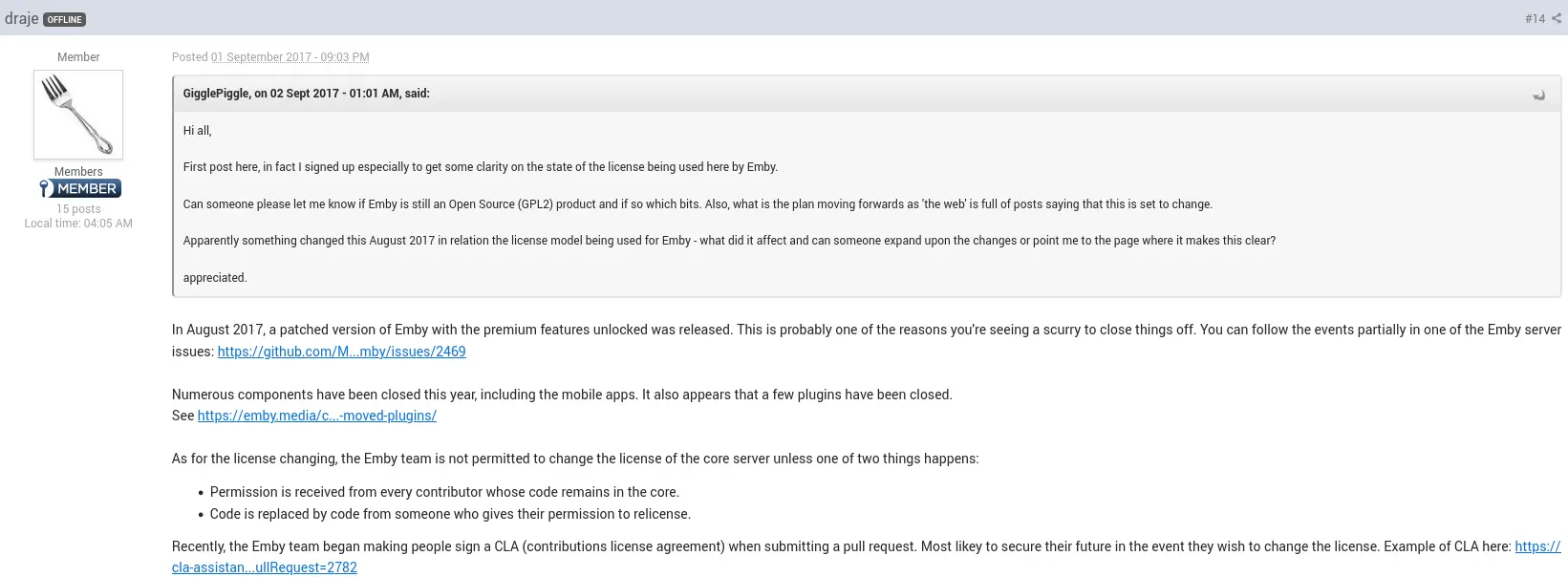
Basically, slammed the source code door shut after making promissory statements like "Don't worry, we'll always be open source" for years. With little/no notice they relicensed everything and pivoted to a closed source paywall model.
No discussion with the community or contributors, no alternatives explored, no polls or surveys. Just woke up one day to a "Sorry, but we're going closed source because moneyyyy" blog post
Jellyfin was born right after, forked out of vengeance.
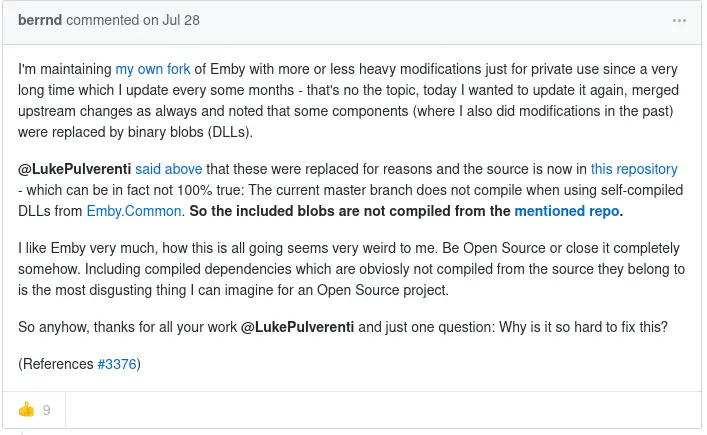
In retrospect we should have seen it coming when they would do odd little things, like keeping the build scripts closed source n crap, but eh hindsight and all that lol
Another user said that was because users were modifying the code to avoid supporting the project? I got a lifetime subscription relatively inexpensive and haven't had trouble
Who said that? I did a search in the thread and no Ody said anything about that that I saw
So the issue is kind of similar to bitwarden; how to protect the premium bits when having an open source core?
They just didn't handle it as gracefully.
https://www.theregister.com/2024/11/04/bitwarden_gpls_password_manager/
Here's the history regarding emby if you're curious:
https://github.com/nvllsvm/emby-unlocked
I'm not pirating a bunch of shows just to pay Plex for the privilege of watching it.
I have a lifetime plex pass so this does not really affect me but I expect the trend of degrading experience to continue. I would have switched to Jellyfin a long time ago but I am dreading contacting everyone I share with and getting them migrated.
Same boat here. I chose Plex because the apps were everywhere. Smart TV's, phones, web...
I can switch, no problem. I don't want to have to teach my parents a new app. OMFG!
This is also true of Jellyfin, though. I have apps on my Windows PC, my Android phone, multiple Nvidia Shield boxes on my TVs, plus the web interface if I need it.
I switched over from Plex several years ago, and while it takes a bit more time to configure, compatibility for clients seems just as good for Jellyfin as it is for Plex.
Most importantly, Jellyfin is strictly client/server, no "cloud" bullshit and no remote account is required; I don't want Plex phoning home with a list of the media on my file server.
Jellyfin certainly took off. Great for them. It just wasn't polished or an option when I set things up way back then.
its actually the sole reason why i ended up paying for plex myself. its not because on ME that i ended up using plex, its moreso everyone else that I want to give my server access to with the least amount of hurdles that made me ultimately go that route.
You can use Cloudflare Tunnel as well.
Everything I see online says it’s free.
I’ve also used it recently and did not pay for it.
It's against CloudFlare ToS to use CF tunnels for media streaming like this. You can risk it ig but I have important stuff like domain registrations on CloudFlare so I'm personally not willing to risk getting banned.
I have not used it for streaming, but you’re right. I purposely do not proxy my media traffic for this reason, utilizing their other solutions.
Hellooooo jellyfin!
Only use open source software
If you don't like the price there's always jellyfin.
Got to say that I have been very happy with it.
Glad I bought the Plex Pass like 13 years ago. While I understand everyone seems to think everything should be free, I'm sure your boss wishes you worked for free too, but the world doesn't work that way.
I'm OK supporting products I use , and Plex is an example of this for me. It was a well spend $75 in 2013
As a plex pass lifetime user, this doesn't change anything for me.
I am, however, blown away that the price went from $75 CDN to $350 CDN over the last 10 years!! That's just insane!
I'm surprised by the resistance to Jellyfin in this thread. If you are using Plex, you're already savvy enough to use bittorrent and probably the *arrs. If you can configure that stuff, Jellyfin is absolutely something you can handle. If you like Docker, there's good projects out there. If you're like me and you don't understand Docker, use Swizzin community edition. If you can install Ubuntu or Debian, and run the Swizzin script, you're in business.
Can’t say I have a huge issue with this - Plex isn’t FOSS and the infrastructure to make this happen isn’t free. Other options are available if you don’t want to pay the fee.
So glad i switched to jellyfin half a year ago
Same. My wife also just asked me to get a bunch of audio books too...so looks like I have to set up that now
The default Jellyfin client isn't great for audiobooks.
For Apple iOS you might wanna look at https://github.com/LeoKlaus/plappa
For Android I would look at https://github.com/advplyr/audiobookshelf
Personally I just download the audiobooks from Jellyfin and play it in https://f-droid.org/packages/com.prangesoftwaresolutions.audioanchor/
I run audiobookshelf and it's amazing!
Thank you
https://arstechnica.com/gadgets/2025/03/i-threw-away-audibles-app-and-now-i-self-host-my-audiobooks/
Check out this arstechnica article on AudioBookshelf. Should cover most of what you need to get started.
I would recommend audiobookshelf for the audiobooks, especially if you have your stuff running in docker. It seemed to me like the solutions to force Plex or jellyfin to do books were a bit more hacky than I wanted.
Dude, I'm blown away by how easy AudioBookShelf was to set up. I was going to go with Jellyfin for audiobooks too since I already had my libraries set up, but I wanted to try an alternative just to see. So easy, I was up and running in under 10 minutes! Thanks for the recommendation!
I've been meaning to set up a homeserver with plex recently but will defnitely go for jellyfin now that I read this thread.
It looks like as long as the host has a Plex pass, this doesn't change much. It is a regression of service, which sucks, but there are viable alternatives for those unable or unwilling to pay. And honestly, jellyfin is the clear winner in that case and always has been.
Now, if they start to charge my friends and family for access to my media after I have already paid them for their lifetime subscription, then I'll grab a pitchfork with the crowd.
Also, why not run both and be ready? The resources required are minimal if you're running via docker, just some extra RAM and a negligible amount of compute for overhead on library maintenance tasks.
This is the best ad campaign Jellyfin could have asked for.
I already pay for plex pass but I'm going to start looking into jelly fin out of principle. I will not support the enshitification of a service I use and this is how it starts. Soon they will have tiered subscriptions and then the cheap one will be taken away and the cheapest paid one will be stuffed with ads then all tiers will be stuffed with ads then they will jack up prices again or charge more for sharing with family or block it all together to force your family to get their own sub and the circle of enshitification will be complete.
I can understand new features being behind a fee, but this is putting old, old capabilities behind a paywall. Hmmm...
This with a recent decision to remove watch together sort of eliminates the whole reason I would have tried Plex so many years ago.
I'm a fan of Plex (it's worked for me) and understand the Jellyfin crowd too. I'm worried about who is calling the shots at the moment. They aren't aligning with their users.
Old capabilities that don't even work as well as free alternatives because AMD transcoding support has been """experimental""" for years.
I can understand new features being behind a fee, but this is putting old, old capabilities behind a paywall. Hmmm...
I am a Trakt user, was an Evernote user and I am (thankfully) a Plex Pass user...
What service are we missing that has done the same? We should make a list if there is not one already.
Another company fucked by executives.
Well, looks like my decision to stick with Kodi and never bother with Plex is about to pay dividends.
The reality is that we need more resources to continue putting forth the best personal media experience
How stupid do they think we are?
Wireguard so you are always seen as being on the local network. This bit of assholery is easily defeated.
Why do people use this when Jellyfin exists?
The audacity of this company to increase prices when:
A) downloads are locked behind the paywall but havent worked in years (probably close to a decade at this point)
B) they focus all the development time on bringing bullshit to the platform (live tv, rentals, other streaming app searches, etc)
Requiring a subscription for remote access is actually fucking insane, they don't have any bandwidth costs associated with that other than authentication so ???
This will drive people to Jellyfin, and watch how fast Plex drops into irrelevance when all the selfhosters move away. Plex is (now was) the #1 thing to that both myself and others in this community would recommend to someone looking to get into selfhosting. ¯\_(ツ)_/¯ not anymore, wonder how much the revenue will drop?
I keep a Jellyfin instance running as a hedge. Here's the thing with Plex (and actually a lot of companies set up similarly): those "lifetime" memberships are a trap. Think about it: Plex gets your money ONCE but they have ongoing expenses. Sooner or later, they'll have spent every single cent made by a lifetime membership unless they either get more folks OR squeeze everyone a bit more.
Once they started adding their own shows and making strange UI decisions, I could sense the end was coming. A move like this brings it up fast. Jellyfin is not nearly as good as Plex in a lot of ways, but it's really Open Source.
Anyway, a lot of rambling, but in short: when there is a "lifetime" subscription, watch out!
I moved on to jellyfin after I found out the hard way Plex servers need to authenticate for use. I'm sure by now there are ways to set up offline authentication but I already didn't like the idea of paying monthly to stream my own content from my own machine. It just didn't make sence to me. Jellyfin isn't perfect, or as flashy as Plex, but it works, looks fine, and its free, not counting a much deserved donation to the devs .
They seem to be getting a lot of hate for this, but Plex is not FOSS... They have the roots but they currently have like 100 paid employees and are trying to make a business out of it. They have to do something to make money to pay people every month. My $75 10 years ago isn't going to do much for that... The fact that they've made it this far without folding is impressive.
I’ve been using Plex many years. I abandoned it about 1-2 years ago when they began their enshittification journey. Now I see they are continuing to double down on being assholes.
They do not need any more resources to allow people to use what already exists. Most people run their own servers, and, they track all that by the way. Hence why people moved away from it.
Don’t give them your money. Let them rot. They fucked their user base who built them.
I stopped using Plex shortly after they started forcing logging in with your online Plex account to connect to LAN only based server. The writing was on the wall all those years ago. Who wants to be locked out of their media when the internet is offline, completely defeated the point of self hosting local infrastructure
Jellyfin, while lacking a bit when I first migrated, has continued improved over the years and it has been joyful to use. Plus Jellyfin supported hardware transcoding before Plex did, which was a gripe I had with Plex at the time.
I stream from my server remotely and share with Family without hassle. I dunno where Plex is trying to go, glad I bailed long ago
Judging by the rest of the thread I'm going to get downvoted for this, but what the hell:
I'm sure I'll switch to Jellyfin eventually but I tried it out a few weeks ago to see what all the hype was about and it just... wasn't great. It was difficult to setup, with way too many overly-complicated settings, and then it refused to play one of the two test files I tried. Like it or not there's a reason that Plex is the dominant player in the game, and a large part of that reason is that it verges on plug-and-play for simplicity of both setup and use.
Yes, it sucks that they're removing remote streaming for free users, but I imagine there's a significant chunk of users who don't know or care how to properly open their server up to the world and are relying on the Plex proxies for their streams (which happens entirely in the background), and those aren't going to be cheap to run. Maybe putting them behind a paywall will provide the resources to make them faster.
I did buy a lifetime pass last time they announced a price hike; it's honestly paid for itself many times over, and I've been encouraging other users I know to do the same before this next one, because yes, it is a significant hike this time around. That said, while I wouldn't pay monthly for it, I do still feel like the lifetime pass is tremendous value for such a polished product. It's a shame they've had to do it at all, but I don't begrudge them for it.
sometimes good software is worth paying for
I gotta be honest, when I look at the problem pragmatically, it'll be a lot easier to pay $20 a year than to switch to jellyfin and get all my users to figure out how to install clients and make it work for them.
I'm already at the point in my life where my primary concern is making things work smoothly, and if I need to throw money at something to make it work smoothly, the choice is a no brainer. (At least for some values of "money")
Subscriptions are a non-starter for me
I've paid for the lifetime subscription for Plex...Still only using Jellyfin
I can justify a one time purchase, but never recurring payments.
I just want to make sure I read this correctly. It says that if you're a Plex plass holder already that remote streaming changes won't affect your service. This means that if I have the lifetime subscription and host my own server than users whom have not payed for Plex pass can continue to access this server without issue correct?
Time to move to Jellyfin for the rest of their users?
Well this is a good reason to finish my migration to Jellyfin I think.
I only use remote streaming a couple times per year, so paying for plex pass just for that seems a bit silly. Their online-only account auth is also super annoying if the internet is down.
So basically.. this is a blatant cash grab, and a nearly 200% one depending on the level of service you pay/paid for. Wonder how long it will be before the lifetime pass is discontinued and everyone gets forcibly moved over to a monthly subscription model
I've said it for years that Plex is shit because of their license and the fact that you have no control everyone said no it's fine it's my media fucking look at it now
All these comments mentioning jellyfish and I haven’t see a single mention of emby. Is it considered bad or something? Because I switched over to it and I am liking it a lot better than plex so far
Why would anyone even used Plex since we have jellyfin?
So I have a lifetime Plex pass, but my friend (who is remote) does not. Does this change mean they have the have a Plex pass to connect to my device remotely?
Edit: thanks for the info! After I posted I continued reading and realized that question was already answered! Appreciate the help!
I used to use Plex, then one day my internet was down and since Plex couldn't phone home, it wouldn't let me log in to watch media ON MY LAN.
So yeah it's inherently broken. That's before you even consider the licensing.
If I didn't already have my lifetime pass, I'd use Jellyfin as my primary media server platform instead of Plex.
One of these days though, I'm sure Plex will make a mistake serious enough that it impacts me, and I'll end up switching to Jellyfin as my main media server platform.
Why would you expect this to NOT be paid? It requires them to be running servers to stream the media through, I wouldn't expect this to be a free feature.
I dislike Plex for several reasons, but asking for payment for stuff that costs them money is completely justified.
I dumped Plex years ago even though I paid for it. Too many issues with it. Constantly losing movie folders, unable to stream to the device I wanted to watch on, wrong codec, wrong sound, etc, etc. I gave up. I’m sure it worked fine for most, but it got to be a pain. Switched to Jellyfin and a DDNS address and have had zero problems since. And it’s free.
Man, my Jellyfin subscription just rose in price too.
If it costs them money to run it, it makes sense?
Why are they proxying the stream through their server though
Not necessarily. Tailscale uses their own servers in order to do the negotiation, but once the connections are opened on both ends you should be directly connected to each other. All without port forwarding or any config on your end.
Right, but IIRC anyone can go on the plex.tv website and use shared servers due to the "proxy"
The self-hosted servers use UPnP and NAT-PMP to automatically forward the port used for media streaming.
They typically don't. They do proxy it if there is something preventing a direct connection, but the proxy bandwidth is super limited and results in pretty terrible playback quality.
They aren't, all their server does is handle the login authentication afaik, and then streaming happens directly from the server to the user.
They do actually provide a relay server if your personal server isn't entirely accessible for whatever reason (for example I recently added a new NIC on my server which changed the IP and broke my port forwarding and my users were still able to watch my media via the relay). It is limited to low res quality but it is something they're offering.
How else would it work?
Directly to the clients from the already self-hosted server, exactly like all the other media hosting software does. Lmao.
Port forwarding, tailscale...
... Nebula...
When I stream from my plex server it's a direct connection between my device and the server. The only time it proxies through plex is if your server isn't directly accessible, like ports are blocked or not forwarded properly.
What a load of BS.
A big part of the appeal with Plex is that you can run a server and friends can sign up for a FREE account and stream remotely. When you take this away, you're going to just kneecap the whole offering. This is such an arrogant move from Plex: they are thinking that when this change goes live they will get a flood of subscriptions. The more likely outcome is they will get a few subscriptions and a lot more angry and frustrated people that walk away.
"A subscription"
Its the same Plex pass subscription for people who don't want to read a clickbait article.
" When running your own Plex Media Server as a subscriber, other users to whom you have granted access can also stream from the server (whether local or remote), without ANY additional charge"
So as a plex pass holder it shouldn't affect any of my (current?) users? Am I reading this right?
edit: Seems I'm good.
I’m inferring from the language of the post that OP is against this policy change, but I’m not sure I follow the argument. Why is it problematic that Plex is asking for money?
Dammit, my friend just said he would give me access to his file server, all I have to do is install Plex. Presumably this announcement means that will become impossible without a subscription.
Huh, I was somewhat excited about the elimination of the playback limit for mobile apps (we are in 2025 ffs!) and then re-read that this will be only applicable for the subpar preview version once it is released... Which doesn't fucking has the watch together feature lmao.
The only good news in a nutshell is that I am still a Plex Pass Lifetime User, so in a nutshell I don't get good news lol.
I don't really have a problem with this. I paid for a lifetime quite a long time ago. Right now I only use Plex for plexamp and everything else is on jellyfin.
Is finamp at a point that it can replace plexamp yet?
On one hand, it looks like this only applies to streaming from a remote server where neither the server owner or the user has Plex pass, so lifetime holders or committed server operators with a subscription can continue to provide access to all our non paying friends. It isn't explicit whether non-paying users people who port forward / do reverse proxying themselves are affected but it sounds like they are, which is utter BS since direct connections hardly cost Plex anything.
It is however nice that they're trading this for getting rid of the mobile unlock BS - it was always awkward explaining to friends that they could watch anywhere except on their phone unless they paid $5.
On the other hand, one notable side effect is that all non-lan streaming will now be associated with a paying server owner or a paying user, which makes it impossible to use Plex to share pirated media without a user on either end giving up PII / payment information. I have a gut feeling that this is an extension of the previous piracy crackdown on OVH(?) hosted servers meant to ensure they have the identity of all users who may be engaged in selling access.
Overall, yeah another reason to move to JF. I paid for lifetime more than a decade ago so I'm going to keep using Plex until my non-paying friends start to have issues, but I really hope this pushes more investment into JF apps. I really need a good android TV app that supports server transcoding (IIUC findroid's beta TV builds are direct stream only).
Can't wait to see a 40 minutes rant on LTT where he will feel betrayed and teach everyone how to use jellyfin
As someone looking to get into self hosting and was researching plex. What’s been the experience like using jellyfish with non techy people? This is mainly something I want to set up for my parents
Any Kodi users here?
Well that's the beginning of the end for them.
I'm about half-way off the platform already (and I'm a lifetime subscriber)
The only thing I go back for is Roku use (better app), PlexAmp (better app) and offline viewing. I don't have to go off JF for those, but it's a lot better on Plex.
But it's not so much better than I can't protest.
This sucks ass. I'm a lifetime Plex Pass holder, so this doesn't affect me yet, but who's to say they won't fuck over lifetime users sooner rather than later?
Honestly, this made me consider setting up Jellyfin. What the fuck?
So I have a lifetime pass. But my family members have their own accounts. Will they be able to watch from their house to my server now or will they need to pay? Cause if that’s so guess I’m switching to jellyfin and teaching them how to work it.
Would Tailscale/ZeroTier work as a workaround for this or do you think Plex would also put that behind a paywall?
Bro what
If the server you are stealing movies from has a pass you still don't need to pay
They could have worded this better
Plex borking itself a year ago for me is the best thing that could've happened. Long live jellyfin
IMPORTANT NOTE FOR CURRENT PLEX PASS HOLDERS:
For users who have an active Plex Pass subscription, remote playback will continue to be available to you without interruption from any Plex Media Server, after these changes go into effect. When running your own Plex Media Server as a subscriber, other users to whom you have granted access can also stream from the server (whether local or remote), without ANY additional charge—not even a mobile activation fee. More on that later in this update.
I was worrying about this change because my Plex server provides free streaming for several of my friends and family and I didn't want them to have to start paying for it. The whole point was to get them away from Netflix, Hulu, Disney+, etc.
But this sounds like, since I'm already a Plex Pass subscriber, my remote viewers will still be able to access my stuff for free. Do I have that right? Because if so, this change is just business as usual for me.
I really need to stop being lazy and swap to Jellyfin....
Jellyfin needs to partner with someone people can pay a very low and reasonable and/or one-time fee to enable remote streaming without the fuss of setting up either dangerous port-forwarding or the complexity of reverse proxies (paying for a domain-name, the set-up itself including certificates, keeping it updated for security purposes).
And no a VPN is not a solution, the difficulty for non-technical users in setting up a VPN (if it's even possible, on smart-tvs it's almost always not, and I don't think devices like AppleTV and other streaming boxes often support them) is too high and it's an unwanted annoyance even for technical users.
I'm not talking about streaming video's through someone else's servers or using their bandwidth. I'm talking about the connection phase of clients and servers where Plex acts like an enhanced dynamic DNS service with authentication. They have an agent on the local media server which sends to the remote web service of the third party the IP address, the port configured for use, the account or server name, etc. When a client tries to connect they go to this remote web service with the servername/username info, the web service authenticates them then gives them the current IP address and any other information necessary. It then sends some data to the local Jellyfin server about the connecting client to enable that connection and then the local media Jellyfin server and the client talk directly and stream directly.
Importantly the cost of running this authentication and IP address tracking scheme would be minimal per Jellyfin server. You could charge $5/year for up to 20 unique remote clients and come out ahead with a slight profit which could be put back into Jellyfin development and things like their own hosting costs for code, etc. Even better if they offer lifetime for this at $60-$80 they'd get a decent chunk of cash up-front to use for development (with reasonable use restrictions per account so someone hosting stuff in Hetzner or whatever and serving 300 people with 400 devices will need to pay more because they're clearly doing this for profit and can afford to throw some more money at Jellyfin).
Until Jellyfin offers something that JUST WORKS like that it's not going to be a replacement for Plex, whatever other improvements they offer to users it's still a burden for the server runner to set up remote streaming in a way that isn't either incredibly dangerous (port forwarding) OR either involves paying money to third parties AND/OR the trouble of running your own reverse proxy and/or involves walking users through complicated set-up process for each device that you have to repeat if you change anything major like your domain name when using a VPN.
If you want to keep using plex and remote it’s important to you, they usually have pretty good deals on pass from time to time. I don’t regret my lifetime pass - I still feel like it’s a pretty solid app and service all things considered- but if I didn’t have the pass already I would be a bit pissed as well ngl.
I don’t like it, but it’s a pragmatic decision.
Hosting for a simple website can be as little as a few bucks a month. That’s easy for any project to absorb, even if they are open-source with no one pulling a paycheque.
Streaming requires high-performance, high-bandwidth machines that cost anywhere from several dozen dollars to several hundred dollars a month. You build a resilient high-availability network, and you could easily be looking at several tens of thousands of dollars a month.
That isn’t easy to absorb, even for a for-profit company with clearly-defined revenue streams.
Some people want everything for free, but free doesn’t pay the bills.
Full disclosure: I don’t use the streaming feature. I prefer to grab actual copies to drop onto my NAS. I also don’t share to friends and family, as I am the only one I know of who uses Plex.
Universal media server works for me. I run it headless on a small instance. Streams my movies and music just fine.
I never got the appeal of plex. I've been using Serviio back in the day and it was free, open source and did what I needed it to, which is play a video on tv, that's it.
Plex wanted me to purchase subscription years ago and I couldn't for the life of me figure it out how to set it up for free.
I've been using stremio for a few years now but i think it's closing in on the EOL as well, so i might go back to serviio and kodi one of these days. Just need a good NAS that could run a streaming server as well. Don't want to keep my gaming rig on at all times just to watch movies.
And that’s why open source is best.
Hypothetically, if I have tailscale setup, would that be a viable workaround since everything looks local on my tailnet?
If you are currently a Plex user i highly suggest at least putting together an exit strategy. I am in the process of it but it's rough. In fact, i think Plex might be the last thing i replace with a FOSS solution.
remote streaming rarely works for me so I won't be losing anything.
I thought that was already true
Glad I went Emby.
Well that's disappointing
Would this affect self hosters?
Never used it. Started with Kodi and moved to Jellyfin when I learned of it forking from Emby.
So then Photoprism is going to lock my photos and ask my mom for money to see them?
Its selfhosting, not freehosting for yet another asshole company.
I still remember sticking files on an apache server and openly sharing that with friends. Not had a need to do that lately but I can always start doing it again if necessary.
So it looks like the server will need plex pass in order to stream to users, or the user can pay about $2/mo to stream from servers without plex pass. I feel like this is fine, doesn't really come across as greedy or egregious.
I've set up plex, overseer, sonaar, and radaar in such a way that my family and friends can request and watch videos on my server. I use plex because it's the easiest for my less than tech savvy family to use, as it's just an app on their TV.
I have never paid a cent for Plex while Plex has allowed me and my family to save hundreds in subscription fees, so I'm feeling rather ambivalent about this new requirement for me to get plex pass in order to stream to the small horde of people I serve. I was considering getting plex pass to unlock hardware acceleration for transcoding anyway.
I've considered Jellyfin, but plex has a ton of features that allow for scripting that keeps me from having to manually do maintenance. Not to mention how hard it would be to get people like my father to use Jellyfin on his TV, last I checked there isn't even TV app available for most platforms.
Fuck this. What the absolute fuck lmao they just decided to kneecap their entire business model.
I was even going to get a lifetime subscription later this year when they usually put the price down. Not anymore
Well that fuckin sucks dick.
If this is enough to push you away from Plex but you’ve tried Jellyfin and it didn’t quite do it for you, try https://emby.media/
It is the software Jellyfin is forked from and bridges the gap between the freedom of Jellyfin and the polished look and function of Plex.
I went from Emby to Jellyfin as they started their enshittification journey. I don't really notice it being less polished.
I’m not aware of any enshittification with Emby, unless you know something I don’t. Emby sort of “just works” which is why it’s a more direct replacement to Plex than Jellyfin is.
As for Jellyfin, I check in on it every now and then and they’ve made a lot of progress but the features and polish aren’t there. I hear good things about the Jellyfin web component, butif you want a good experience with Jellyfin apps on mobile or whatever TVOS you’re running, you have to use third party apps because the official ones are still woefully barebones. I still hear a lot of griping about issues with subtitles, and HEVC playback.
Did Jellyfin ever even figure out proper Intro Skip? That was a big pain point for me for the longest time, as the only way to accomplish it was a third party plugin and the only option was to skip all intros, you didn’t get a button. I remember reading somewhere they added some kind of framework that would allow proper intro skipping going forward, but that the official function was not ready.
The media segments feature has been released as of 10.10.0 and it still needs a plugin. Still feels a bit clunky but works already on my Android TV box. I guess there will be more polish in future versions, now that the groundwork is done.
How is the general perception of emby? They're closed source and US based.
Absolutely not, fuck Emby with a branding iron, they're far shittier than Plex's decisions.
At least Plex started out as a for-profit company and has never misrepresented themselves as anything but. Unlike Emby.
I'm seeing a lot of negativity but I think they offer a great service and deserve to be paid for their work. I bought a lifetime pass many years ago and I almost feel guilty how much value I have received over that time.
Seems reasonable. I'm a lifetime Plex pass holder, so it won't affect me or the one person I let access my server lol