Study Boldly Claims 4K And 8K TVs Aren't Much Better Than HD To Your Eyes, But Is It True?
7mon 23d ago by piefed.social/u/artifex in technology from hothardware.com
A new study published in Nature by University of Cambridge researchers just dropped a pixelated bomb on the entire Ultra-HD market, but as anyone with myopia can tell you, if you take your glasses off, even SD still looks pretty good :)
Kind of a tangent, but properly encoded 1080p video with a decent bitrate actually looks pretty damn good.
A big problem is that we've gotten so used to streaming services delivering visual slop, like YouTube's 1080p option which is basically just upscaled 720p and can even look as bad as 480p.
Yeah I'd way rather have higher bitrate 1080 than 4k. Seeing striping in big dark or light spots on the screen is infuriating
i'd rather have proper 4k.
Stremio
For most streaming? Yeah.
Give me a good 4k Blu-ray though. High bitrate 4k
I mean yeah I'll take higher quality. I'd just rather have less lossy compression than higher resolution
I was wondering when we’d get to the snake oil portion of the video hobby that audiophiles have been suffering. 8k vs. 4k is the new lossy vs. lossless argument.
Just recently, on this site, someone tried to tell me that there was no audible difference between 128kbps and 360kbps mp3. Insane.
A big problem is that we’ve gotten so used to streaming services delivering visual slop, like YouTube’s 1080p option which is basically just upscaled 720p and can even look as bad as 480p.
YouTube is locking the good bitrates behind the premium paywall and even as a premium users you don't get to select a high bitrate when the source video was low res.
That's why videos should be upscaled before upload to force YouTube into offering high bitrate options at all. A good upscaler produces better results than simply stretching low-res videos.
I think the premium thing is a channel option. Some channels consistently have it, some don't.
Regular YouTube 1080p is bad and feels like 720p. The encoding on videos with "Premium 1080p" is catastrophic. It's significantly worse than decently encoded 480p. Creators will put a lot of time and effort in their lighting and camera gear, then the compression artifacting makes the video feel like watching a porn bootleg on a shady site. I guess there must be a strong financial incentive to nuke their video quality this way.
I can still find 480p videos from when YouTube first started that rival the quality of the compressed crap “1080p” we get from YouTube today. It’s outrageous.
Sadly most of those older YouTube videos have been run through multiple re-compressions and look so much worse than they did at upload. It's a major bummer.
This. The visual difference of good vs bad 1080p is bigger than between good 1080p and good 4k. I will die on this hill. And Youtube's 1080p is garbage on purpose so they get you to buy premium to unlock good 1080p. Assholes
The 1080p for premium users is garbage too. Youtube's video quality in general is shockingly poor. If there is even a slight amount of noisy movement on screen (foliage, confetti, rain, snow, etc) the the video can literally become unwatchable.
HEVC is damn efficient. I don’t even bother with HD because a 4K HDR encode around 5-10GB looks really good and streams well for my remote users.
I've been investing in my bluray collection again and I can't believe how good 1080p blurays look compared to "UHD streaming" .
I stream YouTube at 360p. Really don't need much for that kind of video.
360p is awful, 720p is the sweet spot IMO.
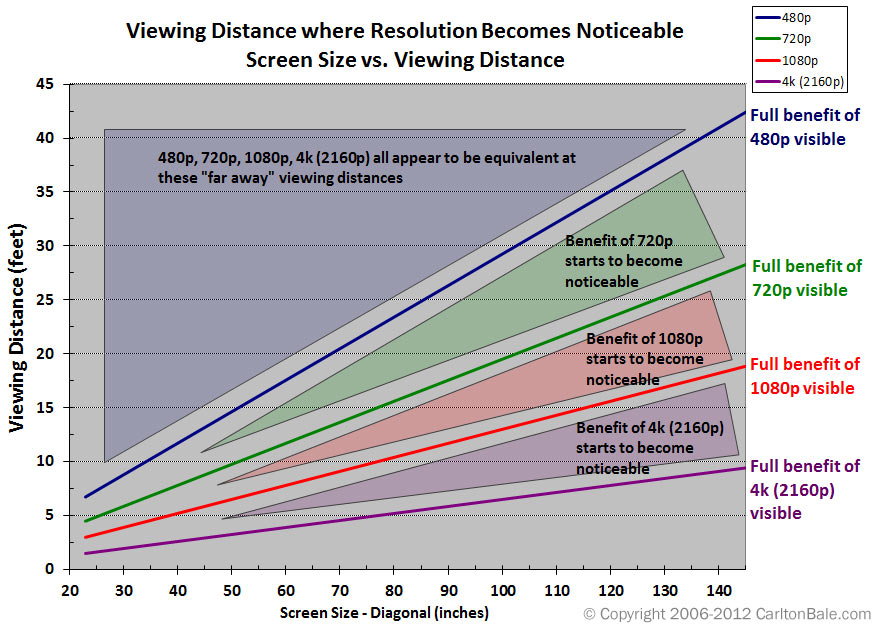
I can pretty confidently say that 4k is noticeable if you're sitting close to a big tv. I don't know that 8k would ever really be noticeable, unless the screen is strapped to your face, a la VR. For most cases, 1080p is fine, and there are other factors that start to matter way more than resolution after HD. Bit-rate, compression type, dynamic range, etc.
Seriously, articles like this are just clickbait.
They also ignore all sorts of usecases.
Like for a desktop monitor, 4k is extremely noticeable vs even 1440P or 1080P/2k
Unless you're sitting very far away, the sharpness of text and therefore amount of readable information you can fit on the screen changes dramatically.
The article was about TVs, not computer monitors. Most people don't sit nearly as close to a TV as they do a monitor.
Oh absolutely, but even TVs are used in different contexts.
Like the thing about text applies to console games, applies to menus, applies to certain types of high detail media etc.
Complete bullshit articles. The same thing happened when 720p became 1080p. So many echos of “oh you won’t see the difference unless the screen is huge”… like no, you can see the difference on a tiny screen.
We’ll have these same bullshit arguments when 8k becomes the standard, and for every large upgrade from there.
I agree to a certain extent but there are diminishing returns, same with refreshrates. The leap from 1080 to 4k is big. I don't know how noticeable upgrading from 4k to 8k would be for the average TV setup.
For vr it would be awesome though
You should actually read it, they specified what they looked at.
So, a 55-inch TV, which is pretty much the smallest 4k TV you could get when they were new, has benefits over 1080p at a distance of 7.5 feet... how far away do people watch their TVs from? Am I weird?
And at the size of computer monitors, for the distance they are from your face, they would always have full benefit on this chart. And even working into 8k a decent amount.
And that's only for people with typical vision, for people with above-average acuity, the benefits would start further away.
But yeah, for VR for sure, since having an 8k screen there would directly determine how far away a 4k flat screen can be properly re-created. If your headset is only 4k, a 4k flat screen in VR is only worth it when it takes up most of your field of view. That's how I have mine set up, but I would imagine most people would prefer it to be half the size or twice the distance away, or a combination.
So 8k screens in VR will be very relevant for augmented reality, since performance costs there are pretty low anyway. And still convey benefits if you are running actual VR games at half the physical panel resolution due to performance demand being too high otherwise. You get some relatively free upscaling then. Won't look as good as native 8k, but benefits a bit anyway.
There is also fixed and dynamic foveated rendering to think about, with an 8k screen, even running only 10% of it at that resolution and 20% at 4k, 30% at 1080p, and the remaining 40% at 540p, even with the overhead of so many foveation steps, you'll get a notable reduction in performance cost. Fixed foveated would likely need to lean higher towards bigger percentages of higher res, but has the performance advantage of not having to move around at all from frame to frame. Can benefit from more pre-planning and optimization.
A lot of us mount a TV on the wall and watch from a couch across the room.
And you get a TV small enough that it doesn't suit that purpose? Looks like 75 inch to 85 inch is what would suit that use case. Big, but still common enough.
I've got a LCD 55" TV and a 14" laptop. Ok the couch, the TV screen looks to me about as big as the laptop screen on my belly/lap, and I've got perfect vision; on the laptop I can clearly see the difference between 4k and FULL HD, on the TV, not so much.
I think TV screens aren't as good as PC ones, but also the TVs' image processors turn the 1080p files into better images than what computers do.
Hmm, I suppose quality of TV might matter. Not to mention actually going through the settings and making sure it isn't doing anything to process the signal. And also not streaming compressed crap to it. I do visit other peoples houses sometimes and definitely wouldn't know they were using a 4k screen to watch what they are watching.
But I am assuming actually displaying 4k content to be part of the testing parameters.
Yeah well my comparisons are all with local files, no streaming compression
Also, usually when people use the term "perfect" vision, they mean 20/20, is that the case for you too. Another term for that is average vision, with people that have better vision than that having "better than average" vision.
Idk what 20/20 is, I guess you guys use a different scale, last mandatory vision test at work was 12/10 with 6/7 on I don't remember which color recognition range, but I'm not sure about the latter 'cause it was ok last year and 6/7 the year before also. IIRC the best score for visual acuity is 18/10, but I don't think they test that far during work visits, I'd have to go to the ophthalmologist to know.
I would imagine it's the same scale, just a base 10 feet instead of 20 feet. So in yours you would see at 24 feet what the average person would see at 20 feet. Assuming there is a linear relation, and no circumstantial drop off.
I doubt it's feet, but if it's a distance, I guess it doesn't matter much
There's a giant TV at my gym that is mounted right in front of some of the equipment, so my face is inches away. It must have some insane resolution because everything is still as sharp as a standard LCD panel.
The counterpoint is that if you're sitting that close to a big TV, it's going to fill your field of view to an uncomfortable degree.
4k and higher is for small screens close up (desktop monitor), or very large screens in dedicated home theater spaces. The kind that would only fit in a McMansion, anyway.
8K would probably be really good for large computer monitors, due to viewing distances. It would be really taxing on the hardware if you were using it for gaming, but reasonable for tasks that aren't graphically intense.
Computer monitors (for productivity tasks) are a little different though in that you are looking at section of the screen rather than the screen as a whole as one might with video. So having extra screen real estate can be rather valuable.
People are legit sitting 15+ feet away and thinking a 55 inch TV is good enough... Optimal viewing angles for most reasonably sized rooms require a 100+ inch TV and 4k or better.
Good to know that pretty much anything looks fine on my TV, at typical viewing distances.
Would be a more useful graph if the y axis cut off at 10, less than a quarter of what it plots.
Not sure what universe where discussing the merits of 480p at 45 ft is relevant, but it ain't this one. If I'm sitting 8 ft away from my TV, I will notice the difference if my screen is over 60 inches, which is where a vast majority of consumers operate.
How many feet away is a computer monitor?
Or a 2-4 person home theater distance that has good fov fill?
4k is way better than 1080p, it's not even a question. You can see that shit from a mile away. 8k is only better if your TV is comically large.
I think you overestimate the quality of many humans' eyes. Many people walk around with slightly bad vision no problem. Many older folks have bad vision even corrected. I cannot distinguish between 1080 and 4k in the majority of circumstances. Stick me in front of a computer and I can notice, but tvs and computers are at wildly different distances.
And the size of most people's TV versus how far away they are.
Yeah a lot of people have massive TV's if your into sport but most people have more reasonable sized TV's.
I used to have 20/10 vision, this 20/20 BS my cataract surgeon says I have now sucks.
Thats what you humans get for having the eyes from fish
You're just jealous we can breath above water, cephalopod.
Oh look I'm a human I only have two arms and can't even squirt ink at people. Oh ha ha I have all these stupid bones so if I'm locked in a prison I can't get out, like a loser.
Seriously. Eyes basically disprove intelligent design because they're kinda shitty at what they do.
I can immediately tell when a game is running at 1080p on my 2K monitor (yeah, I'm not interested in 4K over higher refresh rate, so I'm picking the middle ground.)
Its blatantly obvious when everything suddenly looks muddy and washed together.
I think that's relevant to the discussion though. Most people sit like two feet from their gaming monitor and lean forward in their chair to make the character go faster.
But most people put a big TV on the other side of a boring white room, with a bare white ikea coffee table in between you and it, and I bet it doesn't matter as much.
I bet the closest people ever are to their TV is when they're at the store buying it...
As someone who has a 4k monitor, 1440p is a great middle ground for gaming
The study used a 44 inch TV at 2.5m. The most commonly used calculator for minimum TV to distance says that at 2.5m the TV should be a least 60 inches.
My own informal tests at home with a 65 inch TV looking at 1080 versus 4K Remux of the same movie seems to go along with the distance calculator. At the appropriate distance or nearer I can see a difference if I am viewing critically (as opposed to casually). Beyond a certain distance the difference is not apparent.
Exactly. This title is just clickbait.
The actual study's title is "Resolution limit of the eye — how many pixels can we see?".
Can't believe I had to scroll down this far to find this:
Here’s the gut-punch for the typical living room, however. If you’re sitting the average 2.5 meters away from a 44-inch set, a simple Quad HD (QHD) display already packs more detail than your eye can possibly distinguish. The scientists made it crystal clear: once your setup hits that threshold, any further increase in pixel count, like moving from 4K to an 8K model of the same size and distance, hits the law of diminishing returns because your eye simply can't detect the added detail.
On a computer monitor, it's easily apparent because you're not sitting 2+ m away, and in a living room, 44" is tiny, by recent standards.
Exactly why big box stores force you to look at TVs in narrow aisles, not at typical distances at home. They also adjust pictures on highest margin models properly.
8k no. 4k with a 4k Blu-ray player on actual non upscaled 4k movies is fucking amazing.
I don't know if this will age like my previous belief that PS1 had photo-realistic graphics, but I feel like 4k is the peak for TVs. I recently bought a 65" 4k TV and not only is it the clearest image I've ever seen, but it takes up a good chunk of my livingroom. Any larger would just look ridiculous.
Unless the average person starts using abandoned cathedrals as their livingrooms, I don't see how larger TVs with even higher definition would even be practical. Especially if you consider we already have 8k for those who do use cathedral entertainment systems.
(Most) TVs still have a long way to go with color space and brightness. AKA HDR. Not to speak of more sane color/calibration standards to make the picture more consistent, and higher 'standard' framerates than 24FPS.
But yeah, 8K... I dunno about that. Seems like a massive waste. And I am a pixel peeper.
For media I highly agree. 8k doesn't seem to add much. For computer screens I can see the purpose though as it adds more screen real estate which is hard to get enough of for some of us. I'd love to have multiple 8k screens so I can organize and spread out my work.
Are you sure about that? You likely use DPI scaling at 4K, and you’re likely limited by physical screen size unless you already use a 50” TV (which is equivalent to 4x standard 25” 1080p monitors).
8K would only help at like 65”+, which is kinda crazy for a monitor on a desk… Awesome if you can swing it, but most can’t.
I tangentially agree though. PCs can use “extra” resolution for various things like upscaling, better text rendering and such rather easily.
Truthfully I haven't gotten a chance to use an 8k screen, so my statement is more hypothetical "I can see a possible benefit".
I’ve used 5K some.
IMO the only ostensible benefit is for computer type stuff. It gives them more headroom to upscale content well, to avoid anti aliasing or blurry, scaled UI rendering, stuff like that. 4:1 rendering (to save power) would be quite viable too.
Another example would be editing workflows, for 1:1 pixel mapping of content while leaving plenty of room for the UI.
But for native content? Like movies?
Pointless, unless you are ridiculously close to a huge display, even if your vision is 20/20. And it’s too expensive to be worth it: I’d rather that money go into other technical aspects, easily.
The frame rate really doesn't need to be higher. I fully understand filmmakers who balk at the idea of 48 or 60 fps movies. It really does change the feel of them and imo not in a necessarily positive way.
I respectfully disagree. Folk's eyes are 'used' to 24P, but native 48 or 60 looks infinitely better, especially when stuff is filmed/produced with that in mind.
But at a bare minimum, baseline TVs should at least eliminate jitter with 24P content by default, and offer better motion clarity by moving on from LCDs, using black frame insertion or whatever.
I think you're right but how many movies are available in UHD? Not too many I'd think. On my thrifting runs I've picked up 200 Blurays vs 3 UHDs. If we can map that ratio to the retail market that's ~1% UHD content.
life changing. i love watching movies, but the experience you get from a 4k disc insane.
ITT: people defending their 4K/8K display purchases as if this study was a personal attack on their financial decision making.
Resolution doesn't matter as much as pixel density.
My 50" 4K TV was $250. That TV is now $200, nobody is flexing the resolution of their 4k TV, that's just a regular cheap-ass TV now. When I got home and started using my new TV, right next to my old 1080p TV just to compare, the difference in resolution was instantly apparent. It's not people trying to defend their purchase, it's people questioning the methodology of the study because the difference between 1080p and 4k is stark unless your TV is small or you're far away from it. If you play video games, it's especially obvious.
Old people with bad eyesight watching their 50" 12 feet away in their big ass living room vs young people with good eyesight 5 feet away from their 65-70" playing a game might have inherently differing opinions.
12' 50" FHD = 112 PPD
5' 70" FHD = 36 PPD
The study basically says that FHD is about as good as you can get 10 feet away on a 50" screen all other things being equal. That doesn't seem that unreasonable
Right? "Yeah, there is a scientific study about it, but what if I didn't read it and go by feelings? Then I will be right and don't have to reexamine shit about my life, isn't that convenient"
They don't need to this study does it for them. 94 pixels per degree is the top end of perceptible. On a 50" screen 10 feet away 1080p = 93. Closer than 10 feet or larger than 50 or some combination of both and its better to have a higher resolution.
For millennials home ownership has crashed but TVs are cheaper and cheaper. For the half of motherfuckers rocking their 70" tv that cost $600 in their shitty apartment where they sit 8 feet from the TV its pretty obvious 4K is better at 109 v 54
Also although the article points out that there are other features that matter as much as resolution these aren't uncorrelated factors. 1080p TVs of any size in 2025 are normally bargain basement garbage that suck on all fronts.
4k with shit streaming bitrate is barely better than high bitrate 1080p
But full bitrate 4k from a Blu-ray IS better.
But full bitrate 4k from a Blu-ray IS better.
Full Blu-Ray quality 1080p sources will look significantly better than Netflix 4K.
Hence why "4K" doesn't actually matter unless your panel is gigantic or you're sitting very close to it. Resolution is a very small part of our perceived notion of quality.
An overly compressed 4k stream will look far worse than a good quality 1080p. We keep upping the resolution without getting newer codecs and not adjusting the bitrate.
This is true. That said, if can't tell the difference between 1080p and 4K from the pixels alone, then either your TV is too small, or you're sitting too far away. In which case there's no point in going with 4K.
At the right seating distance, there is a benefit to be had even by going with an 8K TV. However, very few people sit close enough/have a large enough screen to benefit from going any higher than 4K:

Source: https://www.rtings.com/tv/learn/what-is-the-resolution
I went looking for a quick explainer on this and that side of youtube goes so indepth I am more confused.
Bullshit, actual factual 8k and 4k look miles better than 1080. It's the screen size that makes a difference. On a 15inch screen you might not see much difference but on a 75 inch screen the difference between 1080 and 4k is immediately noticeable. A much larger screen would have the same results with 8k.
You should publish a study
And publish it in Nature, a leading biomedical journal, and claim boldly.
With 44 inch at 2,5m
Sounds like a waste of time to do a study on something already well known.
Literally this article is about the study. Your “well-known” fact doesn’t hold up to scrutiny.
The other important detail to note is that screen size and distance to your TV also matters. The larger the TV, the more a higher resolution will offer a perceived benefit. Stretching a 1080p image across a 75-inch display, for example, won't look as sharp as a 4K image on that size TV. As the age old saying goes, "it depends."
literally in the article you are claiming to be correct, maybe should try reading sometime.
Yes, but you got yourself real pissy over it and have just now admitted that the one piece of criticism you had in your original comment was already addressed in the article. Obviously if we start talking about situations that are extreme outliers there will be edge cases but you’re not adding anything to the conversation by acting like you’ve found some failure that, in reality, the article already addressed.
I’m not sure you have the reading the comprehension and/or the intention to have any kind of real conversation to continue this discussion further.
It's not my fault you can't read.
It is your fault if you start an argument over your inability to read however.
K, stay mad.
One of us has clearly stronger feelings on 4K+ monitors. And that is fine.
So I have a pet theory on studies like that. There are many things out there that many of us take for granted and as givens in our daily lives. But there are likely equally as many people out there to which this knowledge is either unknown or not actually apparent. Reasoning for that can be a myriad of things; like due to a lack of experience in the given area, skepticism that their anecdotal evidence is truly correct despite appearances, and on and on.
What these "obvious thing is obvious" studies accomplish is setting a factual precedent for the people in the back. The people who are uninformed, not experienced enough, skeptical, contrarian, etc.
The studies seem wasteful upfront, but sometimes a thing needs to be said aloud to galvanize the factual evidence and give basis to the overwhelming anecdotal evidence.
It’s the screen size that makes a difference
Not by itself, the distance is extremely relevant. And at the distance a normal person sits away from a large screen, you need to get very large for 4k to matter, let alone 8k.
I like how you’re calling bullshit on a study because you feel like you know better.
Read the report, and go check the study. They note that the biggest gains in human visibility for displays comes from contrast (largest reason), brightness, and color accuracy. All of which has drastically increased over the last 15 years. Look at a really good high end 1080p monitor and a low end 4k monitor and you will actively choose the 1080p monitor. It’s more pleasing to the eye, and you don’t notice the difference in pixel size at that scale.
Sure distance plays some level of scale, but they also noted that by performing the test at the same distance with the same size. They’re controlling for a variable you aren’t even controlling for in your own comment.
This has been my experience going from 1080 to 4K. It’s not the resolution, it’s the brighter colors that make the most difference.
And that's not releated to the resolution yet people have tied higher resolutions to better quality.
Depends how far away you are. Human eyes have limited resolution.
For a 75 inch screen I'd have to watch it from my front yard through a window.
Have a 75" display, the size is nice, but still a ways from a theater experience, would really need 95" plus.
Highly depends on screen size and viewing distance, but nothing reasonable for a normal home probably ever needs more than 8k for a high end setup, and 4K for most cases.
Contrast ratio/HDR and per-pixel backlighting type technology is where the real magic is happening.
Depends on your eyes quite a bit, too. If I'm sitting more than 15' back from a 55" screen, 1080p is just fine. Put on my distance glasses and I might be able to tell the difference with 4K.
If you read RTINGS before buying a TV and setting it up in your room, you already knew this. Screen size and distance to TV are important for determining what resolution you actually need.
Most people sit way too far away from their 4K TV.
People that have their tiny displays on the opposite side of a room is so funny to me. It's a similar reaction I have to giant-guy tiny-car.
I remember one time I saw a maybe 27 inch computer monitor on the wall above a fireplace and it was just like.... I need to leave before I say something.
Something like a dozen years ago I visited my father and sat 20+ feet away from his 27" television struggling to make things out. It was comically small for the room. I asked if he was interested in buying a newer and larger one. He agreed and we made the change to a 43". A modest increase and it helped quite a bit, though an even larger model would've been my choice. This satisfactorily infuriated his wife who then had to learn a new remote. Change is hard for some.
As someone who grew up with a 20-some inch CRT in a console format (think TV-as-furniture that sits on the floor and not a TV that sits on furniture), and then eventually got a 19" hand me down for bedroom use... yeah, the commonality of enormous flat panels still makes me shake my head in wonder sometimes.
That said, when my parents' 27" CRT died about 10 years ago, we gave them our old 55" plasma. It was hilariously oversized for the space. But it was free (to them) and we made it work.
Michael Scott vibes.
“Brand New Plasma TV. Fits right into the wall.”
Like literally exactly this omg
That's how we watched TV in the CRT era
My father in law loves to sit and research.. that's his thing.. made a career out of it yadda yadda yadda..
He asked me about a new TV.. I was like..well have you seen rtings.com?
My MIL had to remind him to eat.. lmfao
He just rabbit holed for days. It was like he clicked a TV tropes link or something.
Anyway, he made a very informed decision and loves his TV. Haha
Or they buy an 80" TV to hang on the wall of their camper van.
Honestly after using the steam deck (800p) I'm starting to wonder if res matters that much. Like I can definitely see the difference, but it's not that big a deal? All I feel like I got out of my 4k monitor is lower frame rates.
Pixel density is what makes content appear sharp rather than raw resolution. 800p on a 7" screen is plenty, if you think about it a 50" 1080p TV is almost 10x the size more than 50x the size with a ~25% increase in (vertical) resolution
if you think about it
I tried that, and I'm not totally sure about the correctness of my numbers, but your numbers intuitively seem off to me:
a 50" 1080p TV is almost 10x the size [of a 7" screen]
How did you arrive at this? I'd argue a 50" screen is much more than 10 times the size of a 7" screen.
The inches are measured diagonally, and I see how 50" is somewhat "almost 10x" of 7", as 49" would be 7 times longer diagonally than a 7", and 7.something is " almost" 10.
But if we assume both screens have a 16:9 ratio, the 50" screen has a width of ≈110.69 cm and height of ≈62.26 cm, while the 7" is only ≈15.50 by ≈8.72 cm.
The area of the 7" is 135.08 cm² while for the 50" it's ≈6891.92 cm². The ratio between these two numbers is ≈51.02, which I believe means the 50" screen is more than 51x the physical size.
At least, that number seems more realistic to me. I'm looking at my 6.7" phone screen right now and comparing it to my 55" TV screen, and it seems very possible that the phone screen could fit more than 50 times inside the TV screen, not just "almost 10x".
If I totally misunderstood you, please explain what you mean.
My numbers for width and height were calculated using this display calculator site that someone else mentioned somewhere under this post, and I rounded the decimals after doing the calculations with all decimals included.
Haha no, you have not misunderstood at all! I was just driving a point and I did no calculations whatsoever, by that «50" is almost 10x 7"» I did mean that 50 is "almost" 70 and nothing else x) As your calculations show, it's actually a much bigger difference in area, but that stat seemed enough to make my point and easier to understand :)
Thank you for actually thinking about it and taking the time to do the math ^^
Oh, I see. But yeah, it's a pretty big difference.
You're welcome. I like to think that I like thinking about things and stuff.
Yes, but wouldn't we be using % of your vision vs pixels in display? Steam deck being right in front of my face and tv 5 or 6 metres away etc.
Absolutely higher res does look sharper though, which is great for movies etc. I'm more coming from a performance vs visual fidelity ratio. What I'm trying to express is that given 800p still looks surprisingly good, I'm starting to question the industry pushing higher resolution displays for gaming applications.
Sure but, hear me out, imagine having most of your project sourcecode on the screen at the same time without having to line-wrap.
I've been using "cheap" 43" 4k TVs as my main monitor for over a decade now. I used to go purely with Hisense, they have great colour and PC text clarity, and I could get them most places for $250 CAD. But this year's model they switched from RGB subpixel layout to BGR, which is tricky to get working cleanly on a computer, even when forcing a BGR layout in the OS. One trick is to just flip the TV upside down (yes it actually works) but it just made the whole physical setup awkward. I went with a Sony recently for significantly more, but the picture quality is fantastic.
And then there’s the dev that still insists on limiting lines to 80 chars & you have all that blank space to the side & have to scroll forever per file, sigh….
Split screen yo
80 is a tad short these days, but that's still kind of win/win since now you can have way more files all showing side-by-side.
with all the menus now days I mainly want sharp text
I have 65" 4K TV that runs in tandem with Beelink S12 pro mini-pc. I ran mini in FHD mode to ease up on resources and usually just watch streams/online content on it which is 99% 1080p@60. Unless compression is bad, I don't feel much difference. In fact, my digitalized DVDs look good even in their native resolution.
For me 4K is a nice-to-have but not a necessity when consuming media. 1080p still looks crisp with enough bitrate.
I'd add that maybe this 4K-8K race is sort of like mp3@320kbps vs flac/wav. Both sound good when played on a decent system. But say, flac is nicer on a specific hardware that a typical consumer wouldn't buy. Almost none of us own studio-grade 7.1 sytems at home. JBL speaker is what we have and I doubt flac sounds noticeably better on it against mp3@192kbps.
This is so much bullshit. 4K does make a difference, specially if playing console games on a large TV (65" and up).
Console games that all run at <720p getting upscaled to hell and back. We have come so far since the PS3 where games ran at <720p, but without upscaling. lol
Yeah, my PS5 games are definitely not 720p
Agree they did the test with a 44 inch. That's why they got this result.
If you're sitting 3' from the screen, sure. Even 8K is better, if your hardware can drive it.
Let's agree to disagree. I can see the difference at a distance of 6', and I wear glasses.
Can you see the difference without your glasses?
Not as much, but yes. However, it may be because now I'm actively looking for the difference after this thread, hehe.
Yeah... we have a 55" 4K tv, and from across the room you sort of have to squint to tell the difference between 4K and 1080p, up close sure, but I don't watch screens that big from that close.
Next year, when our house construction is completed, I need to choose 2 new TVs, an 85 and a 65. At this point I'm looking for longevity more than all the marketing sticker BS being pushed now. I will probably go with a couple of Scepter non-smart TVs and just keep running my media from Jellyfin with a couple of NUCs attached to them, hehe.
The closest thing to "Smart TVs" in our home are Blu-Ray players, and they've never been network connected.
I like the ViewSonics we have, and we've had a series of NUCs over the years, but lately I'm finding that the N100/N150 fanless PCs like this are perfectly capable of HTPC duty: https://www.amazon.com/dp/B0CWV439YW
Yeah, I've been weighing those as options too. Great little media centers for little money and lots of privacy.
I didn’t get why HD tv was relevant at all. I really did not understand that for a couple years.
Then I got glasses.
I suspect 4k matters for screens of a certain size or if you sit really close, but most of us don’t so it doesn’t matter.
i suspect screen size would make the difference. you won't notice 4K or 8K on small screens.
It's the ratio of screen size to distance from the screen. But typically you sit further from larger screens, so there's an optimization problem in there somewhere.
so there's an optimization problem in there somewhere
The optimization problem is actually the point of the study, encoded as PPD, which represents the density of a display's pixel per degree of your eye's field of vision. It says that any more than 53-94 PPD is imperceptible to most. You can see if your display makes the cutoff if you have the viewing distance and screen size here:
https://www.cl.cam.ac.uk/research/rainbow/projects/display_calc/
This is highly dependent on screen size and viewing distance.
On a computer screen or a phone screen? No, it's not really noticeable. Hell, on some phone screen sizes/distances, you might not even be able to tell 720p vs 1080p.
On a 120"+ projector screen? Yes, it is definitely noticeable.
I have a small home theater and picked up a refurbished 4K LED projector (Epson 3200) coming from an old 1080DLP (Viewsonic 8200) - massive difference!
But that could easily be due to the quality of the projector rather than the resolution. Everyone in here saying they notice differences is completely missing the point. You’d need to compare against the exact same panel type, manufacturer, model year, etc with the exact same manufacturing processes in order to come to this conclusion yourself.
I get what you are saying, however at 120", less than 20 feet away, you can literally see the individual pixels (especially at 1080). It absolutely does make a difference under the right circumstances, that is empirically true. You can test it yourself if you are skeptical but I'm telling you for a fact that on resolution alone there is a noticeable difference for anyone who has 20/20 vision on a big screen closer up.
I mean sure, but you can say the same about any resolution possible. At some microscopic distance on a 42k display you will be able to see the difference. Your scenario here is pretty much “if you use a display in a manner it wasn’t intended then you’ll be able to see the difference in resolution when you compare it to a display that is used in the manner intended”
I had a 6" 720p phone. Couldn't tell the resolution, but could definitely tell the longer battery life
Yep, on phones and other mobile devices, lower resolutions help significantly with battery life and framerates. Tiny super high resolution displays are pretty much pointless unless you're using a VR headset (then the resolution matters more).
As someone with a lowly 1080p projector and a 4k TV, I much prefer the 1080.
Viewsonic PX701HDH. I blow it up to 185" and I cannot see the pixels until I am uncomfortably close to the image.
The quality of the display/projector itself makes a huge difference. With a projector specifically - the bulb itself (and how much life left) is going to make a huge difference in picture quality.
Now play 1080p content on it to compare
Well, the thing is the 1080 on the 4k projector still looks a little better than it does on a native 1080 because it upscales with pixel shifting. It doesn't look as sharp as 4k, but still a bit better than 1080 (at least from ~10' at 120").
agreed. I have a similar setup and our projectors are not even doing "true" 4k, it's pixel shifting. so the real thing would be even more noticeable.
Pixel shifting is for when it upscales, isn't it? If you have a 4k source, you'll get a 4k picture from what I read about this series.
That said, 1080p upscaled definitely still looks better compared to the old projector (though the newer one is also brighter, which also helps).
The study doesn't actually claim that. The actual title is "Study Boldly Claims 4K And 8K TVs Aren't Much Better Than HD To Your Eyes, But Is It True?" As with all articles that ask a question the answer is either NO or its complicated.
It says that we can distinguish up to 94 pixels per degree or about 1080p on a 50" screen at 10 feet away.
This means that on a 27" monitor 18" away 1080p: 29 4K: 58 8K: 116
A 40" TV 8 feet away/50" TV 10 feet away
1080p: 93
A 70" TV 8 feet away
1080p: 54 4K: 109 8K: 218
A 90" TV 10 feet away
1080p: 53 4K: 106 8K: 212
Conclusion: 1080p is good for small TVs relatively far away. 4K makes sense for reasonably large or close TV Up to 8K makes sense for monitors.
The article updated it's title. The original title is retained in the slug.
The article title is basically a lie intended to generate clicks by pretentious people far stupider than the people who did the actual research which is why the non morons who did the research called it "Resolution limit of the eye — how many pixels can we see?"
You appeared to be complaining that OP's title didn't match the article title, and I was only pointing out the article's title has changed since OP posted.
My apologies if I misread.
My desktop monitor is a 54" 4K TV that I sit about 3' from. It's somewhat difficult for me to pick out individual pixels even when I lean in. My living room TV is 70" 4K, but I sit 15' away from it. There's no way I could tell the difference in 4K and 1080 from pixel density alone. I can however tell the difference between 4K and 1080 streams because of how shitty low bitrates look. 4K streams crush all of the dark colors and leave you with these nasty banding effects that I don't see as often on lower resolution streams.
4K streams crush all of the dark colors and leave you with these nasty banding effects that I don’t see as often on lower resolution streams.
Reason #123798 why I watch archived copies of blu-rays (that were legally purchased completely legally) via Jellyfin/Plex.
No such thing when you're watching live events, and I (and apparently most everyone else) can't tell the difference between 4K and 1080 at a reasonable distance anyway.
I can barely tell the difference between 720p and 1080p. I will probably never buy another TV.
Maybe I need glasses?
Maybe I need glasses?
Mosdef
I do wear glasses and I came here to post exactly your first sentence. There probably is a difference, sure, but I personally can't see it unless I put both files next to each other and really try to see it.
I've been digitising our movie collection so I played around with resolutions to minimise the storage space needed - I did settle on doing everything in 1080p but mostly because it feels weird to use a resolution the internet tells me is bad and I'm vulnerable to peer pressure (voice in the back of my head "oooh but what if anyone ever looks at those files?? What'll they think???" type nonsense).
I also had a few files that came in much higher resolution that I re-encoded to fractions of their file sizes and honestly same effect.
Yeah, I can definitely tell the difference between 720p and 1080p, but the difference isn't so large as to make me use it everywhere, so I default to 720p unless I need a bit more definition (usually for text).
My TV is 4k but I can't remember the last time I actually displayed 4k content, almost everything we have is old DVDs (so 480p?) and 1080p Blurays. I don't see the point in paying extra for Ultra HD when the picture isn't that much better at our viewing distance.
I'm pretty much in the same boat, 720p looks fine to me in the vast majority of cases, and while I'm not great at going to my eye doctor regularly, the last time I had my vision checked it was fine, and it was right around the time I was shopping for a new TV and upgraded from 1080 to 4k, and still had a 720p in my bedroom.
If I looked really hard at them, I could tell the difference from the 720 to the 4k, but truth be told, I'm just not scrutinizing the picture quality of my TV that much.
I was like that too before I got glasses (I knew I had vision issues, but not how severe it was). I can't stand 720p anymore.
If you haven't been tested, or are a couple years overdue, yeah probably. If you put a new 4k TV (with an actual 4k video, not Netflix) side by side with you current one, you'd notice. Especially if it's OLED, because they can turn off the emitters to make blacks actually black.
4k is perfectly fine for like 99% of people.
640K of RAM is all anybody will ever need.
1920x1080 is plenty, if the screen is under 50" and the viewer is more than 10' away and they have 20/20 vision.
4k is overkill for 99% of people
Yeah, but you also don't need anything higher than that either.
Hard disagree. 4K is stunning, especially Samsung’s Neo-QLED. I cannot yet tell a difference between 4K and 8K, though.
You would need a 150+ inch screen for 8K to make any difference. 8K is pretty much dead in the water considering DVDs outsell 4K Blu-Rays and 8K media is pretty much unavailable and 8K gaming being basically impossible. Even the TV manufacturers are phasing out their 8K devices since no one is buying them.
Personal anecdote, moving from 1080p to 2k for my computer monitor is very noticeable for games
Even 4K is noticeable for monitors (but probably not much beyond that), but this is referring to TVs that you're watching from across the couch.
Isn’t 2k and 1080P basically the same thing?
1920x1080 vs 2560x1440
Not crazy higher but a noticeable increase
It's not 2k, it's 2.5k
2k is about double of 1080p and 4k is double of 2k
If 4k is 4k because the horizontal resolution is around 4000, so you'd think 1080p, with its 1920p-long lines would be 2k. It's fucked that it isn't.
It's all just marketing speak at this point.
"4k" is supposed to be a term for cinema widescreen resolution, but got taken over because it's short and marketable because "4k is 4x as many pixels as 1080p"
What makes it worse is that then 1440p becomes 2k because "it's 2x as many pixels"
The flip flop irks me
They shouldn't use numbers at all tbh. QQVGA, QVGA, VGA, q(uarter)HD, HD, Full HD, QHD, UHD and so on works for all aspect ratios, and you can even specify by adding prefixes like FW (full wide) VGA would be 480p at 16:9. It gets a little confusing cause sometimes the acronyms are inconsistent (and PAL throws a wrench on everything), but the system works.
PS: I also don't like that 540p is called qHD cause it's a quarter of Full HD.
1080p is 2k, the commenters above are just wrong.
Yeah. They went from counting pixels by rows to columns. A 16:9 widescreen 1080 display is 1920×1080, and most manufacturers are happy to call 1920 "2K".
Ah yes, my 1920x1080 monitor with a resolution of 2560x1440
Going down from 24" 2048x1152 to 27" 1920x1080 was an extremely noticeably change. Good god I loved that monitor things looked so crisp on it.
This finding is becoming less important by the year. It's been quite a while since you could easily buy an HD TV - they're all 4K, even the small ones.
And then all your old media looks like shit due to upscaling. Progress!
After years of saying I think a good 1080p TV, playing a good quality media file, looks just as good on any 4k TV I have seen, I now feel justified........and ancient.
4k is definitely a big improvement over 1080p. The average person probably doesn't have good eyesight, but that doesn't mean that it's a waste for everyone else.
Sony Black Trinitron was peak TV.
Heh, I'm getting back to physical media, and this big 4K TV is literally the first time ever where I've actually constantly noticed that DVDs might get a bit pixely.
(And even so, I usually blame not so great digitisation. Some transfers of old obscure titles were really sloppy, you really didn't need a great TV to see the problems. Original was a black and white movie, the DVD was a bunch of grey mush.)
The difference between 1080p and 2160p is night and day to me.
I think the real problem is that anything less than 4k looks like shit on a 4k tv
1080p can linearly scale to 4k
This discussion drives me crazy because it’s the EXACT SAME FUCKING discussion that happened when 1080p screens became available in the 00s. So many people argued “oh it depends how far away you sit but you don’t really notice it” and “oh if the screen size is small your eyes can’t tell”
NO monthafucka if you have halfway decent eyesight there’s NO WAY you won’t notice a huge change in quality from 720p to 1080p even on a 6” screen. 1080 to 4k is noticeable on almost ANY size screen (we all just skip 1440p, don’t we?) and as the size of the screen goes up and up, it just gets more and more noticeable.
Edit: Forgot to mention, a big reason I heard people making this argument so much in the ‘00s is because I was in TV and computer sales.
I don't remember that discussion at all... I remember people being super excited for 1080p, but annoyed that there was no content for it because DVDs were still 480p and TV content was similar. Blurays were 1080p, but weren't really a thing until the late 00s.
We've had 4k for a decade, and there's still not much content for it. When there is, the difference w/ 1080p isn't so significant as to be worth the cost, as it's usually just upscaled 1080 content. 4k makes a lot of sense for a monitor that's 30" or larger, but for a TV where you're 10-15 feet away it doesn't make nearly as much sense.
I forgot to mention, I sold TVs when 1080p was popularized and HD-DVD and Blu Ray came out hahaha. That’s mostly where I heard the “you can’t tell the difference between 720p and 1080” BS. There was plenty of 1080p stuff by the end of the ‘00s and people were still making that argument.
Ah, ok. I'm mostly going based on personal experience from the time.
Diminishing returns.
480 to 720 was massive, and 720 to 1080 was big too. 1080 to 4K is definitely not always noticeable and 8K is well beyond worth the file size.
Agreed with 8k file size for now, but 1080p to 4k is still hugely noticeable to me.
And I'm sure most of those people were comparing VHS tapes or regular analog cable TV, or hooking up their DVD player with composite.
I don’t doubt that for a second. It’s like in the early 2010s when tons of people on Reddit were like “30FPS is all you need, you don’t need more especially in a strategy game or RPG” and I’m seething because my neurospicy ass cannot handle the choppiness of 30FPS and they’ve probably never even seen 120, 144, 165FPS…
I cannot tell 4K because my TV is 50'' and I sit three meters away
Here’s the gut-punch for the typical living room, however. If you’re sitting the average 2.5 meters away from a 44-inch set, a simple Quad HD (QHD) display already packs more detail than your eye can possibly distinguish.
That seems in line with common knowledge? Say you want to keep your viewing angle at ~40º for a home cinema, at 2.5m of distance, that means your TV needs to have an horizontal length of ~180cm, which corresponds to ~75" diagonal, give or take a few inches depending on the aspect ratio.
For a more conservative 30° viewing angle, at the same distance, you'd need a 55" TV. So, 4K is perceivable at that distance regardless, and 8K is a waste of everyone's time and money.
The main advantage in 4K TVs "looking better" are...
-
HDR support. Especially Dolby Vision, gives noticeably better picture in bright scenes.
-
Support for higher framerates. This is only really useful for gaming, at least until they broadcast sports at higher framerates.
-
The higher resolution is mostly wasted on video content where for the most part the low shutter speed blurs any moving detail anyway. For gaming it does look better, even if you have to cheat with upscaling and DLSS.
-
The motion smoothing. This is a controversial one, because it makes movies look like swirly home movies. But the types of videos used in the shop demos (splashing slo-mo paints, slow shots of jungles with lots of leaves, dripping honey, etc) does look nice with the motion interpolation switched on. They certainly don't show clips of the latest blockbuster movies like that, because it will become rapidly apparent just how jarring that looks.
The higher resolution is just one part of it, and it's not the most important one. You could have the other features on a lower resolution screen, but there's no real commercial reason to do that, because large 4K panels are already cheaper than the 1080p ones ever were. The only real reason to go higher than 4K would be for things where the picture wraps around you, and you're only supposed to be looking at a part of it. e.g. 180 degree VR videos and special screens like the Las Vegas Sphere.
I've been looking at screens for 50+ years, and I can confirm, my eyesight is worse now than 50 years ago.
Please note at 18-24" with a 27" screen 4K does not max out what the eye can see according to this very study. EG all the assholes who told you that 4K monitors are a waste are confirmed blind assholes.
They are a waste of time since the things with enough fidelity to matter run like shit on them without a large investment. Its just a money sink with little reward.
Are you talking about 8K or 4K? Not only can you game in 4K with a cheap card depending on the game the desktop and everything else just looks nicer.
Ether, 1440p is about the limit I draw before the extra fidelity is not worth the performance hit.
Your own budget is by definition your business but you can run some stuff in 4K on my desktop I bought in 2020 for $700. Not worth it "TO ME" requires no defense but it is pretty silly to say its a money sink with no reward when we are talking about PC gaming. You know where you game on a 24-32" screen 1 foot or 2 from your face. The study clearly says its not.
I have at one point of time made my living in hardware, I would not advise running in 4k or higher without good reason. You being able to run at 4k does not in anyway change the terrible value proposition of losing frames and latency for fidelity. I would not recommend anyone not wanting to go absolutely silly to run a 4 or 8k monitor. Run an multiscreen setup at lower resolution like a normal person. Don't make your own preferences or sunk costs your position on tech in general.
Credentials like "made my living in hardware" are both non-specific and non-verifiable they mean nothing. I have 2 27" 4K 60hz monitors because last gen hardware just isn't that expensive.
When not gaming this looks nicer than 2x FHD and I run it in either 1080 or 4K depending on the game depending on what settings need to be set to get a consistent 60 FPS. My hardware isn't poverty level nor is it expensive. An entry level Mac would be more expensive.
Leaving aside gaming isn't it obvious to you that 4K looks nicer in desktop use or are your eyes literally failing?
I have 2 collage diplomas and worked 10 years in the industry at IBM alone. Your not going to cow me or tell me I have no credentials, those accusations mean nothing. I don't really get why you are so very aggressively pushing this nonsense, do you just love tech slop so much? Are you getting a kickback with every 4k monitor sold? Why of all the hills to die on it is this?
And no, 4k desktops do not "look nicer", it is stupid and tiny for no reason. Unless you have like 250 shortcuts on your desktop what is the point?
On the internet where you go by "Moonpoo" you in fact have no credentials because nobody can verify anything.
It is in a way hilarious to imagine that IBM is so broken that its employees can't figure out how to make fonts not tiny on 4K. You must have been a manager.
Oh IBM is way more broken then that. But by making the fonts bigger so you can read them on a 4k monitor is not the augment you think it is for 4k...
But hey as long as everyone buys monitors for roughly 3x the price then its all good then, right? I think you are even losing the plot here on WHY people should buy 4K or higher monitors. There are fringe cases, of course, but the vast majority of time its just a fool and their money soon to be parted.
Basically every modern OS in existence including Linux supports proper scaling for higher resolution displays. You don't just have to make the text bigger. Proper scaling is implemented. Integer scaling is best supported.
https://linux-hardware.org/?view=mon_resolution&colors=10
Let's look at desktop users
4k = 13.7% of Linux users QHD = 12.4% 3440x1440 = 3.9%
30% of desktop users are using > FHD
What is your point? Why would someone pay for a 4k monitor? Its a waste of money, that is the point I made. How does showing me that even after 10+ years of 4k or higher monitors being for sale that 30% of users have them (well Linux users at least)? That is not showing what you think it is.
The study says that users can appreciate resolutions up to 94 pixels per degree. A FHD 27" monitor at 18" distance is 29 PPD. At 4K its 58. Users can appreciate the fact that a 4K display is much better.
And no, 4k desktops do not “look nicer”, it is stupid and tiny for no reason. Unless you have like 250 shortcuts on your desktop what is the point?
And no, 4k desktops do not “look nicer”, it is stupid and tiny for no reason. Unless you have like 250 shortcuts on your desktop what is the point?
Couldn't find the setting called scale on your windows desktop? Ok mr manager. Do you also call IT when your monitor is turned off to tell them your CPU is broken?
Ok mr manager. Do you also call IT when your monitor is turned off to tell them your CPU is broken?
What are you on about, just tell me why anyone who likes money should buy a 4k or more monitor? So I can fiddle with my desktop settings? Is this a arch thing?
Because if you draw things with very few pixels it tends to look blocky and unrealistic because the universe like your mom has curves. The more pixels you use the more realistically we can represent both real and virtual pictures. Cambridge says people can see up to 94 PPD. This means that 4K monitors on your desk are trivially within the range that people can distinguish but its dubious that 8K TVs are useful. The more you know!
Yes, we are clearly using so much fidelity that 4k is needed.... and 3d TVs are going to come on back. I am not saying you can not tell the difference, I am saying people want smooth frame rates over pixels and that 4k monitors are not worth it. That all the bullshit sold to users is just that. But hey thanks for bringing up my mother, who does not have curves (unless ash is curvy?).
unless ash is curvy?
ooh burn
And no, 4k desktops do not “look nicer”, it is stupid and tiny for no reason. Unless you have like 250 shortcuts on your desktop what is the point?
if you have an ultra-high desktop resolution, you're probably using a scaling factor to make everything look about the same size it would otherwise be at ~ 1080p.. windows will even default to something around that.. just no 'jaggies'.
so yea, it does 'look nicer' and no, everything is not 'stupid and tiny'.
Why is it that this example keeps coming back as if having your ultra high resolution using scaling to look like 1080p is not a self burn? Its not a worth while cost for the monitor, more so when you run them in lower resolutions for performance anyway. You would be foolish to go for a ultra high resolution monitor over a lower response time or higher frequency. The desktop argument is pathetic, its the desktop, no one but arch users spend their time stareing at it.
Subjective obviously.
Oh there are more pixels, sure. But not worth the money and most (and a big most) applications want more frames and smoother movement with less input lag over more pixels. The push for 4k gaming has went no where and it has been more then 10 years. You want to watch some 4k video? sure! That is a use case, but just get a TV with the nicer lumen, slower rates and comparably tiny price tag. I can not stop people from buying stupid crap, but I am judging them.
What about the vast majority of people who stare at screens for work?
Frame rates aren't really important, it's making things more readable in less space.
The cost / benefit is a completely different dynamic.
Oh I said it before there are use cases. Most working monitors are 1080p since excel is not really benefited from 4k+. However I have seen some graphic designers want the higher resolutions for example.
The vast majority of people working will get pissed at you if you changed their monitor to an ultra high resolution (I have been the one getting yelled at) without scaling it to look like 1080p. No one wants to squint to use their workstation.
There's this thing called scaling that allows you to see things in an appropriate size but higher definition.
Anyone who uses spreadsheets regularly wants the extra real estate. Anyone who works with complex documents wants the extra real estate.
It's not about more dots on your 24 inch, it's about larger monitors that can display more stuff simultaneously. Instead of 4x 1080p monitors you can have 2x larger 4k monitors. Offer this to anyone who makes money by staring at a screen all day and they'll tell you it's worth it.
Anyone who uses spreadsheets regularly wants the extra real estate. Anyone who works with complex documents wants the extra real estate.
And yet as I have stated this is not the case for most users. I remember when a national here bank decided to do an "upgrade" to 4k monitors there was so much push back from users (in this case mortgage lending) that after installing the monitors I was back two weeks later to change them back.
People who use spreadsheets regularly (myself included) would rather have a second monitor or a bigger one then one 4k one. I have a 32 inch 1080p monitor as my secondary and it works great at a cheap price. I went with one that is brighter and a slower refresh rate since I don't need or want that on a secondary. And if you are going big why spend the money on a 4k one if you are just going to use scaling anyway?
I have a 32 inch 1080p monitor as my secondary
I honestly find this hard to believe. I have 2x 32 inch monitors on my desk and in 1920x1080 they're ugly to the point of distraction.
if you are going big why spend the money on a 4k one if you are just going to use scaling anyway?
4k isn't that expensive. you can get 32 inch 4k monitors for a few hundred dollars.
Scaling is not the same as reducing the resolution.
I just love how all the articles and everything about this study go "Do you need another TV or monitor?" instead of "here's a chart how to optimize your current setup, make it work without buying shit". 😅
It does make a difference for reading text like subtitles or navigating game menus.
This is literally the only truly important part after a certain threshold. I have a 34”, 1440p monitor and the text is noticeably better than any 1080p screen. It’s entirely legible and 4K would not provide a new benefit except maybe a lighter wallet. It’s also 100Mhz which is again beyond the important threshold.
The only time I can see 4K being essentially necessary is for projectors because those screens end up being massive. My friend has a huge 7’ something screen in the basement so we noticed a difference but that’s such an outlier it should really be a footnote, not a reason to choose 4K for anything under 5’(arbitrary-ish number).
If my quick calculations are correct, the 70 inches screen at 1080p has a pixel size of about 0.7 mm give or take, where 4k would be about 0.1-0.2.
0.1mm is a smallest size of a thing a human could potentially see under very strict conditions. A pixel smaller than a millimeter will be invisible from a meter away. I really, really doubt its humanly possible to see the difference from the distances a person would be watching tv.
The thing is, the newer 4k tvs are just built better, nicer colour contrast, more uniformed lighting, clearer glass, and that might be the effect you're seeing
Basically you are in a study which calculated for you what people ought to be able to see and you insisted on redoing the calculation yourself incorrectly. The study says people factually can distinguish up to 94 pixels per degree. a 70" screen at a meter away is 24 PPD. You yourself could have easily eye balled 2 screens and come to the correct conclusion but are instead asserting nonsense.
Did you notice that FHD tvs larger than 40" literally don't exist in stores? If people literally couldn't see more than 24 PPD than at the more typical 10 feet viewing distance a 70" screen at 640x480 would be just as good as a 70" 1080p was at a meter away! For a 50" you could go down to 320x480! Still 24PPD
Uh... Hol up. So if we can maybe see down to 0.2 mm and the 1080p screen has 0.7 mm pixels... That's pretty much what I'm saying. 1080p is noticeably grainy.
The text in 4k looks crisper. I concur I can't count individual pixels, but reading game menus in 1080p feels rougher and makes me squint. Reading in 4k feels more like reading on print paper or a good e-eeader.
This and yes, the build quality of newer screens also contributes.
The point is that under the best conditions up close centimeters away from your face you can just about see 0.1. And we're talking 4 times that two meters away.
Text on the modern tv does look better though. Bu how much of that is that all the technology got better, colours are more uniformed, the light emmiters are more consistent, there is less dead space, etc.
It's like that old gimmick with cameras and megapixels. Cameras were getting better, but not because the number of megapixels was bigger, still that's the only number everyone cared about, so they started selling numbers that didn't make any physical sence.
I don't like large 4k displays because the resolution is so good it breaks the immersion when you watch a movie. You can see that they are on a set sometimes, or details of clothing in medieval movies that give away they were created with modern sewing equipment.
It's a bit of a stupid reason I guess, but that's why I don't want to go above 1080p for tv's.
I have friends and family with good eyesight and they can tell a difference. Sadly even with Recent prescription lenses I still can't see a difference. Eh, at least I can save on TV's since 1080p is cheaper.
simply incorrect. in some circumstances sure 1080p is sufficient, but if the tv is big, close, or both. then 4k is a definite and noticeable improvement.
4k looks sharper as long as the actual content is real 4k, even from afar.
So completely correct as the point you are trying to make is the point the study focuses on (definition per viewed angle)
well yes a microscopic 4k display is no different than a 1080p one to our eyes.
but theyre claiming it doesnt matter on TVs in the usual setting which is just untrue.
Yeah tell that to my sister, who wants 4k for her laptop simply because she's heard 4k is better 4 times 1080p, she's buying a 13 inch.
Small numbers are just not sufficient for some people. I know if I send this article to her, I'll be questioned "why do you not want me to see happy?". So instead I just watch my nephews collage fund contribution shrink.
Sorry it became a rant of family tech guy.
Eh, let her for a few weeks, but show her how to switch resolution.
Ok, but then 2k would usually do.
Isn't it just a limitation of human vision? No matter how much resolution we can create, the human eye will only ever see a certain level of resolution ... anything beyond that is imperceptible to us. I think I remember reading that 4K is the maximum we can realistically appreciate and anything beyond that is impractical because no one would ever notice the difference.
The only way higher resolutions work is if you start blowing up the size of the image itself. A 20" wide image at 720p looks good but the same image blow up to 60" becomes noticeably pixelated. A 20" wide image at 8K looks sharp and blown up to 60", it still looks sharp.
Some displays really are that big, which is why they are trying to make denser panels. But for the "TV in a living room" use case, yeah, we're already at the point of diminishing returns. That's why they're developing other things, like higher resolutions, OLEDs, and 3D.
There's an e-ink display tech (just published in Nature, so very much in the lab) that has a pixel density >25,000 PPI and it can operate at up to 200FPS. It's on a scale where 1 pixel to 1 retinal cell is possible.
The color gamut isn't as wide as sRGB but it's 100x the gamut of color electrophoretic displays ('e-Ink', like in the Kindles).
Shhh – the ISPs need a reason to sell bigger data plans. Please think of the ISPs…
Except everyone uses crap bit rates and compression on their streaming content and it really doesn’t look that much better than 1080p. UHD Blu Rays tho are a totally different story, absolutely outclassing lower res content.
I think age makes a big difference, too. I'm over 50 and I've never been able to really tell between 720p and 1080i and 1080p, much less higher resolutions. And I'm nearsighted.
Do you wear glasses?
Yep, nearly all my life, or contacts.
If you can't tell the difference your corrective eyewear may be insufficiently corrective. The people who can see can tell the difference between FHD and 4K
i can confirm 4K and up add nothing for me compared to 1080p and even 720p. As long as i can recognize the images, who cares. Higher resolution just means you see more sweat, pimples, and the like.
edit: wait correction. 4K does add something to my viewing experience which is a lot of lagging due to the GPU not being able to keep up.
You know what would sell like hot cakes? A dumb TV with Dolby Vision support. I went down the rabbit hole of finding a large HDR monitor and adapters to trick end devices to output player-led Dolby Vision to a HDR monitors, because I don't need my TV to have a complete OS with streaming services and adverts integrated.
In the end I couldn't find anything that didn't have drawbacks. It's something that could easily exist but there are no manufacturers bold enough to implement it.
Streaming tech moves so fast, I want to add it to my TV through hardware like a fire stick, not to become dependent on the TV manufacturer putting out updates until it's 'Out-of-support'.
I went with a TV and disabled as much of the junk as I could with a service remote and just never connected it to the internet, but jumping through these hoops seems so silly.
So dont give your tv internet access and plug in a pc.
All tvs are dumb tvs if you don't connect them to the internet.
I get where your coming from, and I have done that, but I get constant popup reminders that "You are not connected to the internet, would you like to set this up now to access exciting apps and features?" And on top of that, I've had to switch to a universal remote, because the one that comes with the TV activates a cursor on screen when it senses movement which is a "feature" you can't switch off. I just want a remote with on/off, input, and volume control 😭
What brand tv is that? It sounds horrible lol. I haven't touched my TV remote in years since mine is controlled over cec with my Nvidia shield.
I think high end smasnugs do that. But yeah same, I have a Chromecast and I just sling stuff to the TV. Its tuner hasn't been used in a decade.
Speaking of decade.... I should probably upgrade that thing. But it's big enough, dark enough (LDC, but at least not a crappy LCD), and high enough resolution for it's size and distance from my couch (1080, 50 inches, 10 or 15 feet) that I just can't justify replacing it. I wish it would die already lol.
Maybe if I move and get a big enough bedroom, I'll put it in there, and upgrade to something with HDR. I really wanna get in on some good HDR. Seems like it's getting really good and really affordable if you buy the right thing.
I have an LG 42" 4K OLED, but I miss my 42" 720p Panasonic plasma for it's simplicity. If it didn't decide to die, I'd have kept it. The colours on OLED are impressive on Dolby Vision content from my Google Streamer, I'll admit, but yea, I'm basically using my TV to display content from external hardware, the tuner, WiFi, Bluetooth etc will all be dormant it's entire life.
LG ☹️
It's all about the baseline.
Cinematic, Blu Ray bitrate 1080p vs 4K is not too dramatic.
Compressed streams though? Or worse production quality? 4K raises the baseline dramatically. It's much harder to stream bad-looking 4K than it is 1080p, especially since '4K' usually implies certain codecs/standards.
8k is a little high. I feel like 4k is a significant change from 1080p, especially if you use your screen as a computer monitor.
Yes, as a monitor, if it's over 30" or so, 4k makes sense. If it's a TV, 4k doesn't make much difference given how far most sit from their TV. Maybe if it's a massive TV or something at like 80"...
HDR 1080p is what most people can live with.
This is why I still use 768p as my preferred resolution, despite having displays that can go much higher. I hate that all TVs now are trying to go as big as possible, when it's just artificially inflating the price for no real benefit. I also hate that modern displays aren't as dynamic as what CRTs were. CRTs can handle pretty much any resolution you throw at them but modern TVs and monitors freak out if you don't use an exact resolution, causing them to either have input lag because the display has to upscale the image or a potential performance hit if the display forces the connected device to handle the upscaling.
The question for me isn't whether or not there's a difference that I might be able to see if I were paying attention to the picture quality, it's whether the video quality is sufficiently bad to distract me from the content. And only hypercompressed macroblocked-to-hell-and-back ancient MPEG1 files or multiply-recopied VHS tapes from the Dark Ages are ever that bad for me. In general, I'm perfectly happy with 480p. Of course, I might just have a higher-than-average immunity to bad video. (Similarly, I can spot tearing if I'm looking for it, but I do have to be looking for it.)
It depends on how far away you sit. But streaming has taken over everything and even a little compression ruins the perceived image quality of a higher-DPI display.
Given how much time I spend actually looking at the screen while the show/movie is on, it might as well be in ca. 2000 RealVideo 160x120 resolution.
I’m supposed to be watching Haunted Hotel right now. It’s on, but here we are…
I've been saying this for years.
If you’ve ever connected a laptop or PC to a television as a monitor, the benefit of 4K for text readability is incredibly apparent.
If this isn’t your use case, and you’re not right up against your screen, 1080p is more than good enough; not like most content is coming down on 4K unless you’re paying extra, anyways.
My PC is on a 40" TV at 1920 x 1080. Looks great to me, and my eyes aren't so hot.
That's why I have a 65" and sit barely 2m from it. Stick on a 4k Dolby Vision encoded file through Jellyfin. Looks fucking great!
Me getting 480p videos for my video projector : "Oh... no really?" ¯\(ツ)/¯
PS: FWIW I do have a Vision Pro (for work, I didn't pay for it personally) so I technically could enjoy high res content... but honestly I can't bother using this to watch videos. I'm fine with just my desktop screen or video projector. I just don't get the high res.
This is pretty obvious due to how they had to add HDR at the same time to sell it. The HDR was a real progression, but they wouldn’t get to sell you higher res Blu-ray formats and streaming packages with just that.
They did get around to saying it's pixel density at the end...
But still, it's human variation. Everybody is gonna be different. I'm not a resolution snob, but anything under 100fps pulls me out of the experience. So usually I just run at 1440, when I have fps to spare I'll put all the settings up rather than go to 4k.
Other people would rather 30fps at 4 or even 8k
I watch 576i DVDs on a 24" 1366x768 TV and I don't mind because I sit reasonably far.
But they are much better for energy companies
OP, please update the post to reflect the current article title. It may have changed since you posted.
If you’re sitting the average 2.5 meters away from a 44-inch set, a simple Quad HD (QHD) display already packs more detail than your eye can possibly distinguish. The scientists made it crystal clear: once your setup hits that threshold, any further increase in pixel count, like moving from 4K to an 8K model of the same size and distance, hits the law of diminishing returns because your eye simply can't detect the added detail.
I commend them on their study of human eye "pixels-per-degree" perception resolution limit, but there are some caveats to the article title and their findings.
First of all, nobody recommends a 44-inch TV for 2.5 metres, I watch from the same distance and I think the minimum recommended 4k TV size for that distance was 55 inches.
Second, I'm not sure many QHD TVs are being offered, market mostly offers 4k or 1080p TVs, QHDs would be a small percentage.
And QHDs are already pretty noticable quality jump over 1080p, I've noticed on my gaming rig. So basically if you do the jump from 1080p to 4K, and watch 4k quality content, from the right distance - most people are absolutely gonna notice that quality difference.
For 8Ks I don't know, you probably do get into diminishing returns there unless you have a wall-sized TV or watch it from very close.
But yeah, clickbaity titled article, mostly.
This study was brought to you by every streaming service.
Anecdotally at average viewing distances on my 55" TV I can't really tell a difference. If I had an enormous TV maybe I would be able to tell. 1080 > 2160 is for sure not the leap 720 > 1080, or 480 > 720 was in the average environment that's for sure.
People watch crap quality streaming and old reruns while somehow thinking they need more Ks. Its sad and a bit funny.
Really depends on the size of the screen, the viewing distance, and your age/eye condition. For more people 720 or 1080 is just fine. With 4k, you will get some better detail on the fabric on clothes and environments, but not a huge difference.
8k is gonna be a huge waste and will fail.
Study Boldly Claims 4K And 8K TVs Aren't Much Better Than HD To Your Eyes, But Is It True?
The rare exception to Betteridge's Law.
But yeah, this matches my experience. I can tell the difference between 1080 and 4k from my couch if I work at it, but not enough to impact my enjoyment of what I'm watching, and definitely not as much as the difference HDR makes.
Even at computer monitor distance, running a 4k monitor at 1440 with high pixel density is probably going to be a better experience than wrenching every single pixel you can get out of it. Framerate is better than resolution for gaming, for the most part.
Black and white antennae TV's from the 1950's was clearer than a lot of TV's today, but they weighed 600 kilograms. Nowadays I buy cheap, small TV's and let my brain fill in the empty spaces like it's supposed to. /s
Quality of the system is such a massive dependency here, I can well believe that someone watching old reruns from a shitty streaming service that is upscaled to 1080p or 4k by their TV they purchased from the supermarket with coupons collected from their breakfast cereal is going to struggle to tell the difference.
Likewise if you fed the TVs with a high end 4k blu ray player and any blu ray considered reference such as Interstellar, you are still going to struggle to tell the difference, even with a more midrange TV unless the TVs get comically large for the viewing distance so that the 1080p screen starts to look pixelated.
I think very few people would expect their old wired apple earphones they got free with their iphone 4 would expect amazing sound from them, yet people seem to be ignoring the same for cheap TVs. I am not advocating for ultra high end audio/videophile nonsense with systems costing 10s of thousands, just that quite large and noticeable gains are available much lower down the scale.
Depending what you watch and how you watch it, good quality HDR for the right content is an absolute home run for difference between standard 1080p and 4k HDR if your TV can do true black. Shit TVs do HDR shitterly, its just not comparable to a decent TV and source. Its like playing high rez loss less audio on those old apple wired earphones vs. playing low bitrate MP3s.
"No duh" -Most humans, since ever
I thought this was known. I personally never see a difference between 1080p and 4K, and its great cuz it saves me money :)
Nah man I can tell 4K from FHD pretty easily, if it's proper quality. Having a 4K TV and 20/20 vision helps. :P
I have terrible sight, and on my TV in my living room, I can tell the difference. But I also don't cheap out.
Exactly. With the right equipment, you should be telling the difference, IMO.