lightbulbs
4mon 14d ago by sopuli.xyz/u/SSUPII in lemmyshitpost from sopuli.xyz
Both. Both are good.
Daylight for the work rooms and things like home-office or homework desks, warm light for cozy couch corners and bedrooms.
Or go full high-tech and install lights with adjustable color temperature.
Nah 3kK is cool enough for work unless you're like a graphic designer that needs to see colours accurately. 2.7kK for the rest of the house btw
Exactly.
Changing the lights in the office room to the brightest daylight variant I could find and adding an additional 5000 Lux desk lamp during winter months was a gamechanger for focus and productivity.
Still enjoy the warm glow of the living room lights in the evening, though.
Good luck doing any soldering with that.
I solder with 2700k lighting all the time for extended periods of time. Not sure what the problem is.
Shadows are soft and pertinax color doesn’t help.
I have 2700k spots at my work desk's soldering station, I honestly couldn't tell you why but I prefer it. Maybe because I've always had warm lighting when soldering. Makes me wanna get neutral or cold spots and try that for a change.
For me the bigger issue is light intensity, I swear the old lighting setup at that work desk was as bright as a grave light... dunno how anyone could use that.
My eyesight is shot now. Pretty much all soldering I do with a microscope that has daylight LEDs on anyway.
If you paint you need those 5000 ones or your paintings will look like shit.
Meanwhile all the good paintings were from before lights were invented
I would think that accurate color representation would've generally required the bright lights and broad spectrum coverage of sunlight, so I imagine people just...painted during the day, by daylight.
Except for the cave paintings, that’s exactly the case.
Oil paint needs forever to dry anyways (between layers)
That's why art studios had only windows letting the north light enter. Roughly same uniform cool light all day.
Until the invention of the paint tube (and rail) so you could paint outside.
I don't know. I feel like I'm more alert and the brain is more active with 4k+ in the day time (on days when there's low light outside). But in the evening I want it down to 2700k or so, in order to get a proper sleep cycle.
Hahaha more kelvin is cooler
Yup. Humans and physics are weird.
I know?
I just have bulbs that can change the light temperature
Or go full high-tech and install lights with adjustable color temperature.
I may be ahead of the curve a bit. Adjustable colour temp didn't seem enough. My whole apartment has RGB bulbs since about 5-6 years ago. I just couldn't go back to on/off one shade lights ugh.
Also I rock a 300w LED panel to get a bit more brightness in my winter days, but that's not RGB though.
Most strips are RGB. The one you are looking for is RGBWW. Full RGB and Warm & White. But they are expensive ><
I mean yeah they are RGBWW if you put it like that but wouldn't RGB already include different temps of white? So all of my bulbs are Hue, and yes, they were somewhat of an investment even though my apt is not that huge. Like 300e total years ago though, for uhmm the basic 250e colour set, 5 e27 bulbs hub and remote, and then later I also bought two e14s.
But the LED panel I have is actually a 300w growlight. I couldn't put it on full I'd burn my eyes. But it serves very well as light therapy on the mildest setting. It's not got any adjustments except a dimmer though.
wouldn't RGB already include different temps of white?
Well yes, but actually no. You can produce white-looking light with just RGB, but the quality is going to be shit. Sunlight is made up of the whole spectrum of visible wavelengths, while an RGB will only produce a much sparser spectrum with strong peaks at green, red and blue, and not much else. Looking directly into the light you might not be able to tell, but once the light bounces off colored objects things start looking weird compared to natural light. That's what rgbww lights are fixing by adding wider-spectrum white LEDs into the mix. For white lights, there is a number called the Color Rendering Index (CRI) that tells you how closely a light's output spectrum resembles natural sunlight. CRI 100 is perfect sunlight, less than CRI 80 is already pretty crappy looking light.
I sort of knew some of this, I think, but definitely not all of it, nor as succinctly.
Thanks!
I’ve been rocking my same hue lights for 8 years. I love having blue and red in the same light fixture. Creates a nice night purple with funny shadows.
Yeah I've had mine for roughly the same time. It's kinda annyoing being anywhere without smart lighting. You have to shut off lights before going to bed, instead of shutting them off after you've climbed under the covers.
And having to put on the lights just to go have a piss in the middle of the night? That would wake me up too much. So I just put on a few red low lights to roughly see where things are without waking myself up.
Then again anyone super into privacy wouldn't probably love these, as as far as I know, having several WiFi using bulbs on the ceiling also means that anyone with access to the data could actually function as movement sensors. So the metadata Hue has about me (or at least could access if they wanted to) would tell them when I'm in bed or in the kitchen or having guests or whatnot. Apparently it's based on the attenuation of the signal strength and based on those numbers you can "see" the object moving from the signal strength changes.
Oh apparently to use it myself I'd need a Hue Pro Bridge, but they came up with the system on the old one. Now the pro version has an analyser in it so makes it work better.


We have a "sunshine" script in Home Assistant that sets all bulbs to daylight and 100%. Great for livening up overcast days.
Take a look at the Adaptive Lighting integration if you haven't already. You can set the colour/temp/brightness of your bulbs for daytime and nighttime, per zone if you want, and it will nicely fade over a set period around dawn and dusk.
Also, the first time I wrote that last sentence it got autocorrected to "around dawn and dick".
Hah, yea I have some automations I've used (including a modifiable sunrise) since before that existed, but basically has the same effect.
Dear god no, you never want mixed light, it's like walking into an alien space ship or from the Arctic to the Sahara desert just by going to a different room.
Wow, didn't think about it this way...
But for me: Hell, yeah! Added bonus!
Signals the primeval parts of your brain:
"Here you have to fight to survive the horrors of the pleistocean ice shield!"
Or, after changing the room:
"This is your dimly fire-lid cave, here you are save to relax!"
I'm like this, home office, kitchen, bathroom etc is daylight like 5k, only the bedroom and a corner lamp in the couch room are 3k.
This. My wife loves warm light, but I dislike it. I find my visual acuity better under daylight lights, and find myself cursing if I'm trying to work on something (screws in kids toys or whatever)
Personally I just go for warm white for places which should be cozy and cold white for places with a more utilitarian use.
Cold white LED light bulbs are actually more efficient, so I'll even get more light out of the same power lamp making it easier to see what I'm doing (which is what you generally need lights for in an utilitarian use location).
Wyze light bulbs for the win. I can pick 255 colors.
Oh no, 8-bit is back again... 🫣
I installed Wiz, they can do RGB, but the real trick is to program double tap.
click on, warm white 70%
click on, off, on Daylight 100%
Bonus: Home assistant, throw a rave
R G B R B R G B G.....


The center is 3000K tho
Used 5000K because it is missing from OP's post for some reason.
Warm white is usually 1800 K to 3000 K. What you showed is less Kelvin than the color temperature of fire (1500 K). We don't have a color temperature word for that, but "red" works. Of course, such light has no blue component (helps control the cicardian cycle) and is pretty much monochromatic with CRI of <5.
Personally though, something under 1500K is perfect for me as bedtime approaches. It primes me to fall asleep quickly
I'm not saying it's a bad idea, I have a red bulb too. It's "handmade" by removing thick red rubber from a "golf ball" decorative 7W CFL and stretching it over a similarly-sized 6W 2700K LED that has instant start and higher light output (not to mention, the taut rubber won't send glass ball shards into a mercury-vapor-filled tube if it happens to fall). It is not as monochromatic as pure red LEDs, I think it's close to what the phosphor-based red ones emit (with a lower efficiency of course since I discard the blue and green while they turn almost all blue into red and no green) and those are marketed as cicardian too. I have to avoid looking straight into it though: the pupil is wide open because rods don't react strongly to red light so long-wavelength (red) cones get massively overloaded and I see a green spot for a while.
I use red bulb (or just leds now) unironically, I can see good enough to walk at night and they don't fucking hurt my eyes like dumbass white bulbs. Seriously how do people use those white bulbs? Just going to a hospital is painful.
This is why I don’t use them.
The paint in my living room looks diarrhea brown and corpse gray under warm light. It’s purple and blue, and there are a lot of windows so I can’t plan for warm light as a default like I can in bedrooms. Daylight bulbs keep the color what it should be.
I wasn’t expecting to feel so seen at this ungodly hour
Cold light is so clinical and miserable, and I refuse to have it in my vicinity at night if I can help it.
Happy cake day
Happy cake day!
🎉
I dunno why, but warm lighting at night just makes me feel depressed. I need daylight bulbs across my house. Adjustable brightness preferred though, so I'm not blinding myself at night.
It's curious seeing people equate warm lighting with old people and old homes. Maybe it's just my region but everybody (especially boomers) switched to CFLs when those came out and then to the cheapest, nastiest cool LEDs with cornea-melting levels of blue light after that. Sometimes I feel like the only sane person when I'm walking around and seeing the insides of houses lit up the same color as you'd get from a $5 flashlight 15 years ago.
I have 4000k in the kitchen and bathroom and 2700K or 3000K everywhere else. After reading this thread I'm considering finding some high CRI adjustables because I also find the 4000k lights pretty harsh at night.
the only smart house thing I envy is temperature adjustable lights automaticly adjusting the temperature according to the time of day
some thing like that could bring the best of both worlds easily, I find higher temperatures more pleasing at day but like you they are too harsh for me at night
I have a couple lifx bulbs and my partner brought like 8 cheapo Chinese ones with her when we moved in together. It is quite nice. The LIFX bulbs give much higher quality light and better color, but the ability to schedule lights out and wake up to artificial sunrise is incredibly nice regardless. As cool as that is I would not recommend WiFi bulbs to anyone for the following reasons:
- They are horribly insecure. I have them walled off in their own little VLAN but it still makes me paranoid. I'm no hacker but they have Internet access and radios, so I'm sure there's a server in Shenzhen that knows our comings and goings, when we have guests over, etc. They also have my IP address and all of my neighbors' SSIDs so they know exactly where I live.
- They are a pain in the ass to set up. You have to power cycle the bulb five times, then wait for it to enter a pairing mode, then you have to wait for the stupid app to find the bulb,which doesn't always work. After that, you have to select your wifi network from the list, which again it might not always actually detect, even if it's a 2.4GHz network (because almost none of them support 5GHz). Then you have to type in your wifi password. Repeat this entire process for every. Single. Bulb. You'd think the process for the LIFX bulbs would be more streamlined because they're six times the price, but you'd be wrong. In theory they're Homekit enabled, which is cool if you have an iPhone unless you lost the barcode they put in the box. Or unless you have an older model. And again, sometimes they'll just refuse to work. I have a Color Mini that just stopped being smart one day. It's a really expensive normal bulb now.
- If you put too many of them on the router your ISP gave you there's a good chance you'll start overwhelming it and your performance will degrade. More than like 15 devices total (including the bulbs, smart speakers, TVs, gaming consoles, phones, laptops, etc) and a bottom range router is going to start begging for death.
I'm keeping them because the lady likes them and at present, everything works so long as I don't touch anything. I'd like to try using zigbee bulbs because they solve a lot of the problems I have with WiFi bulbs but replacing the system I have would be expensive, even after liquidating the old ones on eBay.
2700K is the closest to firelight. I refuse to abandon thousands of years of archetypal affection for cheap LED false suns.
2700K kin checking in. Fuck those false gods.
Short take: you don't have to clean as hard for company.
Just heard about a phenomenon where people paint their houses white right before selling them (I assume apartments too) and then the new people won't paint on fairly new paint so they end up keeping the bland colors.
Some people probably depend on their lightbulbs to make the walls look yellow instead of white, I can see those cases comparing the light to a hospital.
I personally like cooler lighting, but there's too much color around to feel like a hospital in my case.
They remind me of the old style fluorescent circle lights from the 50s, where they were almost green.
More than even color temperature I'm shocked at the number of people who illuminate their rooms with four clear-glass bulbs in the ceiling fan, so bright you can't even look at them from the sidewalk. Have these people never heard of a lamp? You can practically see the shadows of dust motes in the air against the sterile white walls.
Modern led bulbs can do both and then with home assistant you can script it so the color temperature changes through the day as the sun changes.
In the morning my house is cool light around 6500k and over the day it warms up to about 3k
You don't even need to script it. Just use the Adaptive Lighting custom integration. You can sync your light color temperature with the sun, or customize it any way you like.
I came here to see if anyone mentioned Home Assistant + Adaptive Lighting. Every single lightbulb in my house is at least a colour temperature bulb and most of them are controlled by Adaptive Lighting. It's hard to explain just how well it works and how nice it is to have a nook or hallway be ceiling lit and daylight-bright during the day, then warm and cozy by lamplight in the evening.
It's hard to explain just how well it works and how nice it is to have a nook or hallway be ceiling lit and daylight-bright during the day, then warm and cozy by lamplight in the evening.
Completely agree. I only run it in the living room as it's north facing and can feel a bit dark.
Besides the light bulbs being coloured, are they a special kind? I tried to find high CRI lighting and ended up replacing the led strips in a cheap LED panel with Auxmer led strips.
I tend to find that white tone bulbs work better than RGB for getting room lighting right, though you can get RGBWW bulbs which do well at both. Honestly I'm not attached to any specific brand but I've had consistently good experiences with IKEA Tradfri and Lidl Silvercrest bulbs, which both work with Zigbee.
Ooo what an amazing idea!
They also make bulbs that automatically change as you dim them since a smart bulb may not be practical or even possible everywhere.
Incandescent did this without software.
It also generated a ton of heat without software. Everything has its pros and cons.
I've never seen an incandescent tube bulb but maybe they exist
Yeah, but they are generally banned over here in the EU so it's good rhat there's alternatives that does the same but are also energy efficient.
Part of my job is selling lighting.
The following conversation takes place at least once a day without falter:
X: I’d like one light like this please (puts some form of light on the table)
ME: ok (goes through the script to make sure they know what they want/it’s compatible/…yaddayadda).
X: oh and it needs to be warm in colour.
ME: 2700k got it.
X: yes, but like warm right? Because it’s led.
(Variant: the rando looking for something small for his toilet. “Oh you know, something like 18000 lumens and 60000k”
You value your eyes at all?)
"You want cold white or warm white?"
"I need a cold light source, like an LED. I'm afraid the fixture would melt if I put incandescent in there." (Yes, some E14 fixtures in cheap plastic bathroom mirrors etc. only take up to 10-20 W and have a warning sticker)
"What, higher temperature is colder?" (It's not their fault though that in nature, white and blue things 🧊 are generally colder than yellow and orange things 🔥)
Do people actually confuse color temperature with operating temperature? I wouldn't want any lights in my house if their operating temperature was ≥2700 K. I want the room to be bright, but not if that means melting the steel beams in the ceiling.
The colour temperature of an incandescent lamp is, exactly and by definition, its operating temperature.
A 2700K lightbulb will not melt steel. The glass is not that hot (you can tell because it's not glowing itself). In any case, it's really power that matters - a small object at 2700K will not damage steel if it's not being continuously heated; it needs to be heated at a rate which brings the steel above its melting point before the heat can dissipate.
Yes, for incandescent lights that's true. Are they still being sold?
Probably in some places, but that's not my point. People remember that lightbulbs are hot, and it's literally called colour temperature (for good reason).
“Your fixture won’t work with led for dimming”
confusion
nervous laughter
disbelief
“You’ll have to replace the driver”
same cycle but even more intense
head explodes
It does not help that some people pronounce LED as "led", or "ice" in Slavic languages. And "led lampa" is a homonym of "letlampa" (bunsen torch).
Take them up on their offer of lumen output and show off one of these bad boys.
That's a neat form factor.
I have something like this mounted in a torchiere floor lamp. high output (something like 15000LM) and a cool color temp (6500K I think). My office has daylight when I turn it on, but it's aimed up, indirect and high enough it's not generally in line of sight. Probably would have used the bulb above if I could find cob lights when I bought this one.
Oh yeah I've seen those before! I kind of figured they'd give off some uneven light, but I never did try one to find that out.
Daylight bulbs are everywhere in Japan and it's so strange. I tried looking for warm light bulbs at a local store and they don't even stock them as an option. I do see them used in some people's houses so I'm sure it's not universal, but the prevalence of daylight/cool bulbs is weird to me, I'm very much warm bulb gang.
Could you find adjustable LED bulbs? Those are honestly the best of both worlds. Daylight is great for things like cleaning, but I much prefer warm light for general living.
Modern society is telling me I need to take melatonin.
I tell modern society I make my own melatonin, and sleep perfectly fine because my lights are warm in the evening.
WoHo, míster not addicted to your phone who doesn't watch it in bed.
We can't all be like you.
I can't help you with your addiction, I can only offer warm glow.
Jokes aside, swtiching to a eink reader helped my sleep so much it's not funny
I'm fully addicted to my phone, but, if I try to watch it in bed.... I'll be laying on it in 20 minutes. Don't know what it is, I hit the bed, I pass the fuck out. pretty sure it could be on fire and i'd just die there.
As a side note, one of the reasons why cold white LED light bulbs are a thing is because they're a bit more efficient than warmer light colors.
The reason is because they all just have 2 kinds of light emiting diode (LED) junctions inside - red and blue - plus a phosphorus layer on top that smooths those two perfect lightwave color peaks in the wavelength domain into a broader light spectrum, and the blue is more efficient than the red, so lamps with a higher proportion of blue emitters to red emitters - and which hence emit more light towards the blue end of the spectrum (i.e. a colder white) - will emit more light for the same power consuption than those with more red emitters and hence whose light is more towards the red side of the spectrum (i.e. a warmer white).
EDIT: So it turns out part of this which I learned 10 years ago is outdated. The efficiency thing is true but when I went looking for how phosphors (the layer between the LED emitters and the outside, which absorbs the single wavelength light from the LEDs and emits light with different wavelengths) prompted by the points made by another poster, from places like this it turns out that red LED emitters aren't at all used anymore, only UV and blue (whose light the phosphor then converts into light with different spectrum distributions depending on the material of the phosphor). If you search for it a number of recent scientific papers pop up around various such materials.
There's practically no chance this knowledge will ever benefit me, but I'm happy to learn something new regardless. Thanks for sharing!
It seemed odd the lower frequency diodes would be less efficient so I did a quick bit of reading and it seems like red light is efficient, but red and blue light aren't as effectively picked up by the human eye as green and because each light has a different operating voltage there are some consequences.
From what I read the things that makes white lights more effiecient is they only use blue diodes which probably means less circuitry is needed to operate than two sets of alternating diodes and there's less difficulties going from higher frequency (aka higher energy) to low via filters. Hence efficient green light, blue light and red light at a single voltage.
From what I read last time I properly looked into this (so, almost a decade ago when I was considering setting up a business importing LED lamps), the blue light emitting diode junction simply uses less power to emit the same amount of light.
Electrically speaking it's no bigger or lesser a problem in terms of circuitry to have just blue diodes or blue + red diodes in there since they're bundled in blocks of diodes in series (and then multiple blocks are in parallel) and the only thing that differs between those two kinds of junctions from a circuit point of view is the drop voltage of one kind of diode being different from that of the other (diode junctions done with different dopants have different drop voltages), something you take into account in the design stage when deciding how many LED diodes you use per block or what DC voltage will your 110v/220V AC input be converted to to feed those LED strings.
More specifically for LED light bulbs, the messy stuff in terms of electronics is the circuitry that converts the 220v/110v AC input into a lower voltage DC suitable for the LEDs whilst limiting the current (as diodes' only ability to "limit" current is them burning out from overheating due to too much current), not the actual LEDs.
But I'll put it even simpler: if the problem was indeed simplicity as you believe, then LED bulbs with only red LEDs would also be very common as they're simpler than blue+red ones.
You can't easily use a filter to turn red light into blue. Imo if you needed to light a room for a camera or something not the human eye, red seems like it would be effective for that, but given the filter situation and the eye being best at detecting green light it doesn't make sense to use red as the base color for indoor bulbs.
From what I read, red LEDs were most efficient at 1.8v and blue more near 4v. Maybe its trivial to do second voltage line but the filter situation is probably the limiting factor here.
Here are the LED drop voltages for reference.
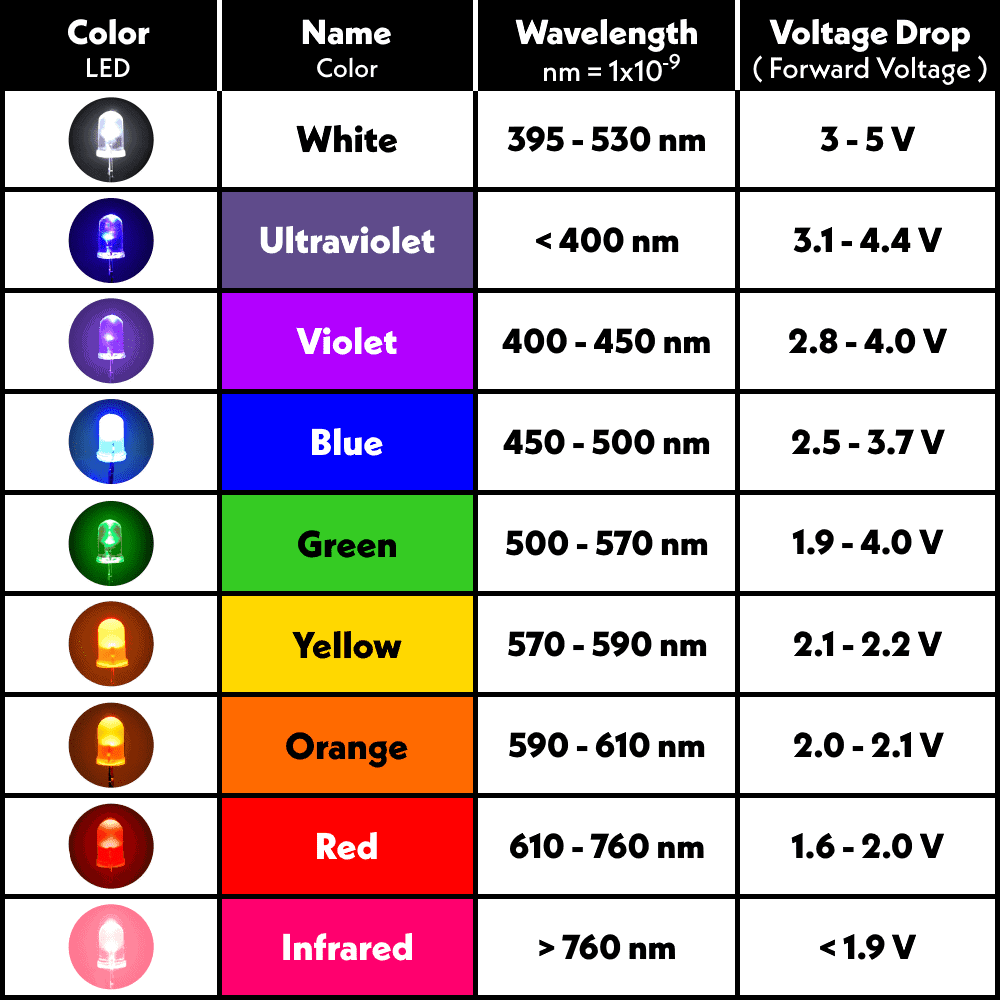
LEDs aren't just more efficient at those voltages, those are literally the difference in voltage between one side of the LED and the other side when in operation - if you feed it less than that the LED will simply not work. (Note that these drop voltages are not actually an absolute value but rather a very steep curve relative to current, but for simplification we can treat those as absolute ON/OFF voltage values).
Also the phosphor doesn't filter light - rather it absorbs light and re-emits it in different wavelengths, the process being such that the emitted light covers a range of wavelengths even if the input light has a single wavelength as is the case for LEDs - so it's not at all light manipulation by filtering and mixing light sources.
That said I went looking at how phosphor is used in LEDs nowadays and judging from this they don't use red LEDs emitters at all nowadays, only blue and UV ones, and then chose a phosphor (which can be any substance, not just Phosphorous) whose emission range is towards the desired light range.
I've corrected my original post.
The phosphorous coating here is serving to reduce the amount of blue light as an absorptive filter. Its just also doing other stuff. Idk if there's a proper term for what its doing in whole, but your explanation is otherwise in line with what I've read.
That's not even close to reality.
Read the material linked or just google it yourself.
your explanation is otherwise in line with what I’ve read.
That’s not even close to reality
That's a bit incoherent.
Fwiw, I did read the article you linked. That's one of the articles I looked at originally.
I'm just saying its innapropriate to say its "not a filter" because the coating is doing more than partially filtering a wavelength of light; Its a categorical error.
The coating's primary engineering function is not a filter, so maybe its frustrating to hear it described as one but it is absolutely incorrect to say its not a filter because one of things its literally doing is filtering out a % of the blue light emitted by the diode.
A phospor absorbs the incoming light and then uses it as power for its own emission process, in a processes called "fluorescence" rather than "filtering". It's a very efficient process because almost all of the light coming in and absorbed by the fluorescent material ends up used to emit light.
A filter just cuts out (literally "filters out") things other than what it's supposed to let through. Filters just block stuff and thus cannot have on their output anything that's not present on their input. Further, filtering can be very inefficient because everything that the filter doesn't let through just ends up as waste heat.
Filtering doesn't make any sense for light emitted by a diode junction because that specific light emission process emits light of a single wavelength - it's a totally different process from incandescence and only emits photons whose energy exactly matches a specific quantum gap in that junction, hence all emitted photons have the exact same wavelength, thus there are no other wavelengths in the light emitted by the diode to filter out - thus if you filter out that specific wavelength, no light at all goes through the filter because there's nothing else there.
Calling a phospor a "filter" is like calling a system with a solar panel connected to a green LED a "filter" - sure, the spectrum of the light coming in is not the same as that of the light going out, but that's pretty much the only way the thing behaves the same as a filter - it does not share any of the other characteristics of a filter.
Anybody with a Physics or Engineering background will react the same as me when somebody describes a fluorescent material in front of a light source as "a filter" because per the scientific and engineering definitions "fluorescence" is not at all the same as "filtering".
Whatever source you learned information about LED lights from, it's really bad and shows no domain expertise, which is probably why you ended up with some things right in your explanations and others horribly wrong. If I was to guess, I would say that you "learned" it from AI, as getting the general stuff mostly right and the domain expertise details incredibly wrong is a common problem of AI.
I was looking at exactly the same pages you were. Try reading those articles (or use ctrl+f) if you want to know where the filter discription is from.
You don't need to concoct a fictional story about where the information came from. Its clear your purpose here isn't to inform anyone at this point. If you've ever talked to an engineer prior to this you would not have this opinion of my colleages.
And the analogy here is so bad. If the solar panel were partially transparent and part of system (the resulting spectra) was dependent on that transparency it would work.
Engineers say its "acting as a filter" because thats a way of analyzing the system. For all and intents and purposes anything can effectively be modeled as a filter in certain design situations has been called a filter. So yes, engineers do talk like this.
Source: used to work in an electronics hardware development lab with electrical, optical, and software engineers.
Mate, I have a Masters in Electronics Engineering and a partial degree in Physics.
I just didn't want to pull the authoritativeness card out, so instead tried to explain things to you from basic principles.
You're either confusing some other application with what I was talking about - which was the emitters used in LED light bulbs, the ones which look yellow when they're switched off, the yellow stuff being the phospor - or you mentally over-generalized something you heard, either to an area were it doesn't apply or missing the required context to make sense.
You keep throwing conjectures out there based on somewhat head scratching assumptions. And you're doing it again. I am not an electrical engineer, but I have worked in the industry long enough to know the electronic definition of filter is not the optical definition and often optical engineers do model things as filters for ease. I write engineering reports for a living. I do the english part of the engineering because they're usually pretty bad at it.
When I said that I am in agreement with everything you said except referring to the phospher as "not a filter" I was fully aware of what the coating was doing. I concurred with that. And you said it was nowhere close to reality. Which is truly incoherent.
What I'm saying you're muddying things by saying its not a filter. This is the sort of thing the electrical and optical engineers would say during meetings and the project managers would get annoyed because they'd both be talking past each other.
So like knowing you're an electrical engineer here isn't surprising. Engineers (and especially electrical engineers in my experience, probably the lead exposure) in general are abysmally bad writers, poor communicators and often overstate their disagreements by being unaware of their audience. Its why I'm called in to clean up their messes.
plus a phosphorus layer on top that smooths those two perfect lightwave color peaks in the wavelength domain into a broader light spectrum
The phosphor absorbs some of the blue and downconverts it to green and red. Some of the blue is let through for us to see. The mixture of R, G and B looks like white to us (but not necessarily to other animals with different cones in their eyes).
2 kinds of light emiting diode (LED) junctions inside - red and blue
I've never seen a red LED die inside a white LED. I've only ever seen blue dies on their own.
Technically UV-pumped white LEDs exist, but they're rare and I've never seen one. They're less efficient and require a third phosphor (to make the blue).
You can remove the yellowish looking phosphors on the LED with a small pick to reveal the blue die underneath. Fun fact: some high-power "red" LEDs are actually blue leds + phosphors, not that it's a particularly good choice but it's a thing: https://halestrom.net/darksleep/blog/018_led_cob_cutting/
i put one of these in a ceiling fan and my roommate started referring to it as The Sun
she's not wrong but i like to be able to easily see the stuff on my desk I'm tinkering with ffs
Overhead lighting makes it so much worse.
Install spotlights up there and point them at the walls - problem fixed
Or just use lamps. And you can move them around at will.
Team lamp here.
Do you just leave the wires dangling from the ceiling? Both. Team both here
I mean the light fixtures are all there we just dont use them unless we're cleaning or trying to find something we dropped. So I guess both
White light is a must for makeup, or any time where you need to see colors accurately. Otherwise give me yellow all the way lol. I love the coziness.
The difference is not as pronounced as in the picture. If you're used to 4000K as neutral white, yellowish white is 3000K, amber-ish white is 2700K. Only below the temperature of fire (cca 1500K) is when blue fully disappears and you get actual orange or red. And pure yellow is not a possible black body (incandescence) spectrum (that is, it does not correspond to any color temperature) so even though you can set an RGB bulb to that, buy monochromatic yellow LEDs or go under a low-pressure sodium vapor lamp, such lighting feels unnatural.
High CRI is what you want. This is the number corresponding with ability see colors accurately.
Or, and hear me out. Get one that you can change. On a gloomy day, during the daytime have it at daylight white. In the evening a nice 2700k.
This was one of the things that got me into Home Assistant. All the bulbs in my house can be controlled and having them transition automatically between daylight white and cozy warm light is kinda magical even after several years.
I have an actual full-spectrum daylight bulb and it’s pretty good. I use it when the days get really short, seems modestly effective. It’s not the typical “warm” lighting, it’s much more actual daylight. I can’t stand those hard white almost blueish light bulbs. Makes things feel industrial and cold. No idea why anyone calls them “daylight”.
can you name the model? am interested in fielding the winter blues away
Sunsy Shine.
Daylight is full-spectrum, not just cool. Flicker-free and high color rendering index. If you can get that in a bulb (bit more expensive than cheap LEDs) it's quite nice indoors.
Daylight spectrum is skewed by time of day from blue shifted to red shifted.
True, but I just mean that daylight has properties that not all LEDs do, which is why some LEDs may seem harsh even if they are the same color temperature as daylight. But a good LED with high CRI and no flicker is nice at various temps.
I just want to be able to slaughter a pig if I need to. Gotta do that under cool whites my guy.
I'm surprised to see pretty much all the comments stating that they prefer the warm lights. It hurts my eyes and feels very awkward to have light coming in through windows into a room with warm lighting, so I mostly use daylight bulbs.
Do warm lighting people just keep the lights off when their curtains are open, or am I alone in this issue?
When my curtains are open, I'm getting ample sunlight and don't need lighting. When it's night time, I don't want light which emulates daylight in my home.
Yes, we only turn the lights on after the sun's color temperature matches our 2700K lights. During the cloudy winter days we spend the entire day in darkness to avoid mismatched temperature.
Sometimes I really want to get adjustable LEDs for winter, but it is hard enough to find warm ones with a high enough CRI. I once ordered and returned about 8 different bulbs which had price points from €2 to €100, before going to Ikea and buying bulbs there.
I am going to be redoing the lighting in a house I just bought. I went down the rabbit hole of learning about all the options. It's hard to find but it is possible to find dimmable, tunable LEDs with a high cri and have matter support so I could use them with Home Assistant. I haven't actually purchased any though so I can't report my experience.
Please share your experience when you get to it! I try to avoid iot stuff though and thought of something simpler like dimmable lights that get warmer when dimmed - like the Ikea ones, but with 2700k as the highest point it does not really work.
I thought that maybe the ideal solution would be to wire DC lightning with relays controlling groups of different temperature LEDs. Maybe glueing LED strips to the ceiling and a translucent film under them to diffuse it a bit? I feel like ordering a giant bin of random LEDs should lead to the best possible CRI.
Also each of the 8 bulbs I ordered had Ra>95 written on the box and they just lie because I can instantly tell that the light is wrong. Bad CRI is so prevalent that friends come to my house and think my lights are incandescent.
I did buy a super expensive dimmable tunable led strip from Yuji LEDs. It was expensive even before the tariff situation, so really bad now probably. But the LED was top notch. I followed a guide someone had posted to reddit to make a SAD lamp, and used ESP Home to make it so it made a sunrise effect starting all the way as far yellow as it went and ending at the brightest point. It is just a strip with 2 different temperature LEDs on it and it combines them with directions from ESPHome (oh I had to get a controller for the ESPHome connection. It's just a "dumb" strip that you have to control the voltage to change).
Since programming it was rough for me, I had some fun experiences where it would just randomly go from super dim to full bright while I was sleeping and hoping for a gentle wake up from a nap. My half asleep brain really thought someone had opened the curtain to the sunny outside. I started thinking of my project as "sunlight in a can".
Anyways I happily shipped that expensive project off to my brother who suffers from SAD and he never used it even once.
I'm a mixed light person and I prefer to keep my lights off when the windows are open. Modern bright lights tend to hurt my eyes, especially as my wife has a nasty habit of standing right next to one when talking to me.
Am I the only one who doesn’t replace light bulbs based on color temperature? I usually keep around whatever is already in the rental unit/whatever spares the last tenants left around, because I usually move every year anyway.
In the rare chance I get a choice, I usually choose daylight though.
I definitely have four different temperatures in my tiny studio. I imagine that would set a sort of person on edge.
I don't go out of my way to replace light bulbs with all these smartbulbs that have day/night cycles.
That being said, if they go out, I normally pick a smartbulb because the price difference isn't that much for all it offers in return.
I've been working remotely from 3 to 10 PM and the gradual change in color temperature both from the smartbulb and my screen really helps me take it easy as my shift is ending.
Most people I know who do care.
Change all of the bulbs when they move in. Throw the old bulbs in a box.
Put the old bulbs back when you move out.
Use the new bulbs at the next apartment.
Some of them also have smart bulbs and those are way too expensive to give away.
We don't know Celsius. How do you expect us to know Kelvin?
10800 to 18000°Ra for the Americans
Oh, thanks! That's... totally a comprehensible metric for humans that have been inside several suns.
whole house is setup with daylight bulbs except the dining hall. it has warm lights. I hate it. it's like I'm eating in the dark.
There are ones that are adjustable. I don't have to choose one or the other.
This is the kind of constructive, rational and informed opinion that flies in the very face of the concept of internet forums and everything for which they stand. If you won't rabidly advocate for an extreme position on an insignificant issue with an irrationally vitriolic diatribe, what are you even doing here? This is Lemmy Shitpost. Please observe the appropriate decorum, and comment accordingly. So fuck you and the ISP you rode in on. You can have my daylight bulbs when you pry them from my cold, dead fingers.
ha! imagine shilling for light bulbs that only has one color! couldn't be me!
(am i doing it right?)
Excellent! You've got it up there. Now break it off [30 Rock reference].
Thank you for the phrase "and the ISP you rode in on" which I will be shamelessly stealing from you
I feel honored.
But you do.
You just choose every minute of every day instead of each time when you run out to Home Depot so you can finish whatever you were doing.
Everybody is entitled to their own opinion, but just be aware that your opinion is wrong if you want the colourtemperature to be above 4300K.
Warm white 2700-3000k is fine for bedrooms Soft white 3500k is better for awake spaces that aren't task spaces White/Daylight 5000k+ is for getting things done, I use them in the garage, the basement, and for some of the kitchen lights
I used to hate integrated LED fixtures, but I put in under-cabinet lighting that can switch color temp so that is nice because I can set it to daylight during meal prep and warm during eating.
I use them (5000k+) where I want my cornea pierced by the 460nm spike
Preach
I love my warm bulbs!
...wait...
My sisters can't decide which ones she wants to use, so every room has a different lighting hue. Most rooms have different bulbs for each lamp, so hot and cold are right next to eachothert
I have a somewhat basic home automation, and my lights are programmed to be cooler during daylight hours (where necessary, desk lamp, corridor, etc), and they become warmer at night. The reverse happens early morning in winter, where I wake up while still dark.
I was gonna flame you but the reality is both have their place. Sunlight bulbs in hallways and bathrooms looks awful. You can’t see shit and they cast long shadows which makes visibility worse. Daylight bulbs are great for those areas.
That said daylight bulbs are too harsh in the living areas so I understand both sides.
The wavelength has negligible effect on shadow geometry (yes, there is chromatic aberration, refraction, interference but those are very minor in normal lighting, you need special prisms, tiny slits and perhaps lasers to really observe them). What do you even mean?
Also, sunlight (6000K) and daylight (6500K) is pretty much the same color because direct sunlight is >90 % of daylight (the rest is the blue sky and white clouds).
Doesnt warm light make you eepy? Seems like a good reason not to use it in rooms where you wanna be productive.
I don’t have this problem. Cold light puts me on edge though.
At night, yes, red/amber lights make your melatonin go brrr
In my room its always night if i turn the lights off :D
Gimme 5k temperature light bulbs
I love my daylight bulbs
This scale feels wrong. 4000K is neutral white and should have no hue. Of course, that depends subjectively on what the light around is. 6000K should only be in the center if you're outside a lot. And the difference between 6000K and 10000K is greatly exaggerated. Not even the visible portion of "infinite" Kelvin is that blue if 6000K is calibrated to white.

I found the light scale for lamps to be a bit weird and inconsistent between brands. I think they refer to sky color, not actual Kelvin color.

404: Image not found
So you're saying the people who prefer 4k and below need to touch grass more? I concur
We accidentally installed a white light bulb in the hallway outside my bedroom. It made me feel so pissed off and on edge every time my door was open and someone turned that light on.
Once we swapped it to a warm bulb I was much more chill.
I do keep a tunable light bulb in a task lamp, but the rest of the lighting in the house is warm.
Blue lights suck. Yellow lights suck. White lights (6000K full-spectrum) are good, but more expensive and harder to find.
Only warm white 2700k. Any other colour is for sociopaths.
for a kitchen, especially the lights over the counter, being 5-6k, is wonderful to cook.
I disagree. A very high CRI warm white is just as good as daylight in the kitchen. And better way less ugly
Warm light feels so ...indoors... to me, I don't quite know how to put it, but I don't like it. It makes me feel like I'm in a 90s home. White light feels natural and nice.
I have full spectrum bulbs in my office to help stave off SAD
Daylight bulbs only belong in the bathroom. That's the only place I want to see things that bright. Also, if there's anyplace you want to feel sterile and hospital like, wouldn't it be the bathroom?
I want going to the bathroom to feel like the scene in Fear & Loathing where there's a dude getting high off LSD by licking it off another dude's sleeves.
the kitchen too
A theory, it's you life somewhere warm you want white light. If you life somewhere cold you want warm orange light
Maybe it's the lack of sunlight and I look like a Lich under white light.
Matches my experience. Idk why.
It does. Mexicans seem to love their cold white lights
The only people I know in Florida who have warm lights are snow birds.
Everyone else uses cold white indoors but it's sunny af outside, and every house has lots of windows.
Warm light looks weird when it's sunny outside.
Rooms you work in: bright cold light.
Rooms you relax in: low warm light.
Rooms you game in: dark+back light behind the monitor for eye relief.
Rooms you femboy in: the purpliest purple that ever purpled.
For the people saying “5kK+ in the office, 3kK- in the bedroom” what do you use in your kitchen? In your bathroom?
Adjustable temperature bulbs and local control/automation
The correct answer.
4k
I want my home to have full range color equivalent to open windows. But I prefer my lights to change color with the sun so as not to mess with my circadian rhythm. Incandescent color bulbs just remind me of being a kid visiting the elderly. I'm mostly a "open the blinds instead of turning on a light" purist during the day.
Also, emberlight for bedtime, and simulated sunrise as an alarm. Though my wife hates both of those as I have to wake up earlier than her.
I love my smart lights for this. I can change them at my whim. By default they're brighter and whiter during the day, slowly moving dimmer and yellow after sunset. Or I can make them whatever other color but I do that pretty rarely.
It's also fully offline and no WiFi used. But it seems almost everything you see in the stores are WiFi bulbs you have to get an app for, where one day they might go bankrupt and suddenly your lights dont work. Or the internet goes out. Yuck.
You can't just sell me on your smart lights and not name the brand/model
Brand/model isn't important.
You'll need a HomeAsstant controller. You can buy one premade or you can look up tutorials and make your own with a raspberry pi or old laptop or PC. Then you'll need a ZigBee controller, this is a radio that will talk to your smart lights and other accessories.
You then get ZigBee compatible lights. Phillips Hue is the top of the line but so stupidily expensive I'd never recommend it. Innr makes good ones at half the cost. ThirdReality makes decent ones too for even cheaper.
You'll probably also want some ZigBee switches to have physical controls for your lights instead of just by phone. They make models that replace your actual light switches. Or, if you rent like me and can't modify that, you can get battery powered ones that stick on the wall. Battery life is like a year or more so not too bad.
That'll do it. You can also use HomeAssistant now that you've got it. It's a home automation software that's open source and locally controlled. You can hook up much more than your lights. Smart plugs, your TV, 3D printer, fans, cameras, tons of sensors, your thermostat, robovac, etc. Then make automations that connect them. For example my living room ZigBee switch, one press up toggles the main lights. Double press for the lamp. Hold down and it turns off all lights and the TV. Some lights like my closet light are controlled by a door sensor instead of a switch, so they come on automatically. Some people prefer motion sensors so all lights are automatic. Turn off stuff automatically when you leave, etc.

There's a solution here you're not seeing... RGB lights. Setting the hue on the fly to match what I need has been pretty neat. Pure white for work, natural white for relaxing, red only for venting in the summer since insects can't see it, green and blue strobe for dance nights, the only limit is your imagination. Living in the future has at least a few perks to go with all the downsides.
Though IME, the light quality of a real white LED is better than the mix of an RGB led. Also interesting: the cooler the LED is the higher the quality of the light.
Most "RGB" lights also have 2 white ones of different CCT for a more natural white.
Yes, and blending in between, including RGB, can enhance the quality of light as well to estimate a natural light source.
Not doubting you, but how do you define the quality of the light?
There's various metrics, like CQS, CRI or newer versions of it.
It's basically about how close the wavelength spectrum is compared to a black-body radiator given a color temperature (e.g. an incandescent lamp or the sun).
Most of them are so expensive, though.
No, Philips, I am not spending $50 on a single bulb, that is madness.
wait insects can't see red? does that extend to spiders? i keep all my windows and doors closed all the time even when its sweating hot because i'm terrified of being invaded by insects and spiders
You guys use lightbulbs?
Whale oil gang unite!
This is the kind of comment that motivates me to read the entire section.
I use one in my houseplants. Actual house plants - there's a dispensary a block away from me for the rare times I feel like getting high.
Is kinda sad you have to specify.
Nah, I just wanted to cut off the tired old jokes.
I have a light fixture with adjustable light temperature. Colder light helps me to wake up faster.
FYI, CRI is more important for image forming cells. CCT that includes a specific blue (440-495nm) may improve waking.
3000K or GTFO
Warm in living room, bedroom, and hallway.
Cold everywhere else. So, bathroom, kitchen, garage, and closet.
Warm where you want cozy. Cold where you want honesty.
lack of honesty in the bedroom sounds bad, yet the opposite also sounds terrible
Just buy every K value in an even distribution to get all the benefits
Don't forget to take your Ketamine first
thats why I eat Special K every morning, so I can have a heavenly glow right out of my rectum
Warm lights in bedroom lamps daylight in ceiling lights. Though it always looks like my bedroom is on fire when I look down a dark hallway towards it.
As someone with shit vision, I also want my house lit up like a hospital.
I feel... seen? or maybe not seen.
If I need to read some tiny-ass model number printed in silver on a grey background off the back of a gadget, I need me some 6000K and 1000+ lumens, not some muddy-warm-white <800.
Specifically updated my house to only use daylight bulbs everywhere.
I use lights to see. I don't need stupid orange lights
You need both. Daylight during the day, warmer (<2700K) in the evening.
laughs in adaptive lighting
4000k does a good job of being able to see vs not overwhelming your brain.
No. 5k minimum.
White lamps are only for looking for things we lost while operating under warm lamps. Also for when doing more than 1 thing in the kitchen.
Not every lightbulb is intended for living rooms. Some are designed for workplaces...
Por que los dos?
For my bedroom I have the ceiling light with two 13W(100W equiv.) for when I need the light and a 6W(6W equiv.) GE 'vintage' LED in a nightstand lamp for the rest of the time.
Why not just buy a dimmer switch?
I already have one, but not for color tone. The 'vintage' is supposed to simulate candlelight, while daylight simulates the sun.
I don't mind a daylight bulb for overhead lights, but they have to be supplemented with warmer lights elsewhere around the room
2700k ambient indirect, and 4000k direct overhead with 4 times the illumination when we need to see something. One or the other, the ambient ones are synced to power off automatically
just get lights that are adjustable via open source smarthome solutions
cooler light is more popular in places where it gets hot: Middle East, South East Asia countries prefer using cooler tones because it gives feeling of freshness and cooleness
Feel like this is a very US thing. Here in Brazil we just don't use the white light if we can't. Same thing with overhead lighting, we love it here but seems like the US guys just don't go for it
3500 to 5k. My brain hates all others.
Feel like youre playing both sides
3500k is warm 5000k is daylight
Nobody is buying higher K for their home
Your piss colored light feels like I am living in the 80s and we haven't invented halogen bulb yet.
Imagine having a bulb that you can't change the colour of at will.
Imagine having a bulb that doesn't require an account, that "just works"
Zigbee or Thread does this. Example (now not that I use this one): https://us.aqara.com/products/led-bulb-t2-gu10
I think this is the bulb I bought. I want to redo the lighting in my house and I was considering putting these tiny bulbs in the ceiling. It's pretty bright though, so I was worried it would be annoying to look up at. You are using it now, does that seem accurate?
Sorry, typo - I do not use these lol
Also anything that runs Tasmota or ESPHome.
Imagine having both
ZigBee baybeee. Fully local, offline, forever. Nobody can stop them working.
Does Zigbee have the same issues that other smart bulbs do with loss of Internet connection, and voltage drops/brown outs/black outs?
They all turn on the full brightness for "safety"
4 AM my voltage drops from 120 to 110 - not even noticable to a human being, and every light in my home turns on. Happened with Hue more than a few times and I got rid of every single bulb. I ain't got sleep to lose.
Well zigbee has nothing to do with internet, the bulb just communicates locally to your hub. You can then connect that to your own local Homeassistant for example. What the bulb does with viltage drops is on the manufacturer I guess
loss of Internet connection
No. They aren't controlled via Internet (they can be, but it's not vital). You have Zigbee switches that control them through radio. Or you control them with your Zigbee controller which is hooked up to your network, but works locally so even if your Internet is down it works on LAN.
voltage drops/brown outs/black outs ... They all turn on the full brightness for "safety"
Depends on the brand. Some do this. Most do out of the box but you can go into the settings of your Zigbee controller and disable that. Some don't let you configure it. I'd read reviews first.
Also Phillips Hue is actually a Zigbee bulb, which can be used with non-Hue Zigbee controllers. If I'm reading right this setting can be configured. https://community.hueessentials.com/t/how-to-set-up-power-on-behaviour-for-my-lights/720
Zigbee is a communication protocol. The way your bulb reacts to a powercycle is up to a bulb. Mine remember last settings for example.
Yeah, I bet those grapes are sour af and require account to actually eat