Just saying
3mon 29d ago by lemmy.world/u/JimmyMemes in memes
Why are utilities privatized?
Our energy provider increased our rates, then reported record breaking profits the next year. :(
(US)
Nah, let's privatize all the services you need to have a functional home. That way the companies can extract maximum value from the customers.
Brilliant.
Won't anyone think of the shareholders!?
For real though, I had a job where the management team tried to motivate us by setting "shareholder expectations" or some such nonsense. Obviously this didn't work. Also the company was small enough that pretty much everyone working there personally knew all the shareholders.... Because they also ran the business. They were the managers.
The balls it must take to be a shareholder, and to be known as a shareholder then talk about shareholder expectations like those are for a different set of people that isn't just you... Gotta be massive...
And those who are/want to go off grid:
Straight to jail.
That's so typical.
Source: also US
Same here and I just found out the majority shareholder of my electric company is black rock. And the same year our rates went up the highest is the same year the CEOs made a bunch of bonuses.
Grid should be public and production should be privatised.
Because as a general rule governments aren't efficient running services and that's fine for a while but long term that means infrastructure isn't properly maintained which leads to service malfunction, which leads to privatization because someone else can do it better and competence appears because someone else things can do it better than the other or to collapse because things don't work anymore.
Source: I am Spanish, a lot of companies were privatized after the dictatorship because they weren't efficient and infrastructure was falling apart. Privatizing allowed competence which meant someone had to invest in infrastructure to be better than the other. Problem is now governments are confabulated with some of those companies to create oligopolies. For example my city has it's own water/trash company (half private half public) so no one is allowed to bid against them; you can imagine how that is going (from paying 35€ every 3 months to paying 65€ in one year), price goes up, no one can't complain or hire a cheaper one, while with cable and phone companies since Telefonica was privatized other companies popped out and you can have cheaper and better internet/phone/tv.
Portugal decided to privatize their electricity and outsource it to China.
So government can spend the investment on schools and hospitals instead. (In the civilised world, obviously not America)
This has little to do with where you're from. It's just neoliberal rhetoric. Having a public energy sector would be beneficial in the long run and would reduce what we have to pay for it. Right now the earnings are privatized in most places.
My area privatized the publicly owned electricity provider and since prices started going up they then had to implement rebates to bring bills down a bit. Effectively a roundabout way to move public funds from paying for the actual infrastructure into subsidizing corporate profits instead
Exactly. Privatize the profits and socialize the costs. What a brilliant system. Unfortunately it benefits only a small handful while everyone else picks up the tab.
How's Venezuela's infrastructure after two decades of socialism?
Ah, whataboutism. How cunning. I'm done with you.
It's called evidence lol
Having a public energy sector would be beneficial in the long run and would reduce what we have to pay for it.
A well-run public energy sector, certainly. Idk what we'd end up with given the most recent rotation of people in charge.
The state does have an incentive to keep consumer costs low in a way the private sector does not. But state officials also traditionally do a bad job of maintaining and expanding utilities to match consumer demand.
The end result tends to be low end user prices at the expense of reliable distribution and surplus volume.
It's not rhetoric. It's economics 101. Opportunity cost.
A mixture of private and public is best. The Nordics show market socialism done well.
Edit. A mixture allows more spend on more things. Govts can't sell infinite debt
Thanks professor. Do you know private debt and state debt are hardly the same? Have you considered the opportunity cost of not having public energy, therefore losing potential "earnings" to private investors? Or are you telling me next that rich people are a necessity as well? Is trickle-down part of this course or do I have to wait for 201?
What a lot of shite you write. Where does the state debt come from genius?
What opportunity?
Opportunity cost. If you spend money on one thing, it means you can't spend it on something else
Of course. So providing profits to utility “owners” is money stolen from the people that could be more productively used literally anywhere else.
The profits are in return for investment that the government couldn't otherwise do. What's the alternative?
Also, the private company employs people, they pay income tax.
Nah. They would be 50-60% cheaper if;
- They required the choice between two different administrators.
- They were ran as non profit (private equity is ruining utilities currently).
They required the choice between two different administrators.
Most US states have this. They mandate you can choose your energy provider.
Lol my state is one! Except it's only offered to commercial customers. Both electric and gas offer no choice for residential.
L-o-fucking-l
Edit: seems a lot of states don't offer electric choice for residential.
National Grid is still cheapest for me. Womp womp.
Wish mine was one.
That's why republicans hate it.
It sounds evil and simplistic, and it is, but these are evil and simplistic people we're talking about.
"Oh, new innovations in technology can help consumers pay less to power their homes? We can't have that! It would affect the profits of my friends Oil Baron and Coal Baron."
Not really, I live in a country where green energy keeps going up but so does the electricity prices. You have to believe in Santa if you think the savings ever reach the consumer.
That's called artificially inflated prices
Of course it's artificial, but knowing that doesn't change the reality for the people who have to pay the bills.
Competition and choice lowers prices. Government "investment" usually raise prices.
Correct. The system is supposed to encourage investment in efficient energy production so that it can sell energy at the level of the most expensive energy that is brought to market. Resources for the Future explains it like this:
The capacity market auction works as follows: generators set their bid price at an amount equal to the cost of keeping their plant available to operate if needed. Similar to the energy market, these bids are arranged from lowest to highest. Once the bids reach the required quantity that all the retailers collectively must acquire to meet expected peak demand plus a reserve margin, the market “clears”, or supply meets demand. At this point, generators that “cleared” the market, or were chosen to provide capacity, all receive the same clearing price which is determined by the bid price of the last generator used to meet demand.
Merit order used to be a perfectly good and fair system. But renewable tech throws a monkey wrench into that system. Also shifts cost to be less demand dependent.
I live in Minnesota and the majority of the power produced in my area is Wind Turbines that are all pushing 5-10 years of use. The company operating them is well past the break even point and pure profit for every watt they get now but the price of energy is higher than ever.
Public companies or private?
Solar is so cheap now, that some people can just build their own solar and battery setup themselves.
Yes, but at scale it is significantly cheaper to build larger and distribute it. It also means people don't have to over invest in their own set up just to cover their peak usage. There is also a large amount of up front capital required to build with usually years before you get back what was invested. Its also almost impossible for renters or apartment buildings to do it themselves.
Yes I know all of that, I'm saying that solar is so much cheaper than coal power that even private individuals can buy it, so we shouldn't be wasting money on new coal plants or gas plants.
Same for nuclear. U.S.-Americans are brainwashed on this topic.
First, they pay with their tax dollars for the subsidies that the private for-profit companies use to build the nuclear reactors. After that, they pay again, because the private company charges them extra on the electricity bill for the electricity generated by the very same nuclear reactor so that they can make even more profit.
It's so stupid and they're brainwashed to defend it to the teeth. They also always try to deflect from the fact that renewables are cheaper than nuclear and can be owned by them instead of a for-profit company, by pretending that everyone who opposes nuclear energy must be in favour of coal and gas. It's mind boggling to watch.
Nuclear power is really cool, but my biggest problem with building new reactors isn't even the money issues you pointed out, it's the fact that I live in the US and I don't trust any regulatory agency to build a new nuclear power plant correctly/safely.
Solar panels and wind turbines are monumentally cheaper AND they don't potentially cause ten thousand year contamination problems.
Nuclear power is really cool Why though? It's insanely inefficient in terms of costs and really, really dangerous if something goes seriously wrong.
If you install a solar panels with a regulator, it's running in less than 2 weeks and goes for decades with very little maintenance that almost every idiot can do. Plus, you don't have to pay for a company's profit while getting that energy. Now THAT is cool in my opinion.
Will they really though?
Have you looked at your power bill and seen how much of the bill is not power consumption?
We have also seen multiple times where the wholesale price of electricity is below zero yet consumers are still paying for power during those times.
It's almost like utilities are a natural monopoly that do not fit within the economic ideology of "free market" capitalism.......
People seem to be forgetting that unless green power or nuclear power are socialized projects they would by default have to find a way to capitalize their products by some means. Whether it would be by capitalization via consumption rates, maintenance fees, or even subscription, a private business would have to be able to make ever increasing profits.
Yep. Even the most liberal of thinkers agree that natural monopolies shouldn't be for profit.
Have you looked at your power bill and seen how much of the bill is not power consumption?
Not in US, but after our power went private it literally doubled. The nice lady tried to convince me the "extra" charges were always there but not itemized, but while holding the previous bill with the same (within a few points) my usage was the same but the "fees" were as much as my power usage
Did she open the flaps on her shirt and start rubbing her nipples?
Now that you mention it, I think I did hear that velcro ripping noise
In the long run, yes. In the short term, the grid upgrades are quite expensive.
One form of government investment is subsidized panels for homes so you rely on utilities less.
Would also be cheaper if the government owned the energy infrastructure and ran at cost.
but that's communism!!!!
Ikr? What else is it? A good idea that would benefit people broadly instead of specific people narrowly?
You want elected officials to be competent and follow the will of those whom they represent?
that's woke nonsense
Pfft caring about anything but myself, what a suckers game.
Empathy? what woke bs is that, as a true Jesus loving Christian I hate my neighbors
China does subsidize their electricity, and are self declared communists. It seems like if it goes to corporations it would be more of a Corporatocracy however.
How would it be cheaper?
How is it so expensive?
That's not an answer. In my city for example, the water and trash service are public and price duplicated from 2024, water pipes, sanitation and all that is public infrastructure maintained by the city, the only thing private in this whole thing may be the trash trucks.
Energy is also heavily subsidized and we still have to pay a lot.
In my experience government doesn't make utilities cheaper.
If it was private, you would pay more for the same service, because the private company has all the same costs as now, but also needs to make a profit. So if you keep it public, it will cost less.
Not necessarily, it could also be better run, more efficient with less employees.
For example maybe instead of 4 sets of at least 2 trash containers around my street there would only be 2 or 1 with all the pertinent colors (the company does more stuff than water)
But I guess this is the bad side of living in a country with more public employees than private.
That would be a reduction in the service quality, which is the other thing that always happens when utility services are privatised. So you get to pay more money for less service. The company has no incentive to provide a good service, because what else are you going to do?
The government has no incentive to provide a good service because what are you going to do? Stop paying?
You can not re-elect the ppl to decide who runs it...
No I can't when the people voting just say "let's the government do it" without thinking about why or what would that improve. I can vote against the current gov, I can try to convince people or make them think but as you proved in a previous reply they will just ignore it.
No you can't personally decide who runs anything, in either case. But you get a vote when it's a government, you get nothing when it's private.
You vote with your wallets, it's has a bigger impact on how companies proceed.
I can't fight the local company because competition isn't allowed.
Spending money isn't voting.
Or the quicker way: the government nationalises all power companies, and sold electricity for cheap... Because it's necessary.... For society...
Both. Both is good.
Where I live in Scotland about 73% of electricity generated come from renewables (mostly wind and hydro). I'm hugely in favour of this, but the bills keep rising.
I firmly believe the utility companies should be nationalised. I'm not against capitalism per se, but the current setup is a racket.
Water is essential to living.
Electricity is mostly essential.
Why these two utilities are privately owned is beyond me.
To pay dividends to shareholders whilst you let the utility degrade to the point where the government steps in to bail you out anyway. Perfect investment.
I really should have started a monopoly, that is 0 risk 100% reward. I mean just take the money from the government, give myself a huge bonus, and then when there is no infrastructure upgrades done, say whoops, its too expensive, get more money from the government, rinse and repeat!
If the state of the Scottish energy grid is comparable to mainland Europe, then the prices go up due to increasing cost of infrastructure.
Renewables are a lot cheaper per kWh, but require a substantialy higher up front cost in infrastructure due to their decentralized nature.
Before renewables, the electricity only ever flowed in one direction, from the power plant down to the consumers. A few centralised main powerlines could deliver most of that.
With the increase in renewables that suddenly isn't true anymore. Smal villages often are net positive, we've reached a point where even the medium voltage grid of entire regions is net positiv and the energy has to be transported somewhere else, sometimes even outside the country.
All this requires substantially more powerlines (or at least thicker ones, so still new cables). But more importantly, devices to measure the current load of the grid at all times and modernized equipment that can remotely be operated to respond to variing load.
Not to say that we should stop building renewables. All this infrastructure will be needed eventually eather way, but at least in the short term, investments will be needed regardless.
Also the 'price cap' in the UK mainly just guarantees a minimum percentage profit added on top of what is otherwise a bunch of assumptions largely provided by the energy companies.
Then some how their costs almost always come in under the assumed numbers increasing their profit further, they don't need to innovate cos their money is guaranteed.
Also the profit percentage added went up recently, because...
Wind power is paid for if it is used or not.
It could be a lot cheaper up in Scotland where it is often wasted. If it's cheaper up there more industry will move up there and use more of that cheap electricity and it will mean less is wasted.
But this would benefit Scotland at the expense of England so it's not going to happen. As such electrical prices are same around country which keeps jobs down south and electricity expensive.
Public necessaries like energy, water, public transport etc should never have been handed over to companies to begin with in my opinion.
Yeah honestly even if we were at 100% renewables, the price has been set and people are used to it now. No company is going to voluntarily start discounting unless more competition enters the market to start a price war. So far most of the energy "competition" has gone bust.
You know why right?
The grid is constraint and because of this it makes prices really high where the congestion is. Now the logical thing is to allow a different price where there is free energy like in Scotland verse where it is constraint.
But! The issue is where it is constraint and that's south east England. And as everyone in the country knows no one gets anything in the UK unless south east England has more of it for less.
So higher prices in SE England is not going to happen. If it was the other way around I'm certain the government would say fuck the Scots they should have more wind power if they wanted cheap electricity.
Government should be for the people not for the corporations
In many cities in America, private companies threaten cities demanding that they get paid to expand, or else they'll leave.
Comcast demanded they get city investments to expand wifi to more of the city and even promised free wifi to public places. And after millions of city dollars given, they said, "nevermind".
But your not thinking of the poor poor oil execs whom won't get their return on their bribe invenstment made to their super PAC.
Super PACs are so 2012. In 2024 SCOTUS ruled that officials are allowed to accept "gratuities" so long as they don't directly say it's a bribe.
Unless it's for the President. Then they can just say it's a bribe.
I forgot about those rulings. This SCOTUS is really set to mess up a lot in the coming decades. Hopefully, it can be reigned sooner rather than later
Hopefully, it can be reigned sooner rather than later
Is that a regional way to say guillotined?
It should be but here we are.
How do you want them to be for the people and not for corporations if you want them to subsidize an industry? At the end of the day that will be paid to corporations, and you are giving corporations more incentive to get into your congressperson's office to help them figure out how to divide it up. Why would you want more cash exchanged between them and more face time between them? Bad idea if you want corporations out of politics.
More money for [industry x] literally means the government working for some corporations. Doesn't matter what industry x is.
Yes but how would the fascists get kickbacks and bribes then? That's a big chunk of their income. Won't someone think of the oligarchy???
Clearly this sub haven't seen this video from Technology Connections. It breaks it all down for you step by step why the statement is true.
Its still crazy how great solar can be when doing the maths based off his states solar farms. Imagine how great the numbers would be if the sunny parts of the world did solar too
I'm not gonna watch the full hour and a half, but I skimmed through to make sure his message was at least mostly consistent. This guy is talking about renewable energy for cars and vaguely extrapolates that to all energy requirements.
Doing a quick Google search came up with 2.2-5.2 trillion watt-hours as the amount of energy needed if all US vehicles were electric. Currently the US generates ~11 trillion watt-hours per day so this would increase that amount 20-50%. In this video the guy mentioned a 27 megawatt solar farm (130-150 MWh/day), but a large coal plant generates 15-24k MWh/day (500-1000 MW instantaneous).
The US currently has ~12.5k utility scale electric power plants, to replace those with solar and switch all cars to electric you would need ~2-2.5 million solar farms the size represented in the video.
The industry standard is that each megawatt a solar farm is rated takes 5-10 acres. For nuclear that value is ~0.8 acres/megawatt and for coal it's ~0.64 acres/megawatt. While large power plants generate ~500-1000 MW they vary in size dramatically so the actual average is closer to 50 MW per plant. By that math, the current total land for existing plants should be ~400,000 acres but the equivalent if we switched to 100% solar power would be 270-675 million acres of land.
I'm not saying that renewables are bad or that we shouldn't pursue them, I'm also not arguing that we should all hold on to gas burning cars, but there is not compelling enough evidence that switching to 100% renewable energy would be cheaper.
EDIT: The estimates here don't include things like the coal mines included in them but it also doesn't take into account the production of panels, batteries, or the component materials in either of them such as lithium mines. I think solar probably wins out when comparing just that side, but their land usage alone likely tips things.
Okay, so I've double-checked all the most important numbers you've used. One thing I've noticed is that Alec compared the land-use of ethanol and solar power, but our fuel is only 10% ethanol. Even then though that doesn't explain the whole number you got to.
By that math, the current total land for existing plants should be ~400,000 acres but the equivalent if we switched to 100% solar power would be 270-675 million acres of land.
With 270 million acres, and 1mW for every 10 acres, that's 27 million mW (648 trillion Wh a day). Far more than what you say is needed for all cars to be electric. At some point you must have swapped to the goal of meeting America's entire electricity demand with solar. Even then though ...
America consumes 25,000tWh of energy per year (about 7Twh per day, or 3Tw). 27 million mW is 27tW. Even with 10 acres per mW, we'd only require about 30 million acres to meet the entire country's energy with solar (which happens to be exactly the same as the amount of land we spend on ethanol).
You should really double-check your math.
EDIT: 30-35 million acres is still correct, but my working is wrong. I made two mistakes that cancel each-other out. See https://aussie.zone/post/29798627/21519669
EDIT: I basically skipped over your 3rd and 4th paragraph, but what is that nonsense math your doing? I didn't even bother trying to comprehend it because it was so nonsensical, but what in the actual hell were you trying to do there.
Okay, so I’ve double-checked all the most important numbers you’ve used. One thing I’ve noticed is that Alec compared the land-use of ethanol and solar power, but our fuel is only 10% ethanol. Even then though that doesn’t explain the whole number you got to.
As I said in my post, this guy is talking about fuel for cars, not the entire power usage
With 270 million acres, and 1mW for every 10 acres, that’s 27 million mW (648 trillion Wh a day). Far more than what you say is needed for all cars to be electric
I basically skipped over your 3rd and 4th paragraph
That is literally what I said in paragraph 3 "The US currently has ~12.5k utility scale electric power plants, to replace those with solar and switch all cars to electric you would need ~2-2.5 million solar farms the size represented in the video."
America consumes 25,000tWh of energy per year (about 7Twh per day)
My research said the US produces 11 trillion Wh per day and said that if all US vehicles were electric it would require 2.2-5.5 trillion Wh more per day. Looking at consumption is important, but looking at production is more accurate. Some electricity is sold or wasted, but that's to ensure demand is met when the grid sees a spike in usage.
27 million mW (648 trillion Wh a day)
You must have skipped paragraph 2 as well. A 27 MW solar plant is rated as such because that is the maximum instantaneous power outout, but most places only have ~16 hours of sunlight and won't be running at 27 MW for all 16 hours. As such a 27 MW solar farm will only make ~130-150 MWh/day.
Okay, lets redo the math with your new numbers.
- 11TWh (+6TWh) per day production.
- Average of 1/5 of maximum output (27MW * 24 = 648 MWh per day. 648 / 130 = factor of 5).
- 1 MW per 10 acres of solar power (It's 27MW on 120 acres at the DePue site)
- 270-675 million acres.
Now lets get all the units into average MW
- 700,000MW needed (17TWh per day = 0.7 TW average)
- 0.02MW per acre. (1MW / 10 / 5 = 0.02MW average)
That means 35 million acres. Now I'm going to post this immediately before double-checking my math previous maths, because this number should be about 10 times higher than my previous answer based on the numbers you've given me. Did I overestimate the land required in my first reply?
EDIT: Found my problem.
America consumes 25,000tWh of energy per year (about 7TWh per day, or 3TW)
7TWh per day is not 3TW, it's 0.3TW.
I worked the problem a different way, first of all I evaluated both ends of both spectrum (2.2-5.2 trillion for adding cars to get the number of solar farms needed and 5-10 acres per MW rating, this is how I built my range). I believe I have an error in the number of solar farms needed (2-2.5 million farms in my original post), but I have not been able to replicate my math that got me the error. I made this post in sections and at some point realized that 27 MW doesn't make 648 MWh, but I might have missed switching it out somewhere to get the math I got.
Rerunning the math I took the amount produced and needed (~17 trillion Wh) and divided it by the production for one 27 MW site (150 MWh) to get the number of plants and then multiplied that by 27x10.
17x1012 / 150x106 x 27 x 10 = 30,600,000 or 30.6 million acres.
All that aside we are still talking about 75x more land usage before we talk about time zones, day night cycles, distribution of the panels, etc. The big counterpoint that people seem to have is batteries, but we already use batteries and the amount more we would need to provide 24 hour coverage with just solar would be astonishing.
Market forces push business decisions, the only way solar power would be cheaper for the consumer is if it was also cheaper for the business. If solar was realistically cheaper then power production facilities then corporations would be switching to it and probably not drop our end costs because that would just be extra profit. Whether it's a lack of battery capability, unattainable capital costs, lack of reliability, or something else at play, solar power would not be cheaper for the end user or else corporations would be switching to it.
EDIT: Good work on your math.
As per the video, 30 million acres of land is used to grow ethanol that is mixed into petrol. We could replace every car in the country with electric, and power our entire electricity grid with solar power, with that land. Solar farms are less destructive to the land than corn farming so even if replacing all that farmland with solar panels only provided enough power for electric cars, it would still be a positive in terms of land use.
75x land use is as compared only to power-plants. If I go swimming tomorrow I've 999999x'd my shark attack risk. And as a share of America it's only 1-2% of the total area of the United States (to power the entire country) and can replace all the corn ethanol crops to a net environmental benefit.
As for batteries, they are recyclable (as the video goes into). They do add to the cost of renewables but not so much that they cancel out having to constantly mine coal and set it on fire to never be used again. There are wind turbines which even out the duck curve, but in this thought experiment the entire country is going solar powered only.
As for why business leaders aren't investing in renewables, I need to make an important distinction. Renewables aren't the "cheapest form of power generation", they are the "cheapest form of new power generation". It is cheaper to keep running existing gas-fired and nuclear power stations until they reach EOL than it is to tear them down prematurely and replace them with solar. A large number of power stations are rapidly reaching EOL and it's very important that we don't build any more coal-fired power plants right now (due to an explicit government policy of burning more coal, perhaps). Each one we build will last 50-100 years and be cheaper to keep running than replace with renewables.
30 million acres of land is used to grow ethanol that is mixed into petrol
The majority of ethanol based crop production comes from growing corn in the Midwest, specifically Kansas, Nebraska, Iowa, Illinois, Missouri, and Indiana. Ranked by population density that's:
- Nebraska #43
- Kansas #41
- Iowa #36
- Missouri #28
- Indiana #17
- Illinois # 12
By percentage of the US population that's
There are practical reasons why we typically try to generate power close to where it will be used. Yes, theoretically you can realistically supply power up to 3000 miles away, but most power plants only provide power to around 500 miles away. Yes we could cover the Corn Belt with solar panels and then wire it to the coasts, but doing so has it's own risks and drawbacks. Ethanol agriculture makes sense where it is because the population density is so low and both corn and ethanol can be shipped with relatively low loss.
As for batteries, they are recyclable (as the video goes into). They do add to the cost of renewables but not so much that they cancel out having to constantly mine coal and set it on fire to never be used again
I'm not arguing that they aren't recyclable but rather they aren't accessible at the volume needed. A quick google search said that current utility scale battery storage exceeds 26 GW (109), but only represents 2% of total generating capacity. To provide power for approximately half the day, based on our previous math, we would need need ~7x10¹¹ W.
Just so my math is clear from the beginning, 17x1012 W / 2 (half the day) / 12 (hours per half day) = 7x10¹¹ W of battery which is 27 times more than we currently have.
Renewables aren’t the “cheapest form of power generation”, they are the “cheapest form of new power generation”. It is cheaper to keep running existing gas-fired and nuclear power stations until they reach EOL than it is to tear them down prematurely and replace them with solar. A large number of power stations are rapidly reaching EOL and it’s very important that we don’t build any more coal-fired power plants right now
I think this is a fair and nuanced point. In my opinion the solution is not one singular option, such as 100% solar, but a mix of options which might include some percentage of non-renewable energy. I think reduction of non-renewable should be the goal, but switching 100% to renewable does not seem feasible to me.
The majority of ethanol based crop production comes from growing corn in the Midwest, specifically Kansas, Nebraska, Iowa, Illinois, Missouri, and Indiana.
My argument was never that we "should" replace all our ethanol corn crops with solar panels. Just that we could. And we could still theoretically make it work with enough money and gumption (and moving energy intensive industries inland to reduce the need for transmission).
I’m not arguing that they aren’t recyclable but rather they aren’t accessible at the volume needed.
Lithium supply is a concern. We don't have enough in the world to support the green transition and there's no clear solution. A few that come to mind are:
- New battery technologies that have been in the pipeline for a while.
- Overbuilding renewable electricity to account for a lack of batteries.
- Building a diverse range of renewable power sources.
- Peak pricing, and load shedding when there's not enough supply.
- Interstate power connections to share surplus and deficits.
I think this is a fair and nuanced point. In my opinion the solution is not one singular option, such as 100% solar, but a mix of options which might include some percentage of non-renewable energy. I think reduction of non-renewable should be the goal, but switching 100% to renewable does not seem feasible to me.
I think we should use a small amount of methane to supply power in the event of an emergency, instead of building enough batteries to supply us for an entire year of cloudy weather and stagnant air. In the first place the thought experiment was about 35 million acres of solar, not about a 100% renewable grid. That's a separate discussion to be had among engineers.
Guys, Gals...hear me out: I can easily half all the numbers in your calculations: do something about the energy efficiency and get to the same per capita consumption as e.g. France and Germany.
Boom, instant less area consumption.
Won't be enough to resolve the fact that we just don't have enough lithium.
stop using chat gpt to argue
stop using chat gpt to argue
I've never used ChatGPT in my life, you can shove your accusations where the sun doesn't shine.
Your maths is wrong.
Here is a video that corrects and explains why Solar is, even in the northern climate, far more economical then your incorrect calculations show
You literally just reshared the same video the guy I'm responding to shared in the post I am responding to. Obviously you didn't read anything.
Ironic
- The video:
- The video literally goes over the numbers in worst case scenario for solar and still comes out ahead, while also going through a bunch of mistakes that people make and deconstructing the gotchas along the way.
- Your comment:
- Saying you weren't going to watch the full video
- Skimmed some of it and took some numbers and made mistakes
- Someone else:
- Links to the video you skipped that would have gone through your mistakes before you commented.
- Your response:
- This is the same video
YES! It already goes over the mistakes you were making.
On a side note, this was probably the best video I've seen in the last 12 months.
I thought it would be a nice and nerdy breakdown of solar panels, but the more I watched the better it got.
For those who did watch it: wow what a whiplash!
Yeah, the video is 1.5 hours long. I don't care how good you found it to be, I'm just not going to watch that long of a video, you need to convey what is important in the video through written dialogue or else you may as well not use it. While I did make a mistake in my math my fundamental point is still true, the video's point was entirely based on scaling renewable power usage for cars to all power usage and the math just doesn't provide a sound basis for it.
I’m just not going to watch

This conversation chain is hilarious. The guy in the video does a great job, but you don't want to watch 90 minutes - then watch the first 30 minutes at the very least without skimming. Okay, but then I see you go do long replies - how long did all of that take you in total? an hour? 90 minutes? for what? But it appears that you prefer it presented as a Coles notes version so maybe you learn differently.
To put it in simpler terms for those that still haven't gotten it, if you were min-maxing for the long game, which one would ultimately come out on top? You must consider the cost of not only capital, but also environmental impacts and how this will affect the general economy as as a whole (agriculture for example rely on stable weather patterns). I am sure the long view is to go for the one that is long term sustainable with minimal drawbacks.
The only common ground that we can agree on is that the best we can do right now is to have a hybridized system. But we need to start transitioning where possible - and fast. The solar tech mentioned in the video has vastly improved since its inception. This isn't going to happen overnight, nor in 5 years or 10 years. This is an ongoing project for humanity as a whole. Producing usable and store-able energy without killing ourselves in the long term is one of the biggest hurdles we have to face as humans.
Or …. The extra electricity needed for EVs is zero or maybe even negative. Except for batteries, power is not dispatchable. Power plants can’t react to the amount of power needed at any time and they get inefficient trying. If we had a way to charge when supply is greater than demand, we can not only make use of previously wasted power but even make power plants more efficient by giving them steadier demand
The extra electricity needed for EVs is zero or maybe even negative
That's unlikely to be the case, the US already does use batteries in power production and the amount more we would need to switch all US power to solar would be astonishingly high.
Power plants can’t react to the amount of power needed at any time and they get inefficient trying
They can't react in the minute by minute basis, but they do react to usage. Most coal fired plants only operate at about 50% capacity most of the time and bring on reactors to match the predicted power usage curve. When building a power curve profile the power company typically takes into account constant power as a baseline (solar and hydro being always on during the hours it is active and the power output of a given number of reactors is relatively set). Power is then supplemented with smaller generation sites which might use natural gas or even petroleum products. The smaller sites are far less efficient and make less power, but the name of the game when making power is making sure you always have enough for demand.
Let's say it's peak day, 25 solar farms are making 675 MW right now, each coal plant reactor can make 500 MW and the demand right now is 1250 MW. You start up your natural gas turbine plant to make up the difference during peak day, but as the sun goes down you start up reactor 2 and 3. As reactor 2 and 3 get going the power usage goes up to 1600 as people come home and the solar farms stop generating power so you continue using your turbine plant but also start drawing from your batteries. Once reactor 2 and 3 are up and running you might stop using your turbine and keep drawing from your batteries, but when people go to sleep the power usage drops to 700 MW. Now power usage has dropped but you keep the reactors going for a while or begin to shut them down (they will still make some power as they shutdown) to recharge the batteries.
All these numbers are hypothetical, but it's a description of how the process works.
Why not nuclear?
You can double check it but I think solar is cheaper now. I was shocked as well, I thought nuclear was the cheapest still.
But solar is unreliable. Night day, snow cover, dust cover. It also has to be local and supplemented by other sources
Energy production being local is a benefit.
Just like the fediverse being unaffected by some servers going down. Deliberately or accidentally, doesn't matter, the rest will keep up.
Smaller production is also easier to scale up. You can erect a solar farm in a month or shorter, while a nuclear power plant takes a decade to build.
Batteries.
Batteries plus solar is still cheaper than all other power systems. It's remarkable but true.
Batteries plus solar is still cheaper than all other power systems.
Several of my friends live in states with energy provider choice. Buying from the 100% green power providers is more expensive. Natural gas is extremely cheap after all.
Natural gas is extremely
cheapsubsidized after all.
But solar is unreliable.
Which is why you add storage and wind to the mix. Overproduce energy when it's available and store the leftovers for when you under-produce.
At this point, saying Solar doesn't work at night is kind of like saying cars don't work without wheels. No one is getting solar without storage, just like no one is driving a car without wheels.
Yep, the unreliability is exactly why buying from 100% green energy providers is more expensive than buying from natural gas providers. Batteries are extremely expensive, natural gas is cheap.
Source: Several of my friends live in states with energy provider choice; the green providers cost more.
Why do you think solar has to be local?
Most expensive way of heating water
Russia is doing it and their electricity costs are cheapest on the planet
Yep, France has cheaper energy than Germany. France went nuclear, Germany went solar/wind (and even had to re-online some coal plants due to shortages).
The pushback on nuclear from anti-fossil advocates never ceases to amaze me.
France is heavily subsiding nuclear power.
Without it, it would be the most expensive one.
I am all in for nuclear power, as long as it is waaaaay cheaper than it is right now.
Even buying the uranium is today more expensive than building a solar plant. (compared to resources per power generation)
Additionally, why it is stupid to build new nuclear plants (keep the old ones as long as the maintenance is not too high).
If you now decide you need 1 GW in 10 years Then you can plan your nuclear power plant and start to build it. However as we know it will now take 30 years to build it and costs 10 times as much, while your demand is now 4 GW.
Also what do you do in the meantime? Hope that the power is enough for 10 years?
Nuclear is expensive, not scalable, and takes way too long to build.
It is pretty safe. Especially new reactors. Also the atomic waste should be recycled in different nuclear reactors, which can use it as fuel, but those are still in research.
Isnt Germany's costs are absolutely outrageous? Like the most expensive in Europe
Yeah. A series of fucktarted decisions caused Germany to fuck themselves:
- Germany turned off all their nuclear plants (why?!)
- Germany turned off all their coal plants (good)
- Germany vastly increased natural gas imports and tied themselves at the hip to Russia (they were publicly told this was a bad idea. Germany laughed it off)
- Germany ramped up solar/wind production (good)
- Germany did not invest in grid-scale storage to go with that solar/wind (Just going whole-hog on trusting Russia)
- Russia invaded Ukraine and held natural gas exports to Germany's throat (boy, who would have guessed Russia would fuck over Germany?!)
- Germany had to emergency expand their LNG imports amid record-high prices and with hastily-built LNG terminals (LNG is also the most expensive way to import natural gas)
- Germany had to online coal plants due to shortages (boy, those nuclear plants would have been damn helpful!)
- Germany now has some of the highest priced electricity anywhere
They really, really, really should have kept those nuclear plants like France...
Every German energy problem is entirely down to political self owns
Yeah Germany fucked it really hard.
Going away from nuclear without a good plan b to replace the power was stupid.
We basically replaced nuclear power with wind and solar, but the new power demand that was coming since the turning off of the nuclear plants, was achieved by building gas turbines. So fossil fuels again.
And now our energy minister is a lobbyist from the gas energy sector.....
There was a time when investing deeper into nuclear would have made a lot more sense. That moment has passed, though. The economics are not on the side of nuclear and the numbers are getting worse by the day - nuclear is getting more expensive over time while renewables and batteries are trending in the complete opposite direction.
It's basically impossible to get any nuclear built without heavy subsidization because of how poorly they function economically, not to mention how impossible it is to buy insurance for such a venture. This is not inherently bad, but it does definitely displace other areas we could be subsidizing instead. I would be in favour of this if nuclear didn't have a completely natural replacement in renewables and batteries.
Only in us I think.
Because of decades of fear-mongering and under-investment (that gets redirected to fossil).
Radioactive waste storage.
I do think that goal power plants need to be turned off before nuclear ones, but neither is sustainable.
The amount of high level nuclear is overstated and over-exaggerated it's common for people to refuse the actual figures.

This is what 20 years’ worth of spent nuclear fuel looks like safely stored at the former Maine Yankee nuclear plant.
The plant generated 119 billion kilowatt hours of reliable power from 1972-1996, which is enough to power half a million homes each year.
20 years for half a million homes. And that's an old generation reactor which is less efficient with fuel usage and not even considering that something like 98% of it can be reprocessed into useable fuel if the incentive was there. The reason its not is the same reason old solar panels aren't reprocessed into new panels: It's cheaper and easier right now to just produce new ones.
This pic doesn't include the less active waste and the hulidng materials of the reactor, thus it's misleadig to claim this is everything that needs to be stored.
Nuclear waste is a problem for the most like any other. Given enough investment it can be solved, and no I'm not talking about finding better ways to store it. China has made major advances in this regard, their newest reactors generate waste that is much less long-lived (hundreds rather than tens of thousands of years), and they can reduce the volume of that waste through recycling.
I'm not saying nuclear waste is not a hard problem to solve, it is and we must be careful as a society to make sure it is managed well. In the meantime, we have a climate catastrophe which is much more pressing. Coal plants, which provide base-load electricity, are a prime target for conversion to nuclear, because their steam turbines can be reused. This could decarbonize a large part of the electricity mix of many countries.
The nuclear waste that lasts for thousands of years isn't going to be a problem.
It can be used to make betavoltaics.
We might actually run into the problem where we don't have enough nuclear waste and we might need to spin up a reactor or two to keep making RTGs (for space) and betavoltaics.
Cheaper utilities was never the goal
Call me pessimistic. Companies say they switched from paper bills to digital bills for "the environment", and none of that trickles down back to the customer.
New data centers should have to pay on a sliding scale based on energy availability in the local grid. And if they want to build out generation it should be solar and wind only.
New datacenters should be heavily regulated for emissions (including sound) and water consumption and should provide their own power as much as possible (renewables and SMRs come to mind).
Except for AI, fuck those.
Agree entirely about the regulation, that's lagging everywhere.
SMRs are a distraction. Lots of little, less effective nuclear generation doesn't fix the problems nuclear faces - the waste (yeah, smrs still make nuclear waste!) and cost / approval / certification timelines. by the time we waste years fiddling with SMRs we could buildout huge swathes of renewables that work today.
Newer designs eat waste, don't they?
Not exactly, they reuse waste which reduces the amount of waste but makes the remaining waste more radioactive.
That isn't a reason to not use nuclear though since either: the waste can be made worse (which also makes it better because it doesn't last as long) and can be buried only for 200 years which is easy to manage, or the waste can be used as an ingredient in betavoltaics which gets rid of the waste (and might get us to the point where we need to spin up nuclear reactors just to make more waste to use).
Either way it doesn't matter, green generation and storage are now to cheap for nuclear to be considered economical anymore.
maybe one day. maaaaybe. there aren't enough samples out there in use to say if it'll work. also, the flow of said waste - how does that work, is it reprocessed or just whatever? where does the depleted material it's being swapped out with go?
what spartan says is 100%: we don't need this - we have better already.
Spain invested in green energy and I am paying a shit ton on utility bills.
Producing the energy has become cheaper. Delivering however… and costs for maintaining the grid will only go up after the blackout from last year
It's kind of hard to judge considering the whiplash from Europe moving away from Russia.
Checkout the cost over time here (and set it to the 10 years view): https://tradingeconomics.com/spain/electricity-price
It's cheaper now than 10 years ago, but the Russian invasion made everything way more volatile.
As I understand it, Spanish generation is cheap but its grid is outdated, so it'll continue like that until more of the grid is switched out.
I feel like the reason is obvious. Maybe it is just me.
In the end, green energy will win. It's already happening even though, right now, the black energy lovers are doing everything to pull the brakes on green energy. They will not be able to hold on to their power forever and many countries are already investing heavily in green energy. It's only a matter of time.
In the end all energy sources will win as energy demands continue to rise.
Technology Connections has a video on it...
But i doubt bills would go down; it's just that line would go up.
Lots of US states have legislation that lets you choose your energy provider. People buy from the 100% green energy providers if they wish to pay more, not if they wish to save money.
Source: Several of my friends live in these states; they pay more to buy from 100% green energy providers.
Yeah because companies in the US exploit everything and everyone until they get stopped (which they don't)
And probably because fossil energy gets subsidised heavily to compete with renewable energy. So on your electricity bill the fossil is cheaper but your taxes are sent there ten times.
Well currently the US is fucked anyway
In the US, a big part of it is that natural gas is a waste product of oil fracking. If you want the oil, you will get a giant gob of natural gas to go with it. The stuff is really, really fucking cheap because of this.
Except you can't choose where your energy is coming from as the grid is balanced by any means necessary and that tick box to buy only green energy is just free money for energy companies.
Are you getting their specific electrons? No. (Electrons in AC systems don’t actually travel very far, you get the same ones jiggling back and forth!) But they make that much more power and your previous provider makes that much less power. The end result is you buy power from that provider, just as promised.
As you said, the grid must be balanced. Your old provider cannot generate the power, and your new provider must generate the amount if power you now buy. If either of those are not the case, the grid is not balanced.
When the price goes up it's because the renewables don't produce power when there is no wind and sun (which pretty much sums up January here). Building more of something that does not produce power is not going to help with the price shocks.
We need to figure out grid scale storage, fusion or build nuclear power to get rid of fossil fuels. Until then utility bills will be occasionally more shocking than jamming a fork in the outlet.
figure out grid scale storage, fusion or build nuclear power
You don't necessarily need that, actually. Another option is to invest in a larger, wider grid with more interconnects and more long-range transmission capacity.
Maybe the sun isn't shining and the wind isn't blowing where you are ... but the sun is shining somewhere, and the wind is blowing somewhere. If you can transmit the power from those places to where you are (and vice versa) then you really don't need nearly as much storage capacity or continuous generation. If you can transmit power from farther away, that can really help even out the random variability in renewable power sources by averaging them out over a much wider area.
Another often-overlooked constant source of renewable energy is geothermal. Geothermal power plants can be extremely green and efficient, and their power capacity basically never changes at all. They're only viable in certain places that have geothermal hot spots, of course ... but once again, you can solve that by increasing long-range transmission capacity. Build massive geothermal plants in the few places where they're viable, and then transmit that power to all the places where geothermal isn't viable.
I know storage is almost viable and i read articles about improved battery technology monthly, nuclear we know works, fusion has been a decade away for the last 50 years. But what transmission technology do we have coming that makes it a contender?
Transmission doesn't really require any new technology that's not already in use. Just need to build more of what we already use every day. More high tension power lines, over longer distances, more interconnects between grids, more capacity in those interconnects.
If you really want to go full power on this (and especially if you want your solar power to be continuous generation 24/7) you'll need to develop a bit of new tech. Well, not so much new tech as just scaling existing tech to be massive. A truly gargantuan transmission line across the Bering Strait could link the two hemispheres into a single worldwide grid. (Though Australia and other more isolated islands might still have to have separate grids and couldn't take advantage of this as 'easily'.) If you build that, then you can have a global power grid that the sun is shining on 24 hours a day, so even if solar power was your only power source and even if you had no grid storage capacity, the power grid could still operate all day every day, with that big hemisphere interconnect transmitting power from the day side to the night side, switching direction of flow twice a day.
i read articles about improved battery technology monthly
For grid-level energy storage, we don't really need any new battery technology. Yes, it might be nice to have cheaper, greener, higher-capacity, more durable batteries, but we don't need that to make grid-scale storage work. Even our lunky old lead-acid batteries that have been around for over 100 years would do just fine. We just need to build MORE of them. Like, a lot more. (Plus chargers and inverters to change the AC grid power to storable DC and back again.)
But lead-acid batteries have limited life cycles!
They do. But you don't throw them away when they reach the end of their life cycle -- you recycle them. Even completely worn-out and absolutely useless lead-acid batteries can be recycled, recovering 99% of the materials in them. And you can use those materials to build fresh new batteries, likely on a massive scale, running continuously, always recycling the oldest batteries on the grid and shipping out fresh newly made batteries to replace them. Aside from the energy the recycling (and transportation) processes use, it's pretty much a closed loop system. Recycling and replacing the batteries just becomes a regular maintenance task.
While grid interconnections help, there is still a problem of weather not drastically changing at country boundaries. So for example Europe currently looks like this:
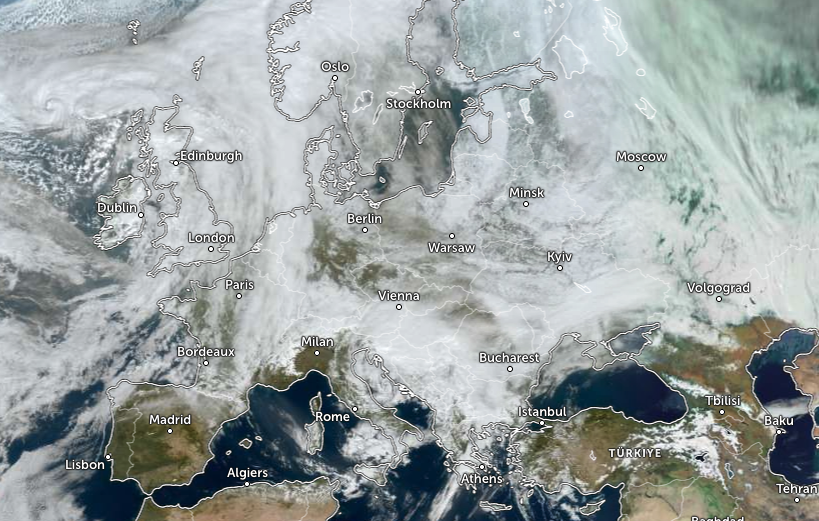
and has looked pretty much the same since the start of the year.
So very little solar production is going on anywhere, that leaves wind as the only active intermittance source, so places that have a lot of wind production like UK and Denmark use all the wind they produce, and countries that make less power from wind and more from solar have nowhere to import significant amounts from.
You need either dispatchable power (gas/nuclear) or long term grid scale storage (multiple weeks worth) to make a power grid work. Currently the latter is prohibitavely expensive so the former is needed.
Well, they could be cheaper.
Or the power company -- the only one you're allowed to do business with -- could lower their production costs but leave your rates the same, pocketing the difference as profit.
At this point we should call it embezzlement instead of investment
Energy is cheaper where the government has a public alternative. That goes for all utilities and services.
Anything cheaper for the consumer means less profit, which means less money for bribes, which means conservative governments are against it
I vaguely recall a lemming posting a highway outdoor advertising "Green coal" or something like that. Guess that's the green energy the USA govt is investing in (also crypto bros, because they got money to buy entire fucking power plants to run their stupid coins)
"Green coal"
Yeah, the US ain't evolving - it's devolving.
Plug and play solar and wind are the future:
- Solar
https://www.amazon.com/SOLPERK-Maintainer-Waterproof-Controller-Adjustable/dp/B08GX19KT9?
- Wind
https://www.amazon.com/pofluany-Generator-Controller-Turbines-Windmill/dp/B0D1VHSHNH?
- Wind, not plug and play, but you get the idea
https://www.amazon.com/VEVOR-500W-Wind-Turbine-Generator/dp/B0D3T9Q6QC?
- You would need a few of these and also not plug and play
This 500W vertical axis wind turbine utilizes a helical design and a permanent magnet generator to operate effectively in low wind speed environments. Its high power output and low starting wind speed make it ideal for maximizing energy production.
https://www.amazon.com/Vertical-Generator-Permanent-Intelligent-Controller/dp/B0DSC27VD1?
How does this handle grid power outages?
In my area, you're required to prevent back feeding if the grid goes down (otherwise it can be hazardous for the linemen repairing the issue).
It can also be hazardous for electricians or DIY home repairs if they don't know about it.
Oh, you think you're safe because you turned the house's power off at the main breaker? Forgot about the solar panels backfeeding into the panel -- all the circuits are still live!
(Or, even more fun, only half the breakers in the panel are still live, since the solar panels are only feeding into one of the two phases. So maybe you test to make sure the power is off by turning on the lights, and the lights don't turn on so you think you're safe. But the power outlets you're about to work on are on a different circuit, one that's on the same phase as the solar, so they're still live. Fun stuff!)
All that's to say... You should definitely still do home solar if you can. But document it well, and establish ways to disconnect power to ensure safety!
They all have controllers? I'm guessing it's all done through that. You'll probably want to be careful when you get one for your specific area that it follows all of the laws.
Energy would be so abundant it'd be free, if we'd done Fusion 50 years ago.
Well maybe, but only if they owned the infrastructure themselves.
As it stands, the price paid to renewable energy suppliers tracks the amount paid to fossil fuel suppliers.
There's a reason every farmer wants to fill their fields with solar panels, and it's got little to do with making electricity cheaper for the end user.
That said, there's no reason not to do it anyway, at least if we want more than a few more hundred years of humanity. A tough ask in a time where every decision is made based on an election that happens in the next 4 years by people who won't live another 20.
The UK is spending billions on green energy and has the highest electricity prices in the world.
Yep. Meanwhile the US has some of the cheapest and is mainly Natural Gas.
Unfortunately Trump has no ability to think about a future past tomorrow much less one that benefits anyone other than himself, so there’s no chance this will be fixed until he’s replaced.
Not necessarily
However, this misses the point. We need to modernize our aging infrastructure as it is on its last leg. It honestly doesn't matter what drives it as long as it gets done.
Just say it's better for AI and they're all for it
Nuclear energy
That's incorrect. Nuclear power is one of the more expensive options when you factor in the costs after operation ends, which you should obviously do.
Remove coal subsidies and factor in newer reactor technology before you calculate nuclear cost.
That's kind of funny. Nuclear energy is actually getting more expensive:

A few reasons come to mind:
- The newer the technology, the higher the cost.
- Each reactor and its power plant is a huge project. This makes scaling up production difficult. And please don't start with tiny reactors. We're not in Fallout.
- Safety standards have risen.
There are probably more reasons. I would of course not compare it to coal but to renewables. They're the future. Storage will be needed but those options are also getting cheaper by the day.
So, the government. Where does it come from?
Where does it go?
Usually the middle east
Cotton eyed Joe
[ cries into green but super expensive Romanian electric bill ]
Presumably Romanian electricity is expensive because non-Russian gas is expensive.
Here's the breakdown of Romanian Energy:
They still have a long way to go to be considered green.
https://en.wikipedia.org/wiki/Energy_in_Romania#/media/File:Energy-consumption-by-source-Romania.png

Oh, I shouldn't have just blindly accepted their premise. Their electricity bill has basically no green in the first place.
I was about to say, the economics of this post don't really add up. And sadly, we have a living example behind your computer screen.
That doesn't change the way lemmy works. "Someone said something supportive of the thing we like. So it must be true." Too bad economics doesn't work that way.
If you want things to be cheap, you pit fossil fuel against green energy in real competition. Then they are both forced to get as cheap as possible at every layer of their supply chains if they want their respective supply chains to continue. That's what kills profit and greed because they have to give up short-term greed for a shot at long-term survival. When you give either or both a government crutch, the executives involved try to reap as much cash out of that crutch now while the crutch exists.
Whether you give a crutch to either fossil fuel or green energy, at the end of the day you are giving it to an executive. He's going to take advantage of it and not give you what you want every time.
Do you guys remember the incentives for rural internet rollout? Now they are paying premium cost for crapy internet, which the government already paid to exist. It doesn't matter how much you agree with the thing you want money to go to, you aren't going to get a good outcome.
LOL son, that is not how this works at all. It wasn't true when Reagan made the same argument. It wasn't true when W Bush made the same argument, and it's not true now.
HINT: You're trying to fuck with a global price market by changing things at a local level. It's like trying to fart south to push a hurricane off the coast.
Didn't you hear? That's the problem! The prices must always go up. For the quarterly growth!
Shit sun power won't make my yacht go burr.
No need, use a sail
That's just solar with extra steps!
It would be cheaper to just end most of the oil subsidiaries and move some of those subsidies to solar/wind/etc. refineries and processing and distribution, while profits are private, are heavily funded by public tax or tax breaks on profits.
https://www.fractracker.org/2025/03/fossil-fuel-subsidies-free-market-myth/
If the electricity bill would be lower people would use more energy and switch to electric cars real fast. I'm sure some people would not change their habits, but I'm inclined to think a lot of people would just use more and care a bit less about trying to use it as efficiently as possible.
Just take cars as an example. Everyone wants low gas prices, but when gas prices are low, people are buying bigger cars that consumes more gas/energy. Another example are places with renewable energy powering the grid, having cheaper electricity, but also ending up using more per person.
The province of Québec is one of the biggest consumer of electricity per inhabitant in the world, behind Iceland and Norway. Source in French.
Those places have super high percentages of cheap renewable energy being generated, but they also consume much more per inhabitant. Sure, if we cover the earth in solar panels, reservoirs, tap geothermal, and have enough energy to waste for everybody, and every manufacture. But this takes resources, space, batteries, and ends up polluting too. The less we need, the better it is for everyone.
I'm not saying we don't need renewable nor deserve lower bills. Just that the actual system of consumption cannot only be reduced to "more cheap renewable energy". I'm in Québec and energy is mostly renewable and relatively cheap here. But we also can't just continue to build giant reservoirs visible from space to quench our insatiable appetite for electricity. We'll have to learn to use less energy too; be more efficient with what we have. Not just convert everything to renewable and call it a day.
We don't just do it for cheapness sake. We mainly do it for sustainability. Cheapness and abundance is a bonus.
How does this article manage to say so many things about energy use in arctic tundras without even once recognizing that just maybe it takes more energy to heat a living space in an arctic tundra? Bafflingly stupid analysis.
Honestly, if anyone is talking the freaking arctic when discussing the energy transition, they're a bad faith actor and can be completely ignored. We care about the bulk of energy usage. The tiny little remainder is irrelevant. A few innuit can keep their gas generators for all I care.
Have you read it? Translated or in French? Because this is a list of facts, with a conclusion addressing what you are pointing out. It's literally from the government of the province.
Le Québec, avec son climat hivernal rigoureux, connaît des besoins élevés en puissance électrique lors de périodes de grand froid, alors que toute la population doit se chauffer simultanément. Ces épisodes, appelés périodes de pointe de puissance, ne durent que quelques heures par année, mais exercent une pression sur le réseau.
Translated: The province of Québec, with its cold climate, has high energetic needs during the peaks of extreme cold periods, because the whole population has to heat their homes at the same time. Those periods, called power peaks, are only lasting for a few hours every year, but are putting pressure on the network.
Also, those places have summer. Most of the population in Québec and Norway don't live in an arctic tundra.
A few hours a year? That's what batteries are for.
I guess the issue I have is less the report itself, but the way you are trying to wield it to prove that the concept of induced demand which is not what the report is talking about at all.
If the electricity bill would be lower people would use more energy and switch to electric cars real fast.
Let's spare the power grid by building AI datacenters instead, noted.
I'm just pointing out that cheaper energy means people tend to use more. I'm very much for renewable energy and against AI. Just that we also need to find ways to be much more efficient with it. I live in a place with "cheap" renewable energy and we use more per capita than most of the rest of the world. So it's just something to keep in mind. I'm saying it's excellent to have renewable energy, it's excellent to have it as cheap as possible, but it can also lead to waste and pollution in other ways.
You don't have to make a false dichotomy where it's either one or the other.
EDIT: Just to give you an example. People know here that our energy is "renewable" and cheap. So when we're asked to reduce usage during peaks, there's a few people yelling at the top of their lungs that we just have to build more dams, flood more land, and that "water will always flow in the turbines anyway".
How markedly do people stop caring because of price?
I don't think the source of the energy has a significant impact but have no data to back it up.
Hydro may be clean but it sure as hell ain't environment-friendly.
Remember how now that countries have stopped recognizing US medial science we see cures for cancer coming out of the woodwork? Yeah....
Wut
Generally speaking medical research in the US has been scrutinized due to the incredibly profitable privatized nature of it, so much so that people believe solutions are actively suppressed in favor of more expensive options. In the last few weeks after the US left the WHO a whole bunch of cancer cures started coming up. While probably a coincidence, after the last few months of conspiracy theorists being proven at least to some degree right it's getting hard to ignore that this may not be a coincidence.
Maybe Nuclear, given it can actually support the base load power, except they need to fully deregulate it first so Nimbys and lawsuits balloon the cost. It shouldnt cost more nowadays in inflation adjusted terms than France building them in the 70s.
Your talking points are ten years out of date. The cheapest form of baseload power now is batteries plus solar. For seasonal variations? Nuclear is so expensive that it's far cheaper to just build enough to meet your winter electricity demand and have abundant power the rest of the year.
Fission is a dead end technology that people mostly support now so they can feel a sense of contrarian intellectual superiority. It's all just vibes at this point.
Do you have an example of a city that runs on renewables with battery storage with no duplicate backup base load generator?
As far as I was aware there were none, as it is non-feasible outside of areas with hydro dams for power storage.
Do you have an example of a city that runs on renewables with battery storage with no duplicate backup base load generator?
Thankfully cities don't build isolated power grids.
So that's a no. Noted.
What's more important? Cheap power for the whole country? Or the pockets of the people in charge?
just in case
/s
Don't most countries offer subsidies for photovoltaics? Put solar on your roof and your energy bill goes down. That's the most direct government investment I can think of that will effect you directly.
Other than that, its supply and demand. The government building huge solar arrays wont bring your bill down if the demand for energy keeps rising. They'd need to build more production than there is demand.
Don’t most countries offer subsidies for photovoltaics?
They do, but they also keep subsidising black energy too.
So what you’re saying is - if the government spent more money, they would make less money off of us in utilities bills…. Makes sense
And housing would be cheaper if it wasn't treated as a value-retaining investment.
Finland has done something like this and the few days of winter where it's very cold and no wind are kinda rough. There was a day recently where I spent 50 euros on electricity alone. And I have somewhat efficient heating tech like a geothermal heat pump.
Guess the problem with green energy (hint: it's not the fact that it's better for the environment)
Green energy can't be scarce, therefore cheap. Solar, wind, water, never happen. They can always slow the generators, can't slow the sun.
can't slow the sun.
Take a look at what happened April 28th in Spain.
Considering the only conclusion so far is that there was a surge and final reports are not in yet, do enlighten (pun intended).
There won't be ever a report that's how Spain operates.
One of the possible reasons was too much sun power and not enough demand. Solar and wind are unreliable.
One of the possible reasons was too much sun power and not enough demand. Solar and wind are unreliable.
No.
The issue wasn't that there was too much generation, or that it is unreliable.
It was a grid issue, it wouldn't have mattered what generation was used (solar, wind, gas, nuclear, coal, etc...).
Don't be mislead by everyone who jumped on the coal bandwagon a day after the incident before we even knew what the cause was.
You need a place to store that energy, a way to convert it so it's usable, transfer it to where it is needed. Etc.
Thorium nuclear plants to replace coal and natural gas power stations to provide the energy required to build the solar panels, wind turbines, and geo thermal systems to transition away from fossil fuels.
Thorium is awesome, but fully renewable energy plus storage got too cheap for any kind of nuclear to stand an economic chance.
Nuclear Energy because green energy is really expensive too
Wrong
Brother in christ, i work with energy companies that do renewable energy and trust me, that stuff is really expensive to maintain for the amount of power you get out of it, Even the amount of environmental disturbance those wind turbines cause alone, un healthy for people, unhealthy for animals(Look it up). Nuclear power is very safe these days and there are storage places like Onkalo https://en.wikipedia.org/wiki/Onkalo_spent_nuclear_fuel_repositoryWhich make storing the waste super easy and viable as well as secure for even post human civilizations.
The only thing green energy is good for is politics
Well turbines kill birds. Just 10000 times less than cats. Good luck aligning budget for 10 - 20 years with this volatile economy. I can sustain myself and my family with solar easily
Educate yourself on Nuclear power, you already got 50% of the work done, Renewable energy needs nuclear power to kick out fossil fuel.
Its not a this or that its the combination of both that will make us carbon neutral
And i cant remember when was the last time solar panels poisoned the land for 10000 years
https://rewi.org/wp-content/uploads/2023/05/REWI-Solar-Energy-Wildlife-Interactions-Summary-2023.pdfInteresting read on fatalities in north america though they mention they could not find a root cause yet due to lack of data
https://sistinesolar.com/solar-panels-and-wildlife/
- Depending on the kind of setup, if a central tower is used to concentrate the light to boil water the concentrated light become a death trap to birds and insects
- These plants can appear as lakes due to the reflection and colors(Especially in deserts where these are build confusing wild life
- The floating solar power systems disrupt fish activity and affect water quality
- It also messes up migrations of birds(Wind turbines can do this too)
It is still infidelity better than carbon in the skies but if you put this against nuclear energy and treat the MAN MADE NUCLEAR DISASTERS for what they are MAN MADE then you can see that nuclear power in this day and age is very very safe because we have years of safety development.
People who do not understand this are still stuck in the past or follow a global anti Nuclear rethoric without putting in the time to actually understand the technology.
Meltdowns are a thing of the past when thorium salt reactors become mainstream because those reactions dont run away they halt the moment you remove the fuel, https://en.wikipedia.org/wiki/Molten-salt_reactor
MSRs eliminate the nuclear meltdown scenario present in water-cooled reactors because the fuel mixture is kept in a molten state. The fuel mixture is designed to drain without pumping from the core to a containment vessel in emergency scenarios, where the fuel solidifies, quenching the reaction. In addition, hydrogen evolution does not occur. This eliminates the risk of hydrogen explosions (as in the Fukushima nuclear disaster).[2] They operate at or close to atmospheric pressure, rather than the 75–150 times atmospheric pressure of a typical light-water reactor (LWR).
Nuclear power is really cool and i highly suggest you give it a chance at least in researching it, there are tons of awesome videos on YouTube to help with this which gave me a ton of insight and storage facilities like:
- https://en.wikipedia.org/wiki/Onkalo_spent_nuclear_fuel_repository
- https://en.wikipedia.org/wiki/Ontario_Power_Generation%27s_Deep_Geologic_Repository
- https://en.wikipedia.org/wiki/Nuclear_Waste_Management_Organization_(Canada)
- https://en.wikipedia.org/wiki/Schacht_Asse_II
- https://en.wikipedia.org/wiki/Repository_for_radioactive_waste_Morsleben
- https://en.wikipedia.org/wiki/Salt_dome_Gorleben
- https://en.wikipedia.org/wiki/Schacht_Konrad
- https://en.wikipedia.org/wiki/Wolseong_Low_and_Intermediate_Level_Radioactive_waste_Disposal_Center
- https://en.wikipedia.org/wiki/Final_repository_for_short-lived_radioactive_waste
- https://en.wikipedia.org/wiki/Waste_Isolation_Pilot_Plantand https://en.wikipedia.org/wiki/Yucca_Mountain_nuclear_waste_repositoryto name a few give me hope that this nuclear waste has plenty of places to go to sit out their long half time by the end of it becomes inert
I see 2 problems First - human error and human greed.
Second - we solve problems only after we face a disaster, we never know if the system is flawless right now.
And Id rather live near solar grid that might malfunction sometimes and requires maintenance every decade.
But I respect your anti ff point of view. I also understand everything you talking about. I wasted too many years learning chemistry, engineering
Second - we solve problems only after we face a disaster, we never know if the system is flawless right now. This is why the tech is tested in a controlled matter, This counts for everything including wind turbines, solar panels and the food you eat.
human error and human greed. Funny enough this is the exact thing working against nuclear energy, there is big money in Green Energy because it creates a ton of jobs, Nuclear energy is so efficient the surplus of energy would fuck over most fossil power companies thats human greed for you.
I would rather live in a city that has a respected and well maintained nuclear power plant so there is more area for nature than to cut down a forest so we can win some power, Molten Salt reactors are the future and its going to be a whole different world compared to traditional reactors, China is ahead in this because they dont have anything blocking this development.
But with projects like ITER i am convinced its only a matter of time before nuclear is in again, Its going to be a combination of Tidal/Hydro, Solar/Wind and Geothermal plus nuclear to phase out fossil fuel, these cannot do that on their own, even nuclear power.
If we want to rid ourselves of the cancer that is gas/oil/coal then we have to embrace the alternatives not fight against them with a mindset from the 1980's (Fukushima was engineered against twice the highest recorded tsunami, The sendai earthquake tsunami was a freak show) That said it was TEPCO that fucked up royally by sticking with General Electric design which placed the backup gens below sea level(The engineers of TEPCO warned against this vulnerability but TEPCO sided with GE instead) this is why those gens failed.
That said if they had a Molten Salt reactor(Thorium) the reaction would have halted on its own before triggering a meltdown which would have prevented:
- The need to vent radioactive steam into the atmosphere
- The sacrifice of the 50 who stayed behind to halt the reaction
- Marking Fukushima as dangerous
I agree fully that traditional nuclear power has its dangerous if not handled correctly, The future will eliminate most of this danger and compared to other energy(non fossile) Hydro and Nuclear have to be the most mature oldest ones
Btw since you are an engineer too i highly recommend checking a few videos on Fukushima, their reactor design is super cool and has multiple failsafes which prevented the disaster from being worse such as the cooling ring / pool with steam vents to prevent over pressure or cool down fuel in case a meltdown is about to happen.
The movie Fukushima Daiichi is also super awesome and has some famous japanese actors in it, they sticked very close to the actual events, was a thrill to watch :D
Also thanks for keeping an open mind, i respect that
Us is pathetic. Nothing is planned.
No direction. Every 4 years fuckers change shit.
Centrally planned china can run circles around
Yeah, China is great!
All dictatorships are more efficient than democracies, so just give it a little time. Our dictator will catch up. It's our first try at fascism. Cut us some slack.
I've heard a lot of definitions of fascism, but the one that makes the most sense, that explains the most is this:
Fascism is what they call it when an empire takes the murderous and dehumanizing policies it uses on it's periphery - it colonies invasions territories "frontiers" - and begins using them on the citizens of the "homeland" or imperial core.
Germany had concentration camps in its African colonies well before they started ghettoizing Jewish people. The United States has had "fascist" policies all my life and all your life. Those dehumanizing and murderous actions have just been turned outward. But your means always become your ends.
If you want to know the future of this country, look at Abu Ghraib and Guantanamo. Look at the black-sites and the special rendition treaties. The water tables poisoned by depleted uranium ammunition. The families lost to drone strikes as so-called "collateral". We have always been fascist. Those of us who just happen to live here, no different from the German citizens who simply didn't know and did not ask too many questions.
The picture you painted frightens me because I know we're heading there. I'm trying to remain hopeful that we can still stop this insanity.
Yeah, I'm somewhat paralyzed by it myself. It feels mean to spell it out like this, but fuck... I just cannot just let this rattle around in my head for any longer.
There is some cold comfort to know others see this too, that I'm not just driving myself crazy.
I think the majority are against it. Unfortunately, there is as long history of minorities leading and oppressing majorities.
And just to clarify, I'm not referring to minorities like blacks or hispanics. I mean like rich, old, white guys. Or MAGA in the Republican party. Or whites in apartheid. That sort of thing. The majority of Americans didn't vote this in, the majority of VOTERS did.
Whoever downvoted is either in denial or a fascist.
Fun Fact: Doesn't really work in Winter.
Source: EU countries that don't have a ton of cheap gas, flowing water or nuclear power and unlimited storage.
Unless you live in the Arctic Circle, it does in fact work in Winter.
You provision enough solar so it still works in winter, then sell your excess in summer.