Europe has survived 3 energy shocks in 4 years. The only way out is to stop buying power from its enemies
2mon 22d ago by lemmy.world/u/rikviergever in buyeuropean@feddit.uk from fortune.com
Europe has survived 3 energy shocks in 4 years. The only way out is to stop buying power from its enemies | Fortune
https://fortune.com/2026/03/25/europe-3-energy-shocks-in-4-years-what-to-do-next/
Nah, we'll just buy gas from US and postpone electrification of transport couple decades. What could go wrong?
Thank you! We just do not do enough fracking here yet.
I would electrify my transport in a heartbeat, if only it wasn't so fucking expensive. Like ~30k€ for cheapest Kia BEV? Not even speaking about more "premium" brands. How tf should I get that with mediocre eastern european salary?
I love my BYD dolphin
It was the cheapest car I could find, and it cost about €17,000
Yup, but in Poland there are still small fraction of evs…
Renault is government company, why they dont want to sell evs cars cheaper? Is it really necessary to make bigger profit than from ice?
You meant Renault? They made the Zoe back in 2014, then made the Megane only electric, made the Spring through their Dacia subsidiary, now the 5, and they are launching the new Twingo generation as only electric. This makes them cover all EV segments, from the sub 20.000 euro electric car to the 60.000 one through alpine. They use more and more European made batteries and motors. Out of all the European car makers Renault and Mercedes are the ones that are the most pro electric now.
Yup, but why electric model is more expensive than ice one? Because of government subsidies?
The new twingo is the exact same price in constant euros as the first gen twingo that came out in 1993.
Besides that, prices of EVs are not more expensive over 5 or 10 years despite the shown price because you run them at a much much cheaper price : electricity is often cheaper than gas, the only real cost you would have to pay is tires and shock absorbers, breaks pads and disks get used a lot less because of regen, no belts or chains, no spark plugs, no oil change, no exhaust, no turbo, no belts driven AC, no starter motor, no alternators etc... All those things that cost a lot in mechanic repairs for most cars.
Citroen ec3 was 2x more expensive than ice version…
European evs are ridiculously expensive in comparison to for example Tesla
Tesla's start at over 30.000 euros! That's not a cheap car by no means!
Plus: there is a huge problem at the top of Tesla. It's not the subject here but I cannot close my eyes on Greenland's fate just for a car. I have the same reservation over Tibet or the Uyghurs for other brands.
I wanted to buy ev in 2023/2022. I could get Tesla for price x and skoda for price x 1.5
Have you considered the Dacia Spring? It should be fine for short-medium range trips and it costs "only" 20k
To me a car like that kinda defeats the point of owning a car.
If it's only needed for driving around town and getting groceries, I can do that with (e-?)bike+transit+carsharing.
A significant fraction of my yearly km are driven on trip of over 500km/day, and to do that with the family it really helps to have a car. It'll still be a while before electric cars are completely viable for my use case.
Replacing the short range use of cars with electrical ones is the wrong approach. It should mostly be reduced by offering alternatives. If people use the car only half as much, that's a nearly 50% reduction on emission and fuel consumption, right there.
Wouldn't you do it the other way around, where the car you own is for commuting and kids taxi, and you use a car rental or sharing service for the long trips?
We have bought the smallest car that would satisfy all our needs (a small station wagon), and we use it as necessary.
My commute is outrageous BTW, 50+50km, at highway speed and with airco, that might already be a stretch for the Dacia Spring. I do it mostly by train though.
I would have thought that:
"Reducing car use is better than just replacing them. Cars cover a lot of difficult corner cases, but let's offer good alternatives for the day to day life"
should be a pretty uncontroversial take, and yet I'm here discussing with people that want to use cars everyday, and cover the exceptions with the alternatives.
I agree with you, and I get around town mostly on bike. Many people don’t, and I think it would be better if they drove EVs. Anyway, if I’d need to buy a car, I would still consider the Spring, since its range would be fine for heavy loads that I wouldn’t carry on a (cargo) bike or 100-200 km trips
For over 500km/day, I use the train. Not many people put on 115 500 km/year on their car. You are an exception.
Easy there, we do ~15000 km/year, but ~4000 of those are on long trips. That's "a significant fraction". I didn't say I spend all day every day in the car.
There are many logistical reasons why we still need one car, but we are actually also able to walk, bike, and use transit.
And I expect I spend more time on a train that you do. But it's not always the most practical option.
Crossing the alps on a train means too many changes, with trains from different companies, and my bored kids (depends on the origin and destination, but it's true in my case). Even using the plane, with all the associated changes and buffer times, usually takes 6 or 7 hours.
Holidays in the mountains also gets a hell of a lot harder without a car. That's true in general, but it's doubly so in the places where I like to go (less crowded secondary destinations). Public transport requires density, and the last thing I want in the mountains is high density.
Edit:
As I wrote in another message, I would have thought that:
"Reducing car use is better than just replacing them. Cars cover a lot of difficult corner cases, but let's offer good alternatives for the day to day life"
should be a pretty uncontroversial take, and yet I'm here discussing with people that want to use cars everyday, and cover the exceptions with the alternatives.
I own a Dacia, I want a cheap car with no luxury. But but the Spring is just a bad car. Poor charging, poor range, can't accelerate at highway speed. Those are not luxuries. It was the first electric car at this price range, but now there are better competitors.
Yeah, it's gimped too much. Especially the first generation with weaker motor feels barely like shopping bag on wheels... It could work for work/school commute for me, but apart from that? Visiting parents in different region? No. Weekend family trip? No. And honestly I don't want to spend that much on something I can't use for more purposes than just daily commute.
Thanks for the insight
Don't buy new. The second hand market for EVs is great. 3-4 year old cars with over 200 miles range for £12-15k, and lots of them.
Maybe in UK?
There is a second hand market where I live (Czech rep), but it's still not cheap. We're traditionally a country where others' used car end up. Same with EVs, but re-sellers ask a premium for this "brand new technology" and yada yada yada... The cheapest of Swasticar model 3 (first production year 2019, with over 200k km, smaller battery) I could find is over £15k. Kia EV6 similarly aged and (ab)used? Hand over well over £20k...
That sucks, but could you buy in a neighbouring country. If you save enough it could be financially worth it.
Obviously UK would be of no use. Stearing wheel in the wrong place.
I'm sorry, but what does that have to do with anything?
I've been going around in cars powered by natural gas most of my life, but I'm the very very small minority. The overwhelming majority of cars don't run on that, heating and the electric grid do. If you run out of gas the cars won't stop, the trains will.
Stop buying gas from the enemy after 4 years of war? Preposterous!
The EU has reduced Russian gas imports from 45% of the total gas imports of the union before the invasion of Ukraine to 13% at the end of 2025 and will be at 0% by 2027.
Coal and oil are already at 0%.
It's not like you can just switch off 150bn cubic meters of gas overnight
The problem is that they replaced most of it with the 3 times more expensive USA's LNG.
This is an outrage!
But it'll be an outage.
Or, ya know, build on self-sustainable sources.
But nuclear is so bad!1! Better burn coal and oil and "clean" gas!!
Renewables FTW, with a nuclear backdrop til we can phase out that too is the way forward IMO.
You know nuclear isn't self-sustainable? Uranium is mined in only a few places.
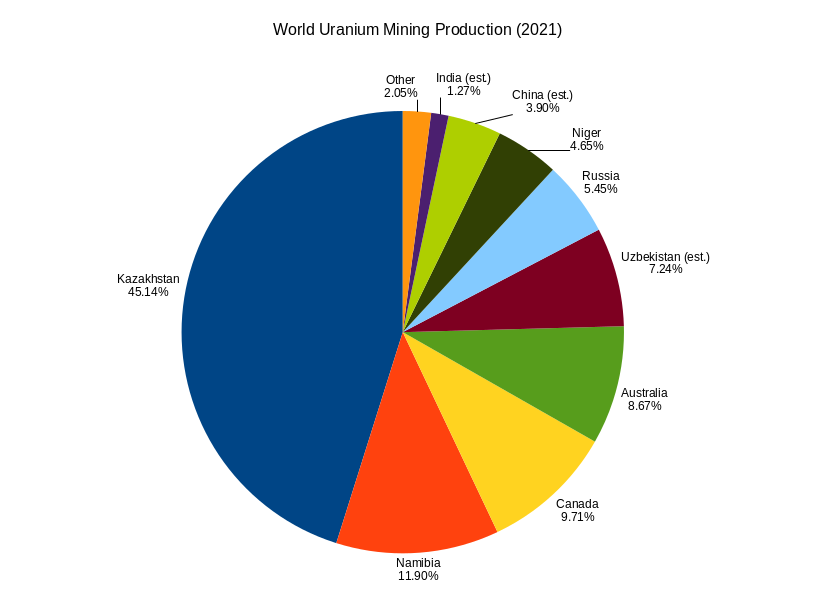
The volume of uranium used is so low that is feasible to store years of supply; this is not possible with gas.
But it should be noted as a risk, of course.
Uranium-based nuclear power isn’t ideal, but thorium-based nuclear power shows a lot of promise, because thorium is both way more common than uranium, and way harder to weaponize.
Yeah but that's still experimental, right?
It is the other way around though: because it cannot be weaponized, there was no incentive to develop an industrial reactor and a supply chain. The remaining technical and scientific challenges on this technology are non-trivial too as I understand, so it will be a few decades before we see one in action even if we took the decision to invest in it today.
Thorium reactor rely on transmuting thorium into a form of uranium, a form which itself can be extracted and weaponized...
And? You're trying to argue it's like oil?
So you advocate for coal, gas and oil until we can be 100% reliant on renewables?
There's no option. Transitioning to nuclear will keep you burning stuff for 10-15 years whilst they're built. Even SMRs will be 5-10. Renewables come online with a much smoother transition curve. You reduce burning stuff sooner, and we need whatever is quickest.
Still need batteries big enough to power global shipping etc. Nuclear can do that, even though building reactors takes time
It can, and I'm not anti-nuclear for all use cases. I just don't think it stops us burning stuff soon enough.
No perfect solution, sadly. We're also very late to start reducing emissions. And humanity doesn't seem to be able to get their shit together and actually do something about it any time soon
That's a bad faith interpretation of the above comment. We already can be 100% reliant on renewables. Nuclear is so clownishly expensive that it's far cheaper to provide baseload power via solar, wind, batteries, and other energy storage mechanisms.
Well what will you use for power generation before we have enough renewable energy? You say it yourself: "can" be reliant. Yes but we are not, so what's the way forward? Nuclear til we have enough renewables, or you know, my question : shall we burn coal up til then?
And nuclear energy is less expensive than coal, oil and gas IMO.
What are you on about? We don't have the nuclear we're talking about. This is about future plant construction. And new renewable capacity can be deployed in a fraction of the time that nuclear can.
France have upped their production massively, you don't always need to build a whole new nuclear central to augment production.
France went all in on nuclear in the 80s and 90s. They're upping their production now to replace their aging stations that are needing to be decommissioned. Their power generation has been 90+% nuclear for a looong time. That was a good time to do it. Renewables weren't practical like today.
You seem to think that renewables only help when we have enough for 100%, but that's not true. Take the UK for example. It currently has about 32GW of installed capacity. Of course the wind doesn't always blow, but over the last year it generated about 10.5GW on average. That's all fossil fuels not being burnt. CO2 not being emitted. Today.
For comparison: That's 6-10 nuclear reactors worth. Modern ones. And it's mainly happened in the time period that the UK has been building one 3.2GW nuclear site (2 reactors) that had an opening date of 2025. If they'd not invested in wind, and just gone nuclear, starting 10 or so reactors around the country, we'd have been burning fossil fuels at full rate for the last 15 years and only now be able to switch off coal and a bunch of gas. Going from 6-700g of CO2 per kWh to todays 125g.
This image wouldn't be a transition, it would be a sharp step to the left at the end. (From here)

Unfortunately that nuclear site is delayed 5 years to 2030. So we'd still be burning fossil fuels. No reduction. By that time it's planned that 50GW of wind will be installed, so about 15-16 GW on average. Another 4-5 reactors worth, but that doesn't stop the reductions we have today.
You forget that France is also exporting power to countries who have not yet got onto the renewables bandwagon, all your data is worthless without that in mind.
And thank you for not putting words in my mouth again. Ask if I think this or that instead of just going with some gut feeling about what you think I do in fact think. I usually answer!
This is the correct answer. Nuclear is not a perfect energy source, but it fills one big gap that we currently have with the renewable energy sources.
I would also say that gas can be an ok alternative in some situations. For example as replacement of a coal power plant if it is built together with solar and/or wind power. The gas power plant can increase the power when the renewables does not produce energy and be turned off during sunny or windy days.
What exactly is the big gap? Are you going to mention baseload, a concept that's been obsolete for a decade? The baseload power demand, according to the according to its actual definition, is zero on many grids. Solar and wind produce energy Joule-for-Joule far cheaper than fission. And we have any number of ways of storing that cheap energy. Renewables are the cheapest form of baseload power. It's not 2010 anymore.
Plus, if we're talking national security, we've seen from the Ukraine conflict that every nuclear plant is a huge geopolitical liability. There have been many near misses and scares relating to Ukraine's fission plants. Many have had to be shut down due to the risk of being struck. And hell, Iran's plants are actively being targeted by US and Israeli air strikes. In a big war, your enemy can create an instant chernobyl in your backyard if they want. You can design a reactor to be intrinsically safe, but that doesn't help if someone drops a ballistic missile on top of it. And yes, if you did this to a nuclear power like the US or Russia, it might provoke a retaliatory strike with actual nuclear bombs. But there are dozens of countries that have nuclear reactors but no nuclear weapons. For them, having nuclear power plants is a huge strategic liability. Far better to have innumerable solar panels and wind turbines scattered across the countryside than one big vulnerable reactor, an Achilles heel that an enemy can target to knock your whole power grid offline.
Solar and wind power are dependent on the weather to generate power, where nuclear power is not. I agree that there are many ideas on how to store the energy from solar and wind power, but how many of them is used on such large scale that it makes a difference on the grid?
Out of topic but do you have any data that shows that the baseload is obsolete? I have a hard time to believe that based on the definition from https://www.sciencedirect.com/topics/engineering/baseload
Baseload refers to the minimum level of demand on an electrical supply system over a 24-hour period, with baseload power sources being those plants that generate dependable power to consistently meet this demand.
Yes, but unless we figure out how to store a ton of electric energy, renewables are limited in use and somehow counterproductive as it makes energy cheaper during sunny days and thus making nuclear even more expensive (due to the fact that nuclear can't be easily throttled). 🤷
Storing a ton is easy. It's storing gigatons that's hard.
Uranium is one of the most dense elements. It's like 30x more dense than gasoline.
In practice you only need to store about a day's worth of electricity, a few hours really. Solar panels are so stupidly cheap now that you can solve seasonal variations in production by just spamming solar panels. You deploy enough panels to meet your demand on a cloudy day in winter. Then the rest of the year you have dirt cheap abundant electricity. Maybe shut down some of your most energy-intensive industries on the cloudiest winter days if you must. Give everyone at the steel mill a week off and instead ask them to work longer hours in the summer.
And what about people living in extreme latitudes? We can use excess solar power during the summer to capture atmospheric CO2, use that to make synthetic liquid fuels, and the handful of folks living north of the arctic circle can just keep burning carbon-neutral diesel fuel forever. You could use small fission plants for these remote locations, but there's unlikely to ever be enough demand just in the high latitudes to sustain an entire nuclear supply chain. Synthetic carbon-neutral liquid fuels would have many applications, so a supply chain could be developed.
For places up north connected to the grid, would it not be enough to send solar-generated electricity from sunnier areas to the south most of the time? (Although synthetic fuel burning sounds like a good backup plan for when the grid connection fails).
That's happening but moving to renewable isn't something you can just magically do
Unless we figure out energy storage, it will never be a solution.
Energy storage is slowly being figured as battery prices drop year by year
That's nowhere near enough. It's magnitudes away.
Nah, if you assume 6-12h of storage needed it's close to break even. I'd say if prices of batteries get halved again, it's solved
Can we do some calculations for worst case, ie winter week with clouds at best? How much does a single household consume when using heat pumps for warming? That would be at least 30kWh per day just for heating. Let's round it to 40kWh pet day which makes 280kWh per week. Shall we add an EV car into equation? 140kWh? We are at 420kWh per week you might need to back up with batteries. Now multiply this number with millions of households. Or simply take a look at electric energy consumption in your country during winter days (when many don't even have heat pumps and EVs) and you think there is enough batteries around and is simply a matter of price? Good luck with that. Wind and hydro would help to some extent, though.
When I said break even, I meant financial feasibility. Point is you can invest in solar power plus 12h of storage and this makes financial sense.
As for winter periods, noone expect solar to magically work in winter. Point is to reduce dependency on fossil and this can be achieved. You'd still expect strategic energy reserves and winter power to be delivered through fossil, due to avaliabliy and good energy density.
You could substitute fossil with wind power during winter, but that still requires storage.
Energy storage is a largely unnecessary. You only need to store a few hours worth of electricity. Solar panels are so stupid cheap that you can solve seasonal variations in solar production by spamming solar panels. You build enough panels to meet all your needs on a cloudy winter day. Then the rest of the year you have abundant cheap power.
The energy storage problem has been solved by stupidly cheap solar panels. People will whine about the footprint required, but the actual math shows this is just FUD.
See my answer to BlackLaZoR
The enemies of europe (and any other country) are billionares and politicians.
Politicans can be cool. Some are not. But you could be.
100%, especially from Poland perspective
if your words and your actions, which never seem to gel
will get you into heaven, i'd sooner be in hell
Owed to a Hypocrite, a song about the dangers of preachers and politicians
Nuclear is a much better option in the short and medium term.
And renewable doesn't solve the supply chain issue, a lot of materials for construction and maintenance need to be imported as well.
Nuclear isn't a option in the short term at all, simply because you can't build it fast enough.
It's also too damn expensive. And please tell where in germany we get the uran and the building materials for nuclear.
Canada. SMRs and uranium.
Ein von der Firma NuScale Power zusammen mit dem Energieversorger Utah Associated Municipal Power Systems (UAMPS) geplantes Projekt in Idaho (siehe auch das Idaho National Laboratory) sollte Stand Anfang 2023 USD 102/MWh erreichen, wenn man die Subventionen herausrechnete.[17] Das Projekt wurde im November eingestellt, weil die ursprünglich für die Errichtung geplanten Kosten von 5,3 Milliarden Dollar auf bereits 9,3 Milliarden Dollar gestiegen waren.[18] Zum Vergleich der Stromkosten: Nach Schätzungen aus dem April 2023 erreichen Solarfreiflächenanlagen Stromgestehungskosten von USD 24 bis USD 96/MWh
zu teuer.
True but dont forget. If you will buy it from France, you will leave money locally :) and economy will get this money back
It is much faster to build nuclear power plants that can cover a country's needs than to fully transition said country to renewable.
It's expensive upfront. But it is cheap to operate afterwards, and cost efficient to renew. Look at France.
Germany made a major, major mistake when then phased out of nuclear energy.
We have uranium in Europe. We just don't exploit it. But even if we did not, there is plenty of countries in the world exporting uranium, on all continents. It's much less of a strategic issue than relying on rare materials for renewable, or on gas/oil.
I present Exhibit A, the new Reactor Flamaville in France. Construction took 17 years and 12 billion Euros.
Exhibit B, solar panels I can mount on my roof for a few thousand that run for 20 years without maintenance.
I rest my case.
EDIT: I did some estimating and figured that instead of building a NPR, France could have supplied around 500.000 households with solar and storage instead. That would be the populations of Lyon, Toulouse and Nice combined. And they would have around 65% of their power for free.
I am not sure if you mean it that way, but I will take this comment as a good joke!
What are you talking about? Building new plants takes decades. Renewables are much faster to build and are even cheaper than keep running existing nuclear plants
No, what are you talking about? A nuclear power plant takes less than a decade to build.
Renewable energy at the scale of a country is impossible to achieve in such a short time in Europe. We dont have huge geothermal taps, which countries having achieved 100% renewable energy have, and we consume a lot more energy.
Cheaper is great, but it's not continuous, it's not scaleable in a short period of time, and requires a fuckton more maintainance capability than a dozen nuclear power plants.
I will reiterate: A full renewable energy grid in Europe is impossible with our current tech, especially in a reasonable timeframe. That's why instead of solar power plants, countries prefer to subsidies local, individual solar panel installations, for instance.
A nuclear power plant takes less than a decade to build.
This is demonstrably a lie. The most recent nuclear power plant built in the US took 15 years to complete.
And the power plants in china took 6, with some that took 4 year. You can make nuclear faster if you want to. This is not a technology problem (or at least, not only), but a bureaucratic one. Chinese are building plants based on the AP1000, the same the US are building. It is a US design.
So even with an authoritarian government that can roll over any political opposition or protest, it still takes four-six years at best to build a damn reactor! And in actual democracies, it will take even longer. In functional democracies, people have the power to make sure the reactors are built safe. And they've put in regulations to make sure they're built safe. The best the people of China can do is to simply hope for the best.
Chernobyl was also built cheap and fast. Look how that turned out. "Fast" is the last way I want a nuclear power plant to be built!
Just because is China that does not make it unsafe.
CAP1000 is an incredibly safe 3+ generation design that uses multiple redundant passive safety system. A reactor like that can cool itself without electricity nor human intervention.
The comparison with Chernobyl is laughable. That design had a lot of flaws that do not exists in modern reactors. Just so you know there are still 7 reactor like Chernobyl running in Russia. I would worry more about those instead of one of the safest industrial facility ever designed by humankind.
Yes, you're quoting the marketing well. I'm sure the platonic ideal of the CAP1000 is perfectly safe. But you're making the fatal assumption that the plant will be built as designed and properly maintained to maintain that level of safety. It still relies on a massive network of piping that can become clogged or damaged if not properly built and maintained. Your naivety is laughable. Regulatory capture is already a problem in capitalist countries. Now your regulator and construction/operator company are the same people!
And again, you've completely ignored the 'problem' of democracy. The CCP can simply decree something and it will happen. There's no opportunity for local feedback. The opinions of the locals are irrelevant. There's no environmental review. You simply build it.
But ultimately, you completely missed the point of my comment. Democracies demand a certain level of process and accountability. (Yes, the US's present leadership is making a mockery of that, but Trump is an authoritarian.) In functioning democracies, you have to work to build popular legitimacy and build support for any major project. Dictatorships can just decree something to happen. Democracy itself makes nuclear power plants expensive to build. You need to work really hard to convince people that what you're building is safe, as you're building a damn nuclear reactor. I know technofascists find the idea of having to convince the common rabble to go along with their grand visions abhorrent, but I'm in favor of lynching technofascists, so fuck it.
The CCP can explode a nuclear bomb in Beijing also, but why should they?
A well maintained power plant is a resource and the maintenance cost less than building a new power plant. And if the power plant lack maintenance it will stop working and that's it.
If you perfectly and simultaneously clog all eight primary injection pipes (a statistically impossibility, must be elaborate and deliberate sabotage) the reactor will meltdown, and the corium will sit at the bottom of the containment dome where natural air circulation will reduce the temperature with all the radiation trapped inside.
I trust an AP1000 in China more then an older reactor in France. Your critique is based on fantasy. No dictatorship can decree that physics stop working.

Yes, China is not a magical place. If UAE was able to build a nuclear program from nothing at 8 years for each reactors, then we also can do that. (this time a Korean Design). We just need to understand why they can and we cannot. This is a regulatory problem, not a technology problem
It's easy to say that, but 15 years ago I thought the US do it too, and I was proven very wrong. I think Europe is a lot more like the US than it is the UAE, in terms of (for example) the ability of anti-nuclear activists to cause delays.
So given it is possible to create a nuclear power plant in 6 years (China did it, France did it), we just need to understand what needs to be done to make it possible again. And the answer is economy of scale (build more then one at a time) and streamlined bureaucracy (unify component requirement and simplify certification procedures).
The problem is nobody want to invest in the effort to make these changes against misinformed public opposition and fossil fuel lobbies.
I agree with knatschus@discuss.tchncs.de, everything about nuclear technology involves cost and time overruns. A nuclear power plant would ultimately take a decade or more to complete. Even the newer developments of SMRs or Thorium require real world experience and expertise that limit the number of countries who can explore this technology.
While countries are quick to make claims that they unlocked commercial thorium reactors, I'd say the only superpower realistically on track is China.
China hopes to complete the world's first commercial thorium reactor by 2030 and has planned to further build more thorium power plants across the low populated deserts and plains of western China, as well as up to 30 nations involved in China's Belt and Road Initiative.
Is nuclear really cheaper than renewables + batteries nowadays? I wonder if there are recent studies looking into it
Quick search points to this:
Levelized Cost of Electricity: which is a measure of the total cost of building and operating a power plant over its lifetime and expressed in dollars per megawatt-hour. [...] LCOE serves as a comprehensive metric that consolidates all direct cost components of a specific power generation technology. This includes capital expenditures, financing, fuel costs, operations and maintenance, and any expenses related to carbon pricing. However, LCOE does not account for network integration or other indirect costs
LCOE for advanced nuclear power was estimated at $110/MWh in 2023 and forecasted to remain the same up to 2050, while solar PV estimated to be $55/MWh in 2023 and expected to decline to $25/MWh in 2050. Onshore wind was $40/MWh in 2023 and expected to decline to $35/MWh in 2050 making renewables significantly cheaper in many cases
[...] Global weighted average levelized cost of electricity for newly commissioned utility-scale solar photovoltaic, onshore wind, offshore wind, and hydropower projects experienced a downward trend. The most notable drop occurred in utility-scale solar PV, which saw a 12% decrease from 2022 [in LCOE costs][...]
In contrast, nuclear power continues to face cost overruns and long construction timelines [...]
Source: https://www.worldnuclearreport.org/Power-Play-The-Economics-Of-Nuclear-Vs-Renewables
[Caveat: Below numbers are most likely not using LCOE]:
[...] In 2025, developers added 87 gigawatts of combined solar and storage, delivering power at an average of $57/MWh
By contrast, benchmark cost of a typical fixed axis solar farm increased 6% compared to 2025, hitting $39/MWh, while onshore wind reached $40/MWh and offshore wind climbed to $100/MWh globally [...]
If we aren't there yet, I still think we might see renewables + batteries as cheaper options in the short term.
I'd really like to see an LCOE analysis including batteries. If we naively assume LCOE costs for PV+batteries is the same as PV, we might already be there
My focus isn't on which type of energy is cheapest. An energy grid that is not predictable is worthless. Wiknd power, solar power, are great complements, but a grid using only those is not viable. Hydroelectric is great, but limited. Geothermal is not really viable in mainland Europe.
I'm worried about a realistic transition from fossile fuels to non fossile fuels. Nuclear is realistic, renewable as a main source in Europe is utopic and unrealistic.
You must hate nuclear then, it has awful synergy with renewables since you can't turn it off and on again quickly. Just overproducing with renewables and using batteries + gas plants for the few days the wind doesn't blow enough is much more realistic.
This is just..wrong. an unpredictable grid is perfectly fine for almost everything we currenty use it for, it just requires a very small amount of moving usage around and feedback on pricing/demand.
I'm not sure we define unpredictable in the same way. I mean not being able to rely on a continuous source of power (batteries mitigate but don't solve this issue) is problematic.
Nuclear power plants have to turn off if the weather gets too hot. They have to dump their waste heat in rivers or other bodies of water. To keep them from cooking the local wildlife, countries have to limit the amount of heat they're allowed to dump into the river. When the temperature of the river increases due to warm weather, the amount the reactor can dispose of in the river decreases. Rivers are not the infinite cold reservoirs your thermodynamics class taught you.
Predictability of renewables can be minimized via national grid interconnection. Even if it's cloudy and the wind is stagnant in one location, odds are that's not the case 500-1,000 miles / km away. The larger the grid, the more predictable renewables becomes.
Also, most Lithium-based BESS storage can discharge power to accommodate unpredictable renewables for up to as long as 4 hours, which can be enough to bridge the gap. If storage can't do it, the grid will.
And let's not forget other types of renewables + storage that don't care about clouds or the wind: run-of-the-river hydro (not reservoir hydro), pumped storage hydro, tidal, solar thermal, even wave although I highly doubt wave power will take off, etc.
The more diverse our power generation, both in type and location, the more predictable our grid will be. Diversity is key.
Edit: let's not forget about the other end of the power equation from generation: utilization. Energy efficiency and conservation through Distributed Energy Resource Management Systems (DERMS) are another tool to help the grid manage unpredictable renewables.
Tell that to Georgia Power. And while you're at it, pay my electric bill for me if it's so damn cheap!
Nuclear is part of the solution. We shouldn't rely on a single source of energy.
👆🏻 This is a key point.
No-one should rely on a single source; neither geographical location nor type of energy.
Europe is sharing both gas and electricity amongst countries, but also needs to generate more and use less.
Nuclear is a much better option in the short and medium term.
Nuclear is not a good option at all if you want to stop buying energy from the "enemies" such as the billionaires and politicians who will be in charge for it.
Nuclear takes decades to permit and build. You can build solar, wind, and BESS storage plants in 2 years, including permitting l, procurement, and construction.
The IPCC put it best: the fastest way to decarbonize and make independent the power sector is through renewables + storage.
We should hold onto the nuclear plants we have, and recommission the ones still standing (so long as they still operate safely), but all remaining efforts should be put towards renewables deployment.
Where do you store the waste? Nuclear is more expensive than renewables. Where do you get the nuclear material for the plants? Where do you get enough professionals to man these new plants? How to ensure the new plants you've build (fastly) are safe? How to ensure the plants are not easy targets for enemy attacks and sabotage?
It's not a perfect solution, and ideally we would all be on renewable, I am not disagreeing with you there.
But a full renewable grid in Europe is simply not realistic with the tech we have now. A full nuclear grid is.
Keep researching renewable and nuclear (fusion would be the ideal option, even above renewable), but use the best we have now.
We have uranium in Europe. But we can also import it from many countries all around the globe, ao strategically much more diversified than rare materials needed for renewable.
Educate new professionals. Build them securely, not fastly. Still a better time perspective than a full renewable switch. Plants will always be easy targets, nuclear or not. Modern plants do not catastrophically fail like Chernobyl. Do yoh really think France has not thought of the security implications with their plants all over the country?
Now for nuclear waste... Yeah, it's a problem. Also being researched. But it is little waste. It's manageable until we have the right renewable tech or nuclear fusion.
As for the cost, again, it is expensive upfront, cheap to operate, cost efficient to renew.
Stop with the lie that it's cheap to operate it's not true at all wind and pv already beat it and are still on a downward trend
Your talking points are twenty years out of date.
Not too sure why this comment got downvoted.
Grid balancing is no joke - you'll likely have new nuclear up and running before you rebuild the grid of an entire nation (which is needed for renewables to take the lead).
Let's not forget, lithium for batteries, a key element in a renewable grid (to help offload and balance) is also not widely produced in Europe. Water batteries could work, but those are not small projects.
Nuclear is your "short" term because renewables (grid rebuild) are still a long term project.
Exactly, don't buy from the usa, our once allie has shown open hostility.
Its pretty funny how little that narrows down your nationality
Non-usians is a pretty wide nationality.
Trump was driving trade diversification around the world with the idiotic tariffs, and now, with the illegal war against Iran, he's creating a resurgence of interest in renewables and EVs. Exact opposite of what he says he wants but maybe not so bad in the long run.
That's a really positive outlook and I love it.
Except that a bunch of people on the other side of the planet are dying because of this.
Maybe he was always a democrat plant 😂
/s
He definitely has the intelligence of a plant.
I feel like it should have been clear to everyone since at least 9/11 and the aftermath but no one in leadership has made the obvious case that renewables are great for national security and not just the environment. Really shameful loss for humanity.
I was of the opinion that after 9/11, if the USA was actually interested in security, we would have invested in alternative energy.
Instead we invested in death and oil. Like always.
The technology is there. We need solar, wind, batteries, hydro-storage and nuclear, which is hold back by fear and costs driven by bureaucracy. What we lack is political capital and supranational coordination. We need to scale up production and learn from the Chinese. The demand for batteries is there.
- More nuclear power plants
- more renevables
- more public transport and evs
Do you kbow where Europe get it's uranium to power these nuclear power plants from? No? Let me tell you: We import it from countries like Kazakhstan, Niger a bit from Canada. France, one of the biggest nuclear powered countries imports it's uranium from Russia. This is exactly the same as with oil and gas. So tell me: How do nuclear power plants help us, if we have to import the fuel?
Do you know what are the resources we have in Europe: Wind, water and sun. To be fair, we have cole too, but this is one of the dirtiest ways to produce energie.
The only way out are renewable energies.
I know I know.
But fuel is small money factor in comparison to importing lng to gas power plants.
You dropped half of your w
It's called "reduce, reuse, recycle"
nuclear power is very geopolitically sensitive and very expensive. It is a target to get Chernobyled if war or civil unrest happens.
So there's no need for subsidies money because the epic capitalism Invisible hand private market "just needs permission to go green"? This might be one of the dumbest "conclusions" to an article I've read in a while. I hope this entire thing was written by AI.
Its published in Fortune, I'm curious what you expected when you clicked on the link.
A bit more of a guide on energy independence than just a mostly vague history lessen with an incoherent conclusion
To be fair, the permitting and environmental impact process is crazy and is really holding back deployment. If the government gets out of the way of renewable projects the growth would increase massively.
Some of the process might be necessary. However, it should be the government's burden to bear, not the applicants'. The process should be as straightforward and simple as possible on the applicant end.
Exactly, that's how it should be but it isn't. Wind power has to do an environmental assessment on birds when it's only 1/6000 deaths. Offshore wind needs to show effect of the noise on marine wildlife when fossil fuels and farminc poison the water.
Here's a UK example, maybe unfair to use UK as an example but this is how it is for one of the largest wind producers in Europe.
Mandatory almost always
- Planning Statement
- Site Layout Plans and Drawings
- Environmental Statement (EIA) [almost always required at this scale]
- Landscape and Visual Impact Assessment (LVIA) [politically critical]
- Ornithology Report [required if any bird sensitivity; very often triggered]
- Ecological Impact Assessment (EcIA)
- Noise Impact Assessment (ETSU-R-97)
- Transport Assessment
- Grid Connection Offer / Electrical Layout
Conditionally required
- Design and Access Statement [required in England for most major developments]
- Habitat Regulations Assessment (HRA) [if near/impacting SAC/SPA/Ramsar sites]
- Shadow Flicker Assessment [if residential receptors within ~10 rotor diameters]
- Construction Environmental Management Plan (CEMP) [often required pre-construction condition; sometimes submitted upfront]
- Peat Management Plan [if peat soils present; critical in Scotland/uplands]
- Heritage Impact Assessment [if within setting of listed buildings / conservation areas]
- Archaeological Survey Report [if potential below-ground remains]
- Flood Risk Assessment [if in flood zones or drainage impact possible]
- Hydrology and Hydrogeology Report [if affecting watercourses, groundwater, or peat]
- Aviation Impact Assessment [if within radar/airspace consultation zones]
- Socioeconomic Impact Assessment [if material local economic effects claimed]
- Community Consultation Report [mandatory for DNS/major schemes in some jurisdictions; strongly expected]
- Decommissioning Plan [often secured via planning condition but sometimes included upfront]
But it can also be blocked by these:
- Local Planning Authority (LPA) [primary decision-maker; can refuse planning permission]
- Secretary of State / Planning Inspectorate [can overturn or refuse on appeal or call-in]
- Statutory Nature Bodies (e.g. Natural England, NatureScot, NRW) [can object on ecology/HRA grounds]
- Local Community / Parish Councils [political pressure; can trigger refusal]
- Environmental NGOs (e.g. RSPB, Wildlife Trusts) [strong objections, especially on birds/bats]
- Ministry of Defence (MOD) [radar / aviation objections]
- Civil Aviation Authority (CAA) / NATS [airspace / radar interference]
- National Grid ESO / Distribution Network Operator (DNO) [can delay or deny viable grid connection]
- Historic England / Cadw / Historic Environment Scotland [heritage objections]
- Environment Agency / SEPA / NRW [flood risk, hydrology, pollution concerns]
- Highways Authority [can block due to abnormal load transport constraints]
- Landowners / Rights Holders [access, cable routes, lease issues]
- Aviation Stakeholders (airports, heliports) [radar / flight path conflicts]
- Public Inquiry (Inspector) [can recommend refusal after appeal]
- Legal Challenges (Judicial Review) [can quash approval post-consent]
Needless to say, spending millions on reports and assessments when it can be blocked anyway by some rando NIMBYs sucks. Then there's also the fact that the UK grid needs tooooons of investment just to accommodate these new developments.
So all of these reports are not really an issue when you're making a massive power plant where the price of the plant dominates the cost. The process makes a bit of sense for large scale installations but the amount of work you need to put in for a modest 20MW wind farm in absolutely bonkers.
So yeah, if the government would get out of the way the whole process is a piece of cake and we can have full grid saturation incredibly fast.
laughs in Icelandic
Do Icelandic people power their cars with electricity from geothermal? I'm not in Europe but where I live 94% of our electricity is hydroelectric, yet the vast majority of cars are still using gas/petrol. So even if we are independent on electricity, and it's somewhat clean, we still import oil to power cars and trucks.
It was mostly a joke. Most of our vehicles are still fossil fuel powered. EVs are pretty popular but I think they're still less than half of sales.
Yes, don't buy from Russia, the U.S., and China. It wouldn't make sense to replace dependence on fossil fuels by dependence on renewable technology from the regime in Beijing. The is often forgotten imo.
Still way better to depend on someone for renewables rather than fuel. This way, the already installed capacity will keep on working.
China also doesn't seem to be the conflict type. You want solar? You'll get solar.
What an absurdly weird comment. You want oil? You get oil.
China is not only a decisive supporter of Russia in its war against Ukraine, it's been bullying practically all its neighbours in Asia. Beijing's envoys have openly threatened foreign government officials (as Japan's PM) and other countries' populations (Japan, Australia), and threatening Taiwan. A Chinese envoy in Europe claimed that former Soviet-states (like Ukraine, Estonia, Lithuania, Latvia, and all others) have 'no effective status' in international law. And this is just a TINY sample of what China stands for.
Saying it's not a 'conflict type' is absurd. China isn't a reliable partner, and it doesn't get better because the U.S. gets worse.
china may not be a reliable partner, but what was said is true. Solar is not fuel. There is zero fuel cost involved. Once it is installed it is there until you need to replace the panels, decades in the future. Same with batteries. And arguably the same with nuclear, given the low amount of uranium and the refueling cycle every 2 years.
We're comparing bullying to actively commiting war crimes. Those are leagues apart. There's nuance to these conversations. One buy it and forget it while you prop up manufacturing is infinitely better than being dependent on war criminals.
I meant that from the position of energy security. Sure, China doesn't always play nice politically, and there could be reasons to avoid Chinese imports. However, China is not particularly known for sanctioning its trading partners, so you can be reasonably sure that the supply will be there.
I mean, you buy a solar panel once and get energy for decades. It's a bit of a different dynamic.
explain that to the graybeard in politics
The rightwingers will never allow that.
EU literally destroyed its own nuclear energy. You had energy, eurotards killed it youself.
Lithuania had nuclear power plant, eu entry condition was to dismantle it.
Go ahead. Buy 750 billion worth of propane from trump instead
Latvia never had a nuclear power plant. Lithuania did, in Ignalina, that started operations back in 1983. It was also the same design as the one in Chernobyl, with the same design flaw, and that was only addressed after the disaster in '86. The building didn't have a proper containment structure, so yes, the recommendation was to shut it down.
The problem is that the plans for replacement never came to fruition, and decommissioning costs went through the roof. All due to incompetence of the government.
Everything was fixable. They just didn't want competition in, and now energy is just super expensive. Same design still operational in Russia and causes no issues
Yes, Russia is famous for its safety standards and care for her peoples welfare.
It is though. They have universal healthcare and working social system. Electrical and utilities are lowest prices on the planet
Is universal healthcare why hiv is spreading rampantly and the life expectancy is at the bottom half of the world, one of the lowest for a developed country?
There is universal healthcare and a working social sytem in theory, not in practice. That doesn't even account for the loss of life from the way where over a million are, avoidable, dead. They aren't values, they just churn them like meat to grind.
People are seeking to flee Russia, not move there.
Affair MATTEI ... guys... europe and the med sea is FILLED with gas and oil , but we are under the boot of Victoria EMBANKMENT and the brit crown... they shut down the drilling platforms in the Italian sea water and speaking about renewvable ... there is only one thing which is not a fanny tail ... the 44 terawatt per hour that are possible do produce around mons etna ... the other stuff are simply damn manipulations, ask to a geologist expert in energy probe. Here is not facebook and stuff like that must be said.
terawatt per hour
Terawatt is already an energy per time unit, and terawatthour is an energy unit. This whole comment doesn't seem worth addressing, it's just that stupid.
really .... it's a scientific measure and the Etna monts is one of the most powerful source for geothermal energy .. but the idiocracy diffused in europe is big that you are able to wait the tubercolosis insted to warm up again the home in which you live. Check a science called GEOLOGY you will find replies not policies written by idiotic bureaucrats
I looked up your claims, and there is absolutely no mention of Etna being a powerful source of geothermal energy.
"Check a science called GEOLOGY you will find replies"
Maybe take a communications class online or something? I have no idea what are you trying to say.
"you are able to wait the tubercolosis insted to warm up again the home in which you live"
What?
Lol. Ok. So you plan is to discover oil in poland or something?
It's typically too late to do anything about it when bad things already happened
Get rid of oil, duh.
Or, you know, you could stop making enemies.
It's not that easy. E.g. Europe was on good terms with Russia. It is not like Europe decided to become an enemy of Russia, Russia attacked an European country. Of course we should question ourselves if we should have trusted Russia in the first place.
The only way out is to become more enery independent by using more renewable energies.
Oh, yeah let Russia do whatever they want. Useless troll
That's not remotely what they said. Useless troll
Can't see the connection?
Hm, must be plain dumb I guess
Go back to Reddit
Please elaborate.
Part of the problem there is that they're vassals of the US so unless they change that relationship somehow, they're tied to US foreign policy. And the US loves making enemies. Makes it easier for politicians to give juicy contracts to their buddies who make bombs. Plus if European gas imports get disrupted, it just makes them more dependent on imports from the US. As the empire declines, the vassals are just going to get more and more fucked.
them's fightin' words
Could only read 1st paragraph. From Fortune's Zionist/Empire agenda... Russia.
It is Europe's alliance with US that has made all of its energy shocks. Nordstream was a US devotion hari kari. US played a somewhere between extreme and 100% role in puppeting Ukraine to war against Russia (Nordstream 2 was created specifically because of a nazified Ukraine demanding higher transit fees), and forcing its colonial rulers to give you Russophobia.
Going back to 2021 Russia-EU relations would be obviously best for EU, and understanding that US/Israel was its real enemy all along, but especially in contempt for global economy this month, is key to EU future, but whatever source has cheapest energy (It is China by far) is path to minimizing energy shocks. Geopolitically sensitive energy reliance is the achiles heal that will always be used to extort EU/world/people.
ukraine warred on russia?
huh, normally the tankies on are on .ml
We fucking did stop buying from Russia. That caused the previous shock.What else do you want?
Start buying more solar panels and batteries instead of oil and gas. Even if China (or whoever else you're buying from) goes to shit at some point, those things will last you decades while you figure out what to do next. Fossil fuels can only be used once and you can't even stuff a single year's worth of them into reserves.
EU is alredy on the forefront of moving into renewables - almost half of electricity is from green sources. You can't speed up the transition to be any faster.
You can't speed up the transition to be any faster
China has moved far far faster. I understand they're a bit of a rough comparison wise, but it CAN happen, just not under the European capitalistic model.
They were far behind on that too. In the absolute terms, they deployed much more than EU but their energy mix by % is pretty similar (although still lower) than EU right now.
Because of the population size/ electrical needs the raw % is a bit misleading. Their current total renewable output could satisfy the entirety of EUs needs. If you look at their per capita metric their rate of adoption is quite high compared to EU.
They're also almost doubling their nuclear capacity in the next 5ish years and this number is without that. 
We shifted to importing a bunch of LNG I think. It just takes time to build up new infrastructure
No, we stopped importing oil and coal completely. And we reduced LNG imports to absolute minimum.
LNG from USA they meant
Frienemies....like if you teleported directly from Europe into any given US street nobody would say "hey, that guy is an enemy". We in the US have a problem, an idiot is driving.
I have to come clean. I am also an idiot. But I am working thru my problems. The idiots driving our country may, hopefully be replaced. One day. Hopefully while I'm still alive and not 89 years old.
like if you teleported directly from Europe into any given US street nobody would say “hey, that guy is an enemy”. We in the US have a problem, an idiot is driving.
I think that what you find will actually happen is that they will get held at gunpoint by ICE, be unable to show identification, get beaten up for talking back, and get thrown in a concentration camp for a couple months, where if they can't prove European citizenship in time they get deported to a death camp in El Salvador.
Though to be fair, that's if they hit the bad luck of being stopped by cops for engaging in the suspicious activity of walking, or ringing the doorbell of a Republican, or ringing the doorbell of someone who calls the cops when someone is at the door with an implausible story asking to use their phone.
Basically they would have to rely on the kindness of strangers to avoid the militarised police and to get in contact with their country's embassy for extraction. The only benefit over Iran or Russia is that they might speak the language.
Though to be fair, that's if they hit the bad luck of being stopped by cops for engaging in the suspicious activity of walking, or ringing the doorbell of a Republican
That's not entirely fair. Sometimes when you ring the doorbell of a Republican they just shoot you through the door.
But that's still not us. That's the king and his followers doing that.
Ok, I would like to buy a million barrels of crude oil, can you set that up for me without involving "the king and his followers?"
Nope. Again, please point your pointy bits to the real perps, not the American people who like me are happy to help others.
This post is about "not buying oil from your enemies" and you're like, "But I'm not your enemy! Also, I don't have any oil!"
I don't really understand your point. Which nationalities / races would be identified as an enemy if teleported into a US street ?
As individuals, Americans might be nice well meaning people just trying to get along.
As a nation, the USA is a hostile trading partner, an inept negotiator, and a heavy handed aggressor.
As an individual you don't need to apologise, but as a nation it's not enough to say "the driver is an ass".
As a nation we are basically hostages. There's nothing in our legal power to do that can bring back our troops or deploy them. We don't vote to deploy troops or start wars. Its the idiot king that the electoral college picked who is doing all that. I'm just saying the rest of us are powerless but welcome people from anywhere if it was up to us. Ofcourse there are exception to this as there would be in any nation. But that's Normal. You wouldn't want a sudden invasion. But you'd be okay with tourism. Tourism can get out of hand too but you know, you go to a mall and you year people talking a different language, that's okay by me.
Stop buying solar panels anf wind turbines from China, then? I‘m afraid things really aren‘t that simple but I agree we need a long term plan yesterday.
Well, we actually produce our wind turbines - and most wind turbines outside of China (https://sopuli.xyz/post/30659580).
And it is different with solar panels than with oil & gas. If China stops exporting the panels today, well, the ones we bought will continue working for decades. If oil and gas stop flowing, we will run out of them in months, if not weeks.
You seem to be conflating energy with energy generation/conversion equipment, one of these is a consumable they are not the same
You seem to think there is absolutely no reliance on China by buying and relying on their tech. Or that it doesn‘t fuel their next invasion all the same. It does.
Besides, if you think buying turbines, panels and storage systems from China in 2026 is a one and done deal you‘re mistaken. They know how they work. They can shut them off if we sanction them. And they will give us many reasons to sanction them sooner rather than later.
And yet I still think we should buy them because we simply are out of alternatives. I also feel confident we can eventually turn them on again if they press the kill switch. And on top of that we will re-develop a domestic renewable energy industry that will make us much more independent.
But it will be painful. We will supply our enemy with money for their next war until then. I have no illusions about that.
When's the last time China invaded. Next invasion lol
Even if that was the only option, which it is not; a tank of gas is used up and must be replenished constantly, a solar panel is like a free gas station that lasts a really long time. Like a really long time. Gas? Use it and there is no gas no more, and you have to buy more gas, again and again and again.
So if china one day stops selling solar panels, we'll have decades of time to figure out what to do, not days or weeks.
I see two options for EU: either stop being hostile and make partners, or revert to primitive communism.
EU isn't the one being hostile, tho?
Not hostile to russia but hostile to Iran
Fair enough. I think more EU countries should take the Spain route of Iran relations.
Well, hostile not in a directly violent way, but they act stupid, arrogant, and aggressive.
Do you have a favourite country that doesn't act like that?
This guy might just speak French. When he says "EU" he actually means "États-Unis"
Nope, I do not have a favorite country at all. Unfortunately, we live in a world where might makes right. The problem with the EU is that it lacks the any strength to play this game but tries hard.
Yup, because we have corrupted governments, who decide to make deals with Russia, who dont see russian propaganda, who buys 3x more expensive military equipment from usa (Poland)…
Can you maybe name some Russian propaganda examples that haven't turned out to be true yet?
- Covid vaccines cause infertility
- They pretend that they are not responsible for Katyn massacre
- Coal mining is cheap in Poland
- The evs cause more environmental impact than ice
- a lot of bullshit about Ukraine
And others
- I do not know how you missed it, but 16 years ago the incident was condemned by their president at the time.
1, 3, 4 sound like Poland-only nonsense from the “Fakt”
- Well, It really depends; that country is kind of weird and at war now.
You watched way too much Russian propaganda. What are you even doing here? You are supposed to watch Russian TV
Communism has never solved any problems though, only made everything worse.
The same could be said of capitalism. The reality is that both systems, in a purist sense, are ridiculously naive. Lots of problems have been solved through decommodification and common ownership of public goods, just like lots of problems get solved by markets. The trick is knowing how and when to use each.
You're not wrong but that's a big old whataboutism IMO. Or switching goalpoasts (I'm not here defending capitalism) or similar.
Common ownership of goods, like we have in europe (schools, hospitals, roads, and so on) are not inherent to communism and are very good IMO.
Communal ownership isn't related to communism? Interesting take.
So france is communist now? What a take.
Yeah, that's exactly what I was saying. /s
Your ancestors would strongly disagree with this opinion.

Calling that communism really doesn't work. Family groups of a few dozen people sharing things doesn't just scale up to modern societies.
Communism probably could actually be done today properly. The problem with the Soviet Union was that the logistics technology just wasn't where it needed to be. It wasn't practical with the tech a hundred years ago to gather and compute all the data needed to manage production chains. Now? Private megacompanies have already built the infrastructure of state communism. It's called Walmart. They do the exact kind of demand projections and intricate logistics planning that the Soviet planners tried and failed to do. The Waltons just have much better computers.
You could establish state communism in the US just by nationalizing Amazon and Walmart. Instead of paying money, everyone gets a certain number of credits to spend at Amazon or Walmart each year. Then we use all our computerized supply chain systems to direct those funds to actual production.
The problem with communism was that it was tried a century too early.
Sure, you can lean on more universal tropes like, "if everyone is paid the same, no one has an incentive to work." But those same failures of incentives exist in capitalist economies. Very few workers receive any benefit from being more productive at work. They're paid hourly or salary. At best they get a nominal bonus at the end of the year that is meant as more of a symbolic than actual reward. Modern capitalism also doesn't incentivize workers to work hard. It incentivizes them to work just hard enough to not get fired.
Communalism was succesful in history and scalable
What examples of post Industrial Revolution communism are you thinking of?
I specifically say post Industrial Revolution because the societal changes brought about at that time and since pretty much invalidates earlier examples. The genie is out of the bottle and there's no way that the global society is going to go back to being mostly agrarian.
The ottoman communal system worked post the industrial revolution. The system collapsed not because the system was flawed but because the Ottoman was over militarizing . I do not advocate for a complete communism system either but rather an hybrid
It's called primitive communism. But you can call it primal society.
It's so primitive you can call it whatever. Just as you call it primitive communism, someone could probably argue it is primitive feudalism, capitalism, anarchy, or whatever else.
I'm not sure what a modern day picture of russia has to do with our ancestors.