Interviews these days
1mon 9d ago by discuss.online/u/VetOfTheSeas in whitepeopletwitter@sh.itjust.works from discuss.online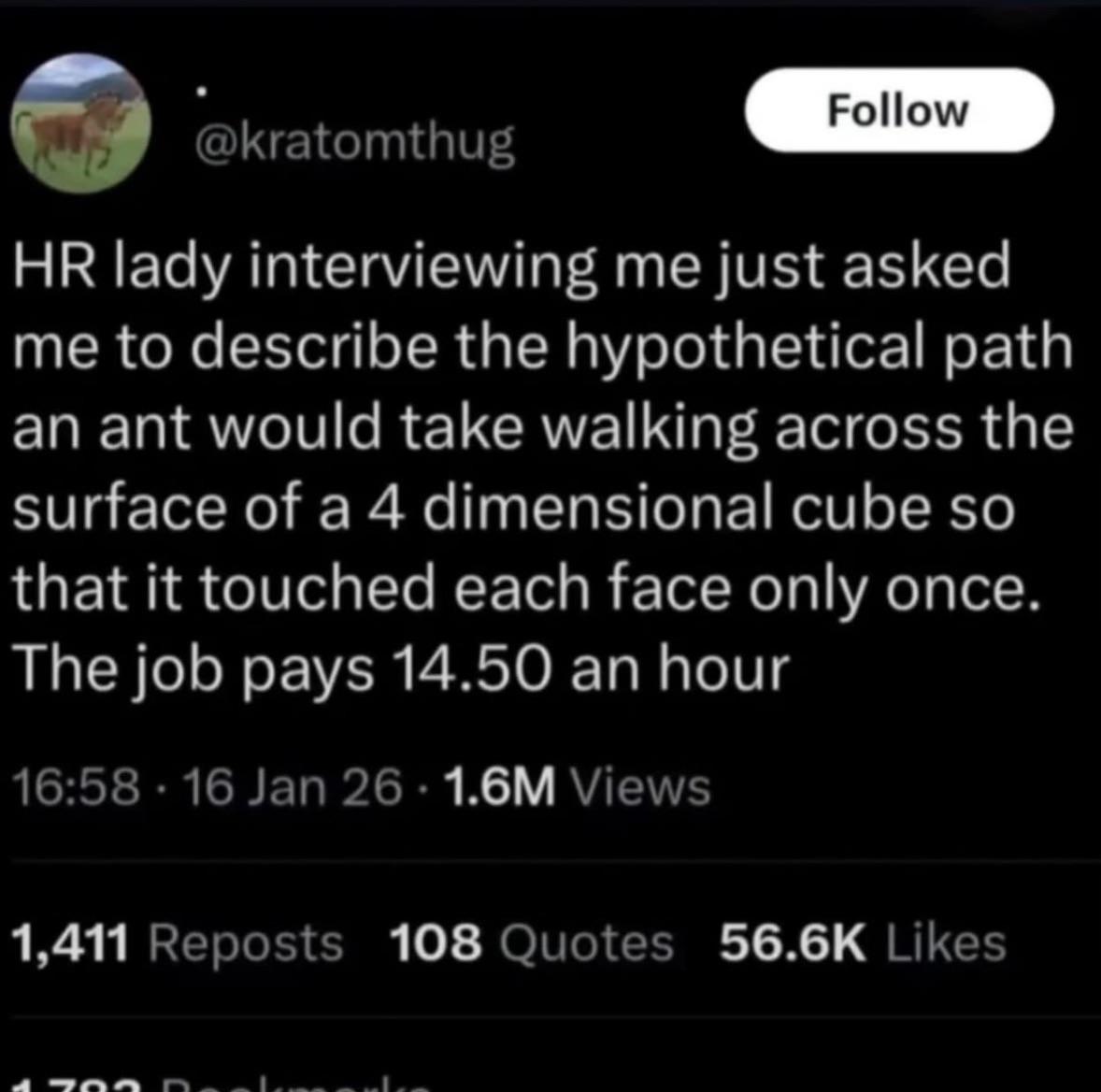
Every cube is four dimensional, assuming time as the fourth dimension. So it would travel forward in time at a relatively constant rate (since ants don’t typically walk at relativistic speeds [citation needed]) and it would traverse the other three dimensions in normal ant ways.
Damnnn bro. They gonna start you at $15 with that kinda mind.
If the ant can only move a single direction in time, it cannot reach all the time corners. Every corner in 3 dimensional space has a twin corner, at the beginning and end of time. Since the ant can only walk forward in time, it will only reach 2 4D corners, where it started, and where it ended.
I've seen this site so many times, and yet open it again each time I come across a link, just to marvel at its unhingedness 🥴
I wonder what would have happened if someone had attempted to explain sinusoids to that man. Like, they'd probably be called a dumb evil bastard and some racial and homo/transphobic slurs followed by the sort of logic that only schizophrenics can follow. But still, a chunk of this really is just a man mapping squares on circles
iirc, the author goes out on tangents about how people trying to explain actual maths to him were "educated stupid"
It must have been difficult for him to be so insane.
Interviewer did not define time. I will define it as 0 seconds per second. The ant can not move as movement is impossible at this time scale.
I was thinking 4 spatial dimensions and was trying to trace a hypercube
You were doing it for free?
Unfortunately I don’t think this is true. Every 3D face is the intersection of a 2D plane with the upper and lower bounds of the 3rd dimension. So I think a hypercube “face” would be every 3D “plane” at both the very start time AND the very end time. Meaning the ant would need to immediately accelerate to light speed - so no time would pass - and then (otherwise) normally traverse the faces, wait until the end time, and then repeat the process in reverse (still at light speed).

This is a lot like when Boston PD was found to screen out all the smart applicants. Sometime the company wants an obedient idiot.
Might actually be the case, lol.
Answer this question correctly (or even intelligently at all) and your application is rejected.
This is a direct appliacation of the hairy ball theorem.
I ain't even kidding
Hairy ball theorem applies to even-dimensional spheres (the ordinary sphere is the 2D surface of the 3D solid), but a cube in four-dimensional space is a three-dimensional surface, so it doesn't apply.
This is a question about graph theory, not topology; it's asking for a Hamiltonian path on the surface of 4D cube (where faces are vertices, which is different than the normal polytope graph).
You are right.
However most proofs of the hairy ball theorem also prove the converse, so that there is a continous non vanishing tangent vector field on uneven dimensional sphere surfaces.
This can be extended to all 3 dimensional surfaces in 4 dimensions homomorphic to the sphere. The ant walking can follow the vector field and solve this problem topologically.
My point being that the HR goon following the expected leet code solution might not understand this because they might expect the "approved" graph theory solution rather than an alternative approach.
Why does following a tangent vector field visit all faces of the hypercube? Surely it's not going to visit something like a dense subset of the hypersphere's surface? (Or is it? My intuition comes from thinking about the torus)
I'm more interested in the maths ;)
My topology and maths are very rusty, am a software developer these days.
I think that there are both tangent vector fields that don't and some that do. In the two dimnsional case (circle) certainly all do.
In n I intuitively would say that you should be able to have a vector field that does but I am now less confident to think about a proof on my bus rides while I answer here. I tried twice already.
I will try to think about this more, will ping here if I get more
You're hired 🤝
Yaayyy, where's my hypercubicle?
This is actually quite fun and simple! Even if the problem and my following explanation look complicated :P
Let's look at the three dimensional case. One can parametrize a 3 dimensional cube as the Cartesian product of intervals [0, 1] x [0, 1] x [0, 1]. This means a cube is a set of points (a, b, c) where a, b and c are real numbers between 0 and 1. The 2 dimensional sides of the cube are then given by fixing one coordinate. That is, the 6 sides are
{0}    x [0, 1] x [0, 1],
{1}    x [0, 1] x [0, 1],
[0, 1] x {0}    x [0, 1],
[0, 1] x {1}    x [0, 1],
[0, 1] x [0, 1] x {0} and
[0, 1] x [0, 1] x {1}.
Now we just start in the middle of a side at (0, 0.5, 0.5). To get to the next side we walk towards an edge (0, 0, 0.5) and then to the middle of the next side (0.5, 0, 0.5). We iterate this process until we run out of sides with a fixed 0, then walk towards a side with a fixed 1 and continue there. That is:
   (0  , 0.5, 0.5)
-> (0  , 0  , 0.5)
-> (0.5, 0  , 0.5)
-> (0.5, 0  , 0  )
-> (0.5, 0.5, 0  )
-> (1  , 0.5, 0  )
-> (1  , 0.5, 0.5)
-> (1  , 1  , 0.5)
-> (0.5, 1  , 0.5)
-> (0.5, 1  , 1  )
-> (0.5, 0.5, 1  )
This path basically spirals around the cube, going through every side only once. Here's a visualization (sorry, I'm no artist :P)

The same procedure works on a 4 dimensional cube or any other higher dimension. For the 4 dimensional cube it goes like this:
   (0  , 0.5, 0.5, 0.5)
-> (0  , 0  , 0.5, 0.5)
-> (0.5, 0  , 0.5, 0.5)
-> (0.5, 0  , 0  , 0.5)
-> ...
-> (0.5, 0.5, 0.5, 0  )
-> (1  , 0.5, 0.5, 0  )
-> (1  , 0.5, 0.5, 0.5)
-> (1  , 1  , 0.5, 0.5)
-> ...
-> (0.5, 0.5, 0.5, 1  )
This works for arbitrary dimension except for the 1 dimensional cube (which is just a line) because the "sides" there are the two end points of the line and not connected at all. Additionally note, that it is never specified how edges count in this problem, whether they somehow count towards a face or whether you're allowed to go back and fourth on edges. You could technically only walk along edges and step into the sides every now and then.
You owe me $14.50 for reading that.
I skipped all the blabla and looked at the drawing and was pleased to see the path I started visualising in my head was exactly like that. I do think I would've needed a cube in my hands to confirm it, or a bit longer thinking about it instead to complete it.
I don't usually do this, but I'm gonna go out on a limb and say this didn't happen.
Too many people are obsessing about 4d topology in this thread. The real difficulty in the question is the non -deterministic pathfinding of the ant, in the absence of pheromones.
Four dimensional? That is a tesseract. This is impossible to describe how an ant would even interact with let alone touch all eight cells only once.
Once done with the first cube, the ant takes a gondola, going along the 4th dimension and repeats the walk he did on the first cube.
The ant is a mathematical metaphor - a point that can trace a path along any surface and can cross to another surface only by crossing an edge, but cannot leave the surface.
It's not hard to imagine a 2d square sliding across a 3d surface or a line traveling across a 2d plane so an ant travelling across a 4d surface is not that weird.
making sure you cannot solve it, so you are perfect for the job
Possible candidate responses:
- Solves it (too smart for job)
- "That's bullshit, who needs this for a $14.50/hr job?" (too intolerant of bullshit for job)
- Tries to solve it but fails (lacks self-awareness for job)
- Knows they can't solve it so doesn't even try (too lazy for job)
- Doesn't understand the question/comprehend what a hypercube is (too dumb for job)
Maybe they're trying to weed out all actual applicants because they're hiring the boss' kid.
You forgot option 6, spew a bunch of techno bubble at the HR person who will definitely not understand the problem themselves and wouldn't be able to tell if you'd answered it or not.
That's just response 1 from the perspective of the HR person scoring it.
I'd argue that 3 and 5 are actually selection qualities for a job paying that low, with a question like that. The rest are all dis-qualifiers of course.
I believe this is sometimes the case. I was called for an interview with a group of 15 other people ones. We were like a class, being interviewed as a group, and were supposed to solve some problems together. Nobody in that group could solve even the simple, obvious problems - we're talking basic math and reading comprehension here. Got an email the next day informing me that they had I had not been selected for recruitment.
Sure. Draw the cube for me and I will plot it's path.
Here you go: 
That renders in 2d for me
No shit? Next thing you say that there are no 3d games, because there are no 3d monitors. And those that say they are 3d as well as VR are just faking it, by using two 2d projections instead of one.
Just code up a lemmy plugin that lets you embed basic interaction for navigating 4D shapes, my dude. It's just basic eigenvectors.
Just wait until they figure out how eyes work
They were being a smart ass.
You must be fun at parties
There are 2D monitors though.
You can project a 3d object into 2d space and you can do the same with 4d into 3d, but collapsing more than that generally loses too much information. Edit: If you include movement you can reduce this effect somewhat depending what you're doing.
Your portrait is now just a colored line the height of your subject, and this "4D cube" doesn't mean anything because it looks like a 3d cube with a smaller cube cut out of the middle of it. Unless you're really into geometry I guess it you dropped a /s.
I still don't understand it. Can you rotate it along the W axis so I can visualize it better?
Sure thing boss.

tricky with only four dimentions, but I'd use a Grathenbour's loop with a transverse Z axis movement if gimbal locks are ignored, naturally.

How does this compare in efficiency to casting Xagyg's Planar Binding and simply using a standard verity geas to question a daemon from one of the higher hypergeometric dimensions?
Be glad you got the shitty interview instead of getting ghosted
Okay, if you can explain to me in detail how four dimensional topology is going to be important to me while I'm stocking the shelves of your grocery store, I'll give you an answer.
Listen, once you get the job, you'll discover the truth about those shelves. And all I'm saying is, it becomes relevant that you can find your way through four dimensional space. Okay?
They got the shelves from an old university library, the librarian who sold the shelves was an orangutan.
stocking the shelves of your grocery store
See that's what's so ragebaity about the post. There's no mention of what the job was, which means people can just make up whatever bit of background allows them to feel the most superior.
It has a pay rate that is less than a living wage in many places. In fact, any job that could justify such a question could would be salaried. So it couldn't even be described with an hourly rate.
in many places
You do realize you’re still doing the exact thing I just described yeah?
I think we can safely assume he was talking about the US.
Entry level positions to Gregg's (fast food sausage roll chain) require 1000 word personal statements as part of online applications
Yeah but you also get equity in the company so I think that's fair enough.
You have to be proven worthy before you are handed the recipe for the vegan sausage roll. I want to know what addictive substance they put in there.
Ever heard of ChatGPT?
One does not simply walk into the 4th dimension
You're hired.
Just the sort of employee we want here at Moore Door & Supply.
Expanding into the coveted "ant house on a 4 dimensional cube" market.
At $14.50 per hour, he's going to take the shortest route.
Choose a starting face and remember it. Walk each face of a cell containing that face touching each face once much like you would a 3-cube.
Pick any adjoining cell and move into one of its faces from there, walk each of its faces saving the one opposite the face you started on for last.
From there you're on a shared face with the cell opposite your starting cell. Traverse this one in a similar manner to the last, but this time also visit the adjoining faces of each cell adjacent to the second cell you filled, before once again ending opposite the face you started on for this cell.
Now you're on a shared face with the final cell, opposite the face you started on. Walk around the remaining four faces and you're done.
Followed these steps, ended up on the ceiling of my neighbor's tea room.
Wait, isn’t this trivial?
If we’re talking about “faces” as in the cubic faces of a tesseract then each of the 8 faces are connected to all other faces except the opposite face. So just spiral around from your starting face (keeping the faces you’ve visited on the inside of the spiral) and you’re fine.
If you mean 2D faces connecting the 3D ones, then things get more difficult but not that much because you can do the exact same thing. Choose a 1D edge as your origin, pick a face touching that edge to start with, traverse that edge twice to get the next two faces. Then traverse three faces which share edges with those faces you already traversed (there are 6 faces with this property, 3 for each vertex of our origin edge, the set you pick determines the “direction” of your overall progress through/around the tesseract). Repeat that step again but for the faces that share edges with two of the three you just did. Repeat again and again and again until the last three faces share a vertex with the origin edge you started with. You’re done.
Am I missing something? Did the prompt mean to say you can only traverse each edge once?
Edit: the 2D face path I described would miss 6 faces. Those six faces should be traversed in the middle, so do the first three faces, the second three, then all six which touch both those three you just traversed and the three you would have done next on the original path. Then do the rest just like I originally mentioned.
I understood some of those words.
Have you ever seen one of those images of a tesseract where it’s like a cube in a cube? (You can just look up “tesseract” to find an image)
Now, pick one of the corners of the outer cube and find the line that connects it to a corner of the inner cube. That’s our origin “edge” and we’re basically just going to move in through the cube along that direction.
There are three “faces” which share that “edge” (line). We do those ones first.
Then we move deeper in and do the three faces of the inner cube which share the corner our origin line connects to.
Then we have to zig zag around the six “faces” that exist between inner and outer cubes which are roughly perpendicular to our origin edge. (Imagine you broke the tesseract in half by cutting halfway between your starting corner and the corner opposite it. The “faces” we need to traverse would intersect that plane)
After that, we do the three faces on the far side of the inner cube. (The ones opposite our starting corner)
Then we do the three around the line which connects that far corner of the inner cube to the outer cube.
Then we do the three faces on the outside of the large cube at that corner.
Finally we do the three faces on the outside of the cube around our starting corner.
But the sentences continue to elude me
Isn't a cube by definition a 3 dimensional object? If it were 4 dimensional, it would no longer be a cube.
Its a generalisation. A 4d cube is a shape that has the same length in all 4 dimensions. You can also talk of 5d cubes, 6d cubes, etc. These are commonly called n-cubes: a 4-cube is a 4d cube.
There are also 4D spheres, even though spheres are definitionally 3D. They are called n-spheres.
robot voice: how many 'd' is <USER_MATERNAL_PROGENITOR> a...cube...within? Ha ha. Ha ha.
spoiler
I looked:
ERROR: unbounded_index
Does not compute. Ha ha.
Well I think the ant would probably wander around until it found food
Forward, left, right, forward, left.
That’s a three dimensional cube.
Which I thought by definition was a cube.
What is a four dimensional cube?
What is a two dimensional cube?
What is a four dimensional cube?
2 three dimensional cubes, A and B, and each corner in A is connected by a new edge to it's equivalent corner in B. This is also called a tesseract.
What is a two dimensional cube?
A square.
In general, if you have an n-dimensional cube, you can get an n+1 dimensional cube by doubling it, and connecting each corner with it's equivalent corner.
A 0-dimensional cube is just a single dot.
A 1-dimensional cube is a two dots, connected by a line.
A 2-dimensional cube is 2 lines, connected. Also called a square.
A 3-dimensional cube is 2 squares, connected. Also called, well, a cube.
A 4-dimensional cube is 2 cubes, connected. Also called a tesseract.
A 5-dimensional cube is 2 tesseracts, connected.
In general, this is called the n-dimensional hypercube.
And continuing this, each edge on an n-dimensional cube will, together with its copy and the two edges connecting it to its copy, form another face on the n+1 dimensional cube. This new face will border exactly one face on the original cube, and one face on the copy. It's also bordered by two other connecting faces.
So, basically, if I start out on a face on the original cube, I can walk onto a connecting face, and then walk around all four connecting faces, and walk to the copy face. From there, I walk to another copy face, over the four connecting faces, and then back to the original cube. This way I should be able to continue going back and fourth between the cube and the copy, always walking across all the connecting faces.
I got a rubics cube here, with sides white, red, blue, orange, green, and yellow. For each of these faces, there exist 5 additional ones on the tesseract. For white: white, white_copy, and white_c1 to white_c4.
The solution is white, white_c1, white_c2, white_c3, white_c4, white_copy, red_copy, red_c1, red_c2, red_c3, red_c4, red, green, green_c1, green_c2, green_c3, green_c4, green_copy, orange_copy, orange_c1, orange_c2, orange_c3, orange_c4, orange, blue, blue_c1, blue_c2, blue_c3, blue_c4, blue_copy, yellow_copy, yellow_c1, yellow_c2, yellow_c3, yellow_c5, yellow.
I guess I'll never get that $14/hr job...
4th dimension is time?
5th dimension is your soul, and the 11th dimension, well we don't talk about the 11th dimension.
You can easily add additional dimensions to a three dimensional cube: color, sound, wall thickness, surface material etc.
But can you prove that this solution wouldn't work on a 4 dimensions cube?
This is how you spawn a tank in GTA
Am I fucking stupid? Just walk in a shallow spiral?
"with it's legs"
*its
"it would start by crawling up your ass."
I dunno if this is supposed to be derisive to the wage, but considering that 9/5s 6 days a week in Venezuela are 200$ monthly... where do I sign? Ill learn physics!
Just one caveat, you have to move to a place where the rent is $2000 a month.
a room here with the right to use the bathroom and the kitchen is 250-300.
"Being that the fourth dimension is time, it would need a flux capacitor and have to hit 88mph but where he's going he doesn't need 'sides.'"
"They would head towards the exit" and before they process youre already standing up and walking away.
We gotta start laughing in their faces
They specifically didn't say it was a hypercube, so I'm going to assume its a normal cube traveling through time and say that it could get to a max of 5 faces by moving forward 3 times, turning 90 degrees and moving forward again. The 6th face can be reached, if the cube's gravity-well is high enough, by getting a really good running start and jumping over the next to land on the 6th, Otherwise the ant is fucked and his father is very disappointed in him.
Or move forward twice, turn 90°, move forward once, turn 90° opposite to the direction you turned earlier, and move forward twice
isn't 4d a line of cubes? would need 6d for cubes of cubes?
Well technically as the ant is traveling across the fourth dimension, time in most cases, in the example meaning it instantaneously travels the entire surface and touches the faces an infinite number of times in an infinite path unless only one edge touches a surface without any 3 dimensional velocity. If the latter, then let us define the faces along said edge as 1 and 4, the faces between but parallel in edges as 2 and 3, and the faces on the perpendicular axis as 5 and 6. Then, its path is 1, 5, 2, 6, 3, 4, and dismount. To ensure the ant never again approaches the cube in infinite time, have it travel in a perfect circle around the cube infinitely.
In mathematics, the 4th dimension isn't in any way privileged, so the ant isn't "traveling across the fourth dimension" as such, it's tracing a path through all four dimensions, just like you'd trace a path through three dimensions.
You're needlessly abstracting it. The ant has a constant 4th dimensional vector and a variable 1st, 2nd, and 3rd dimensional vector as a function of it.
I have traced the path, the addition of the 4th dimension doesn't change it.
If the interviewer didn't intend for this answer then they should have specified a different 4th dimension which is non-constant nor linear.
There's no "constant 4th dimensional vector" here.
You’re overcomplicating it by treating the 4th dimension as time. In a tesseract puzzle, the 4th dimension is just another spatial direction. The ant simply walks across adjacent cubic cells on the hypersurface, much like walking across faces of an ordinary cube. The problem reduces to finding a path through the adjacency graph of the 8 cells.
Your lack of understanding of movement as a combination of vectors makes me think you're talking out your ass.
This is linear algebra. The solution can be written as a matrix of 4th dimensional space. Its all vectors.
And despite your confidence, your answer is wrong. You're talking about a 3-cube embedded in 4-space instead of a 4-cube, which is why you only see 6 faces, whereas a 4-cube (a tesseract) has 24 faces.
Real life cubes are 4 dimensional.
The 4th dimension is time.
How you define the 4th dimension changes the question and I leveraged that to get an easy solution.
I can do my job that pays more than that and I can't do this problem lol. 😂
That happened
I dunno. I could see this being a customer-facing role and the question is an attempt to weedle out applicants who might respond reflexively with, "That is the dumbest question I've ever heard. Please go away now."