Why don't they get this?
1mon 1d ago by lemmy.ml/u/InterestingUsername in memes from lemmy.ml
It can be really good to cover the fields!
Reduce evaporation, expand the range of plants that can grow and provide subsidies for hard pressed farmers
Protecting food and water resources are going to get increasingly important over the next few decades
Yes. Both, not either or. Where is that shitty competition thinking coming from?
The cynic in me suspects it's an attempt to sow division within pro-solar panel groups. Get them arguing amongst themselves over where to put them, rather than uniting to push for more panels.
Yeah I really hate this post, and how often it seems to surface on lemmy. Agrivoltaics is good for energy and for the plants*!
*Some exclusions apply. Not all plants grow better with the added shade.
In Switzerland, there was a vote on a petition requiring new houses to include solar panels. Conservatives opposed it, arguing that construction costs were already too high without such regulations. Instead, those same people want to build massive solar farms on untouched natural landscapes. To me, the reason is obvious: energy companies want to maintain control over a centralized power infrastructure. This way, they can keep charging us high electricity prices while pocketing subsidies for infrastructure projects.
Ding ding ding that is correct!
no, it's one thing to allow solar panels on houses, but a completely other thing to require them. i'm against the requirement as well. there's absolutely no sane reason for that besides making people uncomfortable if they don't want them. if they want them, they can already get them.
A lot of the big building companies, in Europe, treat solar panels as a premium option and so charge a larger profit margin on them. Installing solar, while constructing the house is a LOT cheaper and easier than retrofitting them later.
The panels have gotten cheap enough that it's no longer a real cost burden, Vs the cost of the house.
Put them everywhere. I don't care where they go. I want my son and daughter to have a planet to enjoy and raise a family in.
A lot of it comes from conservative AstroTurf.
And, unfortunately, a lot of it comes from farmers and other people living in rural areas, who see fields of crops being turned into solar farms and think "these panels are ugly, these panels are industrial, these panels are taking up fertile farmland" and see it as just one more way the government is exploiting rural areas for the benefit of the cities.
They're wrong, of course, but rural America has been abandoned and neglected and made the dumping ground for all sorts of polluting industries for so long I can't blame them for thinking that way.
It's the way the typical American thinks
'Muricans have a habit of seeing things as zero-sum, because that's what their shitty system relies on
Every single time this gets posted: Both is good.
Farmers are the biggest welfare queens in this country. They all bitch and moan about needing subsidies and everything but they all have crop insurance.
Generally speaking these are the large companies doing this while pretending to be small farmers.
Farmer A through F are family members. They each have their "own" farm, just inside the limit to make it a small farm. Farmer A also has a "small" farm with Farmer B, and C, and D, and E, and F, each qualifying as a "small" farm. Do the same with the rest of the mixes.
The reality is that these "small" farms are really one 400 acre farm run by the same people, worked by the same people (migrants being taken advantage of with illegally low wages).
The actually small farms do benefit from a lot of the programs, and that can be a really good thing. Its unfortunate though that there are enough loopholes that large scale corporate farming finds ways to abuse the system by cosplaying as "small farm" owners.
how many farmers do you know? You understand many are black and you're calling them welfare queens, right? I get that people think farmers are republicans or conservative but that's just admitting you have outdated knowledge. The times have changed
While you aren't wrong about them being good to use in Ag, the scenario where you can do both is more limited.
You can't drive a combine harvester under panels, to harvest the crop you just protected for instance, unless you place and design your panels carefully. It's ok for pasture in that sheep and the like can get in and chow down and it provides shade though.
For a parking lot, it's easier, as shown, but also fuck cars, they're their own environmental disaster
They are using them on closed tailings facilities (mining) to add additional land use or gain benefit where there wasn't really a good land use to begin with.
I think urban settings are where panels will ultimately shine, as you can concentrate them without taking up other land uses - it's just an add on and doesn't detract from existing or future uses like using them in an ag field would.
40% of US cornfields are used for energy today. If these fields were turned into solar farms with natural meadows under them, not only would we actually recover more energy per acre than corn ethanol, but we would start restoring the American prairie that has been nearly erased from the continent.
It uses far less materials to build arrays in a field than over a parking lot. The panels don't need to be mounted as high. There doesn't need to be as much safety margin and protection of the panels because people won't be underneath them.
The bigger problem is getting the power from solar farms to where it is needed, but this is also not as big a problem as anti-electrification lobby wants you to believe.
Technology connections did the math out on this. He found that acre for acre, even assuming very poor fuel mileage for an electric car, the same land used to produce electricity instead of corn for fuel would be about 70x more efficient.
He also found that if we used only ethanol corn fields for solar panels and no other land, we would produce 7x the current total power demand of the United States.

I don't know. Sheep like to park below panels too.
Yeah I was gonna say:
First of all, we probably should not encourage more parking lots.
Secondly, in the words of that kid in A League Of Their Own who gives Gena Davis a ride who hits on her and then she makes a snide remark about smacking him around instead: “Can’t we do both?”
we probably should not encourage more parking lots
I don't think anyone was suggesting that we build new parking lots just to install solar on them.
Woolly engineers hard at work.
On a nearby field, they placed panels in a height that cows can still use the field as well - win-win in my book.
Saw a documentation a few days ago. It was about a berry Farmer who put solarpanels above his berries to shield them from direct sunlight. Works great! And He could replace all his transporters with EVs. :)
I've seen plenty of different types of solar panels, some specifically for agriculture use that have small gaps between the solar cells to allow for more sun to reach plants.
I'm not sure how that affects solar panel output/longevity but it can't be too much of a hit.
How about we don't cover our fields with car parks?
Too radical for Americans
With a pink hotel, a boutique, and a swinging hot spot?
By and large we don't. 53% percent of the surface area of the US is farmland. 28% of it is protected federal lands of some stripe or another — national forests and national parks, BLM land, etc. Everything else, all the remaining cities and suburbs and coal burning power plants, freeways, stroads with no bike lanes, Walmarts, and strip malls are all packed into the remainder. Most of that is along the coasts. The US is absolutely full of wide, huge, horizon-to-horizon, enormous expanses with nothing in them.
It's just that our populated areas, largely along the costs, are utter hellholes.
The raw numbers are very misleading. First, although only (!) 53% of U.S. has been ecologically devastated by farming, the 28% of "protected" federal land is often leased for cattle rangeland, clear-cut by logging companies, or what environmentalists derisively call, "rocks and ice."
The small remainder has been carved up by roads. It would be one thing if all of the pavement were one, contiguous blob in the middle of the New Mexico desert, but it is laced across the landscape from coast to coast. The effect on wildlife has been profound, from direct impact to roadkill numbers, to fragmention of ecosystems, to pollution from tailpipe emissions and road surface runoff.
It's not about the space that cars physically occupy (though that is a major issue in cities), but rather the almost-apocalyptic effect they have had on the natural world. We would be better off if we didn't build all of the parking lots on farmland (or anywhere).
This is ridiculously untrue and confuses too much of what matters for food
I just drove through New Mexico hundreds upon hundreds of miles of nothingness
public transport makes sense above a certain population density. many rural areas just don't have that.
It's called Agrovoltaics and it works pretty damn good,if you do it right.
The pairing can also offer some synergies. Solar panels can help moderate ground temperatures, provide shelter for livestock and help plants retain moisture.[6] For farmers the ability to produce electricity can help diversify their income stream.
Solar panels block light, which means that dual use systems involve trade-offs between crop yield, crop quality, and energy production.[7] Some crops/livestock benefit from the increased shade, obviating the trade-off,[8] such as green leafy vegetables, and spices such as turmeric and ginger, whereas staple crops such as wheat, rice, soybeans or pulses require more sun.[9] Agrivoltaics has also been used at scale in arid and semi-arid regions to stabilize soils, reduce dust storm intensity, increase vegetation cover, provide forage for livestock, and curb desertification, notably in northern China.[10][11]
The picture in the op doesn't look like agrivoltaics though. Compared to the agrivoltaics examples of the wiki article, the panels in the op are more densely placed, placed flatter, and placed closer to the ground. Nothing is getting harvested there, the most they could do is keep rabbits under them. From what I've seen in person, the non agri kind with panels over monoculture grass fields is much more common than agrivoltaics with cultivated fields.
In the US it makes sense. Much of our corn is grown for ethanol so ot can be used for fuel. Replace that with solar and we reduce our reliance on a monocrop and end up with far far more power.
They also use lots of irrigation from aquifers in the Great Plains, so they'll need less irrigation and the shading will help a tiny bit with replenishing the aquifer.
In northern Europe these solar fields make no sense at all to me though. When I see something like the fields below in my temperate marine climate, then I can't help but think of the forest that could have been there.
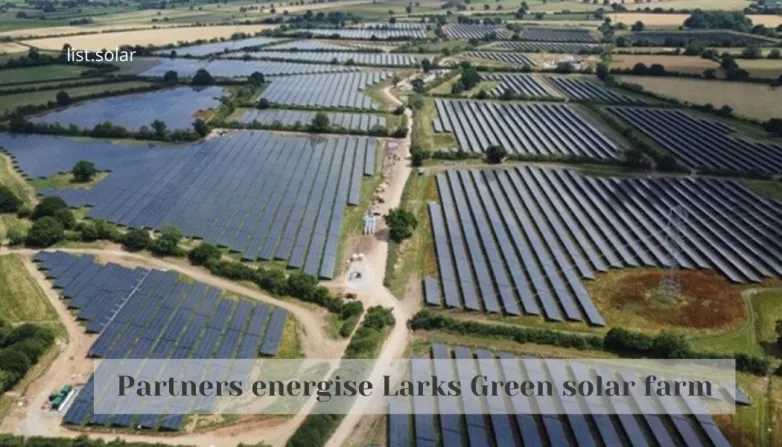
Turning it back into a forest will never happen when the land owner needs to pay taxes on the land and thus need to make income of the land. These solar fields are usually on private property. Not public land. Either they put windmills and solar on the fields or they raise cattle or grow crops. Which one is better for the environment overall?
If you destroy existing forest to make a farm, maybe. But if it's an empty field and you want to do something with it, making it into a forest makes little sense. It's complicated, very expensive, and doesn't do much. Just let natural forests do their things, allow them to expand if you want more forests, don't make one from scratch.
Making wild forests in a temperate climate is not complicated at all. Stamp a bunch of seeds into the ground, fence it off to keep grazers away, wait a few years, and boom there's a new forest. Once it gets started, nature knows just fine how to grow forests, they've been around far longer than our meddling after all. The problem is humans, who need capital and incentives to let nature do it's thing. Making the forest is cheap, buying the land is expensive. And a wild forest has little earning potential, so for private landholders it makes no financial sense.
But if there were incentives, then these solar panels could have been put above existing hardened surfaces (roads, parkings), and the unhardened land could have been returned to nature. We'd have both the solar panel fields and the forest. It requires a much larger up front investment, which is why it's not going to happen without government incentives, and to get those, political will is needed, which is why it's not going to happen anytime soon.
And we should absolutely be making more forests from scratch, Europe has a massive deforestation problem. Reforestation is already an official policy goal in the EU and in most (I assume) EU countries, and this could be one of the ways of achieving those goals.
I'm not an expert by any stretch, but through no fault of my own, I know my way around agriculture, and I know my way around planting and removing trees. Making a forest, a proper forest, is probably the furthest thing from "stamping a bunch of seeds into the ground" you can imagine. You can't even grow trees from seeds manually, that just doesn't work on any scale. You plant saplings that you spend years caring for, and then they die on you and you start it all over. The way you described is the way to get a wild meadow, but the one dominated by some weed monocrop, and exclusively the one you don't want. You will have a country-wide infestation of poisonous hogweed that kills all life around it before you'll get one tree the way you want it to be.
Forest requires very specific amount of biodiversity, soil characteristics, layers of biomass influencing each other, specific insects and animals, it needs tens, and in specific cases, hundreds of kilometers of space, it needs seasonal changes, in some cases cycles of burning, and most importantly, it needs time. Generations of trees need to grow and die and grow and die again in order for a forest to be sustainable and not fragile. Forest isn't a bunch of trees haphazardly put in an empty parking lot, it's a life long project that is not guaranteed to succeed by any stretch.
Europe has the deforestation problem because forests are biomes with their own complicated rules, not a bunch of seeds thrown in an area half a kilometer wide between a road and a waste treatment facility.
I've seen forest sprout up in abandoned dead areas without any human assistance. It takes about 2 decades of being left alone to get enough young growth to start being called a forest, but not really more than that. And it would take generations more to be called an old "real" forest, but it has to start somewhere. To rehabilitate long dead soil it might take what you describe, but turning an old meadow into a wild area that will eventually turn into a forest, does not need human intervention. It just requires to be left alone. In my climate that is. Claiming that forests can't grow without human assistance is absolute nonsense, forests grew just fine before humans came along.
And as further proof that I don't live in fantasialand with my belief that forests can grow without human intervention, here's 2 links with examples: https://en.wikipedia.org/wiki/Passive_rewildinghttps://www.rewildingmag.com/passive-rewilding-natural-reforestation/
A bunch of twigs does not a forest make.
In a pre-industrial Europe, sure, forests are everywhere and foresting alone like crazy. But we're in a post-industrial one. Most land in Europe is altered in some ways, was farmed on at some point, or had something else going on. Everything is littered with plants that we selectively bred or mutated, a wild very aggressive weed are everywhere and will be everywhere. Soil composition is wild and weird. The air is unfit to breathe the food is unfit to eat I am mad as hell and I'm not going to take this anymore, you get the point.
It's not that it can't grow without human assistance, the human assistance is needed to keep it from human interference, because we changed the land and continue doing so.
But obviously, sometimes a forest just grows, when it wants to. But you can't guarantee this process, that was my point.
To give another example:
...
Instead, the trees at Knepp Castle Estate in southern England were allowed to spread naturally. Birds such as jays can disperse as many as 7,500 acorns in four weeks. "Not a single tree was planted, no saplings were bought from commercial nurseries, no tanalised wooden stakes, no polypropylene tubes and plastic ties, no direct financial or carbon costs – no effort," says Isabella Tree, co-owner of Knepp Castle Estate.
...
Chazdon, who has studied natural regeneration for more than 30 years, questions the commonly held assumption that trees need to be actively planted to tackle climate change and biodiversity loss. "There's a perspective that humans did this damage and it's our job to fix it, and that we should govern the process, and just let nature help when it can," she says. "Another view is that forest restoration is fundamentally natural, and that humans can assist it, but ultimately it should be governed by natural processes.".
...
Proponents are arguing for natural regeneration to be taken more seriously in national and international efforts to mitigate the climate and biodiversity crises. Recent research has shown that natural regeneration can potentially absorb 40 times more carbon than plantations, and provide a home for more species. It is also significantly cheaper than tree planting, with different studies in Brazil showing costs reduced by 38%, or even up to 76%.
...
https://www.bbc.com/future/article/20210524-the-reason-wild-forests-beat-plantations
I mean, yeah, that obviously happens a lot. But we started with how easy it is to plant a forest on any unused land, and ended with a forest growing into a bigger forest under the scientific observation getting into national news.
There is no direct adjacency needed to spread seeds from one plot of land to another, that's one of your made up hurdles. Small seeds naturally get blown far in the wind. Larger seeds still get carried large distances by animals, which was why I specifically copy pasted the bit about birds carrying acorns ...
To claim that it would be difficult and expensive to let a wild forest grow in those meadows is absurd, that's what this was about for me. It's a convenient excuse to do nothing, but it's not a very good excuse.
Here's the largest solar farm in California. It covers sand. Also, solar panels don't block 100% of the light getting to the ground, so different species of plants and animals can live and thrive under them. The land under solar panels is not lost to natural use. Life will adapt.
That said, solar panels over car parks is also a good idea. Both things can be true.

Life will adapt
Life will recover:
https://www.ecoportal.net/en/foxes-use-solar-farm-as-natural-habitat/20424/
That article has all the hallmarks of AI-generated slop.
Sweet rig.
Which make/model of mixing deck is that?
;)
Also a solar park like this is a lot cheaper and thus they can sell the energy for much cheaper. Solar over car parks requires a more complex structure to hold the panels since they are higher up and therefore catch more wind and the structure needs to span a larger gap. So a car or two can park between the pillars. This increases the cost.
Pv is around 250-400 times more efficient than energy crops for Bioethanol. So 1ha of pv could free up 249 - to 399 ha of land. Thats an ultimate win!
In the states, though, solar is woke and gay, and thus doesn’t get any financial help(currently). Farmers that live hand-to-mouth in the old model, getting drip-fed agri-subsidies, don’t have a way to soften the blow of the capex needed to push through the expense barrier, even though the other side is cleaner and more profitable.

Shift the subsidy requirement from agricultural to PV migration and that'll fix itself.
Stop sharing this bullshit. It is a stupendously simplistic view that is propagated by those wanting to get in the way of cheap renewables.
Yes, it makes sense in some cases to cover parking lots, but it increases the price and complexity many folds and the areas needed in open land are next to nothing compared to the area being used to grow energy crops today.
The meme should be “stop covering our land with fertilized, pesticide covered corn and rapeseed that go into combustion engines, cover it with solar instead”
Technology connections has a video where part of this is explained.
soooo much this. Also stop building parking lots, people using cars need higher pressure to use other means of transportation. Car pool etc.
Covering parking lots has the benefit of also protecting parked vehicles from sunlight and weather, meaning your car isn't blazing hot when you return to it and you can unload any purchases in peace.
Why would installing panels over a parking lot be many times more expensive than installing them in any other open, flat area? Is it having to bury the power lines?
The meme should be “stop covering our land with fertilized, pesticide covered corn and rapeseed that go into combustion engines, cover it with solar instead”
It's doubly stupid cause it's just greenwashing a fucking carpark of all things. Do they not see the irony here?
both. both is good.
Nah, I'd rather leave the fields open for nature or farming.
Agrisolar exists. If the US converted just a few % of the acreage legally mandated for growing corn for ethanol to solar, the energy crisis essentially solves itself.
also what i feel people forget is that you can join windmills and solar panels on the same area. although i don't know whether that's usually done.
I'm asking out of genuine ignorance here, but... don't you have to distribute it?
A lot of people have asked in the past, why can't we just cover the Sahara Desert in solar panels, and my understanding is that it's because you can't get all of that power where it needs to go. So the installments have to be distributed geographically, not all in one place, no?
The US grows a LOT of corn across most of the nation. HVDC links can transport a lot of power very efficiently over long distances. These systems are in use for this exact purpose in China, Canada, and Sweden where generation is far from the consumption site. It wouldn't work across continents, but going from the Midwest to California or something wouldn't be a problem.
They should at least replace the fields producing corn ethanol. Saves the recurring cost of producing the energy, and reduces the emissions of both harvesting and burning.
Huge swathes of land are used just to burn the output.
Farming is much worse for land than PV. PV is almost as good as leaving it untouched, while farming ruins biodiversity through monoculture, nitrate and phosphate pollution, and possibly pesticides.
Large-scale ground-mounted PV is fine and people need to get over it. If you are in the mood to publicly advocate for more environmentally friendly land use, go and protest the grotesque waste of land for crops like corn and sorghum used to produce bioethanol fuels.
Only bc we choose to farm in the most aggressive and anti nature way possible. Other techniques do exist and are being reintroduced in some areas
The most pro-nature approach I can think of is to use farmland for fuel production (a hectare of corn produces 20 MWh/ha/y in bioethanol), convert 3% of it to PV (700 MWh/ha/y) and restore 97% of it to its natural state while still harvesting the same amount of energy. In the US that could be 40 million acres restored to nature. You can improve farming methods for actual food production, but none of that will beat millions of acres of land not being used for farming at all. Another, much more effective measure would be to reduce meat consumption to, again, render millions of acres of farmland ready for renaturalization.
On the other hand, I do enjoy eating food
And like I said, vast amounts of farmland are for fuels, not for food. So effectively harvesting energy like PV, just much slower, much less efficient and much worse for the ground and fauna.
I hear you, but solar doesn't block the field. Can still use for grazing, for crops, or as nature. It just reduces sunlight, which is a good thing for crops/grass in dry areas especially.
In America, if we only replaced the fields growing corn for Ethanol production to add to gasoline, leaving every other field alone, we'd have enough energy to power the whole country with a huge surplus to spare. We're already using the fields for energy production, we're just being inefficient about it.
Bro we're gonna starve.
Actually, with climate change in the back of the mind, covering fields with solar panels (not 100%, only partially) will reduce heat damage and water usage in the height of summer, and also protect the ground during cold spells of winter. So it is not that stupid after all.
That covering car parks with solar is a good idea is completely independent of this.
Obviously we could do the same or better with coal by just burning as much as we can without any attempt to filter it out of the air, encasing the earth in a wonderful shady smog, keeping us all shaded and cool /s
Plants need direct light to grow… most need full sun. Personally all the solar farms I’ve seen just “grow” grass and everything is kept trimmed down to not cast shade on the panels. Putting the panels up higher would still cast any plants grown in deep shade. I think putting them in places deep shade is needed/wanted on the ground makes sense and because cities tend to be hotter due to paving using solar panels to cast shade would help lower the temps in cities, lowering power usage on things like AC. I think integrating solar into urban landscapes is the future
Plants need direct light to grow… most need full sun
Except for all the plants that evolved and thrive in the low light beneath tree foliage. Evolution is not so picky as a pretty houseplant.
They need direct and indirect light, and agro-panels have a coverage of about 50%. Not enough for high-end farming, but more than enough for grass and similar to grow for grazing. Or some herbs that need shadow to grow properly. Those panels are usually placed on land that can't be used for high-performance farming, anyway.
Plant butterfly bushes and other pollenator attractants / nectar sources.
One can always do this. Quite some of those plants love shadow and half-shadow environments. And, as i stated in my original post, don't ignore the climate change. Many plants growing in a given location for ages will have difficulties in the future because of the more extreme weather.
You can either change the plants you are growing (like people in the south of my country who replace wineyards with olive orchards), or you can help historically local plants to survive, and solar panels is actually one way to do this.
Plants need direct light to grow… most need full sun.
That's only true, if the solar panels are not properly adjusted to this use case.
The solution for that is https://en.wikipedia.org/wiki/Agrivoltaics#Spectrally_selective_modules
Plants need direct light to grow… most need full sun.
The humble Monotropa uniflora:
Crazy thought: put solar panels over A/Cs and tie it into the panel.
How many times is this gonna get posted? It gets dunked on every time too...
I'm convinced this is astroturfing in the same vein as the "Just stop oil" protesters that do all that trolly shit. The goal is for you to view green technologies negatively by association, and to feel like the science and decision-making behind them is suspect.
It's not a bad idea to have energy production near where the energy is being used.
That said, it's not an either or.
Technology Connections actually did a great video on why using solar panels in place of crops can benefit the crops and actually provides more energy than the crops themselves. At least in the U.S., a huge portion of our crops are used for ethanol in gasoline anyway.
Ooooof course it is
So anything that needs energy should have its own energy supply near where the energy is being used on the body as a design principle?
Sounds good.
Sounds even better than the (relatively) mere incremental improvement in batteries from donut labs.
Even if only painting everything [that needs some electricity] with photovoltaic paint.
Not only to feed cattle, also to make ethanol to be used as fuel 🤦♂️
This is emotionally resonant but it's actually sometimes better to cover fields. The right thing is not always intuitive.
Yup, like, what is it replacing? If it's food that goes directly to humans, let's not do that. If it's corn for ethanol, that has little worth. Covering it with solar panels isn't terrible by any means.
I feel like people still haven't internalized just how much of our fields go to corn for ethanol
Exactly, and those take resources to grow. Water, fertilizer, pesticide, herbicide, oil, farm equipment, and so on.
Both. Agriphotovoltaik is neat stuff, proctects the more sensitive plants and enables farmers to generate more income, making them less depending on subsidies, bad crops, etc.
I'll do you one better
Replace most city car infrastructure by bicycle infrastructure. The few remaining required car parks? Move those underground under buildings and parks. Then those places that used to be car parks, make those actual parks to walk and sometimes cycle in
Then move solar on top of building roofs
Or spaceships for everybody.
bicycle-mostly infrastructure is ableist.
Nobody who's actually disabled believes that. Knock it off with the dishonest faux white-knighting.
So how is someone who struggles to walk supposed to use a bicycle?
They could use a car and drive on the part of the road infrastructure that haven’t been converted to bicycle infrastructure. The comment didn’t say that all car infrastructure should vanish. Probably not thinking that busses should vanish.
They're not. They're supposed to use their wheelchair on that same infrastructure that's great for human-scale wheeled vehicles.
Nobody who’s actually disabled believes that
i believe it
The foundations used to support both pictures are the same: W6x9 or W6x10.4 W-beams.
Carports are more expensive, though, because those foundations need to be just as long as the ground-mount ones + 14' to support the panels above parking spaces. And often, ground-mounts can use alternative foundations like helical piles or ground screws which don't need to be embedded as deep as W-beams. This shaves down foundation costs.
Then, you have to consider the steel trusses needed to distribute complex carports loads, which are simplified or non-existent with ground-mounts.
Then, you often have concrete encasements around carport foundations to protect the foundations from vehicles collisions.
All of this contributes to carport solar PV being the MOST expensive out of any alternative.
And if anyone is curious, for Commercial & Industrial (C&I) solar in urban/suburban contexts, cost effective PV usually goes roof-mount < ground-mount < canopy-mount. For utility/DG-scale, ground-mount is king.
Because it's not necessarily correct. There's so many fields dedicated to growing energy plants that covering just a part of those would be sufficient to electrify the entire transport sector. That's just fields for plants for Biofuels etc., not a single beautiful picturesque meadow, not a single field that grows food.
Of course covering car parks is a good idea too, but it's more expensive, and it's a climate change denier's strawman that covering fields would supposedly endanger our food supply or ruin our landscapes.
In the EU at least farmers are getting paid to not grow on certain fields in order to hold crop prices stable.
It's a good idea to put them to produce smething else.
Knowing our great bureaucracy I bet they lose the subsidy if they put solar panels on those fields.
At least there is no Big Chip lobbying against it.
Given that :
A : agriphotovoltaism, can drive up most field yields because loads of places are now too dry and too hot in the summer. Solar panels block the excess sun and keep the moisture in the ground. Conversely, you can't park more cars under solar panels.
B : your average field is much larger than a car park. So installing a solar power plant is more efficient in a field (less paperwork per square meter, spend more time building than moving material around...).
C : car parks are often surrounded by buildings which will block the sun. This doesn't happen on most fields (which rarely have tall trees)
D : a car raming into your poles is bound to happen and you pretty much have to replace the whole pole. A cow ramming into your pole might happen, the pole won't give a fuck.
E : installing solar panels above car park is a lot more expensive (taller infrastructure, need more space between poles so need chonkier poles, maintenance high up is way more costly, etc ) And solar panel companies usually work on a much tighter budget than say the petrol industry for exemple. So every dollar counts
Anyway, next time please do some research instead of posting a divisive post and spreading misconception ;)
Edit : as some others pointed out :
- destroying natural environments in order to put up solar panels is not okay. Which i totally agree with. That's why I was talking of agriphotovoltaism specifically.
- if we get the opportunity, we might as well put up solar panels in both fields and cities. We shouldn't paint it as an either/or situation because it risks dividing the pro solar population and i don't need to explain why this is a bad idea
Around here they're cutting down thousands of acres of trees for them. Tractors are as tall as cars, you have to mow livestock fields. Field installs make a lot of sense for a variety of cases, but there isn't a right answer, neither the poster or your comment.
To me the real issue is the greed, a Florida investment firm buying 1k acres of contiguous woodland, wiping it, installing solar for a casino to but so they can market how green they are. While individual homeowners have to jump through hoops and deal with snake oil salesmen to install, with heavy limits. That transfers the wealth from individuals and small towns to corporate overlords and the ultra wealthy.
Requiring parking lots to have them pushes back on corporations, plus turrets rings of heavy duty light poles in parking lots, people do drive their cars into them, but it's not often and they're not frequently replaced because of it, just designed to withstand.
For the tractor part, some people have started using vertical solar panels which still shield vegetation form wind, excessive sun... But leave much more room for vehicles.
East/West facing vertical panels are pretty impressive. The peak output at noon is lower than south facing angled placement, but there is a boost from East and from West before and after solar azimuth that pushes overall output higher.
Um, they do? Half the retail stores in my area have solar panels in the parking lot.
Lucky. The only solar panels in my local retail parking lots are the ones powering the ALPRs they installed there.
Cover the car parks, make private cars obsolete, turn car parks into fields
Directions unclear, turned National Park into a Wal-Mart parking lot.
It's SO sunny here that I'd probably get better results in my garden by shading it under solar panels, there are plenty of places they help ag, not harm it. You don't have to space them so tightly or have them completely flat like that picture.

I can't imagine. It's so cloudy here that many properties are evaluated as unsuitable for solar if they have even the slightest other obstructions. Overall solar has a super low adoption rate because most buyers don't even break even over the life of the installation.
We have clouds, but in the subtropics solar does pay for itself eventually, the sunlight is so direct. I don't want panels on my roof (we finally got everything hurricane -rated, metal roof, storm windows, and insurers here will sometimes drop houses with solar panels on the roof) but would like solar carport, back porch, and if it was possible, yeah over the garden but angled for the dappled light - I lose a lot more food plants to too much bright sun, than any other factor.
Also warehouses. Also houses. Also literally any structure that already exists that isn't nature. If it is an energy consuming building, it should have solar panels on it. Parking lots count because cars are energy consuming devices.
If any of the billionaires actually cared about the planet or the human race, they would just dump money at a huge loss into making solar panels cost pennies.
I want solar panel Venetian blinds on my windows. The entire exterior of my car should be solar panels. Every roof everywhere should be solar panels.
I want the to see so much money poured into it that for $35 I could get a t-shirt with a USBC port that charges my fucking phone when I'm out in the sun.
But that doesnt make money. I guess the lives of a few hundred assholes is more important than making some super awesome shit that benefits everybody.
I fucking hate this time line.
You need a lift to maintain them and a crane to install them. What happens when someone drives into them? Do you have space for the infrastructure to hook them up to the grid?
You kinda answered your own questions there. You get a lift and a crane. Presumably whatever local company installed them would also repair them.
That crane and lift sounds expensive and cumbersome. I'll just put the panels on ground mounts and buy more solar instead.
That's totally a decent option. Unless you want the space under it for cars or something, of course.
They don't have to be hooked up to the grid necessarily of they directly charge the cars parked underneath
They only generate value when there are enough cars parked that need charging. How do you make sure that utilization is high?
Solar panels are expensive buy and install. They are good when they are used to their full potential. But installing them anywhere just cause it's a flat surface is not a good idea.
Factories and other places like that could easily size the solar plant to their normal needs. Sure, doesn't make sense to build every parking space like that, but some could definitely benefit
Put it on the factory roof and you don't have to worry about someone driving into them. Could be safer to maintain and inspect to depening on roof design.
Does it move? No.
Is there an are nearby where you can put them? No (unless you count on the roof of the adjacent building)
Answer: Sure
Car parks are horrible in and off themselves but the American mind cannot comprehend such a take
Korea recently passed a law that parking lots above a certain size need to have solar panels
Convert parking lots to fields & sparingly cover them with solar panels?
Parking lots need to be the 6 levels underneath a soccer field anyway.
Because with how many parking lots there are in the US it would crash the cost of electricity by sending supply to the moon.
Can't have that. Oligarch lobbyism go brrr.
And don't do Solar Roadways.
Solar Freaking Roadways on the other hand, dump all the money into that
This would work well in old mall parking lots -
Lemmy ragebait
I see this dumb shit all over Facebook too.
To be fair in my small town alone there are 2 fields with solar panels. No crops, no animal grazing, just mowed grass and panels. People here act like that doesn't exist and every green field with pannels is agrivoltaics, which isn't strictly true. Maybe their newer installations and need a few years to mature? Idk the case was the same last 2 states I lived in, ma and ri both had fields with pannels that were very much single use. I thing agrivoltaics is freaking sweet, just like I think covering car parks, roofs, etc is sick. Why waste any space? ESPECIALLY spaced we have already wrecked, no reason not to have pannels on every roof. I say that without having my own but some day soonish...
And roofs. And roads. And maybe roadroofs.
Or, or, hear me out. Deprioritize cars. Build public transportation/car free spaces/walkable cities, reduce/eliminate parking lots. Require smaller more fuel efficient vehicles. Build solar panels on rooftops/windowpanes. Plant and protect trees and other native plants.
cost. it's significantly more expensive to cover parking lots and roofs than fields, because somebody has to climb a ladder to install it.
also many places are already covering the parking lots. which is mostly as a marketing gag i suspect, or to produce the electricity themselves that they feed to the cars instead of having to buy it over the grid. which might be cheaper if the grid has high profit margins.
Because if you put a roof over the lot trucks can't keep getting perpetually bigger and more expensive.
These foxes will disagree with you
https://www.ecoportal.net/en/foxes-use-solar-farm-as-natural-habitat/20424/
The concept of "our" land is sadly outdated. As Chomsky said : "The fundamental role of the government is to protect property from the majority, and so it remains".
(BTW, I'm not as well read as my quote might imply - I first heard it on a Manic Street Preachers track, but it struck home!)
or just cover all the buildings, you already need those roofs
Oh damn. First time I see this idea. That's awesome. Great utilization of available space.
They
As usual.
They are always behind things.
Can't talk about other countries but as someone working in the EV charging business in the UK that gets asked why we don't routinely do this for EV charging bays: planning permission. Anything that goes above head height is a right pain in the arse to get permission for.
(I also suspect people that ask that are wildly overestimating the power output of a parking bay's worth of solar vs what an EV takes to charge - if we do put panels up we just sell the energy straight to the grid, it's not worth the added complexity of trying to actually use the power ourselves)
Those cost money. Installation cost go up and maintenance cost every year goes up because you need that equipment.
If you have any sense you put them where they are cheap to put first. Not where there is any free space.
For electricity purposes the field outside of town is close.
Closer than the walmart parking lot in town?
How much does it cost to transport x kWh of electricity from outside of town into town?
How much does it cost to build an elevated platform, lift the panel up there, rent a lift once in a while to enable routine maintenence?
The reasons you don't see this done is not because noone thought about it, it's because it does not make economical sense (yet).
Not arguing, trying to understand.
Doesn't the covered farm land require the same thing? They're not hucking the panels out into the field and leaving them on the ground. They're creating raised platforms to put them on. And they're obviously going to have maintainence and cleaning and repair as well.
I know it's more expensive in a parking lot, because that platform is taller, but to my (entirely uneducated on the subject) thinking, it seems like taller platform is the only real difference
Depends on where you live and how high it is. Here 2m or higher the worker has to use equipment to prevent falling injuries.
At lower heights you can use a regular front loader, maybe on the farmers tractor.
The reason this is not done is not because no one thought about it before.
The reasons we see this done is because we don't actually value our land accurately. It's very easy to develop over farm land but much more difficult to get that land back.
something something solar roadways
Rooftops, bus shelters, parking lots, south-facing building facades…lots of existing places to put panels other than glassing over what could be animal habitat.
And drainage ditches
Without knowing any technical details, anybody can see by looking that it will be be harder to build and maintain something like is pictured with those fragile individual car covers. A strong wind would take them away.
Why not build a proper roof to put them on?
And all walls, windows, surfaces... because... there have already long been developed (scant ever deployed) photovoltaic paint, photovoltaic dyes, ways to make road/pavement surfaces photovoltaic, not to mention also, simultaneouslly, wind walls, to eliminate eating up farmland and the sea with wind turbines. The paints and dyes (afaiagtu) are more efficient in shallow and ambient low light [than the typical^], which is perfect for such use.
Not to mention other microgeneration... because that'd be too emancipatory and upsetting the industrial leverage over workers and consumers.
Two things have lead to that first picture though.
-
We've been underpaying farmers for a long time. Everyone buys from supermarkets, and supermarkets will pay farmers a meagre amount for produce. Cheap imports are further hammering the farmer. Hard to compete in northern Europe with slavery conditions in southern Spain.
-
We've been overpaying for solar too. Locking it to the rate of fossil fuel energy means it's well worth covering a field in solar panels and reaping the rewards.
Both of these should change, but since nobody has any money, it's a hard sell to make people want to pay more for farm produce, especially when you don't know who is soaking that extra money up. Capitalism says it's going to be the supermarket owners taking the lion's share.
NIMBY but city-dweller edition. "Stop covering up the farmland that you can't make money off of and cover my parking lot instead"
Both will be necessary to generate enough power
But that's not nearly as profitable!
Because people would break this almost instantly?
Who tf breaks car park roofs?
The same people that keep ripping off the fire safety instructions in the lift in our building and who keep violently jumping on the steps of metro escalators until they break and who keep kicking street lamps until they turn off and who keep cutting the seats on trains.
Those are all low effort, instant things with essentially 0 risk. Unlike trying to break the roof of a parking lot. I have actually only once heard of someone smashing solar panels and those were on the ground.
These aren't just roofs though. Throw some rocks up there and you've already done damage.
I'm not saying we shouldn't put solar panels over parking lots but I can see the risk of drunk idiots at night having ideas.
I'm imagining spray painted dicks graffitied all over those solar panels because where there are drunk idiots there will be graffitied dicks
What is wrong with your street lamps that kicking them turns them off? I've seen lamps taken out by cars that still run if the bulb survived and the wires didn't rip.
Idk. It does take effort and usually a few tries but I've done it myself in my younger, stupider years.
Where do you live? I haven't seen anything like that here, even though we do still have vandalism. I don't think it's a good idea to generalize from the sorry state of things in your area.
Cologne and a handful of other places in Germany.
I live in Germany, too and have never seen or heard of that kind of vandalism. So, very localized issue.
Or maybe you live in a very localised bubble of non-idiots :)
Free copper!
There are already tons of solar panels on private homes here, I've never heard of anyone trying to destroy them for copper.
Private homes have people in them at night, which tends to make methheads skittish. Carparks do not. And its not unheard of for thiefs to strip copper from unoccupied homes.
We've had copper thiefs destroy school buildings for a few hundred dollars of copper, I don't see why they wouldn't go for a solar install.
Fields are just as dead as parking lots. Just prettier
Pretty sure the green stuff is alive, actually.
It is and you're right, but there point op was making (perhaps not very well) is that a plain monoculture grass field is about as biodiverse as a car park. In order to be a sustainable ecological habitat for life more is needed than just grass.
Water, trees, bushes, flowering plants etc. These provide shade, places to nest and food that is needed for life to thrive.
A field is essentially an ecological wasteland.
Its crazy how walking into a corn field can feel like a Martian wasteland on the surface
It needs to be native plants too. Just letting whatever grow on the grass often ends up being roadside weeds and invasive species, which is more diverse than just grass but pales in comparison to a truly naturalized praire or woodland.
Fields are made to only maintain life for what is grown on it. There is very little life there besides the plants. Biodiversity wise, they could as well be parking lots. They just look like nature, because, as you say, they are green.
Even that, takes nature away. Birds that naturally nest on flat ground, can't breed there any more, because moderns crops grow faster than they can grow their chicks.
Like, I get what you're saying if it comes to lawns. But I know no field like the above one where nothing but ode type of grass grows. All the fields I know have multiple kinds of grass.
And the animals will come to that kind of field.
This is really freakin' obvious around my part of the world. Farmers don't tend to plant winter cover crops, but rather leave acres and acres of barren soil after the corn harvest.
It is the crops that kill diversity though. Baren fields may actually be better for wildlife
True, the turkeys, sandhill cranes, and seagulls browse the bare soil, so at least some animals benefit. I'm thinking about it from the perspective of somebody who sees green crop plants and thinks it's healthful nature. The empty fields provide a better visual indication of the actual devastation caused by industrial ag.
Except they aren't at all. Fields are host to all sorts of life. Besides the plants that grow there, insects, reptiles, small mammals and the birds that feed on all of them are all found in fields.
Not if the ag industry has anything to say about it, though…
Not every field is a sprayed power crop, you know. You folks who only see the most extreme division of black and white in everything are mentally ill and the screen time is making you worse.
It’s not black and white though; saying fields are biodiverse is an erroneous simplification.
Fields can be biodiverse, but pushing for increased production inherently drives that down. Big ag will make the field deadly to anything other than the target crop to make conditions most favorable to that crop.
We grow subsistence levels of rice each year and choose methods that promote biodiversity. Our paddies and surrounding areas are host to all sorts of life; fish, frogs, snails, crabs, all that attract their own predictors. But even something that seems like table stakes such as using a combine to harvest instead of harvesting by hand is destructive to the ecosystem of the paddy.
…but then imagine if all the rice in the world was harvested by hand instead of by machine. Would it even be productive enough to supply the world? It’s unimaginably more time consuming.
To someone who lives in the country, surrounded by farms of various types, you sound like you've never even been outside.
To someone who lives on a farm, so do you.
You keep saying this as if you're the only one while live in a rural place. It seems like you do too but have no idea of what is going on in the fields around you. And this is the exact point of the comment. Fields look like nature but could as well be tarmac when it comes to biodiversity
No - Fields are biodiversity deserts, and farmers want it like this. They look pretty and look like nature, but could as well be sand
You sure think you know a lot behind your keyboard. You should really go outside more often, because you are absolutely incorrect.
Sounds like you think you know even more though?
I live in the country, surrounded by farms and timber property. There is life fucking everywhere. I'll bet you live in a concrete hell and have never been outside of the city.
Timber property
Lol, look at this guy. Even the 'forested' area around him is a monoculture that looks nothing like real woods. Mate, many of us here on lemmy live or have lived in areas like you describe, or in or near areas that are actual nature. Hell, I'm sure there are plenty like me, who have actually worked in those fields. Unless you're on a rare farm co-op that really cares about biodiversity and promoting 'natural' ways of the ecosystem you're living in, you're basically experiencing the equivalent of this but for a crop field.
My forested area contains all the biodiversity the southeastern united states has to offer. I get a tax break for keeping it that way. You seem to be confused however that every piece of land everywhere is being used for something and that's just flatly incorrect. Maybe it is where you're at, but not here. When I say surrounded I mean within some miles. I'm an hour from town, there's lots between here and there.
I live right next to two fields and in a village with 30 houses, surrounded by fields.
You just prove the point