The rich convinced us that taxing them is too complicated but everyday people can be taxed pretty easily
24d 5h ago by discuss.online/u/VetOfTheSeas in workreform from discuss.online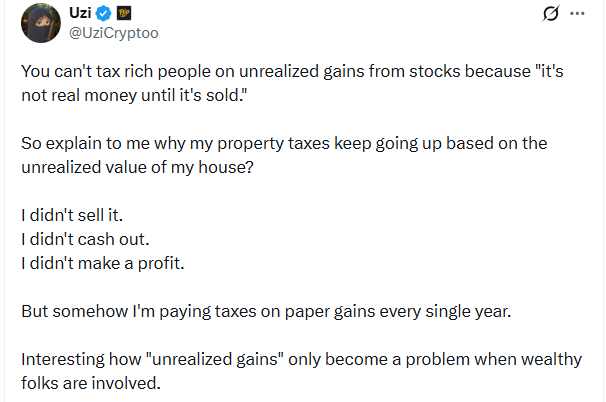
They're right: it is pretty complicated to tax the rich using the current tax code. And there's a very good reason for that: they made sure it's as complicated as possible.
I think the idea that taxing the rich is difficult or our tax code is too complicated feeds into the narrative around the problem being too hard to solve. I think the reality is more straightforward:
-
Bring back the previous top tax bracket of 39% that Republicans did away with. That will bring in a significant revenue.
-
Raise or add the top brackets on the capital gains taxes.
-
Add a new top tax bracket of you want to raise more revenue, e.g. 46% above X millions.
When you look at reports by the congressional budget office or independent budget groups, most of the other proposals are noise in the grand scheme of things. Even the buy, borrow, die strategy that gets a lot of airtime (because it rightfully violates most people's sense of fair play) only really accounts for something like 2% of the funds used by the ultra wealthy.
Most of the things like wealth taxes would require more complex legislation and be treated by the courts, certainly going to the supreme court. But the above three bullets would meaningfully raise revenues, are simple in terms of legislation, and have clear statutory authority and case law on their side.
The only thing hard is electing enough people who actually care about the budget and the people.
Income tax may be a solution to government revenue, but it's not a solution to inequality.
Capital accumulates exponentially, and if you don't address that exponential growth, then there will be ludicrously wealthy people, social immobility, and all the problems we have now. Tax wealth.
Of course it will be complicated. Of course there will be court cases. All of that is true of the current system. We can't get to a working system if we don't even start. Tax wealth.
Tax wealth.
Agreed.
I don't think we even need to tax all wealth. We need to specifically tax registered securities. Financial assets.
Economically, it isn't a problem for a rich person to buy a yacht or a plane: Those assets were produced by workers; they are maintained by workers. The purchase of tangible assets means paychecks for the workers producing those assets. Economically, we shouldn't be discouraging the purchase of personal property assets.
The value the ultra-wealthy are capturing is the ownership of companies. The value of those companies is generated by workers, but is transferred to the ultra-wealthy. The workers are compensated with cash, rather than ownership interest.
What we need to do is make those securities more expensive for the ultra-wealthy to hold, and cheaper for the workers to hold. We need a progressive tax on securities, payable in shares of the security, rather than the dollar value of those securities.
Exactly. Company value shoots through the roof, it becomes a worker owned cooperative. Original owners get paid in cash, rather than in market distorting power.
Billionaires will argue they wouldn't take the bet, but they're bullshitting. They're constantly betting on stupider risks with lower payouts, all the time.
Forget 39%. We have greater national debt as a percentage of GDP than we did in 1944. We need to reinstitute the tax brackets from then until 1965, which had a top rate of 90%. There are reasons we had a middle class back then, and this is one of them.
Nobody paid that 90%. Just like today, there were methods around it.
But they paid much more, and that's the point.
What mulgrubs said, plus at least they had to work for it. Today, it's just handed to them.
Capital gains should just be taxed as regular income instead of having a special rate.
I think Denmark does it like that, but I haven’t verified with any Danes yet.
Realized capital gains are usually taxed at a higher rate depending on the amount of time it was held, but I agree high earners should be taxed a lot more.
Proposal:
-
minimum wage = 0% taxes
-
N * minimum wage = N% taxes
So mathematically that serves as a pay cap, because once you get to 100x you are taxed 100%. Some countries do have compensation caps for CEOs that are a multiple of the lowest paid employee, and I tend to like the model because it incentives increasing pay of employees who aren't generally considered competitive or in high demand, and those are the folks that need market intervention most.
In this exact formula, I suspect it would underwhelm. Someone who earned the federal minimum wage, $7.25/hour working full time would get a paltry $15,080 per year. Someone making $250k/year would only pay 16% income tax, a meet decrease. Now, maybe it is good to shift the cost burden more to the ultra wealthy giving relief to even those making good money. But that would require some data crunching to see where the breakpoint is.
Under that plan, the maximum net income would come from a gross income of 50x minimum wage. Above that, taxes rise faster than pay.
Any minimum raise hike would automatically cut income tax rates across the board.
What would likely happen is the same thing that happened when we had a 91% top-tier tax rate: People with gross earnings above that rate would figure out how to turn everything they bought into a deductible business expense, and spend until they were under the line. Which isn't really a problem, IMO, as that spending turns into worker compensation, rather than a rich-person's stock portfolio.
Under this plan, executive compensation would still come primarily in the form of stock rather than pay. That's already a problem, and this would compound it. Stock needs to be easy and cheap for the working class. It needs to be supremely expensive for the ultra rich to acquire and hold. We need cap gains taxes that start lower but progress much faster and higher than income taxes.
That pay cap would hit at about $1.5m. I think that's okay. I did some napkin math and eyeballed it to graph the proposed tax rates vs 2018's marginal and effective (because that's what was available): https://lemmy.zip/pictrs/image/61835557-1968-4d28-be95-493de6de6900.avif

It's not the worst idea I've heard, but I'd want to scale by the number of taxpayers in each bracket to find out how much tax revenue we'd win or lose. A real congressional study would also consider what is considered "income" for tax purposes, and whether this would cause anyone to get creative with their compensation to avoid paying more tax (well, even more than they already do).
you literally missed the point on the tax loop literally all billionaires use.
How difficult would it be to enact legislation to prevent using loans against stock/assets and avoiding income/capital gains tax? Something like "if you have things worth money you need to sell them before taking a frivolous loan."? Idk I just hate that loophole
Very hard, since you can just take the loan in a different country, even in USD.
Wealth tax is probably much easier.
How about removing property tax for sake of consistency?
How is the government supposed to make money then?
It wouldn't be so bad if you couldn't use the unrealized gains. But people can have a bunch of stock, get an untaxed loan, and have access to money without the tax burden. We should fix that.
Also property tax should probably be progressive
Yeah, we should fix that, but it's still pretty bad because it incentivizes investments in stocks (an inherently speculative asset that destabilizes the world) over bonds (a contractually defined asset that more effectively resists speculation and destabilization). Sure, they're both financial assets, so there's a certain amount of nonsense built in, but I'd much prefer a society filled with people who invest in bonds and incentivized to demand financial regulation.
Also, we should treat stocks like dividends and tax them at the same rate. You get money every month from dividends and you choose whether you want to re-invest it or not. You're effectively auto-re-investing with stocks, so it's not meaningfully different. You should have to pay on the yearly difference in value, and if that means you have to sell some to pay the tax then you should just get over it.
You should have to pay on the yearly difference in value, and if that means you have to sell some to pay the tax then you should just get over it.
There's a much better way.
Don't tax the dollar value of the shares. Tax the shares themselves. Don't demand the liquidation of the shares to pay the dollar value of the tax. Instead, just tax the shares themselves: confiscate the same percentage of the shares held, then have the IRS liquidate the confiscated shares slowly over time.
We can exempt $10 million from the portfolio of any natural person, then tax proportionately from every issue in that portfolio. No exemptions for artificial, corporate entities.
Basically, stocks, bonds, real estate, and other financial assets (the "ownership of the means of production") should only be valuable to the working classes.
Tax the shares themselves.
Hmm, you'd have to dramatically decrease the tax rate for it to be worth investing at all. My investments make ~5%/yr if taxed on the shares rather than the change in value 5%-3% for tax-3% for inflation = -1% per year. That'd literally destroy all financial assets, the entire finance sector, every university and research institute endowment, and the concept of retirement. So, let's assume you did reduce the rate: 5%*3%= 0.15% or $150 tax per $100k invested or 1.5mil/bil. Honestly, this rate I'm fine with as it's functionally equivalent to taxing the increase.
The issue is you're still incentivizing people to put money into higher returning investments rather than investing in more stable and assets, like bonds. I think your intent was to make investing in stocks "fair" but something that unstable should come with costly risks. It's not something sensible people should be investing into. We don't want the government bailing out the stock market at the cost of everything else every five years. People need to be deterred and those markets need to face consequences.
We can exempt $10 million from the portfolio of any natural person
Unless you're lowering the tax rate as I suggested, you'd have to add a lot of exceptions to not destroy most of the world's established institutions, and those exceptions would be used as loop holes. I think it's unwise to add exceptions at all. People should just get over paying taxes. It's literally the foundation of money having value (the demand for money).
you’d have to dramatically decrease the tax rate
This is a wealth tax, not an income tax. We don't currently have a wealth tax to decrease; we would be establishing a new one. I would propose 1% per year.
My investments
Are you a natural person? Is your portfolio less than $10,000,000 in value?
If you answered "yes" to both questions, nothing changes for you. This only applies to corporate entities and ultra-high-net-worth individuals.
The issue is you’re still incentivizing people to put money into higher returning investments rather than investing in more stable and assets, like bonds.
The only reason that higher returning investments are a problem is because they are used as a vehicle to drive wealth to the (ultra-)wealthy. When the wealthy are charged a high premium for these investments, that reason stops being a reason.
Unless you’re lowering the tax rate as I suggested, you’d have to add a lot of exceptions to not destroy most of the world’s established institutions
The established institutions in question are the ones creating the systemic problems. I see no compelling reason to maintain the institutions responsible. I see no compelling need for "a lot of exceptions". Destroy them. To minimize disruption, we could phase it in over time. Perhaps starting with a $1 billion portfolio exemption and decreasing it to $10 million over the course of a decade.
This would have the ultra-wealthy converting their financial assets to tangible assets; they would be buying up personal property (produced by workers) hand over fist, while the working class would be buying up those liquidated shares from the IRS at a similar rate. Ownership interest in these companies would be rapidly conveyed away from the Problem Class to the Working Class.
I see no compelling reason to maintain the institutions
Okay, so you're not serious about change to your supposedly better system.
What?
You're advocating for maintaining status quo "institutions". I'm advocating improvement. You're advocating regression. I'm advocating progress.
Your criticism here makes your stance seem wildly inconsistent.
I think you need to explain what you mean by "institutions" when you suggest that I will be destroying them.
The "institutions" I believe will be destroyed by a securities tax are overtly harmful and should be destroyed. Can you provide me an example of a beneficial "institution" that would not survive?
No, I can't "prove" to you that a "beneficial" institution would not survive because if I name an institution that I think is beneficial, like universities or research institutes, you'll either argue it's not beneficial or argue that it would survive via some other mechanism. Either way, it'd miss the point that there are in fact institutions that do good in the world that are built on the current systems and need some means of transitioning or surviving your radical change. You're clearly uninterested in those arguments, which basically means no decent people (i.e. people who are intent on minimizing harm) are going to be interested in working with you.
Honestly, I don't even really want to write this comment because I'm struggling not to assume you're just some angry kid. Like maybe you're someone who broadly agrees with me but just hasn't worked through the practical math of whole percentile wealth taxes on institutions or who doesn't yet appreciate that endowments effectively serve as a decentralized wealth re-distribution for public good causes. We're probably both positively inclined towards notions of wealth limits and income limits for individuals, but we clearly have very different views on how institutions and organizations should function. I don't really want to engage in an argument about that with someone who seems perfectly willing to see everything burnt to the ground in the name of "progress".
Do you know how you make progress? You gain a deep understanding of how things work and then you tweak, modify, and twist bits and pieces -- this doesn't result in marginal effects either because these modifications aren't just cumulative but synergistic and ultimately transformative. Institutions like academia have real problems, no doubt, but a few simple rules could dramatically improve them: limiting the ratio of administrators to other employees to combat administrative bloat, incentivizing use and teaching of FOSS to prevent corporate software entrenchment, addition of lotteries to application processes mitigate alumni advantages. There are lots of ideas that won't destroy every humanities department or every independent scientific research institute in the country by making endowments nonviable.
No, I can’t “prove” to you that a “beneficial” institution would not survive
I don't believe I asked you to prove it. I asked for examples of such institutions. When you say "institutions", the first thing that springs to my mind are corporate landlords taking investor dollars to buy up residential properties, and artificially inflate housing prices. That is an example of an "institution" that is contributing to the problem. That institution exists primarily to benefit the interests of corporate entities and ultra-high net worth individuals. That is an institution that should not survive in its current form.
Either way, it’d miss the point that there are in fact institutions that do good in the world that are built on the current systems and need some means of transitioning or surviving your radical change.
Name some. You're assuming I'm either going to destroy such institutions, or that I will need some sort of "exception" in order for them to continue operating. I don't think this is likely. I think that such institutions would fall well within this plan. I think they could, for example, structure their portfolios to pass the security tax obligation through to the natural-person shareholders who own and control them.
For example, that abusive REIT I mentioned above is currently under the control of Problem Class shareholders. That problem class is using that control to transfer wealth from the working class to the problem class. When the Problem Class shareholders withdraw, this REIT comes under the control of Working-Class Shareholders; the kind of people who are harmed by that exploitative behavior.
Do you know how you make progress? You gain a deep understanding of how things work
Which is why I'm asking for examples. What harm do you think is going to arise from driving the Problem Class out of these nebulous "institutions"?
I gave the two institutions I'm most concerned with: Universities and Research Institutes. Perhaps I'm not sure what you mean by structuring portfolios through natural-person shareholders, but this sounds like saying this person or that is responsible for this 10Mil of the portfolio. Problematic given that it would seem to give people the opportunity to run off with large amounts of money.
While exceptions are problematic since they're either too simple or too prone to corruption, I think there are exceptions that would be hard to abuse if properly defined and restricted. For example, democratically ran non-profit limited to $10M per voting employee. Perhaps this is what you're thinking when you say structuring portfolios through natural-person shareholders; though, these are rather different in terms of who owns the money, but I suppose you could argue that technically the democratic collective owns the money, so they're the "same". That's not how I interpreted what you said, but I hope that's what you mean, and I could probably agree with that. A $10M endowment is a smidge low for some types of research, but good enough for most especially if collectivized.
This is a wealth tax, not an income tax. We don’t currently have a wealth tax to decrease; we would be establishing a new one. I would propose 1% per year.
We don't need to call it something new. We already have property tax. It's an average of 1.1% around the United States.
Stocks are property.
Real Estate property taxes are assessed at the county/parish level, and apply only to land and improvements on that land. Securities would not be considered "real property". They are generally considered intangible personal property, which is not currently taxed. Further, the tax I am describing would be assessed at the federal level.
We certainly do need a way of distinguishing between existing real estate taxes and the proposed securities tax, even if the rates for the two taxes are identical.
Parent comment refers to "dramatically decreasing the tax rate", but does not describe what tax rate they are decreasing. Parent comment crunches some numbers in which they assume a 3% tax rate, not a 1.1% tax rate comparable to real property taxes you describe.
They did not indicate what tax rate they meant when they said it would need to be decreased. They certainly aren't referring to a real property tax rate when they suggest a decrease. I believe they were referring to either Federal Income Tax or Federal Capital Gains tax, which are approximately 25 to 50 times higher than the tax I was considering. Given the considerable discrepancy between what I meant and what they heard, I felt it important to indicate that this tax would be entirely separate from the existing taxes, and that it would be enacted for an entirely separate purpose.
I didn't (initially) define a proposed securities tax rate, but I did provided context for calculating one:
"stocks, bonds, real estate, and other financial assets (the “ownership of the means of production”) should only be valuable to the working classes
I would tax those securities held by corporate interests and the obscenely rich at a rate equal to or greater than their expected return on investment, so that the benefits of securities ownership convey primarily to working class investors. From Parent Comment's ROI (5%) and inflation (3%) numbers, the context I provided would allow for at most a 2% securities tax rate.
The securities tax rate I had in mind was 1%.
Securities would not be considered “real property”.
I'm not interested in what billionaires would consider "real property".
Stocks are property.
I see. How does that particular distinction affect this discussion?
This is me pointing to the headline.
"The rich convinced us that taxing them is too complicated but everyday people can be taxed pretty easily"
Stocks are property. Easy.
Maybe I'm an idiot, but I am just not understanding the ramifications of your argument.
Yes, Stocks are property. They are a specific type of property: "intangible personal property".
That type of property is not currently taxed. I am describing a method in which that type of property will be taxed.
What does your distinction bring to the discussion?
What happens when my socks value decreases 30% one month? Do I get a tax refund?
What happens when someone fails to pay back their bond? Do I get a tax refund?
No, since you didn't make any money and were not taxed. Also, the bond issuer is now in bankruptcy and/or being sued into bankruptcy. I might even get back the principle depending on the output of the legal proceedings.
Got some bad socks there brother
Lol! Ya got me! Yeah, autocorrect is a bitch, and I failed to verify the text. Socks = stocks. (And it tried to change it to sticks that time).
It depends on the details of the implementation. There are many possible solutions.
If we change it so the rule is like "if you use stock as collateral to get a loan, that is income and taxed as such" then no. You might just default on your loan, but that's kind of on you and the bank for using a volatile asset as collateral.
I appreciate that you took the question seriously and offered a useful response.
What happens to the property taxes you paid when your property value tanks? Do you get a tax refund then? No? Then no.
Ah, yes. It's the old "one injustice makes a new one okay" argument. Hate much?
Taxes are not injustice. And being unsympathetic to the risks that the owning class has to endure is not ..."hatred". More money, more problems, cry me a river.
This was an interesting point I hadn't thought of before, so I wanted an alternate perspective since a Twitter meme is a little one sided, think of it what you will:
Property taxes are ancient — they predate modern stock markets by centuries. Land was the dominant form of wealth, and crucially, you can't hide a house from the assessor. Real estate is immobile, visible, and tied to a specific jurisdiction. Stocks are the opposite: mobile across borders, easy to hold through trusts or shell entities, and private holdings are genuinely hard to value year-over-year.
The other piece is who's collecting and why. Property taxes are local — they fund schools, fire, roads, the stuff that directly makes your property more valuable. There's a clean "benefit" logic: the city paves your street, your house is worth more, you pay for it. A share of Apple isn't enhanced by Seattle paving anything, so there's no equivalent local nexus.
Stocks also already get taxed, just at different moments rather than annually: capital gains when you sell, dividends when paid, corporate income tax on the underlying company, estate tax at death. The argument against an annual wealth-style tax is partly that the system already takes its cut, just not on a recurring basis.
A few countries (Norway, Switzerland, Spain) do tax financial wealth annually, but most that tried it abandoned it — capital flight and valuation headaches. In the US there's also a constitutional wrinkle: the federal government can't easily levy direct taxes on wealth without apportionment among states, which is why Warren/Sanders-style wealth tax proposals have to be carefully structured to survive a court challenge.
The system should take more of a cut, if that’s the argument we are going with.
Also? A new realization event should be defined: collateralization. When you take out loans against the value of your stock/bond/whatever holdings, you are realizing gains from those assets - you wouldn’t have gotten the line of credit otherwise.
People argue that this would prevent homeowners for taking equity lines of credit for improvements but that’s easily remedied by the collateral not being a real asset.
Also? A new realization event should be defined: collateralization. When you take out loans against the value of your stock/bond/whatever holdings, you are realizing gains from those assets - you wouldn’t have gotten the line of credit otherwise.
This is a pure red herring. County property assessors are a thing. We already have systems in place to address this concern.
Also of interest: Taxes aren't paid on stock buybacks which is why they became popular.
They’re not taxed because they used to be illegal and they shouldn’t ever be taxed because they should be made illegal again.
The same way prospect (futures) markets should be illegal, as well as options. The rich apparently couldn't make enough with regular stocks so they had to build gambling into it, and then inside trade to make sure they won.
Burn it down.
Should probably do both for when they inevitably become legal again.
If it’s good enough for weed at the federal level I guess it’s also good enough for cash.
Because that used to be illegal so there was no need to tax it
Stocks also already get taxed, just at different moments rather than annually: capital gains when you sell, dividends when paid, corporate income tax on the underlying company, estate tax at death. The argument against an annual wealth-style tax is partly that the system already takes its cut, just not on a recurring basis.
Yeah, that's sort of the whole point of the post. If I buy a stock for $1 today and still it for $10 tomorrow, I pay taxes on the gains tomorrow.
If I buy it for $10 today and sell it for $1 tomorrow, I claim it as a loss.
If I buy a house for $100k yesterday, I'm paying taxes on $400k property today, and $900k tomorrow. Even if tomorrow I sell it for $200k.
For most of our history, real estate was wealth. You needed property to grow crops, mine resources, build a factory, or do any kind of venture that would make money. It's only in the 20th century that we really start having a significant amount of wealth in stock markets that couldn't be directly traced to a physical asset. The robber barons figured that was a good excuse to stop taxing their wealth.
Property taxes are local — they fund schools,
Funding schools by highly localized tax isn't universal. The US adopted it to make sure less affluent areas have worse schools. I believe the UK does similar things, but they also want marked differences between public and private school alumnus.
but most that tried it abandoned it — capital flight and valuation headaches.
And most importantly: relentless lobbying by the wealthy to get rid of those taxes.
source on the size of the effects of lobbying vs flight risk?
I would like to agree with you, its just very not-obvious which influence dominates.
The main issue is that, once you have enough value in stock, you can take loans out against it, thus extracting the value of the stock without actually having to sell the stock.
Let's just say they won't pay with money seems to be their current position
You wouldn't even have to make a huge reform to make a big difference. If we changed using "unrealized gains" as collateral to count as realizing those gains, the ultra wealthy would pay a fuck ton more in taxes. Also, the interest on those loans should not be deductible. Boo hoo if you end up with a margin call. Don't make risky bets.
This is where I stand on it. Charging taxes on unrealized gains is never going to happen, and its not like we're going to give them a refund if it swings the other way.
Taxing collateralizion and usage of the unrealized gains would be massive, and if they don't like the new system, then sell them and pay taxes like everyone else.
Edi: also you can audit what they spend and how they got the money to afford it to trigger the tax. Knowing someone's unrealized net worth can be incredibly complicated beyond public stock ownership, and even then that can be hidden as well.
Don't try to tax the dollar value of the securities. Enact a wealth tax of the securities themselves. Transfer shares of the security to the IRS, to be liquidated slowly over time. Non-liquid securities would be held much like a lien.
That's significantly more complicated for no real benefit. It actually carries a much higher risk for the IRS as the securities are volital.
All you have to do is tax them when they use the assets as collateral, and for good measure tax the loan as income.
You could even throw in a minimum threshold to not apply it to regular people, and force them to pay people more in the process. This can be achieved by setting the threshold to a variable, like 100x the average annual take home pay of the bottom 20% of earners (~$1.6m) and make it a annual total of loans to close the loophole of a bunch of small loans.
If they want cheaper loans people have to be paid more.
All you have to do is tax them when they use the assets as collateral,
If you tax loans backed by collateral, the banks will just change their lending policies on unsecured personal loans. No collateral = no tax on the use of that collateral. The method of taxation you are suggesting is trivial to evade.
That’s significantly more complicated for no real benefit.
It is more complicated, but the benefit is immense. The benefit is that Shareholding becomes much less valuable to the oligarch Problem Class, and much more valuable to the Working Class. Company ownership and control is driven toward workers. Working Class shareholders become the predominant voice in determining company policy. Profit extraction goes to Working Shareholders rather than the Problem Class.
It actually carries a much higher risk for the IRS as the securities are volital.
Describe that risk. Remember: The IRS is not owed dollars. They are only owed the shares. The dollar value of those shares is entirely irrelevant.
That's why they're going to great lengths to remove or at least weaken government legislation limiting their acquisition to more wealth, while putting the screws on anyone below them.

Mitch McConnell on the bottom left, looking like he came in through The Wall
The "it's not real money until it's sold" argument is such horseshit. Just give it to me then if it's not real. It's like saying the money in your bank account isn't real until you take it out at an atm. Dumbest shit, but for some reason a super appealing argument because people keep repeating it.
They can't give it to you because it's not real.
Also your money in your account isn't real until you take it out of the bank is true. You never heard of a rush on the bank? Your bank isn't keeping most of your money, they are using it. The system only works if everyone believes it works, but if everyone took it the money, 90% of people would find out there money isn't there.
Same with taxing stocks. It only works if everyone isn't rushing to the market to sell. If we taxed stocks, the money would have to come from somewhere or the system collapses. This is why no party has dared yet taxing unsold stocks. It would collapse the system.
They can’t give it to you because it’s not real
You literally can. You can transfer ownership of stocks. Dumb argument.
Until you actually can't, super dumb argument. We've seen these "bank runs" over and over again, they aren't mysteries.
How did transferring stock ownership help the common person, or help the government run programs?
Have you heard of a federal reserve? Yes your bank doesn't have your money, but someone does. Your money someone else has is insured by the federal reserve so bank runs don't happen. You're talking about an economy that existed 100 years ago.
You clearly didn't know how money works
You are so very wrong. The Fed does NOT have the cash, nobody does.
It exists only in the banking system itself with no tangible assets to back the majority up, we don't have the actual cash to cover even 10% of deposits.
Where did you hear "the fed has the money"? Please share how the Fed "has the money" (or anybody else).
The "insurance" will collapse, just as the banks
You're talking about an economy that does not exist. The FED does not have the cash.
Also, please note the more cash that they do print, the less the dollar is worth.... this is called "inflation".
Okay a history lesson on how capitalism started and feudalism fell.
When you are "rich" in feudal society it means you have land. Land that everyone sees, that gives predictable income and even least educated peasant would be able to tax you reasonably (reasonably = as high as possible without you starting a rebellion over it). But then come merchants - they can have a wagon full of wood or just a small pouch of spices and it would be worth the same. Nobody really knows how much their wares earn because it fluctuates and every goods transport is a huge risk. So the merchants gain wealth indefinitely because king can't see how much they have ant tax them accordingly, while landowners get poor because they are taxed to oblivion.
Now who is the modern "nobility"? Who has wealth tied up and measured in such a way that government knows exactly how much to tax them? Wage workers. In fact your employer rats you out to government on how much you earn. In exchange things like companies, banks, stocks, loans etc. are in the "nobody knows how much they are worth" category. Say you are taxed 10% on the value of all the stocks you own, this means you have to sell 10% of your stocks annually, and by selling stocks you make those stocks less valuable for everyone... so technically they should be taxed less because value drops down? Generally speaking if taxing something changes it's value drastically then governments avoid taxing it.
My personal solution - outlaw stocks, bonds and loans for fucks sake.
Yeah, the financial market was never actually useful. Its just a money vacuum that the rich benefit from
I enjoyed reading this perspective, thanks. It's definitely compelling.
Just have countries force the "you can't charge interest" rule on Christians.
Islam coming later was able to see the obvious loophole so they added you can't accept loans with interest btw.
Though this does interfere with separation of church and state it seems countries already forgot about that.
Say you are taxed 10% on the value of all the stocks you own, this means you have to sell 10% of your stocks annually, and by selling stocks you make those stocks less valuable for everyone… so technically they should be taxed less because value drops down?
Just a note, suggesting a 10% tax is pure fear mongering that billionaires and capitalists use to scare people. The average property tax rate in the United States is 1.1% so that's a reasonable percentage to give. People don't sell 1% of their home every year.
Property taxes are a thing. Stocks are property.
I honest to god used 10% as an idea of "ridiculously low tax" but I guess the topic of problems with billionaires may be too american for me.
Stocks should be taxed on buy/sell and yearly hold though.
I honest to god used 10% as an idea of “ridiculously low tax”
You live in a country that has 10% property tax rates?
Say you are taxed 10% on the value of all the stocks you own, this means you have to sell 10% of your stocks annually,
Myth.
You can transfer the stocks themselves to the IRS, and leave the IRS with the responsibility for liquidating them. We can require the IRS to look at the total traded volume of any issue they acquire, and prohibit them from selling more than 1% of that volume in the same time period. Liquidated shares will comprise no more than 1%; those shares will not significantly affect the market value of the issue.
My personal solution - outlaw stocks, bonds and loans for fucks sake.
"Stock" is what the ownership interest is distributed among multiple people. When two people equally build a business together, they each hold a "share" of that business's "stock". Banning "stocks" means banning every type of joint ownership, which is every type of business except "sole proprietorship" and "government enterprise". Banning stocks is only feasible in a completely centralized economy.
Banning Bonds and Loans is even less feasible, and results in even more absurdities. Taken to extremes, your Amazon driver would have to collect payment at time of delivery, not at time of order. Payment before delivery could be considered a type of loan. Likewise, a business's order to a vendor for supplies would have to be paid at time of delivery. Any other time would be considered a "loan" one way or another.
IMO just stop letting them borrow against the unrealized values. You can borrow against what you've paid taxes on.
It's all bullshit guys, like on the other side we have to pay $1500 a month rent because the bank doesn't believe we can afford a $1000 a month mortgage.
Anyway I'm pretty sure $1,000 mortgage payments are a thing of the past.
I mean it's math if you take out a $160k mortgage for a $200k house today it's gonna be right around $1000/mo
Okay but $200,000 houses don't exist anymore. Everything starts at half a million.
At a certain level of wealth, we should be taxing wealth quarterly.
Grant an exception for a single place of residence (sure, let it be magnificent, whatever, but only 1).
Wealth taxes can have brackets like income taxes do.
Also, more luxury taxes etc!
I mean the extremely literal answer is roughly:
All counties/cities have a bureaucracy dedicated to doing the equivalent of yearly audits to determine your home/property's value.
This does not exist for corporate capital assets.
Instead, the audits are privately conducted (either internally or via a contracted private accounting firm), and valuations are basically only issued around time of sale, when corporate capital changes specific private ownership.
Even earnings reports are not done by an outside agency for the purposes of assessing a tax, they're either done privately by the owner (again, internal or contracted out), or as private market research for something like a hedge fund or something like that.
We as a society (legal system?) just decided that homes get a bureaucracy and taxation, capital does not, it plays by different rules.
And by that what I really mean is that ever since FDR, the wealthy have conspired to construct this legal reality bit by bit, compromise by compromise, PR campaign by PR campaign, over time.
So that gets us eventually to Citizens United where money buys elections and laws officially and thus Democracy dies.
Its... its the oligarchy baked into the system, been like this for quite a long time.
Its not that its... any kind of theoretically impossible to imagine a or many different kinds of systems...
Its that rich people have rigged so many things so far in their favor, for so long, that they believe these artificial engineered differences ... are fundamental rules of reality.
Like yes they're very hubristic and classist... but a part of it is that they've basically indoctrinated themselves into thinking this is... objectively correct. Its sort of like a religion, its their dogma.
I will note that at least some billionaires don't buy into this dogma nearly at all... either out of genuine empathy and humanity, or pure self preservation of not wanting to be guillotined... you do end up with the 'Tom Steyer <-> Mr Wonderful' spectrum.
Of course, the Steyer types are exceedingly uncommon.
Should be easy. If you are a billionaire you should be paying at least 40% in tax. So at least 400 million for each 1 billion you are worth.
If you want to pay less then you need to justify it. So pay up front and refund later. Easy.
No one needs 600M, your tax rate is too low.
I fully agree. Maybe a 70-80 tax on everything over 10 million.
Needs to keep up with inflation but yeah.
Nah why? We could boil the frog into 80% on everyone this way.
At some point $10m is the new $1m and normal people retirement would get taxed to death.
And? 1M of retirement money still makes you filthy rich bourgeoisie. State should tax the shit out of you, and provide back minimum fair sustenance.
It really does not.
The fuck...you clearly have no clue how much it costs to live these days...1mil retirement is a joke that's 50k a year if you're lucky, and that's only getting you 20 years. More than likely medical shit will eat that up.
And you have no idea it makes you automatically in top 1-2% world wide.
Cost of living is a thing...1mil USD doesn't make you rich in the USA, it might in some country in Africa but it's not doing that here. The fact that you don't understand how economics work on a global scale is quite telling.
Tax everyone, tbh.
If the taxes are going towards making life easier, maybe we'll end up in a utopia and not the shithole corporations are building.
That's the rub... Rich people don't want life easier for society. They just want it easier for them.
If poor people have life easier, they might rise up and form unions, demand livable wages, and my million's of dollars I inherent every year might be a few thousand less and that is unconscionable.
Hfs, i never drew that correlation before. Yeah, fuk them.
That simplistic comparison has absolutely zero relationship to reality. Think about it a bit more, if you know how making money on stock investing works, and see if you can find the differences.
I am a dumb average guy who is not an economist. Could you please explain the differences?
No! Snark and condescension only!
"I wont explain my point that is very much wrong, and instead will (attempt to) make you sound like the fool, when in reality I am an insufferable douchebag that cant see he has tread into water before learning to swim"
10/10, no notes.
I didn't think I had to explicitly repeat what I said in a couple other comments I made on the matter. I won't cut and paste that for you, (and since you set the mode to name calling) shithead.
I dont talk to someone assuming they know what I said to some other dude 15 minutes ago. I can tell youre terminally online
Lol! You have zero clue. I'm close to the opposite of the on line spectrum. I learned how to be informed in the old days, when we were taught his to read and research.
When I don't know something, I look it up. In discussion forums, I read the other comments before making my own, usually. If someone tells me I'm wrong, I go see what shows up elsewhere on the topic. Most importantly, I'm not immediately condescending or insulting.
Research /= googling
Okay, I'll bite. Other than going to a full-featured library, or contacting the nearest university with expertise on the desired topic, what does count as research for a layperson?
Other than...getting an expert opinion or reading the research material they published? You excluded research to ask me what research is
Oooooh, I miss understood thought you were asking me what research is. You wanted me to do the work for you. Yeah, no. If you are older than 12, you should already know how to do that. If you don't care enough to do it, that's on you. I did.
To play devil's advocate, a lot of money that is tied up in retirement accounts of the "average Joe" would also be taxed, so if your retirement accounts aren't outpacing your income tax rate, then it'd hurt main street too
you know what's not complicated? a wealth cap.
that or guillotines, those seem to be a permanent solution to this problem.
Wealth caps are actually complicated too.
Also... guillotines? permanent? LOLOLOL. "Meet the new boss... same as the old boss..." - The Who
when the new boss has to stare at the old bosses head until it rots off the pike it sets a line that's not to be crossed.
Wow, let me just stand back and give you room to do your badass thing.
I might catch heat for this take, but having roads and schools is nice. But billionaires should be paying for the vast majority of it
You're right though. However the problem is when people's property tax goes up by more than their wages. My parents had an $800 increase even though the property assessment dropped by 100k. They keep allowing all this residential to go up without letting industrial build aswell meaning the tax burden mostly on residential and not commercial.
Til, I pay less than a grand a year on two properties but I'm also in a fairly rural area.
This definitely won't be popular, hope you stick with me to the end, but real estate is collateral that holds its value quite well most of the time, and is insured by the homeowner.
Stocks don't have that. Companies with large valuations can liquidate overnight.
Does that mean it's all a bad idea? No, but it just is different than the frame provided. They are different assets.
Taxing rich people in new ways can be a good thing. Taxing unrealized gains gets complicated, but can be done. But also comparing it to property tax is problematic for a lot of reasons. There are much better arguments, so I think we should stick with those. This one has too many easy attack angles with valid points, even if the main point of "rich people get out of taxes more than normies" is completely true.
Tax unrealized gains
“Oh, but that’s not real money, they’d have to sell their assets to get the cash to pay those taxes, thus diminishing the value of the assets.”
Oh, so the value of the assets is over valued then? So them taking out loans with those assets as the collateral is fundamentally allowing them to take out more money from the financial system than they are realistically due? Damn, tax their fucking loans against their assets as well.
“NOOO! That’s not fair! Then they’re paying a higher tax rate than specified by the law!”
Crazy how that works, crazy how tax rates actually payed can be different from those specified in the laws. Hey did you know that Warren Buffet pays effectively a lower tax rate than his laundry lady, being stated as unjust by himself. Crazy how right now people working for wages get taxed way more than people working for asset valuations.
You wouldn't believe (or maybe yes) how many struggling, regular schmuck commuters I hear saying "But but we can't tax the Job Creators!" Meanwhile they're spending two hours in traffic each way, taking any shit from their four bosses while trying to keep their 2011 Camry in one piece and scrounging enough for mortgage, streaming, and the third star on the fourth stripe on little McEllough's tae kwon do white belt.
It's the evil brilliance of Republican marketing. And just maybe, the mistake being made by modern Marxists is ignoring the so-called middle class in favor of the blue collar classes only. Goddamn it I'm pretty bourgeois, but comes down to it, I'd give up a few things to have free health care and education for everyone, and UBI for those that need it.
I agree with the core argument, here, but...
Interesting how "unrealized gains" only become a problem when wealthy folks are involved
...do you think wealthy people don't own property? 🤔
Ah! So you're telling me that wealthy people DO get taxed on the unrealized gains of the properties they own? Just like us normies do?
Not for long, see the push by Republican groups for abolishing property tax.
If property taxes are abolished it better be for EVERYBODY, not just for billionaires & corporations & private equity groups.
In the US, the mortgage interest tax write-off goes disproportionately to the wealthy. It also inflates housing prices, so it doesn't really help affordability. Certainly not enough to justify the cost.
Because you're poor and don't have any influence over tax policy or enforcement.
But none of it is so simple that it can't be done by a computer. Instead we need a whole industry of middlemen because it's so convoluted and opaque...but also they know what you owe, and then want you to tell them. It's fucking dumb.
100% agreed. This has been going on for some decades, hand-in-hand with "The FED" being so complex that only bankers and their ilk can handle banking, so we must have bankers control their own banking and our dollar.
Banking is easy. You put money in the bank, they save it until you need it for a small fee. But they don't save it any more, you see. They have about one dollar for every 10 dollars deposited. The rest exists only in the banking system itself, and is not a tangible asset.
The complex part is their labyrinthine banking-created machinations to manipulate that one dollar into ten.
I'd get into it, but mods often think anything about The FED is a conspiracy. Don't be like them. Take The Fed at its word, note who serves and where they worked before and after their terms, and reach your own conclusions.
But they don't save it any more, you see. They have about one dollar for every 10 dollars deposited. The rest exists only in the banking system itself, and is not a tangible asset.
Fractional reserve banking has been around for hundreds of years
this doesn't really have anything to do with "work", therefore it's questionable whether it belongs in the "work reform" community. anyways, it's a good post, with a good point.
it's quite clear that we need tax reforms. the current system works for no-one anymore, not even for the rich. the stock market is a bubble only waiting to burst, and everybody's well aware of it. the economy, the way it is today, is absolutely not sustainable. people are getting poorer, due to not having jobs, or rather the jobs pay like shit (bullshit pay for bullshit jobs) because the jobs aren't fundamentally important to the economy. there's a declining labor market because there's not so many new inventions compared to 1900 when stuff was new and hot. (consider that the electric grid was literally invented around 1900, there's an interesting chapter of history there, current wars). that's why the labor market is cooling down.
i advocate for spaceflight partially because it would create jobs. also waging wars would create jobs but deeply unpopular so nobody wants to do that. so jobs will still be lost, and can only be partially replaced. we need a universal basic income or sth similar to give people enough resources to live. we need to start writing policy proposals for that. i propose the following fields should be covered and provided for by state-run services somehow:
- water, food, healthcare
- housing
- transport
- energy
- IT, telecommunication, education
Technically it was people they hired to convince us.
We need a tax system where the government figures out how much they need each year, and then just takes it proportional to net wealth above a certain amount.
You can bet Elon won't be declaring himself a trillionaire under that system.
We need a tax system where the government figures out how much they need each year, and then just takes it proportional to net wealth above a certain amount.
That's exactly how property taxes work if you replace "net worth" with "assessed property value."
(As opposed to what some people think, that rising property values on their own lead to rising property taxes)
So yeah, why the heck not do the same with other forms of wealth?
So, the government should decide how much wealth its citizens should have, and enforce that? I think there are better ways to approch this than turning citizens into subjects.
Property taxes are a thing.
Stocks are property.
It's not rocket science.
How long does one own property, and what resources are used by structures on that property that the community has to supply, maintain, or upgrade? What damage might said structures cause to the community while in use? What is lost by the community by selling that property to a private owner? How does a community fund its own services, governance, police, fire department? How are roads and power lines built?
Now, what community is incurring costs by someone owning a stake in a business? What resources does that transfer of money take away from the community? What is the community? What did that community supply to make it possible to invest in that company or buy that stock?
It might not be rocket science, but it is not a "no brainer". Stocks, like "intellectual property", have no physical presence. They are not semi-permanent objects taking physical space or requiring physical resources to create or maintain over time. They do not take physical resources that can no longer be used elsewhere.
Pretending businesses exist in a vacuum is a very weird take. The government spends a considerable amount of time and cost in maintaining business interests. Maintaining the legal framework for business to operate so we're not Mad Maxxing for more petrol is, on it's own, justification. Then there's the intellectual property side of things. Law enforcement. Military action. Foreign relations. The SEC and similar agencies that exist solely to facilitate business.
That's why we have the taxes we have. As you point out, business works with the help of society. However, taxing it as property is a completely messed up approach and will lead to there being little incente to to invest. That's why we tax profit, not mere existance, as we do for property.
Boot licker says what?
See, ad hominem attacks means you got nothing. Have a nice day, come back when you have a convincing counterpoint.
My argument is you lick boots.
🙄 Hey look it's another loser who spends their free time bravely defending billionaires wealth.
I've been fighting and calling out billionaires my whole life. I also want the rest of us to be better off, so I call out obvious bullshit like this for our benefit, not theirs.
I weary of bots and morons who can't think reacting on pure emotional need to "own" someone else.
Also, see my other comment about ad hominem.
Your concern trolling bullshit isn't for the benefit of the people it benefits billionaires. If you can't understand that I apologize for calling you a boot licker. You're just a fucking idiot who needs to stop talking.
the complication comes from th tax lawyers getting loopholes and diaphanous exemptions implanted in the code
Are Ronnie Reagan's advisors still alive? Those fuckers were heavily involved in creating the present day mess.
If only Jimmy Carter is re-elected in 1980...
But all those years people kept saying even though he was fundamentally a really great guy, a man of the people, he was one of the worst Presidents we've ever had. (??)
Why?
+1...The US Naval Academy graduate would have ended the BS in the middle-east too.
They're right. Taxing them isn't possible but you can be taxed pretty easily.
Twitter screenshot meme slactivism aside, it's because private land is a limited resource. The more you keep for yourself, the more you pay (generally).
Plus, property tax is one of the only taxes that really hits wealthy people hard.
In California the property taxes are such that it punishes people that didn’t buy a house 30 years ago. The apartment I rent pays property taxes on a valuation of ~$250k. This property just went for sale at $1.2 million. Whoever buys it now will pay property taxes on a $1.2 million valuation, while right now due to how the law is structured, the current owner pays taxes on $250k.
It’s just a big fuck you by the system. The tax law was modified because they saw that if they kept increasing the tax proportionally with the market value of the home, soon a bunch people would lose their homes because wages are stagnant and home prices are rocketing. So they passed this cap that helps current homeowners.
I don’t know if there is a reasonable tax under these conditions where home speculation and investment-mindset inflates home prices while wages are stagnant and inflation is a bustling.
Just need ceiling
they only need to convince the conservative plebs.
I think that a completely reworked economy, can make it much easier to tax the wealthy. Specifically, by using fixed incomes according to job rank, and having leadership roles change pay grade according to what workers vote for. Each worker can vote for who holds a leadership position, alongside their job ranking.
As to the fixed incomes, by having all job types assigned a rank with a fixed income throughout the entire nation, that prevents leadership from coercing changes in worker pay. They can't underpay, nor overpay the workers, which makes it easier to assess and collect taxes. If everyone falls into very specific tax obligations, it is harder to game the system.
Alongside UBI, universal benefits such as guaranteed shelter, food, transport, utilities, and healthcare, money becomes optional. This allows workers to not be blackmailed into working for bad employers, which also puts a stick in the wheels of the wealthy. Coercion is the great power the elite uses to abuse ordinary people, so we need to eliminate that.
Also, absolute caps on wealth and assets, both for individuals and corporations. No one should be able to hoard resources that would allow any single entity to manipulate society. Sure, it would suck if someone can't have dozens of vacation homes and yachts, but realistically, most folks won't need more than one vacation spot with a nice boat.
👏👏👏👏👏👏
Well thats not a good comparison. Everyone pays property taxes.
Wealthy folks (in general) are heavily involved in property and consequently pay considerable property taxes. This is something everyone is quite equal on.
It is taxed as the post describes due to being a limited resource, unlike financial instruments, which are not a limited resource.
That might be correct in some places but not where I live.
Recurring taxes on property are calculated with the age of houses taken into consideration. This means the property value for taxation actually decreases over time, unless a given area undergoes through a serious development effort that forces property value up. This can reach such extreme cases that it is possible to get away with remodelling a house - as in a single standing building - completely, fully modernize it, and still keep its property value untouched, unless swimming pools and other value increasing additions are put in.
Property value and commercial value are separate and independent concepts. A property appraised for taxation in 100€ can sell for 100 times that value. There will be sale fees taxes applied to the transactions itself, for the buyer, and the seller may have to pay income taxes on the sale, but there are way to skirt most of these.
And then there are rents.
I pay more taxes on my work than a person for the rent they receive by renting property. It used to be a flat rate of 28%, equal to deposit interest and other values, but then someone said if the taxation on rents was to go down, the rents would go down and more housing would come into the market. Except it did not happen and instead rents shot up and opaque companies started buying homes to rent from people that could not be bothered to manage what they had and pay their taxes on a yearly basis.
Everyone loses.
Jokes on you, I cost taxes. I work with the F-I mean the CIA, that's who I work for, writing educational propaganda on Lemmy World. I'm a "crackhead," which is different than a "pothead," which is a festival cop. I do counterintelligence, obviously, as it is important to know what the surveillance state does, watching places where I frequent, which is here, on the Lemmy World work reform community, where I write educational propaganda, obviously. Wasn't this about taxes? Surveillance state, y'know? I don't even know what I do, but I cost taxes as a whole.
Wtf are you saying
Well, I said it as clearly as I could
WTH? That reads like the first kind of LLM, the random sentence generator with a small database of words.
No it reads like someone who stares at goats wrote it, being as naturally counterintelligent as I be n are, but you got that cultural reference, yea?
Here lemme give you a guided reading quiz to help facilitate your education, cuz that's what I'm about, education:
Question 1: Who do I work for?
A) Some agency that starts with the letter F
B) The CIA
C) The Illuminati, that decentralized autonomous organization of secret police described in the New Testament at an eighth grade reading level
D) Some unnamed organization that stares at goats
E) All of the above
Question 2: What is my job?
A) Cop
B) Counterintelligence
C) Education (our best crime deterrent)
D) Professional goat-starer
E) All of the above
Question 3: What is a one "Donald Trump?"
A) President of the United States
B) A pedophile, by normative definition of the word
C) A cop
D) A distraction
E) All of the above
Question 4: What do you live in and are a part of?
A) A police state
B) A decentralized autonomous organization (society)
C) The Empire of the Sacred Heart
D) A topological matrix
E) All of the above
Question 5: In 2000-7000 of your own words, which is what I write everyday, tell me what you think of feet.
Fun!
Property tax for the win yo. Remember, fat pigs get slaughtered.
So hide your mom op.
Note that property taxes, when reassessed every 10 years or so, are also adjusted with changes to the mil rate, as appropriate to keep taxes from property assessment changes from causing people to leave town.
Equities change in value daily. How should those be assessed, and what is the proper response when the equities decrease in value by 30% during a market crash? Does the government refund the previously paid taxes? What if that money is your retirement income?
At what point does a tax on equities essentially become a continuous draw-down of wealth on the same money year after year, resulting in absolutely no incentive to invest in business and for that matter a situation where it is impossible to build up any wealth? How will startups be funded? How will large, shoot for the stars projects be funded?
At what point does a tax on equities essentially become a continuous draw-down of wealth on the same money year after year, resulting in absolutely no incentive to invest in business and for that matter a situation where it is impossible to build up any wealth? How will startups be funded? How will large, shoot for the stars projects be funded?
That's actually the point: use taxes to force rich people to make high risk investments.
If you can't figure out how to turn enough profit on your farm to pay the property taxes, then you sell your farm to pay the taxes and someone else gets to put the capital to better use.
If you can't figure out how to turn enough profit on your $10B company to pay the wealth tax, then you have to sell enough of it to pay the tax, and someone else gets more say in how the company runs.
Wealth tax encourages people with ungodly fortunes to make bigger, more risky bets, because they have to overcome the constant drain of wealth tax. Ultra-wealthy shouldn't just coast along on the low returns of super-safe investments, because those are the people who can afford to lose part of their fortune.
Instead, we have the guy with $1000 YOLOing his life savings on GME options, because the $80 he can get from an index fund isn't going to get him to retirement, while Berkshire Hathaway is sitting of $300B of US treasuries.
I see your point, but disagree with the approach as a long term policy. We can limit the accumulation by taxing the profits. If we can't do that, then the wealth tax won't be any more successful as they will hide that, too.
If you can't figure out how to turn enough profit on your $10B company to pay the wealth tax, then you have to sell enough of it to pay the tax, and someone else gets more say in how the company runs.
What's actually more likely to happen is executives would take a higher salary to pay the taxes and pay their employees less, because the last thing they want to do is be forced to sell shares which is the same as giving up ownership and control of their company at that level.
So yes there might be more taxes, but itd be at the disadvantage of the employees, and the government will give it all to DND anyway and you'll never see a dime of it.
Edit: and if they were forced to sell shares, its going to be other mega corps, private equity or hedge funds buying it, they'll still treat the company terribly, probably more so than the people who built it and cared about it, with an eventual hostile takeover as they accumulate more and more.
Edit: to be clear, I think this is a bad idea, but I do support taxing usage of unrealized gains. Thats pretty much how existing taxes work minus the gaping loophole that let's them not pay until they die, where they then get tax advantages.
don’t worry cousin. your ships gonna come in someday and all the fretting about taxing the rich will be worth it.
To play devil's advocate, homeowners use a lot of publicly owned civil infrastructure such as water, power, data, and roads. Property taxes are very local.
Play? You're always billionaires' advocate. Water, power, and data have their own separate bills already. Roads are paid for through gas taxes.
The county offices aren't billionaires. They tax the billionaires. They are literally the kind of institutions that billionaires fight to control or dismantle.
Also, roads funding do not come from a singular source in the USA. Some roads are county roads paid for by local offices, other roads are maintained with state funding.
You tried to say that the current system where billionaires don't pay taxes on unrealized income while ordinary homeowners do is a fair arrangement because homeowners use things they pay for in other bills and taxes.
I'd say to stop simping for the worst humans, but I think you'd evaporate if you tried.
Reply to your ninja edit:
Roads are paid for by the TAXES extracted from the non-billionaires you refuse to refer to as people because you don't consider them people.
I wouldn't say it is fair, no, but I am defending property taxes an the two aren't really comparable at all.
Let it be known I have been informing people since 2023 that Kamala Harris' campaign included an Unrealized Gains Tax over $1M which alone could have changed american society for the better.
I wouldn’t say it is fair, no, but I am defending property taxes an the two aren’t really comparable at all.
You're defending charging property taxes on spurious grounds. Homeowners already pay for the things you claim as justification for taxing them.
I don't care what campaign promises harris made. She was a continuation of biden, and that means no promises kept.
Yeah, just be homeless, that will solve all your problems.
The post was litterally about soemone who owns a house