Totally reasonable
11d 9h ago by discuss.online/u/VetOfTheSeas in politicalmemes from discuss.online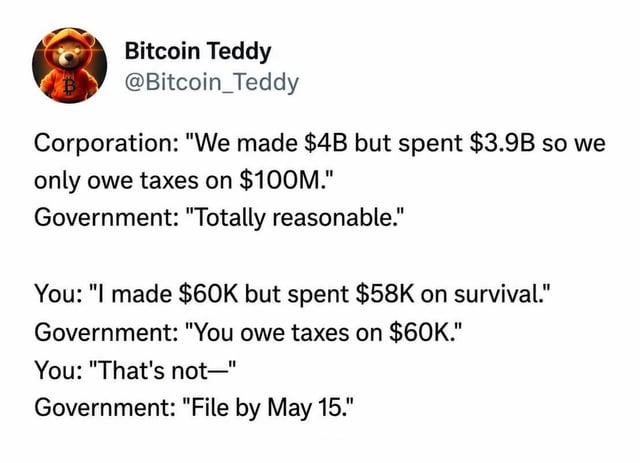
/uj
The "money spent on survival" is the standard deduction and deductions in general. Deductions are viewed as if you never made that money in the first place. Whether standard deduction should be larger is another question.
Yeah, because $16k is enough to survive.
A diet of nothing but rice and beans, living in a rented room in a garage, and dumpster diving for all the remaining necessities and you can almost live in California!
I'm on a fixed income and cannot live in California. I do thanks to parents giving me some intergenerational wealth early by paying my $2k-ish rent for me. (They're in their eighties and still alive.)
What timeframe is that $2k-ish rent?
New York? A half month in a leaky but somehow airtight corrugated metal shed, no air conditioning and a communal bathroom that also happens to be the yard your "bungalow" is in
Ohio? 6 months in a house that used to be someones starter home but they added more to the house, cut it in half, and now charge the same if not more rent for each half than someone paid for the original mortgage. You will be harassed for the rent because "i have to pay the mortgage" but it was paid off over a decade ago. The landlord takes multiple vacations, out of the country, every year. Conveniently around storms and bad weather, so when your roof falls in there's nothing they can do for two weeks.
That doesn’t answer my question at all and you’re not the person I asked.
Maybe asking questions on the Internet isn't for you ❤️
Maybe answering questions you don’t actually have the answer for isn’t for you 🤷🏼♂️
You are in a meme community for politics asking housing questions. Maybe show up at the right house before you start knocking 🤣 the fact that you had no worries but to reply immediately? Get real.
I was about to take out the garbage when I saw your post which was convenient because it was just more trash.
Stay irrelevant
OP even acknowledged this and this shit is still top reply. Dumb fucks everywhere.
So what's that he acknowledged? The amount is too low to be considered a valid argument.
Let us deduct all expenses related to living, and we will quickly learn that for majority of people there isn't anything left to tax.
Or make a standard deductible for companies, let say $1M and any revenue above that has to be taxed.
OP acknowledged the amount itself is of course debatable, and is an entirely separate topic. Yet here we are, again. The concept of whatever you think is a valid argument is moot, a totally separate topic, and there's no argument to be invalidated in the first place.
You're right, of course. But I also think it would open up a giant loophole for the wealthy. A car is essential for survival! A three million dollar car? ... A 15,000sqft house?
Of course, they could set reasonable limits. But when was the last time congress was reasonable?
Corporations can tell the government what their deduction is, the government tells normal humans what their deduction is.
The government tells you what the standard deduction is. You don't have to claim that standard deduction. You can specifically itemize the deductions you wish the claim instead. You can claim considerably more than the standard, if you so choose.
Whether we should be able to claim more and whether the standard deduction is large enough are different questions.
You can claim considerably more than the standard, if you so choose.
You can say that you would like to claim more, but the government sure as hell isn't going to let you claim survival expenses like that. Go ahead and try to claim your rent. Unless you are using part of your rental for business purposes (not just living) they'll just tell you to get fucked and pay the taxes anyway.
So yes, you can put it on the paperwork. But actually claim it? Almost certainly not.
It certainly depends on what you're actually paying, yes. It's very unlikely that your deductible expenses will be greater than the standard deduction. But, it is certainly possible under certain (rare) conditions.
Rent alone here is higher than the basic personal amount, let alone any other necessities. And I'm in one of the cheapest cities in Canada for rental housing.
Which is to say, almost every single tax paying person in the entire country would be getting more than the basic personal amount (Canada's version of the standard deduction in the US) if we were allowed to claim basic necessities. And not by a small amount.
Rent alone
All you are telling me is that "rent" isn't a deductible expense.
None of that changes the fact that if you have more deductible expenses than the standard deduction, you can claim greater than the standard deduction.
The standard deduction is ~$16,000 for a single person. Medical expenses are deductible. If they spend $32,000 in a hospital stay, they would be better off itemizing the whole deduction rather than taking only the standard deduction.
Of course, they aren't obligated to itemize. They could just take the standard deduction and be done with it. That choice is available to them, foolish as it is.
Educational expenses are deductible. They can choose to spend much more than $16000 on school expenses, claiming much more than the standard deduction.
Again, what should and should not qualify as deductible, and the size of the standard deduction are completely separate questions.
None of that changes the fact that if you have more deductible expenses than the standard deduction, you can claim greater than the standard deduction.
You are missing the point that for a business everything is a deduction and for an individual almost nothing counts as an itemized deduction.
It is a lie to say "you could itemize" when the IRS specifically does not allow W2 employees to itemize rent, transportation, food, and entertainment.
It is a lie to say “you could itemize” when the IRS specifically does not allow W2 employees to itemize rent, transportation, food, and entertainment.
You're getting hung up on the categories. You don't have to be just a W2 worker for someone else's business. You can also be a contractor: you can be a business yourself. No, you can't deduct that part of your subsistence you use for W2 employment or personal use. But, you can put yourself on the clock for your own business, and that business can deduct everything that any other business can do.
If you're not deducting that part of your home, utilities, vehicles, electronics, tools, and equipment that you use for various business purposes, you're doing something very wrong.
Your business doesn't have to actually turn a profit. Legally, you have to try to turn some kind of profit, but you don't have to actually succeed. 30% of home-based businesses never do.
You don't have to be just a W2 worker
That's the OP argument! You can't say, employee taxes aren't unfair, just be an employer. It's ridiculous! You have only restated the OP's claim: businesses can deduct virtually everything and employees can deduct virtually nothing.
Sigh.
Forget about all of your W2 earnings for a moment. Forget about the 8.5 hours a day you spend working for someone else. Forget about your bi-weekly paycheck. None of that stuff matters here, or to the IRS.
Forget all of that, hold an annual garage sale.
Now, you're a business. You get to deduct the poster board you purchase advertising your sale. You get to deduct the balloons and price stickers.
You also get to deduct that part of your rent or mortgage that you spend on the garage where you keep your inventory. That is now your "warehouse", which is part of your (non-employment) business. How about your attic? The attic is part of your home. You pay mortgage/rent/taxes on that part of your home right along with every other part. I doubt you use it for anything but storage anyway. Put the crap in your attic on your lawn with a price tag once a year, and you get to deduct the part of your housing payment that goes toward your attic.
You get to deduct the cost of acquiring your inventory. That is also a business expense.
Spend an afternoon in a lawnchair while your neighbors look through your junk inventory, and you get to claim thousands of dollars in business expenses.
If you're worried the IRS might take issue with you if you only do this once a year, you can put up an ebay, etsy, craigslist, or marketplace listing, and it becomes a year-round operation. You are now an online retailer, and your annual garage sale is just a clearance sale for that business. If you're still not sure, you can file paperwork with the state to be able to collect sales tax (and deduct the filing fee as a business expense).
You can’t say, employee taxes aren’t unfair, just be an employer. It’s ridiculous!
I absolutely can, and it's not ridiculous at all. The problem you're having here is that you think you need to be Walmart in order to call yourself a business. You don't. You think you need to generate a profit to be a business. You don't. (You do need to try to generate a profit. But, very few businesses are actually able to successfully generate a profit, and yours doesn't need to be successful either. "Trying" is enough.) I am quite confident that many of the things you do in your day-to-day life can already be categorized as "business", or could be considered a business with slight tweaks. You are legally entitled to count expenditures on those activities as deductible business expenses.
You keep trying to change the argument from the lack of fairness in tax policy to a discussion of how you can dodge taxes by becoming a business.
Yes by becoming a business you can dodge taxes like other businesses. That's not the argument.
OP: "rent is high" YOU: "no its not, just buy a house" OP: "that's not what I said" YOU: "You're not listening, here are tips to buy a house cheaply."
You buying a house cheap doesn't change that the OP said rent is high. Becoming a business doesn't change the tax policy allows deductions for businesses that employees don't get.
And your "garage sale tip" is bullshit of the highest order. If you've done it, you are lucky you haven't been audited. You can't deduct on a loss every year without being classified as a hobby. If you are holding a garage sale, you aren't earning a profit- that's why its not taxable. You selling a 20 year old $10 beanie baby for 25 cents is a loss and you don't have to pay taxes on that 25 cents.
And your "garage sale tip" is bullshit of the highest order.
I completely agree. It is bullshit of the highest order. There is a special IRS term for "bullshit of the highest order". That term is "business".
If you've done it, you are lucky you haven't been audited.
If I had done that, and I was audited, and the IRS had a problem with it. I'd owe what I would have owed anyway. Maybe with a small penalty.
You can't deduct on a loss every year without being classified as a hobby.
How many companies do you need me to name, and how many years do they need to show losses? You certainly can show several consecutive years of losses. You'd be hard pressed to find a company that hasn't shown many consecutive years of losses. Lack of profit doesn't mean a business is unsuccessful. It means they paid out their vendors and workers and creditors a bit more than they brought in.
And why do you assume you will always show losses? Why do you assume you won't find a profitable niche in the process? The only requirement the IRS needs to classify you as a business is the fact that you don't make an assumption like that. That assumption is what makes it a hobby. Don't make it, and you're a business.
Maybe with a small penalty
Small penalty is when you make a mistake. Gigantic deductions with no income would have them charging you with tax fraud. The lawyer fees to defend yourself would be worse than the penalties.
Lack of profit doesn't mean a business is unsuccessful
Companies like Amazon showed losses a decade because they had income from investors. So they had income, it was only that the "business" side of the business was unprofitable.
You can't get away with deducting your mortgage as a business express from a unprofitable garage sale. Certainly not year after year.
Why do you assume you won't find a profitable niche in the process?
So we are back to, "just buy a house if you can't afford rent."
Tax avoidance schemes isn't the argument.
Gigantic deductions with no income would have them charging you with tax fraud.
Tax fraud would be claiming deductions for expenses that were never incurred. The expense of "rent" was incurred. The expense of "posterboard" was incurred. The expense of "balloons" was incurred. Using your attic for something other than storing items you retail in your online store and garage sale would turn your claim into fraud, but I never suggested you should do anything like that. That you attempted to sell everything in your attic indicates it was not used for personal use. They may not allow you to claim it as a business expense, but they can't argue fraud unless you used it for personal use despite claiming business. So don't do that. Don't use it for personal use when you claim it as a business use.
You can’t get away with deducting your mortgage as a business express from a unprofitable garage sale.
I didn't say deduct your entire mortgage. You can't do that, unless you use the entire home exclusively for business. But you certainly can deduct a part of your mortgage, a part proportional to the amount of your house you use exclusively for business.
So we are back to, “just buy a house if you can’t afford rent.”
What are you talking about? That doesn't make any sense whatsoever, and it certainly doesn't arise from my arguments.
Look, you're entering into this from the assumption that I'm suggesting you defraud the government. That is completely untrue. What I am saying is that "business" is a much broader category than you seem to think. A garage sale can certainly be a business activity. Re-selling merchandise online can certainly be a business activity. There is no explicitly defined line on how many business activities you need to perform, nor a explicit time period in which you need to perform them in order to consider yourself a business. As long as you approach it with the intention of (eventually) becoming profitable - even if you can't figure out how to do that right now - it is a business, and you are entitled to claim it as such.
It is the epitome of foolishness to conduct business activities without declaring them to be "business".
Tax fraud would be claiming deductions for expenses that were never incurred.
You aren't even googling before making shit up now.
Look, you’re entering into this from the assumption that I’m suggesting you defraud the government.
I'm entering this from the assumption that you are steering the argument into something completely unrelated because you were proven wrong.
IT DOESN'T MATTER IF YOU CAN LEGALLY DODGE TAXES BY RUNNING A BUSINESS. THE OP STATED THAT W2 EMPLOYEES DON'T GET THE DEDUCTIONS OF A BUSINESS.
You aren’t even googling before making shit up now.
Dude. You are clearly not understanding me. My statement - that you specifically quoted above - summarizes each and every point your link makes. You act like you're disagreeing with me, but you're supporting points I've already made. The disagreement you are having on this issue is entirely within your own head.
For example, from your link:
If the IRS believes you have erroneously claimed a home office or other deduction, it can ding you for anywhere between $500 and $5,000. This penalty can jump to 75% if the taxpayer deliberately and fraudulently attempts to reduce their tax liability.
My previous statement (Emphasis added):
They may not allow you to claim it as a business expense, but they can’t argue fraud unless you used it for personal use despite claiming business. So don’t do that. Don’t use it for personal use when you claim it as a business use.
Your link is just quantifying the penalties for ignoring my advice. Don't "erroneously claim a home office or other deduction". Go ahead and claim them, just make sure your claim isn't erroneous. You are perfectly entitled to make a valid claim.
I’m entering this from the assumption that you are steering the argument into something completely unrelated because you were proven wrong.
That might just be a piss-poor assumption. You should probably go back and see if that assumption is actually justified. (Narrator: It wasn't.)
IT DOESN’T MATTER IF YOU CAN LEGALLY DODGE TAXES BY RUNNING A BUSINESS. THE OP STATED THAT W2 EMPLOYEES DON’T GET THE DEDUCTIONS OF A BUSINESS.
This would only be a valid statement if "being a W2 employee" precluded the individual from also running their own business. As the employee is not precluded from running a business, the W2 employee can get the deductions of running a business. You have no grounds to say that they can't get the deductions of a business, when they can, in fact, get the deductions of a business simply by operating as a business.
Perhaps it would be useful to show you that a business is not always entitled to deduct something. For example, where a business (subcontractor) is hired by another business (prime contractor) and that prime contractor provides various direct compensation to the sub, the sub cannot deduct the expense in question. The subcontractor is, effectively, an employee of the prime contractor, even though both are businesses. Expenses made by the prime cannot be deducted by the sub. Remember that.
If the prime contractor provides eye protection and other PPE to the subcontractor, the subcontractor cannot deduct that PPE as a business expense. If the prime contractor provides transportation to and from the main job site, the subcontractor cannot claim transportation costs.
When you cannot claim your commute costs as a W2 employee, it is because the IRS requires those costs to be included in your negotiated direct compensation with your employer. Your pay specifically includes compensation for your normal commute. You are "reimbursed" for your normal commute costs, and don't get to claim them yourself.
As a W2 employee, you can claim transportation costs to other job sites unless you are specifically reimbursed for your travel to those other job sites. If you are reimbursed, you don't also get to claim it. Your employer gets to claim that reimbursement as a deductible expense.
If you don't like that, don't work as a W2 employee. Work as a contractor: a business. A contractor is allowed to deduct the expense of all non-reimbursed transportation costs, and is not expected or required to demand explicit reimbursement for transportation or other expenses in their negotiated fee.
you claimed you could deduct part of your mortgage for a garage sale.
You claimed it isn't fraud if you can show the source.
You aren't allowed to deduct your mortgage for a garage sale.
https://www.irs.gov/publications/p587
Fraud can be overstated deductions. Given that you aren't allowed to deduct your mortgage for a garage sale, and you are doing it every year to offset your W2 earnings, the amount of your phony deduction could be considered fraud. You can't deduct hobby expenses.
If you don't like that, don't work as a W2 employee
That's not the discussion and you know it.
"Rent is high" you: "buy a house" "Police are corrupt" you: "become a policeman" "Tax policy is unfair" you: "start a successful business"
you claimed you could deduct part of your mortgage for a garage sale.
I claimed that a garage sale was a business activity. I said if you didn't think an annual garage sale was sufficient to count as a "business", you could engage in online retailing or other additional activities as well.
You absolutely are allowed to deduct the costs for that part of your home you use exclusively for business purposes. Right from your own link:
"Part 1—Part of Your Home Used for Business
Lines 1–3.
If you figure the percentage based on area, use lines 1 through 3 to figure the business-use percentage. Enter the percentage on line 3.
You can use any other reasonable method that accurately reflects your business-use percentage. If you operate a daycare facility and you meet the exception to the exclusive use test for part or all of the area you use for business, you must figure the business-use percentage for that area as explained under Daycare Facility, earlier. If you use another method to figure your business percentage, skip lines 1 and 2 and enter the percentage on line 3.
I'm beginning to get offended at the repeated insinuations that I am advocating fraud. You are looking at BUSINESS ACTIVITIES and declaring them to be fraud. You've adopted some sort of weird victim mentality here. You think that if "businesses" do it, it's permitted by the government, but if you do the exact same thing, it's fraud. It's not.
Have you ever worked as a 1099 contractor? Have you ever had any income whatsoever that didn't come from a W2 or capital gains? It really doesn't seem like it. Your position on what constitutes a "business" seems to be some kind of megacorporation, rather than a sole proprietorship. You seem to be under the impression that unless you can survive off the income of your business, it's not a business at all.
Fraud can be overstated deductions.
I never suggested overstating deductions. Your argument here is bordering on libelous.
Given that you aren’t allowed to deduct your mortgage for a garage sale,
Your own link says otherwise.
the amount of your phony deduction could be considered fraud.
There was no phony deduction.
You can’t deduct hobby expenses.
True, but I never suggested a hobby. I suggested a business. And I described numerous activities - not just a garage sale - that would constitute business. You consistently ignore the remainder of my argument: if you don't think a garage sale is sufficient to constitute a "business", you can engage in online retailing and other activities as well.
“Rent is high” you: “buy a house” “Police are corrupt” you: “become a policeman” “Tax policy is unfair” you: “start a successful business”
Your first two points don't arise from any of my arguments. As for the third, I never said "start a successful business". I've said repeatedly that 30% of home businesses never show a profit. They still get to deduct their expenses. Your third observation would be better stated as "Businesses get unfair tax breaks" : "Start a business, so you an claim the same tax breaks"
That’s not the discussion and you know it.
Actually, it is the entire discussion. The fact that the IRS requires your regular commute and other expenses to be included in your negotiated pay as a W2 employee means that your expenses are effectively considered "reimbursed". Businesses don't get to claim reimbursed expenses as deductions. If you don't want to include such expenses in your regular pay, you can work as a 1099 contractor rather than a W2 employee.
I claimed that a garage sale was a business activity.
You can't deduct housing for a garage sale as you claimed.
The fact that the IRS requires your regular commute and other expenses to be included in your negotiated pay as a W2 employee means that your expenses are effectively considered "reimbursed".
They specifically say you can't deduct even if the employer doesn't reimburse.
"Employees can’t deduct this cost even if their employer doesn’t reimburse the employee for using their own car."
https://www.irs.gov/newsroom/heres-the-411-on-who-can-deduct-car-expenses-on-their-tax-returns
So the IRS does not consider your salary as including reimbursement for transportation.
"you can work as a 1099 contractor rather than a W2 employee."
Companies do not offer that choice to everyone.
You can’t deduct housing for a garage sale as you claimed.
Your own link says that I can, especially when you get around to acknowledging that the garage sale was just one small business activity of the whole business I described. I included "online retail" as an additional business activity specifically because I thought you would have a problem with the garage sale alone. I've already addressed your "garage sale" concerns; I addressed them before you raised them. Your own link says I can deduct from my housing costs the percentage of the house I use for business purposes. It specifically says I can use any "reasonable method that accurately reflects your business-use percentage" to make that determination.
They specifically say you can't deduct even if the employer doesn't reimburse.
The IRS basically acts as though your regular pay specifically includes reimbursement for your regular commute. Your regular commute is already paid for with your pay, which is why you can't claim it. The pay you negotiate with your W2 employer already includes (but does not specifically itemize) reimbursement for your regular commute. That is why you don't get to separately deduct it.
Your regular pay does not cover atypical travel. If you are temporarily forced to drive 5 miles further to a different job site, you can claim that additional 5 miles. Compensation for that additional mileage is not included in your regular pay. If that additional mileage is not specifically reimbursed, you can claim it, even as a W2 employee.
Companies do not offer that choice to everyone.
Then find a different company. Find three, or ten. You're a contractor: you provide a contracted service, not your time. You provide it to anyone you want, not just a single company. That's what it means to be a contractor, rather than an employee. You have the flexibility in defining exactly what business you will be doing. You don't have to fit the narrow IRS restrictions associated with W2 employment. You operate as a business, and you are taxed as a business.
especially when you get around to acknowledging that the garage sale was just one small business activity of the whole business I described.
Read what you wrote:
"Forget all of that, hold an annual garage sale.
Now, you’re a business. You get to deduct the poster board you purchase advertising your sale. You get to deduct the balloons and price stickers.
You also get to deduct that part of your rent or mortgage that you spend on the garage where you keep your inventory. That is now your “warehouse”, which is part of your (non-employment) business. How about your attic? The attic is part of your home. You pay mortgage/rent/taxes on that part of your home right along with every other part. I doubt you use it for anything but storage anyway. Put the crap in your attic on your lawn with a price tag once a year, and you get to deduct the part of your housing payment that goes toward your attic.
You get to deduct the cost of acquiring your inventory. That is also a business expense.
Spend an afternoon in a lawnchair while your neighbors look through your junk inventory, and you get to claim thousands of dollars in business expenses.
If you’re worried the IRS might take issue with you if you only do this once a year, you can put up an ebay, etsy, craigslist, or marketplace listing, and it becomes a year-round operation."
You posted what the IRS could classify as fraud and then added "If you are worried..." as an addendum.
Creating an ebay account does not allow you to deduct your rent. You need to sell regularly as a business to qualify. Only the portion of the space used exclusively for business is deductible.
So we have everything that isn't profit for a business is taxed vs everything that isn't business related for a taxpayer is taxed. It hasn't changed the OP's statement at all. If a business needs an office to operate its completely tax deductible but the bedroom of your house where you need to sleep isn't tax deductible.
The IRS basically acts as though your regular pay s
"Acts" is your opinion. I specifically quoted the IRS publication where they said that isn't true.
The pay you negotiate with your W2 employer already includes
The IRS said they specifically do not consider it is included.
Then find a different company.
People are forced through from their birth lottery (intelligence and family wealth) into a system that dictates the rules. Finding the perfect job is often impossible because the choice isn't there.
You posted what the IRS could classify as fraud and then added “If you are worried…” as an addendum.
You claim they could. Not them. They would be burdened with proving it beyond a shadow of a doubt. Which they can't do, because you can cite their explicit guidance to support your claim of business use. It's not fraud, because they specifically state that you can claim everything I said. You linked the exact statement that allows it, and I've cited it earlier. The "addendum" I added was for your benefit, because I recognized that the "garage sale" example was probably too foreign a concept for you to rationally consider. But yes, if 50% of my home is used exclusively for business 1 day a year, I can deduct 1/365 * 50% * annual rent of my home. If I use a room that is 10% of the floor space of my home exclusively to store and handle merchandise for my online storefront, I can deduct 10% of my rent.
Creating an ebay account does not allow you to deduct your rent. You need to sell regularly as a business to qualify.
You need to regularly offer for sale.
If a business needs an office to operate its completely tax deductible but the bedroom of your house where you need to sleep isn’t tax deductible.
Correct. You're restating what I said in my initial comment: "You also get to deduct that part of your rent or mortgage that you spend on the garage where you keep your inventory." You're repeating my words back to me, after declaring my words to be fraud.
“Acts” is your opinion. I specifically quoted the IRS publication where they said that isn’t true.
That citation does not apply to the circumstances we are discussing here.
The IRS said they specifically do not consider it is included.
This entire discussion is predicated on the fact that they do not allow deductions for things like commuting, when they do allow deductions for 1099 contractors to travel to job sites, and they do allow W2 employees to deduct travel to places other than their normal place of work. They do not allow these deductions where the travel costs are reimbursed, whether for W2 employees or for 1099 contractors. So, regular commuting is not deductible; reimbursed travel is not deductible. Regular commuting is treated the same way as reimbursed travel. Contrary to what you think you read, the IRS does treat normal commutes as reimbursed travel.
People are forced through from their birth lottery (intelligence and family wealth) into a system that dictates the rules.
Horseshit. Pure, unadulterated horseshit. There are millions of 1099 workers in the economy. If this tax issue is sufficiently important, you will join them. If it's not important enough to do something effective, you can try to achieve some sort of change through the political process.
Finding the perfect job is often impossible because the choice isn’t there.
In this discussion, you have repeatedly and consistently misidentified perfectly legitimate business practices as "fraud". You have repeatedly defamed me for promoting these perfectly legitimate business practices by declaring them fraud.
You now argue that you don't have the "choice" of your perfect job.
Your perceptions are the problem here. You are failing to recognize the wide variety of choice that you do have. The constraints of "fraud" aren't where you think they are. You are allowed to do far more than what you think you can do. This "lack of choice" problem is entirely within your own head. You are rejecting good options because you don't understand that they are good. You are mistaking them for fraud, then claiming you don't have them.
Be the choice.
If it's not important enough to do something effective, you can try to achieve some sort of change through the political process.
And you have constantly refused to acknowledge that the tax laws aren't consistent.
Your equivalent position: "Police brutality isnt a problem, become a policeman so you are above the law or change it with politics."
I've been on all sides. I've been W2. I've been W2 with a side business. I've been president of a large ISP. I don't have to be in the fight to see injustice.
And you have constantly refused to acknowledge that the tax laws aren’t consistent.
I've shown the consistency.
A W2 worker is, effectively, a subcontractor to a prime contractor who reimburses all normal work expenses. The subcontractor doesn't get to deduct their travel expenses, because they are part of the normal compensation. The subcontractor doesn't get to deduct PPE, because they are provided by the prime. The subcontractor doesn't get to deduct clothing or laundry or tools, because all of those are provided (or reimbursed) by the prime. This arrangement between the prime and the subcontractor is functionally identical to that of the prime with a W2 employee.
The subcontractor does get to deduct atypical expenses not included in the normal, negotiated pay. So does the W2 employee.
The term for the comparison between "W2 Worker" and the type of subcontractor I described is "consistent". They are able to make the same deductions for the same reasons. They are taxed the same. A W2 worker is a subcontractor whose normal expenditures are all reimbursed by the prime. The distinction between them has no relevant difference.
The tax scheme for a W2 employee is simplified relative to that of a 1099 worker. This is the sine qua non of W2 employment. This simplification is the explicit reason why this category exists. This category of worker incorporates all "normal" expenditures, making all of them the responsibility of the employer, and included in "normal", negotiated pay. These "normal", routine, recurring expenditures don't need to be explicitly itemized on the tax return. They are already treated as reimbursed through regular pay, so they are already incorporated and not subject to deduction. The need for these expenditures is included in your pay negotiation with your employer.
This simplification does not extend to abnormal or atypical expenses incurred by the worker. Where the W2 worker incurs abnormal or atypical, non-reimbursed expenses, they can, indeed, claim these expenses. Only normal, recurring expenses are included in the pay negotiated with the employer.
What you are trying to achieve is something that already exists in the tax code. Colloquially, it's called the "1099 Worker". We already have the "1099 Worker". You're trying to reinvent the "1099 Worker". But we already have the "1099 Worker". Everything you are trying to achieve for the W2 employee is already present in the "1099 Worker" category. If you want the benefits of a "1099 Worker", go ahead and become a "1099 Worker". You can certainly hire yourself out to one or more businesses as a "1099 Worker". Companies hire "1099 Workers" all the time for specific purposes. Yes, the overwhelming majority of jobs are filled by W2 employees, but certainly not all. There is plenty of opportunity for you to operate as a "1099 Worker" if your specific needs aren't being met by W2 employment.
W2 worker is, effectively, a subcontractor to a prime contractor who reimburses all normal work expenses.
I already quoted the IRS webpage where it specifically states that isn't true.
But it doesn't matter. If you are a business and get income from a contract and that contract says "Part of this money includes travel expenses." it doesn't matter to the IRS. As a business, you get income and you have expenses. The details of that income do not matter to the IRS.
For example a business gets $50k of income from a contract that says it includes travel expenses. At the end of the year you actually spent $49k in travel expenses. You report $1k profit to the IRS.
A W2 gets $50k and has to report $50k independent of how much they had to personally spend to get that $50k.
"If you’re not deducting that part of your home, utilities, vehicles, electronics, tools, and equipment that you use for various business purposes, you’re doing something very wrong."
Ok, but why should it have to be for business purposes to be deductible? Why does a landlord get to deduct the same exact expenses a private homeowner cannot?
I haven't addressed that issue. I've addressed the fairness issue. If you can present your expenses as business expenses, you should. If the only reason you can't is because you aren't presenting yourself as a business, present yourself as a business and take the deductions.
We're literally talking about corporations being "people" but able to deduct things that people can't. If corporations are people, and they can deduct rent (they can) why can't everyone else.
You've completely lost the plot mate. You can't say THE LITERAL QUESTION WE ARE TALKING ABOUT is a separate question, wtf lol
A large part of my house is used exclusively for business purposes. I deduct that part.
I don't do this myself, but businesses are allowed to compensate workers with, in part, housing. Your home-based business could deduct the housing it provides to workers, including yourself.
Overall, the general shape of the system makes sense.
Everybody receives services provided by the government, so everybody should help pay for that government. The FDA tests to make sure food and drugs are safe. The NHTSA makes sure cars and highways are safe. And, of course, the big one, the military protecting the country from invasion. The standard deduction exists so that people only have to start paying taxes once they get their basic needs met.
Of course, I know that in the real world it's much more complicated than that. The US military might actually make Americans less safe by getting involved in all kinds of conflicts overseas. The terrorist attacks of Sept. 11th would probably never have attacked if the US had a defence-only military. The FDA is being corrupted by an antivax nutjob, and so-on. But, the theory of everybody contributing taxes to pay for things provided for the common good makes sense. The real standard deduction is absurdly low and almost nobody can actually fully meet their needs with that minimal amount.
It also makes sense in the abstract that corporations don't pay taxes on money that doesn't get distributed to the owners. If a Mom and Pop grocery store is doing really well and Mom and Pop pay themselves huge salaries, they pay personal income tax on those salaries. If they arrange to do it through corporate dividends or something, then it's the corporation that pays taxes. On the other hand, if the store is doing really well and they want to expand, it makes sense that the government not tax them based on their revenues if they're re-investing those revenues into the business. If they're investing the money into making a bigger, better store to serve their community rather than simply taking the money out as profits into Mom's purse and Pop's wallet that's good for the community. Also, if Mom and Pop made $400k in revenue but spent $390k on expenses, and that includes the wages of some cashiers, it's probably unreasonable to tax the revenue before the employees are even paid.
The problem is really in the various loopholes and ways corporations claim to be re-investing the money. We wouldn't want Mom and Pop's grocery store to be unable to expand because they're taxed before they can even invest. On the other hand if Pop buys a Porsche SUV under the store's name and claims it's a grocery delivery van, that's not fair. Other people have to buy their SUVs with after-tax money. In theory, if Pop is caught claiming that SUV as a business expense but using it for purely personal purposes, the IRS will go after him. But, of course, the reality is that companies get away with that kind of thing all the time.
I think part of the complaint here is based in the reality that corporations get away with lots of things, and that taxes are a real burden on the poor and middle class. On the other hand, I think there's also a lot of financial illiteracy where people really have no idea how the taxation system works. They just see ragebait on social media and get angry because something about it seems unfair.
Person: $16k for food is part of standard deduction. No deduction for car or rent if you are an employee.
Corporation (which is legally treated as a person): $150k for food for one party. $150k for CEO's Mercedes. $500k for condo for ceo to use when visiting.
Pretty sure that's the point
I'm pretty sure you are correct.
That’s the thing. Corporations report their own deductions, but individuals have to follow existing law, when there’s a high variance among necessary spending
You can also report your own deductions if you itemize. If your income is low, the standard deduction is probably just significantly bigger than your itemized deductions.
Legal deductions are extremely limited if you are an employee. You can't deduct your car, your rent, or the big screen TV you bought.
For employers, anything that didn't end up in the bank at the end of the year is a deduction.
You definitely want to be operating some sort of home business on the side, even if you are employed. You don't get to count employment-related expenses, but you do get to count expenses attributable to that separate business.
Also, not true. You can deduct any expense needed for work. Uniform, supplies, food if you're required to eat on the clock, car payments if you're a delivery driver, all deductible. You can deduct a haircut if your employer has a grooming policy.
It's just not worth it for most people. You need to save receipts and be able to prove it was a job-related expense, and if you do something wrong, you could be charged with tax fraud.
Commuting to and from the job is an expense needed for work. You can claim that part of your non-reimbursed travel expenses to temporary work sites that exceed your normal commute, but you can't claim your normal commute.
You cannot deduct your commuting expenses. Not gas. Not bus fare. Not parking.
Uniform items are deductible only of you don't get a uniform allowance.
If they give you a $50/yr boot allowance, you don't get to claim your $300 Red Wings. If you buy your own tools but your employer provides a (shitty, shared) set, you don't get to deduct your tools.
But, this is all about W2 employment. In practice, the overwhelming majority of expenses you incur in the process of W2 employment are not actually deductible, because your employer is already taking the deduction.
But, if you are running your own home business, your usual workplace is your home, and you can claim transportation expenses anywhere you need to go for that business. You can deduct the use of a part of your home. You can deduct part of your utilities, your wardrobe, your tools. Even if your home business is one of the 30% that are operated at a loss, you can deduct the expenses incurred while doing business, and offset a part of your W2 income.
People can report their own deductions, too. It's just not worth it for most people.
The problem is that the IRS "doesn't have the resources" to audit corporations and millionaires. They basically only audit small business owners.
Edit for sarcasm quotes
Even that though, you can only deduct part of your living expenses. There is no food deduction afaik, there is no deduction for insurance as far as I know.
Most of us also pay a much higher proportion of our income in sales taxes. Businesses are exempt from such taxes; they are only paid by the end user.
That's absolutely not true. Businesses pay sales taxes, too. Nonprofits/churches/etc are exempt, but otherwise, every transaction is taxed.
No, that's incorrect. I am very well aware of this. Businesses only have to pay sales taxes on purchases for which they are the end user. They'll pay sales taxes on their office supplies and services provided to the business. But manufacturers do not have to pay sales taxes on the raw materials they purchase. Retailers do not pay sales taxes on wholesale purchases they make for resale. Only the end-user pays the sales tax on a purchase.
I work with a couple vendors that do not collect sales tax at all. They only sell B2B, and they only sell to businesses who provide them with a sales tax exemption certificate.
What you are describing is more akin to Europe's VAT system. Still, under VAT, everyone in the chain pays VAT, and each vendor remits the collected VAT to the tax authority. But, the business-buyer reclaims that VAT from the tax authority if they are not the end-user of the purchased product. Everyone but the end user can reclaim their VAT payment.
Which is ass backwards. Audit those with the highest amounts and they made way more money. It's proven it worked that way until they cut funding for it
I'm pretty sure I read that auditing the wealthy is a huge profit center for the IRS, because they find people who aren't paying what's owed. Naturally conservatives (of any party) hate this and gut it whenever possible
Auditing in general is profitable, but it's mostly due to it being automated for people that aren't making 7 figures. Auditing the not absurdly wealthy is also generally a positive revenue. Auditing the extremely wealthy tends to not be a great net benefit as the costs of lawyers and court time outweighs the settlement check at the end. There's an argument to be made it's worth the cost to ensure the ultra wealthy do actually pay though.
It's billions of dollars of tax "avoidance", cheating, and simply not paying. Unfortunately, the wealthy who are calling the shots don't really want to pay millions for IRS lawyers
Yeah, if you look at the numbers it's obvious. But libertarians don't let facts get in the way of a good narrative.
True, and broadly deductions, but deductions are very different.
For example, owning my house, the taxes do not care that I pay insurance and property tax on it. They do not care if I have to spend $10,000 on HVAC because it went out.
However, if I own a house that I rent out, I can deduct all of that. And this is ignoring the standard deduction, you can deduct this stuff on top of the standard deduction.
I think this is the sort of BS, that a business can wave away most any expense but a private citizen just has to suck it up.
Corporation: We planned the next 2 years on an ever increasing income stream but the most minor inconvenience disrupted that so we had to lay off 9,000 employees with zero notice so we could meet our bottom line.
Government: That's a shame, here's $500,000,000 to help "mitigate" "economic conditions".
The 9000 laid-off employees: Can he get $200 a week unemployment so we can afford to exist?
Government: You should have planned better.
Well yeah, at this point the corporation and government are the same person.
I'm a Democrat. Not specifically in the party sense but in the genuine belief Democracy is the very best organizational form of government we have... But damn if it isn't dependent on having a well informed, educated citizenry to thrive. Wealth inequality got so out of control and foreign governments undermined us to such an extent our citizens are mostly clueless to being played.
People usually call that a "lowercase D democrat"
I always mix those up, let alone wonder how well other people know the difference so I just tend to explain as I go kind of thing, if that makes sense
“D” is capitalizing a proper noun, the name for the political party. Proper nouns should be capitalized.
“d” for the system of governance, not a proper noun.
Anyone that cares to know the difference will likely note it. Hope that helps.
How do you define best?
The United States (we are a republic anyway I think) is barely 250 years old and falling apart.
We have huge societal problems and we are executing people in the streets.
We are built on genocide and theft.
It's not working out imo. I don't have a solution, but indirect democracy seems to have perverse incentives that lead to this.
I guess I define best by asking myself if I'd prefer at this moment to live in any other system. Not really. Longer civilizations existed but they subsisted off of imperialism, sacrifices to the gods, and slavery. They made marginal improvements but did not expand median life expectancy to the extent our democracies did either. The number of rights attained in such a short time for disenfranchised groups is also unparalleled.
Despite what people complain about wars, we are actually living in some of the most peaceful times in human history -- again much of this is thanks to the imperfect improvements of Democracy.
I don't have a solution, but indirect democracy seems to have perverse incentives that lead to this.
That kinda does imply a solution, doesn't it? The voter fatigue problem of direct democracy can be solved with modern communication technology and liquid democracy.
Yes, but I trust tech less and less everyday.
Something like a public Bitcoin ledger could be interesting for signing your vote and ensuring nobody changed it.
My fear would be th middlemen. Even if we have an open protocol, someone has to wrap it in an app that people can use. Someone has to host the servers. Even the network infrastructure that you and I are using to talk can't be trusted anymore.
If corporations are people (under the law) then the money they make is income and should be taxed appropriately.
But since money is free speech, making corporations pay taxes is compelled speech, which we're protected against by our first amendment rights.
This just in: Saying that is now terrorism as well. Its apparently a form of protest against the government which is now totally illegal.
Bro, I am the biggest psychosexual narcoterrorist in the world. I lead a cult! It's protected by the government, and I get benefits, too!
Better position would be that money they receive (profit) should be taxed since people also pay taxes based on the amount of money they receive (income). But that position is basically what we already have.
The problem with the system is that a corporation has different kinds of 'discounts' as workers and that those differences became excuses to greatly reduce their share of the bill (low corporate taxes are good for the economy, in general) shifting the burden to the working class (since all the money spent on education, healthcare, pensions etc does end up in the pockets of the people).
The true problem is not necessarily because the corporate tax is not high enough, it's because the benefits of a succesful company go to a small amount of people, while a serious part of the costs (infrastructure, healthy and well educated worker) are paid by a large amount of people.
The ones who should really be taxed appropriately is this small group of people who extract a lot of value from the expenses the large group of people have. Let's say a 1000 people together costs 1000 euro, while together they earn 1100, then it leaves 100 on the table. Right now the large group of 95 does not 95, but maybe 5 or 10. While the small group of 5 does not get 5, but 90 or 95. That small group that received the vast majority pay a much smaller percentage of what they received.
The real difficulty is with the vast wealth and power in the hands of the few and the unscrupulous who represent or control capital. Hundreds of laws of Congress and the state legislatures are in the interest of these men and against the interests of workingmen. These need to be exposed and repealed. All laws on corporations, on taxation, on trusts, wills, descent, and the like, need examination and extensive change. This is a government of the people, by the people, and for the people no longer. It is a government of corporations, by corporations, and for corporations.
--Rutherford B. Hayes
Corporation privilege has been a problem in the US and the western world for a long time.
Edit: I found the longer version of the quote by Hayes.
The best part is that, legally, they're both considered people.
And in parts of Delaware, can both even vote!
I'd rather just start with them taking the appropriate taxes out of my check rather than me paying a company for them to tell me I owe another 2-5k
Intuit bribed trump to kill irs autofile.
Yet this isn't all on Trump, his is just the most recent insult
It's on Sasan for making the bribe
True
And the money they spent on that bribe came out of the pockets of its customers. But, not to worry, with no IRS autofile, those customers now have limited options so Intuit can now raise its prices to recoup the bribe money and more.
It's just good business.
Thank that company for lobbying against automated taxes.
This is fucked up. Don't get me wrong.
But if you want to end this just start taxing loans.
That's literally the only form of income in this country that isn't taxable. Kind of nuts.
Seriously with tax loans there won't be billionaires in this country.
Tax general purpose loans , but only loans that use assets like stocks as collateral. Allow a grace amount so regular people can still take a loan when they need it without being punished.
Have you heard of the "borrow until you die" financial strategy? I'm thinking of trying it out...
This is actually exactly what I'm talking about in my original post. Buy borrowed die is a perfectly legal way of accumulating massive amounts of wealth and paying absolutely no tax
But then you get double taxed. You get taxed on the income you earn in order to pay off the loan, and you get taxed on the loan income itself. This isn't viable without some serious nuance. There are far easier ways to snuff out "buy borrow and die".
I agree and there should definitely be Nuance as to how loans are taxed if this ever happens and I'm sure they will I was just being expedient in my comment.
I think part of OP's frustration is that corporations (and the wealthy, for that matter) have a lot more loopholes to be able to claim deductions compared to the average person. And people are spending money to just survive, which seems more important than making a profit. The average person doesn't have the resources to access these loopholes.
Loophole example: say you're just a common multimillionaire. You want to own multiple properties, but to just go out and buy them, you'd need to spend your income on them, which you can't deduct from your taxable income. Instead, you incorporate a private consulting company (just yourself) and instead of you buying those properties, your business buys them for you. You know, so that you can have somewhere to stay when you travel for business. Those become deductable expenses, and your company doesn't pay any tax on the income used to purchase them. You pay yourself a meager $50k per year, pay almost no tax, live luxuriously, and write condescending posts on LinkedIn. Congrats, you win capitalism.
That was the point of Occupy Wall Street. The movement formed in response to the subprime mortgage crisis and resulting bailouts, in defiance of capitalist principal, and without similar response to the people suffering thanks to the crisis and following recession.
In fact, even though Obama navigated through the crisis, almost everyone with financial investments gained profit through the ordeal while the common US worker was in worse straits, which made the people, specifically, uneducated white men, angry and frustrated and set them up to be manipulated by Trump.
When you say that OP is "frustrated" it feels like what I see everywhere. People see the most abhorrently FUCKED UP shit and go, "huh."
I WANT YOU TO GET MAD, GOD DAMNIT. I WANT YOU TO GET UP OUT OF YOUR CHAIR AND SCREAM, "I'M I HUMAN BEING GOD DAMNIT! MY LIFE HAS VALUE!"
People have been doing that. There have been more protests in the US recently than in memorable history. But it would seem that screaming is falling on deaf ears. So it's the next escallation after screaming that people are doing that seems to be making more of an impact. And while it's unfortunate that we need remorseless Italian plumbers, it does bring a sense of relief that it seems to be rattling some of the wealth class.
For what it's worth, humans have historically been really great at ignoring absolutely abhorrent things. Our brains are wired to help us survive, and sometimes that means normalizing the fucked up stuff so that we're not completely overwhelmed with the absolute fuckery of the world around us. It doesn't make it okay, but there's a biological reason for people going, "huh."
I do get mad. I get banned on a near-daily basis for spitting facts, like how the Earth doesn't exist and how we live in a police state, which is obvious when you think about it.

May?
They’re giving them an extra month, how charitable?
I don't know about you guys and your local tax laws, but I can deduct the costs of earning my income from my taxable income.
Transportation to the job, further education for the job, (if I had any) the costs of having my kids looked after while I work, that sort of thing.
Fundamentally very similar to how the business deducts operating cost from revenue, before paying taxes on profit.
the costs of having my kids looked after while I work
Uh, this sounds like a "not in America" thing. Can you confirm that and/or link to the rules that let you deduct childcare expenses?
Ive got family members who would love to hear about that if it is a thing.
He's on a German server but I'm in the US you can deduct some childcare expenses. I use the Child and Dependent Care Credit
It's very little. You can easily pay thousands out of pocket for child care to get a fraction of it removed from taxes / "back"
It is very little and qualified. The place one of my younger kids go qualifies but not where one of the older one's is.
Good catch on the German server bit. Def escaped my notice.
Yes, this is how it is under the cantonal tax law of Canton Zürich in Switzerland.
Transportation to the job,
Normal commuting expenses are not deductible. You can only deduct transportation expenses to work locations other than your usual workplace, and then only that part of your expenses that exceeds your normal commute.
You can itemize other "costs of earning [your] income", but for most people, the standard deduction is substantially greater.
Normal commuting expenses are not deductible.
Not true for me. I did say I didn't know about your locals laws, seems the inverse is just as true
I'd argue the necessary upkeep to remain alive and functional as an employee should be included as a cost of earning your income. Where I am you definitely can't deduct housing, food or transportation costs. Limited deductions for child related stuff.
This is the case in most jurisdictions but the line between expenses that are incurred in the course of earning your income and those which are not will vary to some extent.
For example, the cost of driving to and from work is generally not deductable, but if you need to travel to some third location then that is generally deductable.
It doesn't really matter exactly where the line between deductable and non-deductable is, because the same rules are applied to everyone in the jurisdiction. For example, if you decide that everyone can claim the cost of driving to work, then the tax rates need to be higher to ensure sufficient tax revenue for the government.
That said, you're correct that the difference between a corporation and a person is the extent to which their activities are income producing. Everything a company does is in the pursuit of profit, so all expenses are deductable against income. In fact tax law prohibits company's spending money for other purposes.
Hmm... Sounds like we should do some tax magic to file our cost of living as operating expense in some way, we can't earn those income if we are not alive after all.
You can't deduct personal expenses, but you absolutely should be operating a side business with its own deductible expenses. That side hustle will probably be operating at a loss, and that loss will offset your W2 employment income.
April 15th
Also, you're taxed on spending while businesses generally aren't
That's not really true. Payroll taxes are still a thing, and they still need to pay sales tax when purchasing materials. It's the accounting tomfoolery that lets then get away with not paying taxes on profits.
sales tax when purchasing materials.
AFAIK Sales tax is relatively small in US. In EU it's a 20-25% VAT but B2B transactions are VAT free
If we charged taxes on revenue, vertical integration would skyrocket. Because the more hands their product goes through, the more tax they need to pay.
We could exempt B2B taxes from the revenue model theoretically though.
You basically described VAT. Which works extremely well. Some small tweaks to capture all revenue (not just sales) and a wealth tax to discourage hoarding and revenue taxation would function quite well.
The problem with VAT is that is that it's not a progressive taxation system. Whether you can afford one sandwich or one million sandwiches, you pay the same either way. We could compensate for it by giving money to the poor, but redistributive policies tend not to be popular with the general public.
Corporations should pay more taxes, but since people are talking about how it all works in reality:
Not all corporate expenses are tax deductible, and people are able to deduct a fair amount from their income when calculating their taxes.
Additionally, individuals are taxed on a progressive scale where anything up to ~$15,000 isn't taxed. That number should be much higher to actually reflect cost of living, but you're still paying less to account for cost of living.
With $60,000 in income your taxable income is $44,000 after the standard deduction , and then you only pay taxes on about $30,000 of that because of the bracketing.
Poverty should be tied to livable wage and that bottom tax bracket should be too. So really, for single filer the first ~40k should be tax exempt.
It really sucks when you're self employed. I can almost eliminate my taxes with expenses, except I still pay both the employee and employee tax for social security/payroll taxes which bare almost 15% I can't avoid. Billionaires don't pay that much tax ever. I can't afford to go to the dentist.
100%. And a livable wage based on where you live. The cost of living in some regions is way higher than in others and you can't just say that low income people should have the longest commutes, or spend the most to move to someplace with lower cost of living.
I'd also be in favor of a negative tax bracket. Something that adjusts below poverty income to above poverty. If done right everyone would see some benefit as the system adjusts everyone's income <= $40,000 up to $45,000 or something via refundable tax credit or some such. Make over $40k and you taxes go down $5k. Make $40k or below and you pay no taxes and get a refund of however much less than $40k you made + $5k.
The difference is that corporations have an army of tax lawyers that tell them what the tax loopholes are to exploit. Meanwhile, for most ordinary persons, it's just them following orders from the government to pay up. One could read up on the tax rules yourself, but are people willing to spend hours reading boring documents they have no expertise of? I myself wasn't aware of some of the tax benefits I could claim until much later.
Look up direct file
Yeah, we do get tax breaks, should be way more with inflation unfortunately.
I totally get what you're saying... but to be fair if you did allow people to deduct all the money they spent in a year from their income, it would specifically encourage a lot of people to spend every single dollar they earned just to avoid the taxes.
They'd be like "hang on, if I spend $3000 a month on rent I get taxed on the $1000 I have left over? What if I move to a place that costs $4000 a month? No taxes? That's what I've got to do then!"
Is that sensible? No. The tax they'd pay on the $1000 is way less than the extra $1000 they're planning on spending to avoid it, but people seem to have a real aversion to a little tax, and many would feel they "got something" for the extra money they spent on groceries or restaurants or rent, compared to the taxes which are simply taken from them.
I'm not saying it couldn't work, I'm not saying there aren't better ways to do it, and I'm definitely not saying there aren't weird cliffs in programs like this that lock people into poverty. But I'd be worried that people who are already wrong about graduated tax brackets, for example, would make a lot dumber choices if they felt they could spend $40 on fancier bread to avoid "$40 of taxes"
Or, hear me out, corporations pay taxes on their total income as well.
Business spent 3.9B dollars on vaporware. That's the problem. Or stock buybacks. Or settlements or CEO bonuses. Not on better wages or anything opex related. Basic capex to keep things up to code/inspection/regulation/etc.
It's where the money is going that makes it a scam.
Does that include your local or regional convenience store or your local bakery or any of your local businesses as well, who would most definitely go out of business and go bankrupt because the grand majority of the revenue is spent in operating expenses.
I'm sure a ton of megacorps would love to buy up a bunch of new failing small businesses to enshitify and roll them into everything that you already hate. Funnelling money out of your local communities, making your local communities even poorer than they already are
What do you think all that tax revenue is for?
A corporate environment without wiggle room for excess would also shake out a lot of grifters.
You know what, that is a fair point!
Cut CEO and upper management wages then. Those taxes should be guaranteed to the country and should have been there from the start. There wouldn't be any national debt and publicly funded projects wouldn't be starving like they are now. Hell, even income tax could be wiped away from the money they'd pull in from taxes.
If in the US, a corporation is technically a person, they should also be taxed like any other person.
The grand majority of businesses are smaller, medium-sized businesses, not huge corps that have golden parachute CEOs.
So, by doing this, all you would do is kill all your local businesses, and the large megacorps that you hate would happily swoop in and gobble them up and consolidate them and then enshitify them.
This would be like shooting yourself in the liver to spite your enemy.
Second-order effects are a thing. Laws and regulations need to target these large corporations who are abusing the tax system.
This just sounds to me like a strong argument for not letting corporations deduct expenditures from taxable revenue.
Holy shit what are these AI-ass essay length replies, tax corporations more you fucking squares.
It makes plenty of sense for them to not be taxed on their gross revenue.
You're thinking of this from a mega-corp standpoint when you should be thinking of this from a small business standpoint. Mega-corps really should be forced to abide by different rules, in my opinion.
Let's imagine you own a bakery shop and it brought in $1,000,000 in revenue this year. You spent $400,000 on raw ingredients, $250,000 on salaries and personnel, and $150,000 on maintenance and equipment....etc
At the end of the year, your business would go bankrupt if it was expected to pay taxes on that million dollars, despite your operating expenditures eating up the grand majority of your year. Similarly, every dollar you spend and every dollar that is spent on wages or salaries is taxed anyways, first or second hand.
That's why that exists.
It makes sense for small or even large businesses.
Where the whole thing breaks down is when you have mega corporations like we do today. Who have accumulated wealth, power, and influence well beyond the scope of what any of these laws and regulations were meant to handle
Sorta, but despite what some governments have decided, corporations typically aren't people. Most companies don't want to accumulate savings, the way humans do. Profit is cool, for sure, but companies don't save up for retirement, or go on vacations, or have kids. So some buffer to survive a less profitable year, or a costly watermain break or something, is prudent but that's where it might end.
Anything more than that, and maybe you hire some new staff, in which case that expense to you becomes income for your new employee, which they pay income tax on. Or you buy more merchandise, which the government may collect sales tax on. Or you may expand your office, and the government collects tax from the construction company and property tax on the new unit. Or you may offer a bonus to your existing employees, which is again income tax for them. Or you could issue dividends to shareholders, which they're taxed on when they receive them.
So the logic is that the things a company spends its money on are taxed in different ways, and the corporate income tax is basically the catch-all for "and then the rest of the money you didn't spend some other way"
Now, do we lowly humans typically get double-dipped when we have our income taxed, but then after that also sales tax when we buy stuff? Yes. Yes we do...
Isn’t this what business do to avoid paying taxes also?
Yes.
Company A gets 1k. 1k is revenue.
Company A spends 1K at Company B. 1k is expense.
Company A has made 0 profit. 0 taxes.
Now if Company A owns Company B did it really lose 1k?
This is how money laundering works. More money more problems. You just have to leave a convincing paper trail an accountant will follow. Eventually they won't be able to follow that the flour supplier Company Z that Company B buys from for it's cookies is funneling Company B's money back into Company A. The accountant doesn't know that B isn't buying flour or making cookies. Sometimes they even make cookies...
That's not money laundering, though. That's just normal fucking loophole and corruption in our tax system that only the larger players get to really benefit from, while all the small players, a.k.a. all your local businesses or even regional businesses, usually aren't large enough to take advantage of that sort of thing.
nO YoU dONt unDErsTAnD iTS a ComPAnY iT sHOuldNT pAy TaXEs!!!
They make older people spend all their money to get long term care with Medicare.
Nursing home care is incredibly expensive but Medicare will only help you pay for it if you get rid of all your income and assets until you get to their cutoff limit before they’ll help you pay for it.
There is a whole industry built in helping older people spend their money so they can get health care.
This. They may also make you sell your house too. I spoke to a family who was trying to get a loved one in a nursing home and they said they were quoted something like 20,000/mo. I asked if they meant per year and they reiterated that it was per month. All that money for a place that will let you stew in your own feces...
Wouldn't spending every last dollar result is more sales tax?
People have a real aversion to a little tax because right now in many (all?) places it means "money I earned through hard work is going to fund some rich asshole's party, safe some breadcrumbs that somehow made their way into funding something beneficial to me or other folks like me". With this fixed, at least I will have no problems with taxes

Taxes are completely unnecessary when the state prints the money.
The entire point of taxes is just to punish the poor.
Either this is highly exaggerated, or whoever is doing your taxes hasn't explained to you the various deductions you should be claiming or enjoying, from standard/basic deductions, to tax credits and programs, not to mention tax brackets.
That being said, is there a massive discrepancy in how little tax corporations and the rich pay compared to the little guy? He'll yeah there is.
For nearly everyone the standard deduction is the way to go lately. If you itemize it's absolutely not the same as businesses being able to deduct their business expenses. There's a good argument businesses should be able to deduct these expenses in my opinion, but for individuals itemizing their deductions it's absolutely not comparable.
My hypothesis is that the tax system does not explicitly favor the rich - it favors those who can navigate its complexities. Which is the rich. Not because they are smarter - because they can hire accountants and tax consultant.
Nope. While you can exploit complexities and loopholes, the top 0.1% is propotionately taxed less by basic design anyway. No need of fancy double Irish dutch sandwich or whatnot.
What they're saying is that it is bullshit for a corporation to dodge taxes on their expenses (no matter how frivilous) but normal people can't deduct necessary expenses.
You can deduct your rent. You can't deduct your food. You can't deduct your vehicle to get to the job you're getting taxed to do.
It's not "dodging", and your bills would be a lot more expensive if the government insisted on billing companies by their revenue instead of profit.
But you shouldn't be paying any income tax if you barely make ends meet.