I leveled the Norwegian wood stack
4d 10h ago by piefed.social/u/ExtremeDullard in dull_mens_club from giraut.github.io
As I add layers of logs to the stack, the logs lean outward more and more. It's simple geometry: the stack is round, with an inner diameter smaller than the outer diameter, and the logs are arranged in a spokes pattern - pointing at the center. But the logs are straight, not wedge-shaped, so the inner ends ride on the logs below a bit higher than the outer ends. The more layers, the steeper the lean becomes.
The last time I worked on the stack, it got high enough that the lean became excessive and I couldn't add more logs: they simply wouldn't stay put and would slide right off. In fact, the entire top of the stack was threatening to collapse outward.
I didn't think the lean would become excessive this quickly, but it did. This is my first Norwegian wood stack, and I guess I'm discovering what everybody knew already 🙂
So I pulled down about half of the stack, to get back to a layer of logs with an acceptable lean angle, added a ring of logs all around the outer perimeter to lift the outer ends of the logs above and correct the lean - basically go back to flat logs above this "correction ring".
And then I discovered the fine art of stacking logs horizontally consistently layer after layer despite the curvature of the stack. It's not a super-obvious technique, and it takes a lot of time to place each log properly. But it's well worth the effort.
Now the bottom of my stack has the lean in the logs, then there's this correction layer, then the top of the stack has only horizontal logs. If I wanted this stack to be perfect, knowing what I know now, I would have to pull it down completely and re-stack it. But this is good enough: the correction layer is rather decorative, and it'll serve as a reminder of what not to do below it 🙂
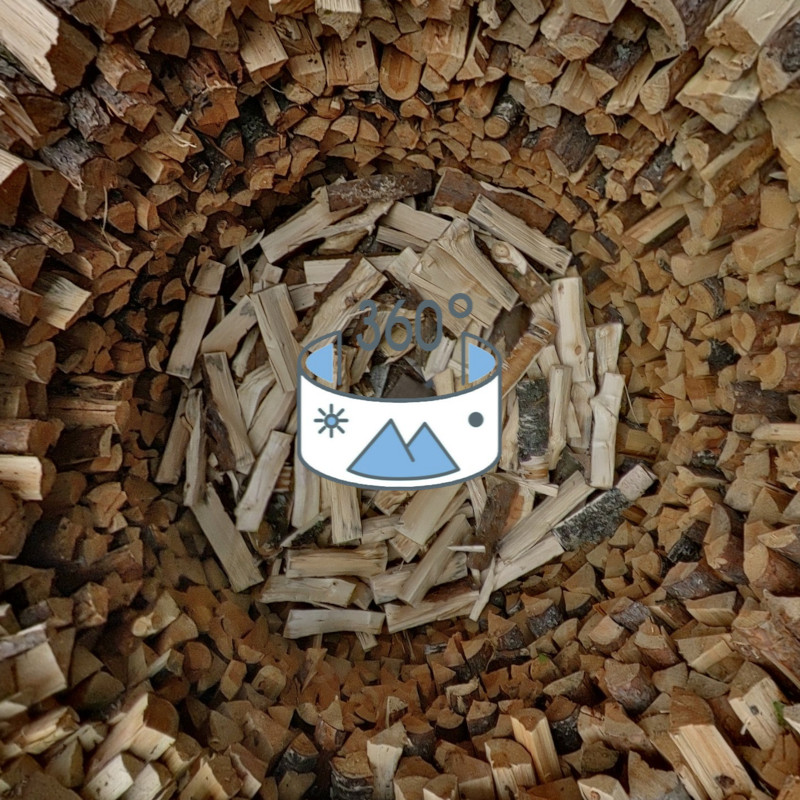
Now the stack is 4 ft high and very stable. I've stopped growing it and I've started filling up the inside, because I'm afraid I'll run out of wood before the inner space is full. Here's a 360° photo taken from the inside:
I really like all your 360 degrees imagery. You live in a beautiful place.
Is this the kind where you slowly move your phone around 360 degrees and on-device software makes a 360 image of it? Is there a common file format for such images?
Thanks!
Yes, it took us many years to find this place, and we got really lucky to get it way below market price.
As for the 360° photos and videos, most of them were made using a bona fide 360° camera (mine is a Ricoh Theta X). But not all: this one was made by stitching images from the bullet camera I installed in a tree for my disabled wife to watch the lake from her computer. This one was made by stitching images from my Olympus TG-5 point-and-shoot camera. And this one was made by stitching images I shot in the nineties with one of the first decent digital cameras - a Sony MVC-FD91 🙂
Stitching flat images often yields better quality panoramas, but they're rarely full 360° images: they're usually missing the zenith and the nadir.
As for file formats, they're standard images or videos (jpeg, webp, mp4, webm...) but the panoramic view is recorded with one of several projection types, that the viewer / player needs to support. The most common is the equirectangular - i.e. an image or video with a 2:1 ratio, encoding a 360° FOV horizontally (left to right) and 180° vertically (up to down).
Most well-behaved players and viewers recognize panoramic media, the type of projection used, and a whole host of related parameters such as initial POV yaw/pitch/zoom, in several EXIF and XMP tags that aren't really standardized formally and can be problematic, but usually the most common tags are normally understood by 360-capable software.
Thanks for the explanation! May your stack grow straight and strong!
Is this the kind where you slowly move your phone around 360 degrees and on-device software makes a 360 image of it?
Brainfart, those were panorama photos.
Wow, sweet.