Putin admits Ukraine's drones are hurting Russia's economy
3d 4h ago by mander.xyz/u/Sepia in ukraine@sopuli.xyz from www.dw.com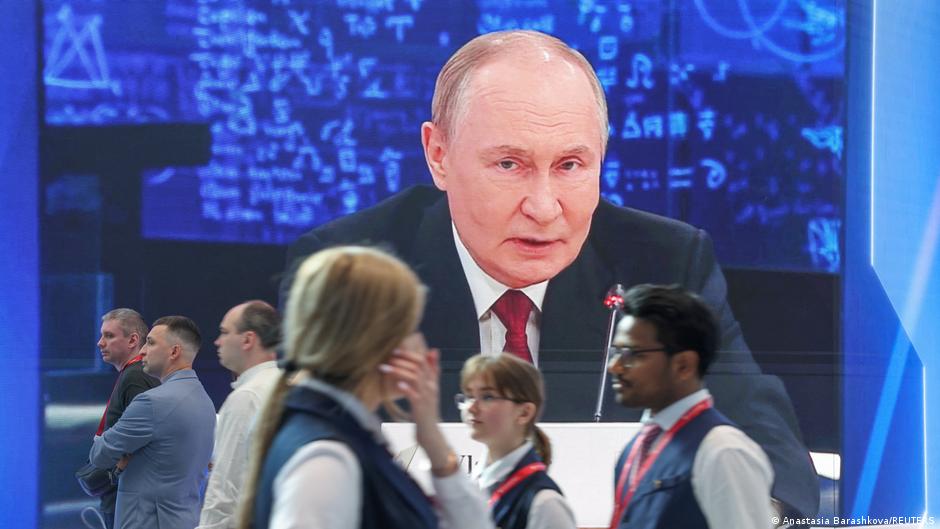
As Vladimir Putin calls for improving Russia's air defenses, DW asks Russian expert and author Leon Aron if Ukraine's ongoing attacks on Russian oil refineries are finally affecting the Russian leader's grip on power.
[Video, 19 min.]
Ukraine's growing drone strikes inside Russia hit oil infrastructure and force the scaling-down of public events, putting pressure on President Vladimir Putin.
But despite the economic strain, declining domestic popularity and military setbacks, Putin insists Russia is recovering and winning.
Experts say he still controls the narrative at home through propaganda and repression, but could mounting pressure eventually threaten his grip on power?
but could mounting pressure eventually threaten his grip on power?
Not until the russian society actually rallies to overthrow his government. As shit as the Soviets were, part of the 1910s movement did do some good by overthrowing the tsar (even if Bolsheviks took false credit for that). I don't think putin's going to just crumble under pressure and disappear, he has to be ousted from his position of power. After that, it's equal chances that whoever replaces him is actually willing to end the war and focus on rebuilding what's left.
The USSR caved without a popular uprising.
There definitely were popular uprises in soviet occupied states, like Estonia.
https://en.wikipedia.org/wiki/Baltic_Way
It's a pretty inspiring movement of bonding together to fight russian imperialism.
As an addition:
Muted dissatisfaction: Russians are increasingly critical of the government’s economic policy
... Survey results [by Nest Centre] show that Russians are generally dissatisfied with the state of the economy and the government’s economic policy. At the same time, this dissatisfaction is not giving rise to protest. Moderately negative views predominate, while the share of strongly negative assessments remains limited. Overall, public perceptions of the economy are comparable to those observed during the COVID-19 pandemic and the period of the 2018 pension reform.
... The most favourable assessments of the state of the economy came from respondents aged 18–24 (positive-to-negative ratio of 82:18), residents of Moscow (67:33), higher-income respondents (74:26), and consumers of traditional media (television, radio, and newspapers). The least favourable assessments came from respondents with a low standard of living (34:66), those aged 45–65 (55:45), and viewers of YouTube channels (33:67).
All in all, surveys did not reveal strong criticism of the government’s economic priorities among Russians. However, as the Nest Centre says,
These assessments stand in marked contrast to respondents’ evaluations of the government’s actual performance. When asked, ‘Do you think the Russian government’s economic policies create more problems, or do they bring substantial positive results?’, respondents gave considerably more negative assessments.
Among those willing to provide an opinion (81 per cent of respondents), 40 per cent chose the answer that ‘the government’s economic policies create more problems, with few positive results’. A further 41 per cent selected the moderately negative option that they ‘create some problems, which will be offset by positive changes in the future’. Only 19 per cent believed that the government’s policies ‘bring substantial positive results, with only a few problems’.
... When the discussion shifts to the impact of government policies on respondents’ personal circumstances, the share of those unable to provide an answer falls to just 5 per cent, while assessments of the government become noticeably more critical. The ratio of respondents who believe that the government ‘creates new problems [for them and their families]’ to those who believe that the authorities ‘help to solve economic problems’ is 7:3.
The report concludes:
It can be stated with a high degree of confidence that the Russian economy has not yet reached the lowest point of its current trajectory. At present, there are no signs of an economic recovery. The situation is likely to deteriorate gradually; economic difficulties will become increasingly noticeable to the population, and this will probably be reflected in public opinion.
It must be deeply painful for him to acknowledge Consensus Reality like that. Or, i really hope it is.