

Just How Much Are E.V. Drivers Saving With Gas Prices Still High? Over a long period, gas prices tend to be more volatile than electricity rates.
1d 3h ago in electricvehicles@slrpnk.net from www.nytimes.comRidiculously cheap. We’re in the UK and our old IC car cost about £0.196 ($0.26) per mile (at today’s fuel prices) and our EV costs us £0.009 ($0.01) per mile; so around 20 times more expensive to drive an IC over an EV.
[We very rarely (i.e. twice) use public chargers. All charging is at home]
The longer eco story is even more astonishing, and I honestly wouldn’t have believed the figures 3 years ago.
We were lucky enough to be able to build an eco house. It took us over 2 years and I wouldn’t do it again, but that’s another story. However, the fuel bills are a real eye opener.
Our average monthly energy bill is around £30 ($40) (plus £20 ($26) standing charge - a fee you have to pay even if you don’t use any power). That works out to £360 ($483) a year, INCLUDING running the car!
Our old (much smaller) home was costing around £2000 ($2683) (plus 2 x standing charge, one for electricity and one for heating gas) and about £1200 ($1610) on fuel for the car.
So we’ve gone from a total energy bill (for living and travel) of £267 ($358) a month to £30 ($40) a month.
Obviously there are some huge capital costs in building an energy efficient house and buying an EV. But the recurrent costs are insane.
What decisions made you financially stable?
4mon 10d ago in ask_reddit@lemmy.durstig.online from www.reddit.comTough to answer empathetically in the light of what people younger than me are dealing with today, but here’s my take:
In one sentence: Wanting stability from an early age and willing to make some serious sacrifices to achieve it.
Worked for over 10 years before taking a holiday.
Decided we couldn’t afford to have kids and never had any.
When we finally bought a house, we stayed in it for 26 years, while our peers would keep moving to bigger and better homes with bigger and better mortgages.
Paid off our mortgage as quickly as we could.
Never paid a penny in interest on a credit card.
We saved for absolutely everything, no matter how long it took. A life with very few impulse purchases.
The single biggest “thing” we did was to save 50% of every ‘windfall’, however hard it was (and sometimes it was very hard). Every pay rise, we only ever took half of it and saved the other half. Every time we got a new job with a salary increase, we saved half of it. Christmas/birthday presents that were money - 50% saved. You get the idea.
Compound interest is a wonderful thing!
I sometimes wonder if it was worth it. We’re definitely financially comfortable by most people’s standards, but I nearly died 2 years ago and I now I often think - was it worth it?
Rolling Out the Internet in the 90s [Best Of]
4mon 13d ago in bestoflemmy from media.piefed.socialIt was definitely not a MMO! It was a bit of a joke comment (British humour - sorry). I’d be amazed if it had anything more than 100 consecutive players (that’s a complete guess).
I had no idea of it’s MUD heritage then and it’s only today that the comments above have really made me join those dots up.
The 300 baud was 1983-84. We must have been near the era of 14400 by 1990, but yeah, definitely 2400.
Permanently Deleted
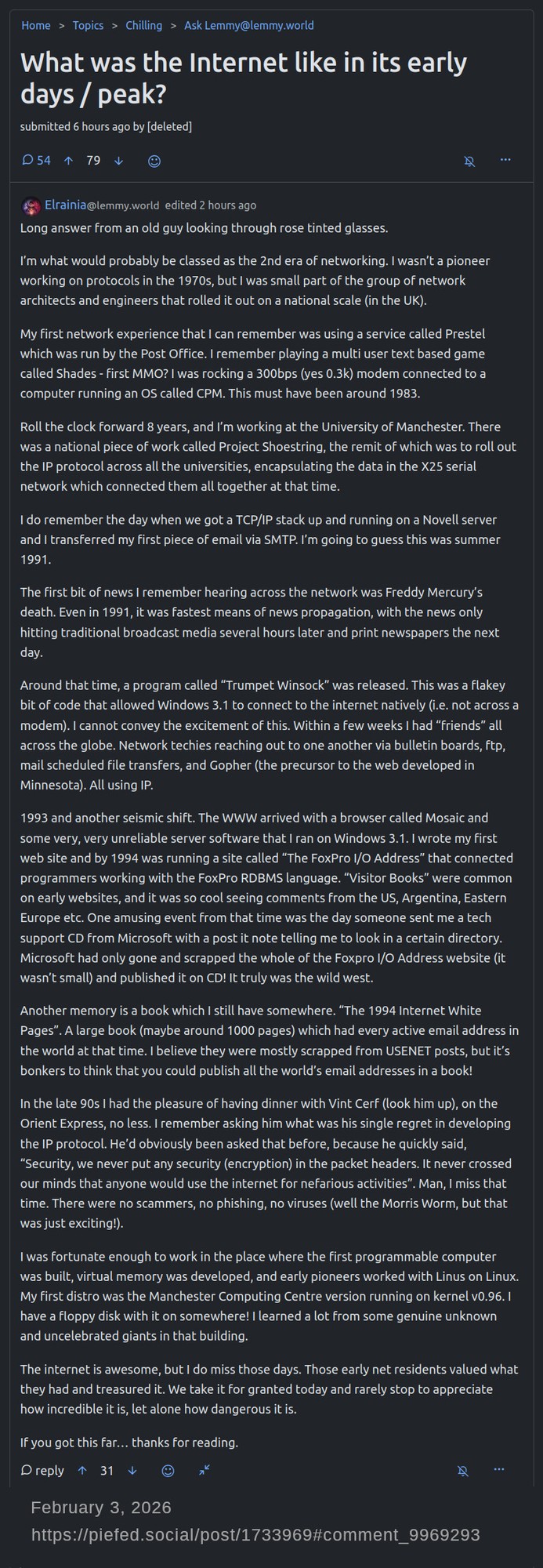
4mon 14d ago in asklemmyLong answer from an old guy looking through rose tinted glasses.
I’m what would probably be classed as the 2nd era of networking. I wasn’t a pioneer working on protocols in the 1970s, but I was small part of the group of network architects and engineers that rolled it out on a national scale (in the UK).
My first network experience that I can remember was using a service called Prestel which was run by the Post Office. I remember playing a multi user text based game called Shades - first MMO? I was rocking a 300bps (yes 0.3k) modem connected to a computer running an OS called CPM. This must have been around 1983.
Roll the clock forward 8 years, and I’m working at the University of Manchester. There was a national piece of work called Project Shoestring, the remit of which was to roll out the IP protocol across all the universities, encapsulating the data in the X25 serial network which connected them all together at that time.
I do remember the day when we got a TCP/IP stack up and running on a Novell server and I transferred my first piece of email via SMTP. I’m going to guess this was summer 1991.
The first bit of news I remember hearing across the network was Freddy Mercury’s death. Even in 1991, it was fastest means of news propagation, with the news only hitting traditional broadcast media several hours later and print newspapers the next day.
Around that time, a program called “Trumpet Winsock” was released. This was a flakey bit of code that allowed Windows 3.1 to connect to the internet natively (i.e. not across a modem). I cannot convey the excitement of this. Within a few weeks I had “friends” all across the globe. Network techies reaching out to one another via bulletin boards, ftp, mail scheduled file transfers, and Gopher (the precursor to the web developed in Minnesota). All using IP.
1993 and another seismic shift. The WWW arrived with a browser called Mosaic and some very, very unreliable server software that I ran on Windows 3.1. I wrote my first web site and by 1994 was running a site called “The FoxPro I/O Address” that connected programmers working with the FoxPro RDBMS language. “Visitor Books” were common on early websites, and it was so cool seeing comments from the US, Argentina, Eastern Europe etc. One amusing event from that time was the day someone sent me a tech support CD from Microsoft with a post it note telling me to look in a certain directory. Microsoft had only gone and scrapped the whole of the Foxpro I/O Address website (it wasn’t small) and published it on CD! It truly was the wild west.
Another memory is a book which I still have somewhere. “The 1994 Internet White Pages”. A large book (maybe around 1000 pages) which had every active email address in the world at that time. I believe they were mostly scrapped from USENET posts, but it’s bonkers to think that you could publish all the world’s email addresses in a book!
In the late 90s I had the pleasure of having dinner with Vint Cerf (look him up), on the Orient Express, no less. I remember asking him what was his single regret in developing the IP protocol. He’d obviously been asked that before, because he quickly said, “Security, we never put any security (encryption) in the packet headers. It never crossed our minds that anyone would use the internet for nefarious activities”. Man, I miss that time. There were no scammers, no phishing, no viruses (well the Morris Worm, but that was just exciting!).
I was fortunate enough to work in the place where the first programmable computer was built, virtual memory was developed, and early pioneers worked with Linus on Linux. My first distro was the Manchester Computing Centre version running on kernel v0.96. I have a floppy disk with it on somewhere! I learned a lot from some genuine unknown and uncelebrated giants in that building.
The internet is awesome, but I do miss those days. Those early net residents valued what they had and treasured it. We take it for granted today and rarely stop to appreciate how incredible it is, let alone how dangerous it is.
If you got this far… thanks for reading.
TUXEDO Computers - Linux Hardware vendor from Germany
1y 2mon ago in buyeuropean@feddit.uk from www.tuxedocomputers.comJust a piece of recent personal experience with Tuxedo:
Getting on in years, I had a yearning to do some dev work and thought I’d dip a toe back into the world of Linux. Going way back, I first used Linux back in 1993 (v0.99 iirc). Along with a FreeBSD box, it became my daily driver until around 2003. My last distro of choice was Mandrake, which I loved. With the advent of Apple’s unix based OSX, I jumped ship and never really gave Linux a second thought for over two decades. I occasionally flirted with Raspberry Pis, most notably for a weather station running WeeWx and another running PiHole and local DNS.
Anyway, it’s 2025 and I started looking around for some hardware. Tinkering with drivers and kernel modules etc held no interest for me and I was looking for something a bit more “turn key”. I wasn’t expecting to find the Linux equivalent of a MacBook Pro, but my interest was piqued by System76 and I then discovered Tuxedo. It took me a while to pull the trigger as I might have been buying an expensive white elephant, but I eventually ordered an Intel InfinityBook Pro 15.
The ordering process was smooth (lots of info about options and some really decent tech info on their website) and the laptop shipped about 10 days later via UPS. I was expecting it to get stuck in a post-Brexit clown show at UK customs, but I payed the custom fees to UPS directly while the shipment was in transit. It arrived, beautifully packaged about 4 days later.
I am genuinely speechless about the product. Bear in mind it’s over 20 years since I last used Linux in anger. Just to provide some context, KDE was on version 3 and I only ever used Gnome 1. Linux today bears very little comparison with the world I left, and man was it an OS revelation! The hardware is well made; the screen is stunning, and I have zero regrets purchasing a laptop from Tuxedo and would buy another without a second thought.
The only problem I’ve had in the last 6 weeks is a kernel message regarding USB ports timing out during shutdown. Ten minutes online and I realised it was a power saving issue which was solved with a simple config change to Grub.
Other than that, I’ve been back writing code for the first time in a lifetime and am having a ball. I now spend about 80% of my time using the InfintyBook and about 20% on my Macbook.
In short, based on a data set of a single purchase, I’d thoroughly recommend Tuxedo if you have the cash and are looking for something made and supported by a company in the EU.

Vivaldi Browser | Source Available
2y 8mon ago in privacy@lemmy.ml from vivaldi.comLike a lot of people, I’ve done the full tour from Mosaic, through Mozilla and Phoenix/Firebird to Firefox and have spent much of the last quarter of a century in the Firefox fold. During that time I’ve also spent a fair time with one foot in the Safari camp and have occasionally checked in with Chrome (just to see what the fuss was about). A couple of years ago, I stumbled across Vivaldi and I realised recently that it’s sort of become my browser of choice. I love it’s customisation and speed and as OP said, it’s tab management is the best out there.
Sadly, it feels like were back in 2005 when IE ruled the roost and set the rules (very badly), and Chrome was the brave new world that was going to reclaim the web for the common man. Now we’re looking to Firefox to save the day. Maybe it will, maybe it won’t, but I honestly think there is genuine mileage in supporting projects like Vivaldi (whatever you may feel about Chromium), and let’s face it, it doesn’t take long to download a browser and check it out for a couple of hours.

Migraine: how it starts and how to treat it
2y 10mon ago in health from www.dw.comI had my first migraine over 40 years ago and have been a regular headache suffer for most of my adult life. I’ve mentioned it to my doctor more times than I care to remember, and last August I mentioned it again. He told me to stop taking pain killers, I said “really, are you completely insane, they’re the only thing that make most days manageable!”. Anyway, I did what I was told, and although September was tough, I can’t actually believe the results.
I keep a bullet journal, and have some personal data of reasonable quality. During August 2022 I had a headache on 28 days out of 31 and 2 migraines (both in the same week). During July 2023 I had 1 headache and no migraines.
In a routine NHS email a few months later, I spotted this article:
https://patient.info/news-and-features/can-taking-painkillers-actually-give-you-headaches
I attribute a lot of my headache free life to this advice, and I’ve saved a boatload of cash from not buying my weekly collection of pain killers.
As other people have commented, it’s a complex medical area, but if you’ve tried everything else and pop pills regularly, it might be worth a shot…
What's your favorite platform for buying shows and movies digitally?
2y 10mon ago in moviesandtv@lemmy.filmApple is my platform of choice these days. Full disclosure, I’m pretty well embedded in the Apple eco system and it’s been my consumer tech of choice for over 20 years.
I live in the UK and have recently cut the cord with Sky (for my non UK friends, Sky is essentially the equivalent of a cable service in the states), and I had a number of movies purchased through their store. Although I can still see those movies on an iPad, it’s not easy to watch them on a TV, so I’ve essentially lost those purchases.
In light of that experience, Apple feels the most future proof for me with Amazon Prime a close second.
I also recently “binned” most of my DVD/Blu Ray collection, but before doing so, I looked up what platforms they were available to stream/buy from. Out of just over 200 discs, Apple won with 122 available with Prime on 114.
Indicating on roundabouts
2y 10mon ago in ukcasualNever heard that before, but I like it 👍

Bug: 0.1.0 (14) Cropped Images
2y 11mon ago in memmy@lemmy.ml from i.imgur.comApollo Recognition
2y 11mon ago in wefwefManchester Collective hit the BBC Culture pages
2y 11mon ago in manchester from www.bbc.co.uk(IOS) Feature request: Scroll to top by tapping the top of the screen
2y 11mon ago in wefwef