

Sanitation rules!
Professional shitposter and amateur historian.

Best view in town
29d 21h ago in Wastewater@crazypeople.online from crazypeople.online
Behind Fayette’s QTS Water Controversy: A Missed Meter, 8,000 Workers and a Massive Construction Project | The Citizen
1mon 5d ago in aboringdystopia from thecitizen.com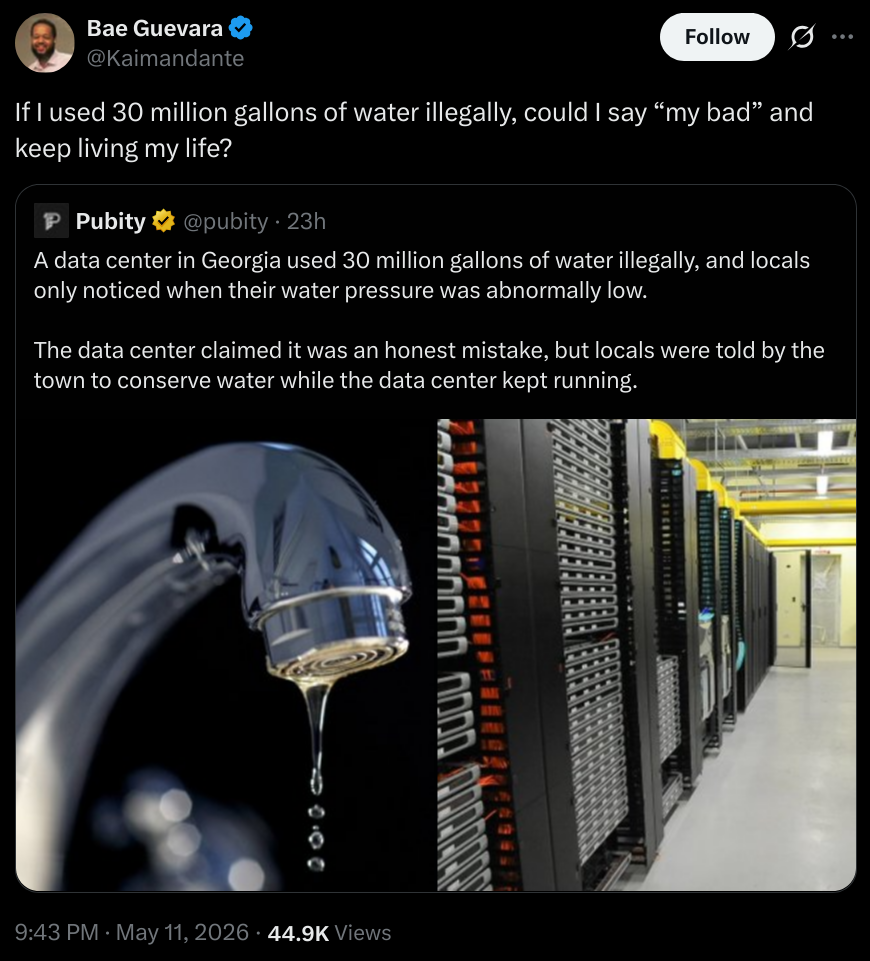
Data center "mistakenly" used 30 million gallons of water
1mon 7d ago in aboringdystopia from discuss.onlineI don't think we are going to see eye to eye on this. We are reading the quotes differently. I'll try one more time.
All from this article: https://thecitizen.com/2026/05/14/the-qts-water-story-is-real-its-just-not-about-qts/
And referencing this letter: https://protectpwc.org/2026/05/05/13786/
There are actually three meters:
- 8" domestic, not given a meter number, on Tyrone road.
- 10" fireline (23006232), highway 54
- 10" fireline (23006231), Tyrone road
The letter says the 8" domestic was installed without inspection, and that the fireline on highway 54 was not hooked up to the account and the fire line on Tyrone road was using more water than allowed and therefore a higher rate will be charged. That's 27.5 MG unbilled and 13.2 million at the 'wrong' rate.
Rapson, Tigert’s boss and the county’s top appointed official, has now told The Citizen on the record that the central claim in that letter is not accurate. County staff did inspect the meter at installation.
This accounts for the 'illegal hookup". The "central claim" is that there was a meter that was not inspected. This person has indicated that the meter was inspected.
Tigert herself has hedged her own letter publicly. She told E&E News, the Politico-owned outlet that broke the national story, “I may have hit ‘send’ too soon.” She acknowledged in the same piece that her staff may have known about the hookups, but that she had not been able to locate the inspection report.
She did not know about the hook up and inspection. She assumed there was no inspection because she could not locate the report.
I was wrong about the leak audits, I was looking at the wrong line of the reports. I will correct my comments.
I can see how you could read it like that but it has been further clarified:
Rapson, Tigert’s boss and the county’s top appointed official, has now told The Citizen on the record that the central claim in that letter is not accurate. County staff did inspect the meter at installation. Rapson’s exact words were, “It’s not like they put a meter in, threw a camel net over it, and we didn’t know they put the meter in.”
The same quote, without explicitly stating the meter was inspected, could be ambiguous. Further:
"Tigert herself has hedged her own letter publicly. She told E&E News, the Politico-owned outlet that broke the national story, “I may have hit ‘send’ too soon.” She acknowledged in the same piece that her staff may have known about the hookups, but that she had not been able to locate the inspection report."
The letter was such a mess. You can't use private fire fighting lines for non fire fighting purposes. It makes no sense the conversation would just be "oh we didn't bill you", not "you need to stop."
The following section was incorrect, I was looking at the wrong line on the audit spreadsheet.
(Begin correction)
The board's meeting minutes are similarly goofy.
The person who wrote this has no clue what they are talking about. The cost per unit water doubled because half the water production was unbilled. Their "leakage index" was 7.01 in 2024, up from 3.46 in 2023.
(End correction)

They haven't met since March.
Tl;dr: the utility clarified there was no unauthorized connection, and wow they are absurdly understaffed I'm not surprised this is such a mess
It has been clarified that the hookup wasn't without the knowledge of the utility, it was a failure of a new transmitter/verifying they were getting readings.
I work in this realm and as soon as I read the quotes from the utility in the first batch of articles it was immediately clear that people who didn't have all the information were responding to inquiries. Your average utility employee, even in admin functions have zero media training. If I had a penny for every time I had to deal with the fallout of some ambitious comment that was taken out of context by the media or public, I'd have several pennies.
Statewide, between 2010 and 2015, the estimated water use by hog farmers increased 116 percent (from 2.26 to 4.9 MGD). Within the livestock category, the greatest water use could be found in beef (15 MGD) and dairy (9.6 MGD) operations. The water use estimates for goats, sheep, horses, and broiler chickens all declined. The region with the greatest increase in animal water use (by percentage) was in the Altamaha region, and the greatest decline in animal water use was in the Coastal region.
https://www.gawater.org/wp-content/uploads/2017/11/GWC_Watering_GA_Report.pdf
The three named uses add up to 29.5 MLD, which is 129% the total capacity of the Lafayette water system production capacity. 😬
I might also suggest that a public sector dedicated to balancing the resident water demands and industry water-use demands could improve the rate/volume of consumption. But that would require a public voting base / private executive staff that valued the long-term health of the state rather than the short term economic growth of the local neighborhoods.
I think what most people are missing is that the water consumption was unmetered. Let me put it this way: the water plant knows how much water it's making at any instant, but there is a huge delay in knowing what the "revenue flow" is. There is always loss in the system between what is produced and what is billed.
I don't know this specific system, but if they couldn't detect the pressure loss without customer complaints, it wasn't some catastrophic increase in demand. As an example, water main breaks with uncontrolled lost flow are detected in the distribution system when pressure cannot be maintained or local pumping stations are running nonstop to maintain pressure. Low pressure is a safety issue so it gets investigated asap, and increased pumping will probably get flagged as suspicious or at least someone will need to explain why the electric bill is so damn high.. Utilities have leak detection tools they can use, and this would have been deployed if there was evidence of a sudden huge increase in demand because the symptoms would have been the same as a leak.
What is more likely is that the mismatch between production and billed flows was being audited and the local complaints about water pressure was the clue that helped them identify the culprit.
We can look at water loss reports here: https://epd.georgia.gov/watershed-protection-branch/water-efficiency-and-water-loss-audits
Their 2024 Infrastructure Leakage Index (ILI) was 7.02 with a validity score of 71, with the 2023 and 2022 results being 3.46 (70) and 3.37 (66). I'll bet that lit a fire under some bodies ass!
Articles on the topic contain statements like:
“We get this notification from Fayette County water system saying you need to stop watering your lawns to help conserve water,” said James Clifton, an attorney and property rights advocate who obtained and shared the 2025 letter to QTS.
“So the first thing they do is lean on the individuals and the citizens to stop water consumption when we have QTS that’s just absolutely draining us — most months it’s the No. 1 consumer of water in the county,” said Clifton, who is also running for a seat on the Fayette County Board of Commissioners.
It really annoys me that this is shared without analysis. The instruction to stop water lawns is entirely unrelated to the data centers water use.
The systems planning documents show the water sources are sufficient for the projected demand in 2070, but the production capacity (treatment plants) needs to be expanded. Even though there were a lot of losses in 2024, the system was still opening in their capacity. Local pressure losses are a reflection of local bottlenecks, not overall system capacity issues.
Further, the water conservation is mandated by the Metro North Georgia Water Planning District and their Water Resource Management Plan which:
requires that Fayette County Water System develop an irrigation pricing schedule that recognizes the impact on peak demand from irrigation.
These restriction have been in place since at least 2007, according to my tired eyes.
Anways, I'm not trying to defend the data centre. I'm just annoyed with all the misinformation about this specific case. The root cause is likely administrative.
While not the case for this specific county, things like non municipal water supply for industries including animal agriculture are a massive risk to water sheds. These water users are subject to far fewer audits and checks, so if they are withdrawing more than permitted they are unlikely to get caught. Water tables drop and municipal supplies are impacted, but again without the means to identify the cause.
Attention on this specific case and all the misinformation about it is a distraction from other massive water users and their impact.
Lol, it was a comms failure

Wait, what?
2mon 5d ago in loweffortmemes@crazypeople.online from crazypeople.online
Thank you North East Ohio Regional Sewer District
4mon 6d ago in memes@lemmy.ml from lemmy.mlYes...someday...

Fun fact (?): The Thames being so gross is one of the reasons modern sewage treatment took off. One of the main tests is designed based on the behavior of the Thames: https://dnr.wisconsin.gov/topic/labCert/BODAbout.html
You can put the water plant at the end of the sewage plant for example: https://en.wikipedia.org/wiki/NEWaterbut yeah the water body does some of the treatment too.
Thank you shark fucker 420! You will be pleased to know that I'm not even that unique among the turd herders. Plenty of us are 'eccentric'.
No and yes.
Most regulations are based on the assimilation capacity of the receiving body which is nerd talk for "how much pollution the water can take before it starts showing signs of harm". So you treat to that, nature does a bit more, and then the drinking water plant takes water from an ideal place.
Most wastewater plants just speed up nature.
The history of centralized treatment is super fascinating because it centred on what the problems were when it was established (very late 1800-early 1900s) whereas drinking water treatment really has changed more to deal with how our understanding of human health has changed. They don't really match up!

Life finds a way
9mon 2d ago in Wastewater@crazypeople.online from crazypeople.online
The Operation of Imhoff Tanks - H. M. Beaumont Sewage Works Journal, Vol. 1, No. 2 (Jan., 1929)
10mon 9d ago in Wastewater@crazypeople.online from www.jstor.org
Discovering Images of Early 20th Century Wastewater Treatment Plants | California Water Environment Association
10mon 9d ago in Wastewater@crazypeople.online from www.cwea.org