

Analysis: Solar overtakes gas power in Asia for first time ever
5d 30m ago in green@lemmy.ml from www.carbonbrief.org
American Medical Association Votes to Put More Plant-Based Food on Doctors' Plates at Professional Meetings
5d 16h ago in vegan from vegconomist.comWhy do people keep trying to sell me bridges?
5d 21h ago in shittyasklemmy@lemmy.mlWhat you want to rent a bridge instead? Get roommates for your bridge?

Average person eats six times more chicken than in 1961, UN report finds | Agriculture is the second most polluting sector of the global economy
6d 6h ago in unitedkingdom@feddit.uk from www.theguardian.comAnimal agriculture is especially worse because it plainly demands much more agriculture to happen due to it's inefficiencies. It requires growing huge amounts of animal feed where most of the energy is lost. Even it's best case is bad compared to the worst case for eating plants directly
Transitioning to plant-based diets (PBDs) has the potential to reduce diet-related land use by 76%, diet-related greenhouse gas emissions by 49%, eutrophication by 49%, and green and blue water use by 21% and 14%, respectively, whilst garnering substantial health co-benefits
[...]
Plant-based foods have a significantly smaller footprint on the environment than animal-based foods. Even the least sustainable vegetables and cereals cause less environmental harm than the lowest impact meat and dairy products [9].
The FAO, unfortunately, has quite a history in downplaying things and sticking their thumb on the scale in favor of the meat and dairy industry on things like this
In a sign of the atmosphere in the FAO at this time, a fourth veteran insider, “Mary Wagyu”, claims to have been admonished after preparing Meatless Monday leaflets for distribution in the cafeteria of an FAO heads of state food security summit in 2008. “Remove and destroy them,” a senior FAO executive said, according to Wagyu. “These will not be put in people’s trays.”
In 2009 a second FAO report called Livestock in the Balance was delayed for several months while the FAO’s leadership tried to dilute references to harm caused by the meat industry, arguing that this had already been covered by Livestock’s Long Shadow. When the research team resisted the pressure, management stepped in and manually rewrote key passages over their heads, sparking what Steinfeld called “a mini-revolution”. About a dozen staff members involved in preparing the report withdrew their names from the paper in protest.
[...]
Between 2012 and 2019, “the lobbyists obviously managed to influence things”, Holstein said. “They had a strong impact on the way things were done at the FAO and there was a lot of censorship. It was always an uphill struggle getting the documents you produced past the office for corporate communications and one had to fend off a good deal of editorial vandalism. You had to accept relatively small steps forward in changing the narrative on livestock.”
Steinfeld added that meat lobby representatives and diplomats would talk to senior FAO managers and encourage them not to invest in work that dealt with environmental impacts.
Graph from the article:

Per capita beef consumption is down slightly, but not as much as chicken / poultry consumption has increased. People are generally eating much more meat overall per capita. Chicken and poultry still have a pretty heavy emissions profile, it's just that beef is somehow worse. The net increase in meat consumption is still a massive net negative on the climate
In terms of ethics, switching to chicken results in significantly more induvidial chickens being killed because of their lower slaughter weight. The factory farms that house the vast majority of chickens keep growing larger and larger and quite disturbing. This is true around the world. For example just in England alone, there are at minimum over 700 factory farms for chickens, four of which have over a million chickens

Bycatch has ‘shocking’ toll on British marine life, first-ever analysis reveals
7d 2h ago in green@lemmy.ml from www.theguardian.com
Bycatch has ‘shocking’ toll on British marine life, first-ever analysis reveals
7d 14h ago in nature@feddit.uk from www.theguardian.comOne way we can help nudge that is to reduce the demand for fish overall and go for for plant-based foods instead. Illegal fishing is unfortunately quite rampant even for places that ban specific practices. It's really hard to ban enforce bans when most of it all happens quite far away in the oceans

The truth will set you free 🥲
9d 22h ago in programmerhumor@lemmy.ml>>> print("proof by counterexample in a python REPL")
proof by counterexample in a python REPL
>>> x = 2; print(x)
2
>>> print("this is not ignored"); print("it's just mostly useless"); print("but you can use as many as you want")
this is not ignored
it's just mostly useless
but you can use as many as you want

India to Require Standardized Vegan Logo on Food Packaging from 2027
10d 16h ago in vegan from vegconomist.com
Portland councilors approve ban on foie gras
12d 16h ago in vegan from www.opb.org
Swissveg Price Comparison 2026: Plant-Based Milk Achieves Price Parity in Swiss Retail
15d 2h ago in climate@slrpnk.net from vegconomist.com
The Coffee Bean & Tea Leaf to Drop Plant-Based Milk Surcharge
16d 10m ago in losangeles from vegconomist.com
The Coffee Bean & Tea Leaf to Drop Plant-Based Milk Surcharge
16d 11m ago in climate@slrpnk.net from vegconomist.comNot sure I get the joke?

A curious response
16d 6h ago in fuck_ai from leminal.spaceAgreed that land and water are smaller compared to agriculture, but the electricity usage change is significant. The LLM boom is unlike prior datacenter workloads. The electrical demand is far higher due to the more power hungry chips and running them at full utilization. It's projected to go from 5% to 15% of all US electrical demand in quite a short amount of time
This is delaying the closures of fossil fuel plants (here's an example of 15 coal plants in the US last year), and starting to rely more heavily on generators to install capacity faster despite solar/wind being far cheaper
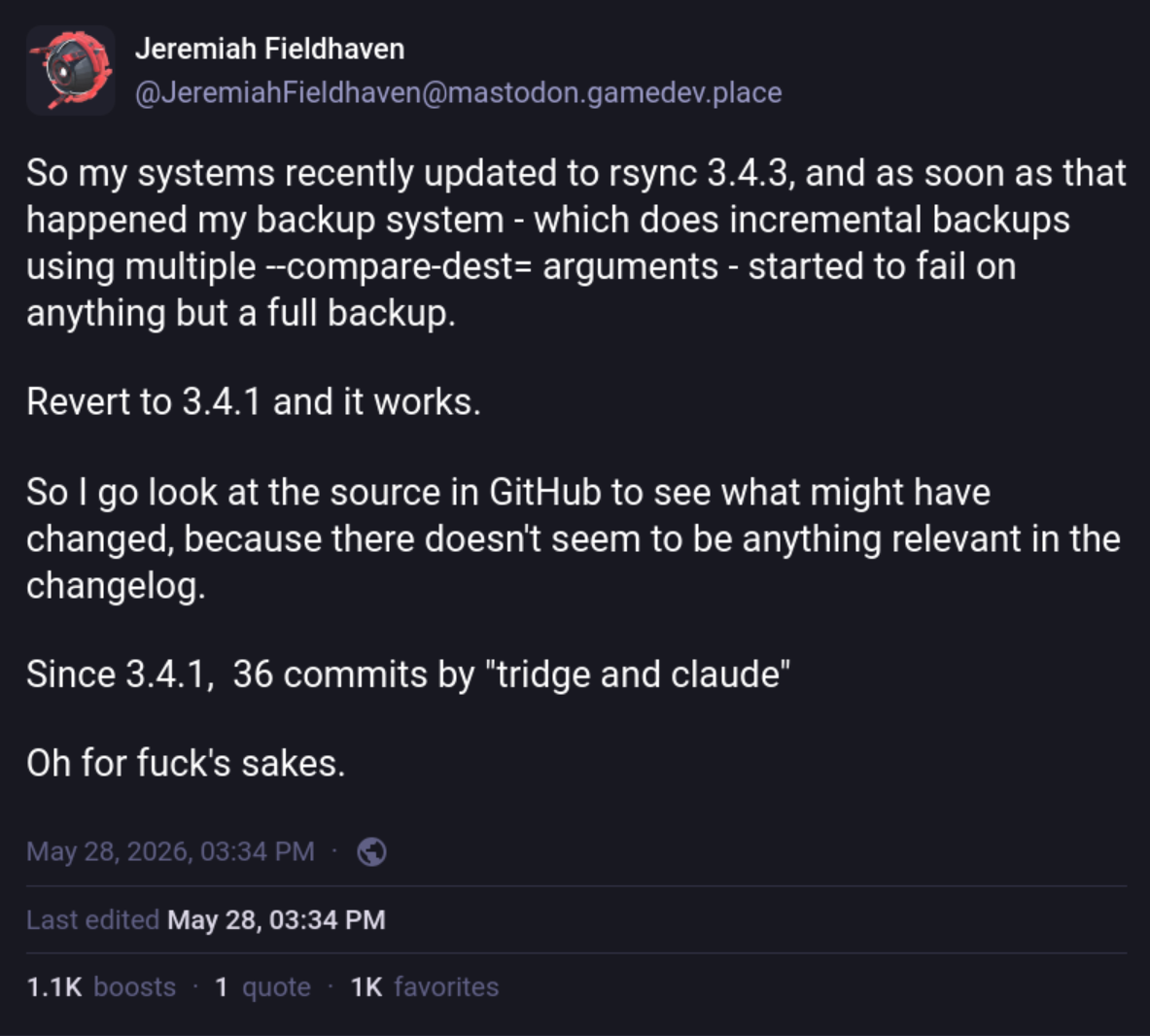
Rsync is reportedly causing backups to fail since maintainer began AI code experiment
17d 17h ago in fuck_ai from files.catbox.moeI have worked on open source projects. I cannot fork sheer number of projects going towards LLMs alone. This is a losing proposition. Open source is not an individualistic action. This is a collective action, and we need developers of open source to live the values of open source
someone else can pick up from here
A big point of my comment earlier was that making a project increasingly LLM generated makes it harder for someone to pick up as quickly. A huge amount of complexity can be added insanely fast. In this rsync example, the entire testing system was changed overnight (while generating issues in the process). The projects become harder to work on in general
EDIT: also to add, this still has the issues of not knowing where the un-copyleftable code lies and/or having to rework large portions of the project are if you want to keep that

California Senate passes plug-in solar bill, advances to state Assembly
23d 17h ago in green@lemmy.ml from www.pv-magazine.com