Am I the only one who thinks social media has destroyed the spirit of the internet?
11mon 2d ago by lemmy.world/u/RealCalliopa in asklemmy
The emergence of social media has destroyed all the small communities to standardize communication and information.
It's a bit of a digital version of rural exodus. And since 2017/2018, I've noticed that everything that, in my opinion, represented the internet has disappeared.
I've known Lemmy for a few hours and I feel like I'm back in the early spirit of the internet.
The early Internet was social media, but it wasn't so corporatized to the point of being ruined.
To expand on that, all media with a negligible barrier to entry is social media. Which describes the internet as a whole. The commodification of such media is both unnecessary and parasitic. The only thing "social media" adds is accessibility.
Social media, at it's heart, is inevitable. We will always find a way to share pictures, information, videos, etc. with each other. It's such basic functionality when you really think about it. We're social creatures and this is the most important thing we would do with technology.
The issue is specifically with platforms; how they consolidate power and who owns them.
I don't know what to do about it, it's one of the biggest problems we are going to continue to face in our time. I can't really armchair solutions for it now, but I think it's of the utmost importance that we recognize it and discuss it.
Social media is not inherently bad, it's the platforms.
Exactly. The internet was always social, connecting people. Capitalism and greed have ruined the internet.
I don't care if people want to make money, and I'm even fine with ads (within reason) but all this ExTrAcTiNg VaLuE is making the Internet unusable and damaging humanity.
Not social media. Capitalism.
The internet was ALWAYS social (e.g. telnet). It wasn’t ruined by people using technology to connect, it was ruined by capitalism finding new, insidious ways to monetize the human social drive.
i think the difference is that before the internet was a social mesh of countless websites.
while today it's just a handful of social media sites.
yhea, it's capitalism, but social media is the main tool capitalism used.
Yes, but in order to properly learn our lesson to prevent this from happening again, we need to call out the root of the problem instead of/in addition to the tools or symptoms.
i think even without capitalism, social media works better on scale (even federated social media, does so but decentralised). you will join the bigger systems, and those systems are more likely to grow if they are bigger...
they will be much less toxic without capitalism though
The "bigger systems" pre-corporate internet (and somewhat in the transition) were sometimes fairly large forums dedicated to one niche (sometimes multiple, but in the same general field). Once Reddit specifically came along after YouTube/Google laid the groundwork for the corporatization of the Internet, it centralized basically every forum to one website. Now even today, forums still exist, but it's nowhere near what they once were.
That's also not to mention sites like Geocities allowing basically everyone to have their own website (which of course, is another version of centralization, but with much more control given to its users).
And it's not like corporations didn't try to take control of the internet before 2005/2006. Just look at AOL in the 90s for a prime example, along with Flash, ActiveX/Internet Explorer, Quicktime/Realplayer browser plugins for video, etc.
Without capitalism, we would still see the internet grow, as even in the late 90s, it felt as if you were being left behind in society if you didn't have an internet connection, but the way in which it grew would look much more akin to how it looked in the 90s and early 2000s.
The internet sure was far from perfect back then, but it was ours'.
I do miss that early internet, it was more discovery and exploration and much less doomscrolling.
and I agree that corporations destroyed it.
i realised that the response StumbleUpon cannot exist nowadays,is because internet is just a handful of sites rather than countless small ones. God StumbleUpon was superior to wherever we have now
This is why I'm finding more and more that it's easier to find local events the "old fashioned way" (word-of-mouth, flyers, local newspapers and zines, etc) rather than through social media. It used to be easier to see events local to me, but now the algorithm pushes events that I may like but aren't local at all. Sometimes I do actually see something local, but it's too late.
Whenever I get overwhelmed by the modern web, I go to http://wiby.me/and click "surprise me..."
It's a search engine that only spits out "real" webpages that were made by people like you and me. Very refreshing.
Thank you for sharing. It's painful to realize in hindsight that those websites were peak internet.
They lack polish, but they were all a labour of love. No enshittification, no selling things, no corporate influence, no shit posting.
Everything had a purpose, every post took effort, and it was all about sharing experiences or knowledge.
I really miss that internet.
EDIT: correcting gibberish 🤭
Content > design
I also like zombocom
Shoutout for https://www.marginalia.nu/too!
Whoever it is that has kept zombo going for most of my adult life deserves a medal.
You can do ANYthing!
Anything is possible.
If I had a lot of money I would fund the creation of a new search engine. It would operate entirely on a white list model. And every website on it would be reviewed by people, for people. No posts from any social media site would be allowed; only small webpages. To be featured in the engine, sites would have to have verifiable human origins. So personal blogs made by real people or small businesses with actual physical addresses that can be fully verified in the real world. In order to get your business featured, you would have to apply, and someone would physically have to visit you in order to verify your authenticity. Oh, and any website that uses AI in any form would simply be ineligible to appear on the search engine.
Yes, this would result in a drastically reduced pool of potential sites, but what remains would be absolute gold.
I love the idea, but wouldn't it be one of those old web indices (like a site or book that was just a list of other sites) with a keyword search function? Like a centralized webring with user submissions?
Yeah, I'm basically envisioning something like that. An old school web index composed entirely of human-curated human-made content. How to actually fund such an effort? I have no idea. That's why I started with the the premise that I somehow had millions to throw at the project. It would invariably be very labor intensive.
It would probably have to be subscription funded. Maybe there's a way to pull it off, but getting people to pay for subscriptions for services like this has long been fraught. Surveillance capitalism was built because donations don't cut it, and no one wanted to spend a few bucks a month for Google or Facebook access.
https://neocities.org/is great too
Needs moar webrings.

3rd one is obsolete now and has been replaced with affection
No, not the only one -
The internet is just a microcosm of social media’s destruction of our entire social fabric
Social media is the front of the house.
What destroyed the internet are the cabal of Corporations monetizing every interaction and directing flows from the back of the house.
Unfettered Capitalism killed the internet experience.
It's not social media per se. It's capitalism. The Internet was this vast frontier, where you could meet anyone. Little communities formed, we all just talked, and self-regulated any bad behavior. It was a gift economy, we all freely shared knowledge, files, culture.
In the past 20 or so years, economies of scale took over. Corporations bought up the server space and aggressively shut down small communities. Community is discouraged, keep scrolling and click on the ads! Marketing killed the internet.
Came here to say exactly this. Capitalism breeds consumerism - and consumerism destroys everything.
I predicted back in 2000 that the net would become a big complex system of cable channels, you pay for every site you visit. It's sure AF going that way.
Something wonderful is gone forever. Thanks America.
The internet has always been a collection of social media platforms: bulletin boards, Usenet, IRC, people hosting little personal sites and making contact with each other via email, etc. It got bad when big money arrived and brought in the general public. First is was platforms like AOL's chat rooms and forums, and later things like Facebook and Twitter. We are all living in eternal September now.
Exhibit A: this t-shirt from 1994

What was the state of the internet in 1994 that it would cause such resentiment?
"A cultural phenomenon during a period beginning around late 1993 and early 1994, when Internet service providers began offering Usenet access to many new users."
"The flood of new and generally inexperienced Internet users directed to Usenet by commercial ISPs in 1993 and subsequent years swamped the existing culture of those forums and their ability to self-moderate and enforce existing norms. AOL began their Usenet gateway service in March 1994, leading to a constant stream of new users.
Hence, from the early Usenet community point of view, the influx of new users that began in September 1993 appeared to be endless."
I think that you left out the part that explains why it's called September. Every year, when first-year university students got their hands on the internet for the first time, they would rampage through the noble message boards with their barbarian netiquetteless ways. Many dreaded the annual influx of newbies, and their worst nightmares were finally realized when the internet was opened up to the greater public.
My reflection on that period would lead me to suggest it was the mass "normie" invasion of nerd-space and the promotion of low-effort participation. I don't remember anything specific about that particular timeframe, though.
The internet was better when it wasn't big enough to be worth monetizing. And the signal to noise ratio has generally grown exponentially with participation. Which makes sense if you think about it.
My reflection on that period would lead me to suggest it was the mass “normie” invasion of nerd-space and the promotion of low-effort participation. I don’t remember anything specific about that particular timeframe, though.
So ultimately the sentiment has never changed?
Eternal September refers to September 1993, when a popular internet service provider (AOL) provided easy access to Usenet for its users, which immediately threatened the existing culture and lowered the quality of discourse.
Before this, September was only a temporary problem as a new batch of college freshman would arrive and be unaccustomed to the place.
94 was when it really took off and the hoi polloi started tuning in.
https://ourworldindata.org/internet
Be easy to make an argument for a few years later, but 1994 has always stuck in my mind as the take off point. By then there were "information superhighway" items all over the news, everybody got AOL disks, Windows 95 was right around the corner to take the pain out of PCs, stuff like that. That's the year I'd point to and say the internet was no longer a nerd thing.
1994: I was still fiddling with a 286 (WITH a math coproccesor I installed!), way beyond my skills at the time. LOL, my gf and I had to drive across town a beg a local IBM guy to give us a copy of the BIOS on a floopy when ours crash. He acted like Neo giving Choi the disk, "Yeah, I know. This never happened. You don’t exist."
The nerds got their wish granted in the most monkeys-paw way possible. For 20 years or so, computer nerds were trying to tell everyone about the internet. They saw the potential and what it could be. They were early adopters, and they wished that everyone could appreciate this wonderful thing they had discovered or helped invent.
Well, they got their wish...
Its not so much social media that ruined it, as capitalism and centralization.
Forums themselves are a form of social media, and they're (mostly) great. For Reddit and Lemmy, debatably the best part is the social elements, like the comments sections. The problem isn't the interaction or the "social" nature of it. Its that these platforms have turned into psudo-monopolies intent on controlling people and/or wringing them for every penny.
Thats not to say toxicity and capitalistic exploitation didn't exist before either. The term "flame war" is older than a lot of adults today. Unlike today though, platforms were both more decentralized meaning they were easier to manage and users could switch platform, and were less alorithmic meaning that users could more easily avoid large, bad-faith actors. You'll notice the Fediverse have both these qualities, which is part of why its done so well.
IMO, the best fix to this, would be twofold. A) break up the big monopolies and possibly the psudo-monopolies. Monopolies bad, simple enough. B) Much more difficult, but I believe that what content a site promotes, including algorithmically, should be regulated. Thats not to say sorting algorithms should be banned, but I think we need to regulate how they're used and implemented. For example, regulations could include things like requiring alternative algorithms be offered to users, banning "black box" algorithms, requiring the algorithns be publicly published, and/or banning algorithms that change based on an individual's engagement. Ideally, this would give the user more agency over their experience and would reduce the odds of ignorant users being pushed into cult-like rabbit-holes.
It's not social media that did it. It's monopolistic, unregulated, greedy, giant tech corporations that made the internet shitty.
Exactly, early social media was tons of fun. It was like the early internet but easier since anyone could make a profile with any info.
Then it had to be monetized. They had to glue eyeballs via attention, no matter what kind. Now it’s all rent seeking, innovation is 100% about what can produce an immediate return, no care for the long term. The grift economy…
It was not social media, that was about the people. It’s what the social media companies did in search of dollars that did it in. Greed. Full stop.
Not the only one, but it's the walled garden platform approach.
The idea (from around 2010ish) was that every platform is an app and every app is everything. A company buys up other smaller companies until you have a payment system, a marketplace, a VOIP system, advertising, job posting boards, 4 different waya to share media, etc. etc.
While the tech world sold this as, and actually viewed this as, some organic online super village, it wasn't. It was a series of shit stripmalls adjacent to a Walmart in a shitberg town on a big freeway linking other shiberg towns with Walmarts. Sterile, restrictive, one size fits all dipshits kind of garbage. There's a kind of person that thrives in the parking lots of Walmarts and stripmalls in shitberg towns, and they thrive on social media, too.
Lemmy reminds me more of early internet as well, but also refined by the common language of those platforms as a common starting point. It's a niche, and it's not for everyone. But it is for you, welcome.
There's a kind of person that thrives in the parking lots of Walmarts and stripmalls in shitberg towns, and they thrive on social media, too.
Well put. I'm old school Tripod days (if anyone remembers what that was). I've seen social media go from "A/S/L?" to "like & subscribe" and everything in between. It was never that clean, and the lot lizards were always lurking.
The idea (from around 2010ish) was that every platform is an app and every app is everything. A company buys up other smaller companies until you have a payment system, a marketplace, a VOIP system, advertising, job posting boards, 4 different waya to share media, etc. etc.
You're describing AOL. This is nothing new. And just as AOL failed and faded, so will the social media giants.
I understand what you're saying, but AOL had the opposite problem. The internet at that time was hard to use in general, so it was more about trying to provide enough of anything to get commercial viability for regular people. At one point, AOL was 30% of the entire internet. Seriously, it hosted almost a third of everything online. The alternatives were CompuServe or Prodigy or simply not being online at all. But you paid for it up front as an ISP. AOL didn't provide anything for free up front.
The Web 2.0 walled garden approach is about preventing you from wandering out onto the wide open spaces of the rest of the internet out there and not seeing the content curated to make the platform provider money. And making the 10% of daily internet content composed of idiotic FB comments and posts seem like it's worth all your time when you can easily use one of 5 or 6 search engines to find alternative content. Making staying in the garden so cost effective and frictionless that even using a search engine seems "hard" to do.
Community has been replaced by the trough.
Is that an Animal Farm quote?
I feel like it's a mix of quite a few things, social media is DEFINITELY a big part of the problem but the monetisation of EVERYTHING is the main problem.
When the Internet was becoming more mainstream around the world (late 90s) most people who put content on there didn't do it for money, they did it just to share knowledge/thoughts or just be part of a small niche community.
This meant while there was less content it was more meaningful, and it got to the point quickly as it didn't need to show you ads etc.
Recipie sites show this perfectly, people used to just post family recipes in cooking forums, now it's all personal blogs riddled with ads splattered between the person's life story and multiple requests to subscribe to related guff.
Ultimately the goal of the Internet shifted from "sharing knowledge/communicating" to "show as many ads as possible". This makes 90% of each site filler to stop you getting to the 10% too quickly, so you get snagged on ads etc.
This is why AI is great for companies, they can put in the important 10% and have it make up the 90%, but it's just adding more noise to the Internet.
Also pair this problem with search engines that now take advantage of the noise to provide "summary" blurbs which mean you don't even visit the sites directly so they don't get the revenue, the search engines do, I think there is a term for this "one click results" or something.
Its such a shame, I loved the Internet from like 1995-2005, you could search for something and get really good information and facts on the subject quickly. Now the same sort of things are lost amongst the filler sites that just aggregate information and regurgitate it as their own, or just out uninformed opinions (maybe even AI results) as content as if it's from experts etc.
I could go on for ages on the subject as there are so many facets to the problem but I can't see any real solutions, it's just a midden heap.
So I will preface my comment with the fact that I hate Internet ads and do everything within my power to block and/or avoid them. Aside from being annoying they're a blatant security and malware risk, and I avoid them for that reason alone.
That being said, hosting websites gets pretty expensive pretty fast when lots of people come to your site, especially with the advent of much higher bandwidth media that goes along with better quality images and video.
In my opinion the fact that the majority of people just have an expectation that everything online should be free is THE problem. I was there when the Internet was free and open and without ads. That was the culture, and the root of the issue we have today is that that culture is the foundation of the general expectation that it should continue to be so.
But that's not sustainable with the costs involved in hosting today. Shit costs money yo, why should other people bear that so you can search for recipes for free without it being annoying for you?
The fact that nobody is willing to pay for content via subscriptions or paid apps is literally why the ad-based model is the overwhelming majority of the Internet, and apps, and why data collection/sales is so rampant.
Web development and running a webpage is not easy. Even for those that are skilled enough that it's easy for them, it takes a ton of time. Usually multiple people's time for any site with enough visitors to make it a good site. App development is hard and takes a skill set that requires a lot of training or time investment to learn. Why should all that go for free for you?
Until people are willing to pay for content they find valuable the Internet will be a hell hole ridden with ads. YouTube ads are awful, but do you have any idea how much it costs to run YouTube? You think someone should just absorb that out of the goodness of their hearts? Ridiculous.
The goal of the Internet is still to share information and communicate, but all the hardware and bandwidth and time costs real dollars, and the only way for most sites to recoup that is via ads because people just won't pay anything if given an option, they'll just go to another site that has free content, because there's SO MUCH stuff that you can generally find what you want, for free with ads, somewhere else.
There's only two possible solutions that I see:
-
everyone starts being willing to pay for content they find valuable. I don't see this happening. There's too many people that share your opinion without taking into account what it costs to actually run a modern website.
-
some complicated type of system that directly pays websites for use, based off of usage from people. I think this is almost too complicated to implement that it's likely impossible with today's Internet. If we want to also maintain privacy/anonymity when surfing I can't see how this can ever work - so unless we have some future system where people are uniquely identifiable on the Internet, and then some additional system that somehow "fairly" compensates websites for traffic from users, this won't happen. It would need to involve ISPs, their customers, and web site owners in some coordinated payment system to work.
Not to sound too preachy but to me your comment comes off as super entitled.
I pay for apps that I think are valuable, even ones with no cost like Signal. Because I value what they provide. I subscribe to sites that I find valuable enough to do so when it's an option. I abhor data collection and ads and I fight them without prejudice. But even I don't think I pay enough directly to offset how much I cost providers, I'm sure I don't, but that's mostly laziness because it's a pain to pay every site directly so I donate to the ones I really appreciate and use heavily. If I could pay my ISP for my link and then have a direct credit system that throws dollars and cents directly into website coffers as I use them, that would be great - but I don't want to give up my privacy either, so.... Yeah.
Long story short, ad-based content is going nowhere until there's a fundamental shift in either people or how the Internet operates.
This is a fundamentally flawed take on this issue, internet is NOT a product, it is a platform where product (content) is hosted, or a platform where other platform is hosted which in turn hosts other products (content).
When was the last time you saw an ad for McDonald's Big Mac™ or LFS Aquarium's hang in the back fish tank pump on Steam? You don't.
That's because there are infinitely many different ways to run a business on the internet, and as a platform the internet does not inherently require you to go one specific way or the other. Yet they chose mass ads and search engine manipulation that augment mass ads because it is the most cost effective way to maximize profit at the detriment of the entire ecosystem.
The culture that on the internet you do not expect to make direct monetary transactions, in order to have access to anything on the internet at all is NOT the problem, rather the problem is a culture of endlessly and infinitely maximizing profit no matter what it takes. And this culture had a chance to lead to wide scale actions that are fundamentally ditremental to the entire internet because the internet was made into a capitalism heaven with practically no regulations at all, the only thing that keeps capitalism in check.
The Internet used to operate fine before this ad riddled slop was spoon fed to us.
I'm pretty sure back in the day you would get some ads on geocities sites and other free Web hosts, and it was fine, I don't expect ads to vanish, you are making out like it's an all or nothing proposition.
The paradigms for "content" is all wrong now, rather than the ads being needed to fund the content, the content is produced as a way to keep eyes on ads.
There are literally design/ux guides around how to best waste a users time to get more ads shown without getting them to leave, click bait shouldn't even be a thing.
Now you can say "this is why we need to support people so they don't need to do this", but I don't feel they do NEED to, they choose to do this as it maximises income, but why do you need to get paid for every thing you do?
Its like people used to Stream and make YT vids because they enjoyed it, uploading new vids whenever there was a reason to, not because some algorithm required it.
I'm not against people making a living from YT or streaming, or even the Internet, but there is a difference between someone who enjoyed doing something and made it big vs people who just want to make money and YT is the vehicle for it.
Too much of society is focused on money.
The Internet used to feel like a university with clever people sharing knowledge and discussing all manner of topics, with some fun student bars to hang out and chat.
Now it feels like a noisy bazzar full of pick pocketers and stall vendors with fake smiles yelling at you to support them and buy their merch (and or their sponsors).
Its a cess pit.
You've never run a website or a server have you. Servers today cost almost nothing. You can get a high quality virtual private server for $4/month or run it in a closet at your house for free on an old laptop. That can handle thousands of simultaneous website visitors for everything except a huge video streaming service. A recipe site would cost absolutely nothing out of pocket. You are seriously overestimating the costs of these things because the big tech companies propagandize the public. But you may notice that none of the big publicly traded tech companies actually ever say how much they spend on servers specifically - because they don't want the public to know how low the number is. Except for Wikipedia that is: out of >$100M in annual spending, <2% gets spent on hosting costs.
Web development and running a webpage is not easy.
It was easy enough in the late 90s for millions of teenagers to figure it out and make their own web pages and easy enough for millions more to get their MySpace page to sparkle. You are over estimating how hard this stuff is. It's not hard as evidenced by how many people in the last generation successfully did it.
The overall problem with your post is how often you refer to things online as "content". It never used to be "content". They just shared their writing, their opinion, their art. There is still a desire to do that! But years ago readers found things via a "web" which was free (clicking links is free) but today they find things via private algorithms which inject ads. That's what went wrong.
I have a little bit of that frustration with people not wanting to subscribe / donate to things, but I think there’s a very reasonable cause for that: Income disparity.
In the end, be it video game design building towards F2P live services or TV being terrible slop, a lot of it boils down to that issue: So much of your audience has so little to give. In a functioning economy, the money would cycle around a little more.
The small communities are still there, you just don't visit them because you are on social media (like lemmy). Forums are still there. IRC is still there. Hell, even BBS and Usenet is still there if you really want to go that way.
What is UseNet ?
Internet history. An old protocol originally for discussion, nowadays also to sail the seven seas, if you know what I mean. It predates the web by more than a decade.
Also you could go to a niche technical forum and find some of the planet's bes specialists of the material. For computing, you'd often see the people that built everything (from software to hardware). It was truly a world forum at a level that things like Twitter never got close to.
Yeah but honestly who uses Usenet anymore if not to download binaries.
Approximately the same amount of people as 30 years ago. It's only that now they are a tiny part of the internet, dwarved by TikTok and Facebook.
I would not consider Lemmy social media. Forums are few and far between, IRC is barely still kicking and Usenet (as it was) simply doesn't exist.
I was curious about Usenet awhile ago, was it still linked computers mirroring information like the old days? No, it more or less simply linked usenet providers at this point.
IRC is as active as it has always been. It was never a high throughput system, you can barely keep track of more than 5 people talking.
Forums are still kicking as well, you have car owner forums for basically any make and model, Hobby Forums, specialist Forums (house building kitchen or gardening just to name a few I consulted recently).
Yeah, they don't have the scale of Facebook, they never had.
And lemmy, reddit, Mastodon and Co are very much social media. What are they if not?
Lemmy isn't social. It's just forums aggregated. One could use it as a social app, and some people do, but it really is not necessary or even really welcomed.
I have seen estimates of a reduction of 50 to 75 percent in the number of forums over the last 15 years. There are certainly a lot less. People go to reddit or discord these days.
Same with IRC but the decline is even higher.
I'd love to see the methodology for those estimates, because I see more every year, not less. IRC stays flat.
Go look at the major irc chat hosts. Add up daily users. Then compare that number to the estimated users in 2005-10.
They are similar.
Well no they are not. Netsplit follows IRC and tracks users and IRC servers. You can watch the decline over time. Quakenet alone had nearly 200,000 monthly active user alone back in 2005.
The split of freenode, the technical abilities of people, and the lack of a easy to use mobile client all made people turn away from IRC. Factor in discord and Reddit and you lose even more.
The number of servers from 2005 to today has dropped also. From 3500 to about a thousand.
I love IRC, but it has been on a decline for a long time. Particularly if you factor in the number of online users today versus back then in general. The percentage of them that uses IRC or even knows what it is, is much smaller.
I suppose you could argue that unpublished networks, onion sites, and other IRC outside of mainstream exist, but how many users do they have?
I agree about percentage, my argument was about abosulte number of active users.
That too, the number of users is way down.
On the channels I frequent, activity seems stable, and I haven't seen numbers saying otherwise. Active users =/= connections.
There are sites that track this information or you can use the way back machine. IRC is a quarter or less of what it used to be in say 2005-2010.
That is real data.
Hard to argue if the source is "there are sites"...
I put the name of one of them in a conment. But seriously, this is basic information. You are basing your belief on not noticing. All evidence is to the contrary. Go look.
I am basing my belief on the stats of my client
One client? Over what time period? This is really selective data, lol
But it's relevant, trusted and readily available...
You can go look at Netsplit.de for all IRC stats, and use the way back machine to compare. But the wikipedia article sums this up nicely:
After its golden era during the 1990s and early 2000s (240,000 users on QuakeNet in 2004), IRC has seen a significant decline, losing around 60% of users between 2003 and 2012, with users moving to social media platforms such as Facebook or Twitter,[5] but also to open platforms such as XMPP which was developed in 1999.
And it is exactly this why it never recovered or came back. Too many other platforms that were easier to use and more mainstream. Like I said I love IRC, but most people are going to discord or something like it instead.
Not social media per sé, but definitely "the algorithm" that was introduced around ~2014 and has been tweaked by the likes of Cambridge Analytica to now provide us with endless ragebait.
MySpace was social media and had none of the toxicity.
Exactly. The algorithm is literally designed to stop people from thinking about what they actually care about. Of course that has caused deterioration of every aspect of human society to some degree.
Truth. We need to massively regulate social media. If I had my way, I would prohibit any large social media site from offering any kind of content stream algorithmically targeted to a single user.
This wouldn't be a restriction on speech. You could still have your website and publish whatever you wanted. You could still have sites where people can upload user content. But something like YouTube would look far different. YouTube could have one main page of content they show everyone, but they couldn't have individual feeds for individual users. If you wanted to find content not on the main page, you would have to find it yourself. You would have to find channels, subscribe to them, share recommendations with friends, etc. If people want to create their own curated content feed, that's fine. But they have to be the ones that do it.
We don't even need to ban social media. What we need to completely ban is individually-targeted algorithmic content. That's what's lead us to the insanity we are currently experiencing. And this should apply to everyone, not just kids. If anything adults need this more than kids do.
MySpace was social media and had none of the toxicity.
Usenet was Social Media and it had allllll the toxicity.

Randall published this on February 20, 2008.
You just gave me the biggest flashback to a comic made by Endling.
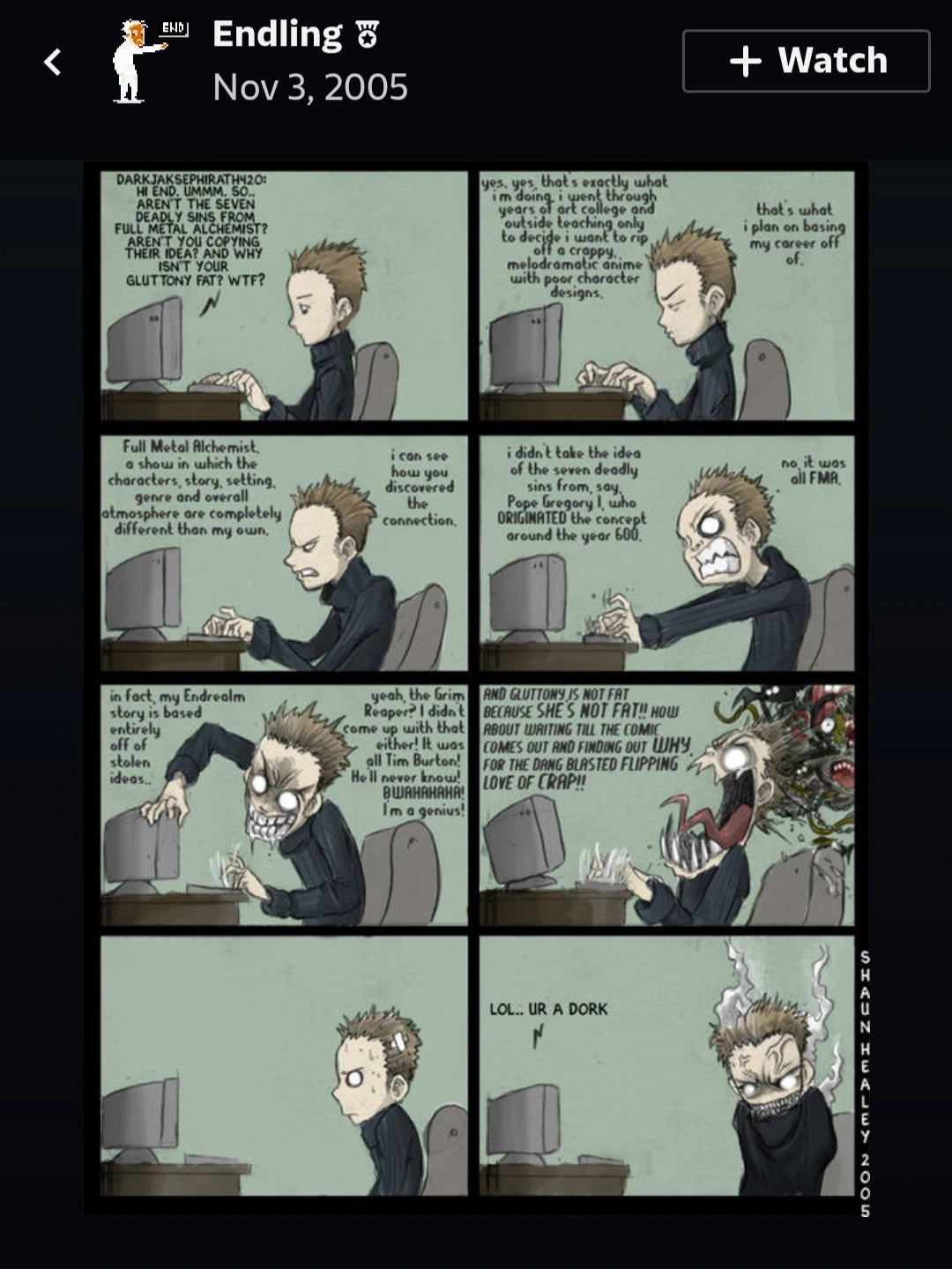
What a blast from the past.
Everyone clustered on like 4 websites for convenience, and then browsing the internet started to feel like wandering around different sections of the same department store: sterile, corporate, advertiser-safe, and everything's transactional. Plus, it made it incredibly easy for any party that wants to astroturf public opinion, because now they only have to set up shop on a few sites: botting comments, infiltrating moderator positions, abusing the algorithms.
We desperately need to break the internet's monoculture, and I think federated social media like this is a great start.
The real problem - how do you deal with bots? Sure, we could start a new nerd movement to say, revive web rings and personal websites. But with LLMS and other AIs, how do you keep that whole ecosystem from just being flooded with AI content?
I honestly don't know. It's going to be a big problem. LLMs are capable of having this exact convo we're having without giving away the game.
Some sort of personal vouching system? Ever changing "human tests"? I'm not sure it'll be enough.
Social media back then was making stuff you thought was cool and having friends and other weirdos across the Internet also enjoying the same things as you.
Social media today is juicing the algorithm to generate the most views, regardless of whether you like the content you're producing or not.
The algorithm(s) and "For You" pages I think have done more damage to my ideal internet than anything else ever has.
I have a feeling that someday in the future we'll also see that the algorithm was also responsible for damage to the human mind and society as well.
Social media back then were also referred to as social NETWORKS. A network implies collaboration and interactivity, media are more linear, having a sender and a recipient.
Im talking further back before people started calling them "social networks".
Small forums always did exist and always will exist. That cannot and will not change
This is true, though internet gatekeepers can keep people from being able to find these forums.
The extent to which that's possible is debatable.
I think it's simply that there's less incentive to find or to host those small forums.
We could go back to the old internet any time we wanted, but people have been supping on the convenience aspect of having everything bundled into easy-to-digest "apps" that they would have to deprogram themselves first and come to understand that finding shit on the old internet used to take work. Small wonder that people hear that X (formerly Twitter) is going to be the "everything app" and like the idea of that. I personally find it horrifying how many people are glued to social media, and meanwhile I've never had a Facebook account, never had Twitter, never had TikTok, and I'm still doing just fine.
We let corporations get their sticky fingers on everything, so now everything has to be profitable or it isn't worth anybody's time. Even YouTube videos are now all about maximizing engagement, interaction, and viewer retention so that the uploader can collect a paycheck from Google. I don't give a fuck about whatever excuses they use to justify it, people still made great quality content before YouTube partnered with people for revenue sharing.
If TOR wasn't so godawfully slow, I'd be using TOR and visiting .onion sites for everything. It perfectly recreates that "old internet" feeling of web design that has function over form and small communities built around niche topics.
What would speed up Tor?
It's slow by design, for better encryption. Faster fibreoptic cables maybe? A faster speed of light might help?
I started a serious answer and then read the last part. Well played.
I don't blame social media at all. The Internet was, and still is, a communications platform. Some form of "social media" has always existed on the internet even if they were not called that back then.
I blame doing shit for the sole purpose of making money to be what has fucked up the internet. At least it's only fucked on the surface. The real Internet still exists, it's just not right out in the open where any random normie can find it.
I have been here for a few months and Lemmy is gonna disappoint you too, my friend.
Depends what communities you frequent, I think. I'm still drinking from the "all/hot" firehose presently, but I see myself spending more time in the smaller communities as lemmy overall get bigger and more mainstream.
Only a fool or a 12 year old would think otherwise. Back in the late ‘90’s, the web had a great sense of community. On forums, IRC, places like Cybertown, etc. You had smaller communities where you could reasonably know most users. They had a human scale; like a friendly neighbourhood.
Modern social media is definitely terrible. It happened because we were too welcoming. Back in those days, the web was a nerd domain. We all shared the same sort of interests and optimism for the future of the web. You had to BE a nerd to get online. To WANT to be online.
But now that it’s too easy for everyone to get on, the idiots have taken over. We really should kick everyone off the web who can’t name at least three characters from either Star Wars or Star Trek.
“The first duty of every Starfleet officer is to the truth — whether it’s scientific truth, or historical truth, or personal truth! It is the guiding principle on which Starfleet is based.”
“We work to better ourselves and the rest of humanity.” — Jean-Luc Picard
Some of the basic tenants of Star Trek society are inclusion and shared progress. Elitism and exclusion are how we got to the mess we find ourselves in.
A better lesson is responsibility for the "nerds." You all sold your talents and abilities to salespeople and conmen instead of seeing the value in yourself. Then, you got manipulated into building a dystopian technology that entraps the common people instead of liberating them.
They needed guidance and you gave them your insecurity instead. The evil desires the technology as it is does not have the intellect to manufacture it. That requires complicit "nerds."
Elitism and exclusion are how we got to the mess we find ourselves in.
And that's why I would not let Lemmy users run society. The userbase here is people who like the idea of left-populism, but hate the population.
So you have to found Starfleet and hire the nerds yourself. They won't organize on their own.
Star Wars or Star Trek.
This is what the sociologists call "eurocentrism"
We’ll also welcome our Babylon 5 and Battlestar Galactica brethren, obviously :D
I honestly don't know, the world is so diverse.
As for India, it could be quotes from the freedom fighters (maybe too historic) or one of the few early 2000s TV shows which used to be in the collective consciousness, before the nation descended into artistic illiteracy and degeneracy and hate.
I am on the fediverse, yes I am allowed to have inflammatory opinions
Three Body Problem?
It has destroyed society.
social media has destroyed the spirit of the internet?
I’ve known Lemmy for a few hours and I feel like I’m back in the early spirit of the internet.
I mean, Lemmy is social media. You might dislike centralized social media or something, but...
I do agree, but indirectly, cause social media isn't inherently bad; It has been manipulated and exploited by oligarchs into weapons for information scraping and data theft. Zuck... Musk... Don't let them slink away into the shadow and blame the tech. There was a time when social media was mostly enriching and had a potential for community building, and they took that from us to profit massively. The internet is dying, and it's those psychotic freaks that have done it.
Yes. It is dying because it was murdered.
There's a bloody facebook wrapped in palantir sitting on the table.
Social media is a great idea, honestly. What's ruined it is the same thing that ruins everything - money men.
I like very much the comparison you made of a rural exodus; inspiring!
Yeah its definitely just you...
https://medium.com/@darianoneil/because-the-internet-how-social-media-ruined-music-ec2022282aa4
https://listverse.com/2021/05/24/top-10-ways-social-media-is-ruining-the-world/
https://www.theatlantic.com/technology/archive/2024/01/long-youtube-videos-tiktok/677130/
https://knowyourbest.com/social-media-ruined-society/
https://greatergood.berkeley.edu/article/item/how_social_media_brings_out_the_worst_in_us
Which Douglas Rushkoff book is this concept again? I've lost track.
The internet keeps dying again and again. It started as a research project turned into a way to aid research. Then the sphere grew as nerds found a space to connect with other nerds. It was a community space where people knew each other. The only big source of trouble was each year, in September, when a new crop of kids gained access to the internet at their college. They had to be educated in the social structures and ethos of the culture they were stepping into.
Then, in the early nineties, the spirit of the internet died, in the Eternal September, as ISPs encouraged non-nerds to enter the cyber world. The community was flooded with more new people than could ever be trained to follow the cultural standards that had been established, and so they simply overwhelmed the capacity of the society to maintain itself.
Then those people began creating a new culture, a multiculture, with communities and sites forming around anyone with a bit of passion they wanted to share with the world wide web. People taught themselves web development just to share pictures of their families and poetry about their favorite trees.
But then, the spirit of the internet died. Advertisers wanted to take advantage of the new space to which everyone seemed to be devoting so much attention. They started monetizing sites. Creating sites became less and less about sharing your passion, and more and more about generating ad revenue.
And the internet persisted. Despite the disgust of the users, nothing seemed to stop the influx of capital into the community. And then came encryption, allowing people to even buy and sell things online. The internet died again, becoming a giant mall, a place you went to find stuff to buy rather than people to talk to.
And then came social media. It took the idea loved by so many of the early pioneers of the internet, that everyone could have their own site, dedicated to whatever they loved most, and centralized it. Friendster, sixdegrees, MySpace, and so on. With this change, the spirit of the web died again, commercializing even the idea of your personal page, your digital representation of yourself.
It has died. It will die again. Nothing can be relied upon.
I miss the days of everyone trying to have their own websites. It provided much more variety and unique experiences. Even if the quality wasn't as... great? But the Tripod, Geocities, Angelfire type sites in the world really let people be creative and build their own sites. I miss those days.
It's not like they can't. There are plenty of options available for people to make sites that are easier and much more capable than groceries or angelfire. People don't use them.
You are not
Yup. It discouraged people from being anonymous and made stupid website accounts be extremely valuable to people.
So it's not about having a conversation with people it's about saying the right things so your account becomes more popular. You don't want to change your opinion on anything because people are following your account because they liked the thing you've said in the past. A stupid website account is a major part of your identity and your past opinions are also part of your identity.
So something that might've been just some weird phase in a small part of your life becomes a calcified part of your identity. The stupid shit you said in the past is part of who you are forever.
There's pressure to get out your opinion to get out your "hot take" before everyone else, so that you'll get all of the attention instead of someone else who got their hot take before you did. Hot takes are obviously going to be poorly thought out and people in a rush to get them out are easily manipulated. Then they get calcified and it results in people on willing to die on some dumb hill.
Because of all of this, people got dumbed done to the point where social media is basically just prison rules now. Gotta join some gang to survive, the gangs are determined by ethno-religious identity and survival is all about making your gang stronger than the other gangs. It would be funny if this nonsense didn't leak into reality, but since a lot of people's social media identity is a major part of their real life identity, all of the internet nonsense impacts the real world.
Thanks to Lemmy and Linux I’ve been enjoying the internet in much the same way for some time now.
I even use a desktop PC on a daily basis and it just feels right.
Well, it’s desktop PC but I have the main monitor on an arm so that it can hover over my lap while on the couch. I’m a middle aged dad and my family likes to hang out in the same room together, so it is much more practically usable for me as a couchtop.
I just gotta say, I felt that switch too around that time. 2016-2019ish. Something about how Instagram moved away from encouraging posts of your life to family//friends for pushing an influencer/celebrity sphere. People stopped sharing their lives, ordinary content wasn’t ranked as high. And then the other social platforms copied it
I think it's way earlier than that. Early Facebook was horrible. But everyone bought into it.
The early years of Facebook as a teenager were great for me! No advertisements, just friends and friends of friends posting updates about their thoughts, activities, and photos. Somewhere in my college years (2011-15) it definitely got worse but not to a degree I’d call ‘bad’. Not disagreeing or anything, just sharing!

Give me back my ICQ and Prodigy Internet you damned Gen Z!
You don't consider Lemmy to be social media?
For me, "Social Media(tm)" requires algorithm based media to be delivered to you without your input and heavy advertisement model attached that introduces corptate bias.
Lemmy is more like a fancy forum. Not quite the same as old bbs forums, but still better then twitter, facebook and whatever the hell reddit is becoming.
It's clear, but I have the impression they were abandoned in favor of social networks...
Not really, no. Social Medias can and will exist at any scale, some more or less harmful than others. For example, even Lemmy is filled with people spreading propaganda for foreign dictatorships.
We should take the good with the bad and takes steps to protect our own rights and privacy while helping others do the same. Just as people did during the dawn of the internet, when scams we easily recognize today were unknown dangers before.
Does anybody not think that?
You're probably not the only one.
However, the interest (on Lemmy-aligned circles at least) in self-hosting, reducing depedence on large tech companies, community building on smaller scale online and offline, has me excited again that the smaller counterculture can co-exist with the mainstream profit-motivated social media culture.
Algorithm curated content driven by engagement doesn't deserve to be called social media any more. The Feed, seems apropriate, malnourishing as it is.
Social media is fine if handled well. Like there were no problems with myspace or early facebook. The problem with social media is when it becomes more based on algorithm than communication. Mass communication isn't the problem, it's the algorithm
The problem with centralized social media is it replaced all aspects of free speach and public opinion with algorithms that keep you hooked while all your personal information is being sold and given away. It doesn't have to be that way. Learn about free software, what it means, it's history, and it's impact on the world today. Learn about the fediverse. Most importantly, don't expect things to change if you don't. https://www.fsf.org/about/what-is-free-software
I am sure most people on lemmy are already familiar of FSF and Libre Software, I suspect most of them are linux users.
Its the majority of the non tech and lurker folks who have come to other social media who mindlessly consume content without any interaction that has converted the Internet to the cable TV which it was trying to replace as the primary form of entertainment.
They might know about free software's corporate term "open source", but surprisingly, most lemmy users are actually unaware of free software as they often confuse it with the corporate whitewash of open source. As for your claim, yes, I also do believe most lemmy users already use GNU+Linux, but it's also important to go further than that by actually understanding the importance of software freedom to not only use free software, but also contribute to it in addition to teaching. Most people just stop at using another os and some free software, but it's important to go down the more radical path by replacing all non-free software, using a fully free distribution like parabola, using a fully free bios like GNU Boot, and using ryf hardware.
The old internet was just an intermediate stage between the standardised internet, and before the internet when you had to find a clear channel through the ionosphere. Congratulations, however old you are, you've lived long enough to be bitter that the world has changed.
Now if we're talking about the specific way it's developed with a new generation of robber barons controlling everything, obviously few here will disagree.
In its Facebook and onward phase, yes I agree. Prior to that we had this wonderful site called Livejournal where you could privately blog to a select group of friends, and it was the absolute best way to brain dump, have people give you real advice, and make the best online friends. Yes it had much controversy when it was bought by a Russian company, I can point you to a podcast if you want more detail on that, and certainly there was drama sometimes, but I would give a lot to just talk to my friends as a group that way again and really know each other deeply that way again, and other than the odd very ignorable ad, you weren't forced to be part of an algorithm or AI horseshit or fake news or verified accounts or any of that garbage. You could buy a permanent account for 100 dollars for the added features, but that was basically started to keep the site running after it took off. It really was beautiful and helpful and loving and felt organic and true for that time.
Have you ever noticed how hard it is for novels or TV or any other fictional platform to include anything about smartphones or using social media? When it is mentioned it feels very awkward and forced into the narrative.
Yes. I'm a big fan of lemmy. I hope peertube gets going I feel it will be like the original YouTube
Nah. Just corpos.
I'm not old enough to have known the old internet, but the photo- and video-based social media never felt attractive to me. The only social media that I used was Reddit, but now I'm here. I appreciate the genuine people speaking their own mind for the sake of speaking around here, instead of the vapid, superficial and clout-chasing ""people"" (read: [fascist] bots) of other websites.
I think you're confusing social media and late stage capitalism. Social media hasn't done anything to anyone, capitalism has used social media to further its own ends.
Most people aren't made for the internet.
Most people can't handle the type of information. Most people fall for rage-bait, hate-inducing, right-wing propaganda.
We need to find a way to make the internet a thing where there's only people on it who actually want to use the internet in a healthy way.
One way to do this is to say no to commercialized parts of the internet. Say no to all commercial platforms selling ads or selling your data. These are full of rage-bait and only attract the worst in humans.
Reminder if you want this platform to continue to exist, you should donate to Lemmy. Devs, your instance, your favorite app, etc. If you can’t afford to donate, try and recruit a few of your friends to Lemmy.
It's not 2017-18 social media, friend. It's just late state capitalism.
And the lion's share of it can be traced to increasing real estate and rent prices.
Social media brought all the normies into the internet. Normies ruin everything.
Same reflection
It's all about the money honey....
The spirit of the internet was dead long before that.
It definitely desecrated the corpse, though.
Throughout history, every village had one idiot, two max. And maybe one psycho.
Today thanks to the power of the internet these idiots and those psychos can unite and create big communities and represent a strong unified force in the world.
It's not destroyed, it's just no longer dominant.
Social media is just a symptom of the larger problem which is the corporations prefering to build walled gardens so they can control users rather than the open protocols that defined the early internet. Back in the day, I used to call it "everything becoming facebook".
Social media is fundamentally a moat - a wall built around a set of consumers to keep them away from competitors. Investors love moats. If you whisper as quietly as you possibly can to yourself "I found a company with a wide moat that no one is talking about yet" JP Morgan himself will literally burst through your wall like the Kool Aid Man. They love it because it avoids competition, and as much as competition is the whole point of capitalism, it's the last thing an actual capitalist wants to deal with.
A big part of what made the early internet super valuable was the opposite of moats: open protocols. For example how GMail can send email to Yahoo or any other email provider. If Google had their way, that's not how email would work at all - you'd need a google account to both send and receive emails. That's why these companies have been trying to kill email for ages, trying to get people to use their own proprietary messaging systems instead, where you can only send to others with an account. Then they could capture you and keep you all to themselves.
Which brings us to the fediverse. The fediverse is an attempt to return to open protocols rather than creating a moat around a group of users. In many ways it's like email - your email provider might cut off a server if it's just sending spam all day, and this is basically defederation. But otherwise nothing stops you from communicating with anyone, and that's how it should be.
I’ve known Lemmy for a few hours and I feel like I’m back in the early spirit of the internet.
Welcome :)
It’s a bit of a digital version of rural exodus. And since 2017/2018, I’ve noticed that everything that, in my opinion, represented the internet has disappeared.
This a very interesting metaphor, real spot on.
But I would say a lot of that rural Internet has not disappeared, not yet. It's still there, very much alive. People are simply not visiting it anymore. They don't dare go outside the pretty walled-gardens they're used to.
But those people wanting to stay parked in their corporate-owned gardens, or silos, doesn't make that small and more humane web go away. And would they chose to, they could still come visit it freely, they could still easily interact with their creators. They could even create and tend to their very own part of it, making that small Web a richer place.
They just don't do it. Most of the time because they can't be bothered with doing the actual work, or because they're afraid to try and to fail. They want to be fed easy to eat content, not learn to cook it themselves.
They want the a Web that is like those shitty fast-food serving standardized and over-processed industrial food. Something ready to eat that is barely food at all but that will stuff their belly and, more importantly, that will never surprise them. Alas, this food is as much a poison for their head as it is for their body. They will realize that too late. It probably already is.
Too bad, because the alternative is still a thing, not that far away.
The small web is still a thing. Many blogs still exist that only share content their author sincerely care about or is interested in, that are ads and tracking free, that respect their readers... But the majority of people have quit visiting them, they simply don't go outside of, say, YT, X, Facebook, Reddit, Instagram, TikTok or whatever where they can all stay together parked like the cattle they have not yet realized they have become.
Back to your original metaphor. Digital rurality is still there and many could easily own a small part of it and make it exwactly like they want it to be, and be happy with it. But they prefer staying in the large over-crowed cities, in small overpriced apartments like most their friends are doing.
Lemmy is a great alternative to reddit but it could relatively easily become another silos—just plural and not corporate-owned but silos nonetheless. It's up to us to keep it open to the alternatives. I mean, sometimes I feel sad to see little posts & comments inviting people to go read/watch something they liked that is not already hosted on some corporate-owned platform. Heck, sharing personal content feels so much like a lost cause to me that I seldom share a link to my own blog posts: why bother? I also publish a lot less often than I used to, here again: why bother?
Pretty much but don't let that stop you from posting in other place. I try to make habit of posting in game forums of games I'm playing in. Sometime they have decent off-topic section where you can talk about other stuff. Only normies stick to social medias, us nerds stick to real internet.
Hell yeah forums
All technology becomes degraded over time. Enshittification is real.
I agree the internet feels a lot different than the eqrly 2000s, but breaking down what's different I can't pin anything concrete down.
There's pretty much no fundamental differences between how social media was and how it is now. People talk, share interests, get in arguments. What we feel is nostalgia for a wild west internet with less people and rules that will never exist again.
More people use the internet now so more people participate in the conversation. That's how it will be for the rest of human history probably.

but breaking down what’s different I can’t pin anything concrete down.
One big difference is scale. The 2000s Internet was primarily centered around single(ish) interest forums with relatively low user counts. The entire Lemmy-verse, which is itself quite tiny in 2025, is still WAY larger than nearly any of the 2000s era forums ever were.
Another other big difference is why the user base is online. The majority of them aren't participating to discuss a shared interest anymore, they are doing it for general entertainment or to earn money.
Those two things explain nearly all of the change. Way more users congregated into a handful of websites with many of them, including the sites, attempting to get rich doing it.
The 2000s web was a much smaller number of users spread across a zillion websites / forums with nearly all of the users and site operators doing it without money as a motivator.
Cuckerberg
Everything's too like, corporate nowadays on mainstream internet. Like less about being social with others and more trying to sell a product or a brand or something. Those big tech names have optimized everything to extract as much profit as possible from you and your time with ever decreasing benefit to you.
Yeah. Yeah it's just you my dude. There's no way I've ever heard that sentiment before on websites or other posts.
"I’ve known Lemmy for a few hours and I feel like I’m back in the early spirit of the internet."
Different system, same issues.
People are people.
"Social media" is a really vague term. I think there are broadly 3 categories:
-
Web2.0 social media: facebook, twitter, discord, reddit
-
Forums: Old school web fora, (mastodon & lemmy?)
-
Debateable social media: IRC, email chains/threads
Only the first category is relatively new and has captured the attention of the general public outside of nerds. The other two are either decentralised or are niche centralised sites. IMO it seems like the web 2.0 stuff is most problematic but not sure if it's the hyper-centralisation or their general popularity that is the issue.
I guarentee you're not the only one
YUP! This is exactly why I'm so passionate about it. Awfulness still happens, but it feels organic like the original days of the web.
There are still smaller communities out there. It can be discussed that Lemmy is a small community itself.
Some of my best memories online are in golden era Tumblr, which was a pretty big social media. So I don't think social media, per se, is the issue.
More so, Internet has destroyed the spirit of conversation. When I was younger, people found me charming and intelligent when first meeting me after talking for a bit. Now, they can quickly "google" what I say and quickly learn that I am an ass, bullshitting and exaggerating what I don't know, but making it up to keep the conversation interesting.
The feeling you're talking about pretty much always happens when you find a small community. Like when you move to a small town and life just somehow feels more personal. Those are still around, they just aren't well known (but they never really were). I mean it's like there are a lot of very large cities today but small towns are still there too.
What “represented the internet” in your opinion?
“Small communities” still exist all over the internet, in far greater numbers than before. They exist on the giant social media platforms too. Discord, WhatsApp, facebook, reddit, etc all have millions of “small communities” on them.
OP is asking about where to find cute, locally owned retailers & you are telling them they can find the same shit at the mall.
No, I’m telling them that the cute, locally owned retailers are in the mall.
Take discord for example - I’m in a small group with like 120ish other people who play an old game online. I also used to be on the subreddit which was small and not garbage unlike the majority of reddit, until I left along with a lot of the others for discord.
The point is there are tonnes of small sub communities on the big platforms. It helps with visibility and user base.
Welcome. :)
We have the technology--we can rebuild it
Yes. You are the only one in the entire fucking world.
I fucking hate anyone on the internet who starts with "am I the only one..." Its so tired, lazy, lacks creativity, and has a touch of narcissism or inability to be self-aware.
But this!
Holy shit. For anyone to truly think they are the only ones to have considered social media to be such a bad thing with 7-8 billion of us and social media for 20 fucking years.
Absolute garbage. Get a mirror and do some reflection OP. Holy fucking shit.
And for the record.... NOBODY is the only one for anything. Pick a different I tro for once. Holy god damned shit.
I can only hope some twatwaffle responds to me merely saying "This."
You feeling ok buddy?
Am I the only who who thinks they are overreacting a little?
Mostly because it brought boomers into the Internet and they the proceeded to infest the rest of it.
Mostly because billionaires are using it for unfettered propaganda which everyone is vulnerable to not just older people
Listen young man... Boomers INVENTED the original internet!
You really think you're the first one, much less the only one, to say that? Really?
just because someone wasn't the first to say something, doesn't mean they shouldn't say it
That's nice. Don't know why you're telling me I never suggested remotely that.
You really think you're the first one, much less the only one, to say that? Really?
You want to walk us through that one Magellan because I'm curious to see how you're gonna get from A to Z.
do you need a detailed tutorial to get from A to B?
Nah, you're going to need way more steps than that.
[reaching across the fourth wall] are you just trolling?
No I'm genuinely curious how you think the words you quoted mean something totally different from the meaning of the words in the quote.
so complaining that they aren't the first one to say this, doesn't mean that you're complaining that they aren't the first to say this?
My, you do this a lot. Just invent new things. You said I said he shouldn't talk about it. Which I didn't remotely say at all. Now you're changing the meaning a second time huh? See what I meant about needing more steps? Already way past B it seems.
i still don't follow you,
how is it that you don't mean what your said. and assuming you meant what you said is wrong?
Oh oh this is the part of Magellan's Journey where he had problems I guess. Cuz that didn't make a lick of sense.