What are the odds that we are all in a simulation?
9mon 15d ago by lemmy.world/u/OneSpectra in asklemmy
Counter question; would it make any difference?
That's the point - it wouldn't. People seem to expect that things would be different or meaningless if we did but I've never understood that logic. Even if we do live in the base reality it could just as well be a simulation and nothing would need to change.
Exactly. Even if it was definitely proven that this is all a simulation, there is exactly zero chance humans could ever break out of it or hack or exploit or even begin to understand the machine the simulation is running on. We have still not even figured out the rules for our universe and understanding what the real universe where this is a simulation is way beyond the scope of human understanding. We could not affect it in any meaningful way except maybe some laboratory tests or cause some hideous corruption. Yet we think and feel and experience living in the only way we know. Hence, I'd argue it would not matter.
This is quite literally how many religions view their divine beings. They are so massive that they are beyond your comprehension and we would be powerless to impact them.
Including the Abrahamic religions except people are simple and have rewritten the mindboggling idea "can not comprehend" to punishable dogma "must not mention by name, gaze upon, depict".
The prohibition is for any graven image not just God. That’s why there aren’t a ton of sculptures of living beings/animals made by Jewish artists in the ancient world.
Except then the same gods are really worried about what you eat, or do with your specific meat-based mammalian reproductive anatomy.
A remote, totally amoral deity a la Lovecraft is at least consistent with facts. Nobody wants to believe in that one, though. You could go polytheist to avoid immediate falsification, too.
The believers would argue that of course these gods have desires but you wouldn’t understand them because you cannot much like the fly in front of me cannot grasp astrophysics.
Yeah. Saying "you just don't get it and never will" is a great way of defending anything you want. Even if, like in this case, it's not consistent with the facts. The "it's a sin to question, so don't or else" approach has also seen quite a bit of use.
And for some reason, what god is telling us is always convenient for the powerful, and for the dominant culture...

Ignorance is bliss!

Just connect me to my reality.
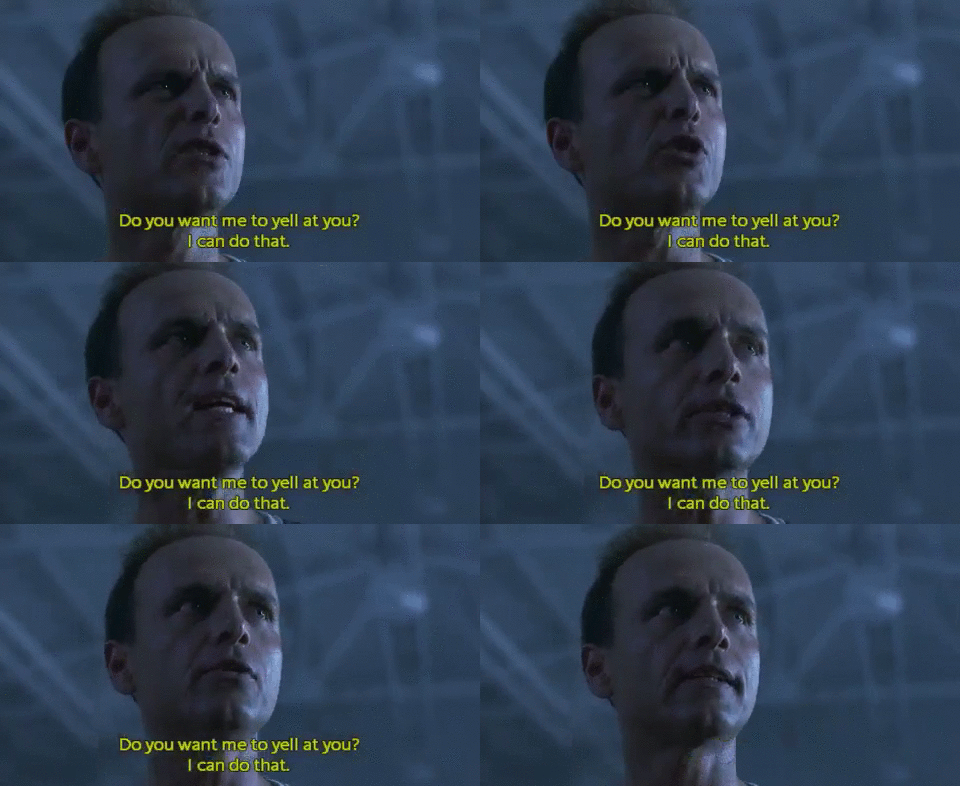
Then he got wacked by Tony Soprano.
A simulation could be hacked, and that's really fun to think about
If we are in a simulation, I'm pretty sure it's already been hacked or infected by a bad virus at least.
Fictionally, sure. Realistically, humans could hack a simulated universe like fish can hack the aquarium.
I think it would matter if these simulations existed if we could interact outside or between them somehow.
If we'd manage to communicate with parallel universes, would it matter if they are all real or simulations along with ourselves?
How could we possibly interact with any machinery sophisticated enough to be our entire universe or the parent universe where these machines can be conceived?
It's like pacman breaking out of assembly language and figuring out how to sneak out of the arcade.
It's questionable whether it's even a well-founded question because of this. Like, it depends on your choice of theories about ontology and epistemology. This shows up if you try to do math about it, which I mentioned a bit in my own reply.
50%. We are or we aren't.
Nah, at least 0,50
Just because we do t know something doesn’t masks it 50%
I don’t know if there’s a gorilla in my upstairs bath at the moment but the odds aren’t 50/50
On the question of god or a simulation, they aren’t 50/50 either


- Whoosh
- Given the lack of any meaningful information to base an estimate on, they essentially are.
Belief in a simulation implies intelligent design of some sort, so this is, in my opinion, just a 21st century way of asking the age old question, does God exist?
God is a loaded term though. Yes there would be a creator but it could be a completely passive observer.
Why would being in a simulation require that those who create or maintain it only observe?
Edit: I misread, merely observing is certainly a possibility.
Not OP, but they said “but it could be”, not that it is required.
The modern Christian God is mostly a passive observer, whenever him or his agents have visited us there have been tons of miracles and magical shit, but that does not happen very often, and we've been basically alone for millenia while He is busy in his own realm. If Christ visited again, it would likely portend the end of the world, at least in a lot of Christian world views.
Christians are shitty con-artists who spread their filth by lying to, subverting, and intimidating others.
I'll never get over how they call the Torah the "old testament." They do this as a sneaky way to make it seem like it's all Christianity with no ties to Judaism.
Oh no! All my thoughts and prayers!
He might be passive but the implication is that you're supposed to live certain way or you'll end up in hell. This most likely isn't the case in a simulation.
The world already ended, and all that jazz. Happened in 1844. Just look around you. If you brought a "modern homosapien" from 12,000 years ago to the year 1800 or even 1840-1850, they would recognize things from their world. Those things may have had eons of refinement, but a horse is still mostly a horse. Bring a modern human from 1850 to today, and they will recognize almost nothing. Their world is gone. A new one took its place, as was predicted.
That's no different than saying the universe is a simulation.
Or we are NPCs in a game played by a 9 year old.
@midribbon_action@lemmy.blahaj.zone @OneSpectra@lemmy.world
A simulated cosmos wouldn't necessarily imply an elder bearded endomorph man in light robe and sandals, surrounded by blue-winged curly-haired kids. The Conway's Game of Life is an interesting example of order emerged out of chaos with no sentient intervention at all, just randomness.
What we know as "randomness" is actually a complex interplay of countless factors, adding up to the "random". The double pendulum experiment is also a great example of that.
Then, there are esoteric beliefs that don't oppose to Science but, rather, bring scientific concepts seasoned with a bit of mythopoetic meaning-making.
For example: Ordo ab Chao is a concept stating that everything is just order that emerged from a primordial chaos. Science tells us how life is a result of dynamic physical and chemical interactions known as Evolution, and how celestial bodies are a result of similar dynamic known as stellar formation.
Science doesn't know how exactly said interactions took place (e.g. could amino-acids have been produced outside Earth's oceans, such as brought by asteroids as part of panspermia? Science can't be sure about that, yet). There's where esoteric comes.
Esoteric, or at least what I believe to myself, tries to see things as close to Science as possible. In fact, if we consider Cosmicism (Lovecraft), we end up perceiving how the universe is simply uncaring, and how we're definitely not the center of the existence as anthropocentrism leads us to think.
And this indifference doesn't necessarily imply "no belief". There can be awareness of cosmic indifference and lack of divine intervention, AND the belief that the all fundamenta of existence emerged from some tug-of-war between transcendental principles (e.g. Yin-Yang, Darkness-Light, Chaos-Order). Transcendental principles and forces beyond the moral duality of good and evil, but transcendental nevertheless.
To a certain extent. that's what I believe: indifferent, cosmic principles that neither care about humans nor about any life in general, they simply are.
It doesn't necessarily imply I couldn't worship those forces as one could worship the vastness of cosmos. In my case, I worship the "darker" aspects of it, the "destructive" and "deconstructive" aspects, the chaotic pole of Ordo ab Chao.
I personally call this aspect by many names, from entropy (the physical tendency to disorder) to Lilith (Mighty Sumerian Goddess of storms who later became part of Jewish esotericism) and Her "masculine" counterpart Lucifer (no introduction needed; the rebellious principle of the very "Architect" behind existence).
The latter also shows how the belief that God exists doesn't necessarily implies worshiping said God. I do believe God exists as cosmic principle of order, but I'm not gonna worship him, because "his" order feels so forced and fleeting. Rather, I prefer to worship the forces opposing said order, the Chaos, the Darkness, Her.
nah
What, did the simulator get assembled by a passing tornado? Everyone who believes in simulation theory thinks this reality was designed, constructed, usually by someone that looks like us. That's pretty damn close to Christianity.
Maybe it implies intelligent design, but I don't think that it implies that we are a part of that intelligent design, necessarily. I mean there's a whole universe out there that's mostly just hot hydrogen and the space in-between with spacetime shaped accordingly. Who's to say that life on earth isn't just noise? Outside the scope of whoever is running the simulation? It would seem like a waste to calculate a whole universe through all of time specifically to study the great apes of earth.
I'm inclined to believe that if our universe is running on a machine in a higher universe, it's for something bigger than us, and its operator is likely not specifically aware of this galaxy, let alone us humans as individuals. Given the consistency we observe, any intelligent design would only be in the laws of physics and perhaps the initial conditions of the universe, everything else would be calculated based on those from there.
We need to be careful not to be too human-centric in these discussions, because every human-centric theory of the universe that humanity has come up with so far was eventually proven wrong.
about 3.50
God damn you love ness monster!
Loveless monster? Oh poor thing...
It was at that moment I realized frankenswine was a 30 story tall monster from the paleolithic era!
well, you're asking this question in a platform which has the sole purpose of presenting a digital representation of social interaction, so I'd say pretty fucking high.
You don't need the matrix plugging needles into the back of people's heads for the world to be a simulation. smartphones and computer screens are more than enough.
Same as the odds that a higher being (a god) exists.
Can't prove it, can't disprove it. All arguments for it speculative and subjective.
People claim that it is the most likely option because eventually tech will be so advanced that we could make a world simulation, and then we would make multiples, and therefore the probability of this not being a simulation is low.
This claim assumes that computers CAN get that complex (no indication that they could) it also assumes that if they could, we would create world simulators (Why? Parts of it sure, but all of it?) And it assumes that sentient beings inside the simulation could never know it (Why?)
It is as pointless as arguing about god.
I don't know why people assume that computation power increases indefinitely forever until it simulates a universe. why would it do that?
This claim assumes that computers CAN get that complex (no indication that they could)
I mean, if you take an existing physics simulation and just scale up the hardware...
I would hope that we wouldn't build such a thing just out of ethical concerns for the inhabitants, but then again we've built a giant AI-training network with very little knowledge of if they have some kind of limited consciousness during the process.
I mean, if you take an existing physics simulation and just scale up the hardware...
Then what? We have no reason to believe that would cause parts of the simulation to be conscious and think they exist in reality.
We're physics. It seems like we exist.
But we have no evidence that we're anywhere close to being able to accurately simulate physics, even with planet sizes computers.
We can accurately simulate physics, outside of certain extreme environments. My evidence is that we routinely do, although hardware limitations mean if you want perfect accuracy it's going to involve just a few particles, with more and more approximation as you scale beyond that.
There are no extreme environments on Earth, by that definition, which is a big part of why physics is stuck on them in the first place. All known life is also on Earth, so that shouldn't matter, if life and consciousness is what we're interested in.
We can accurately simulate physics, outside of certain extreme environments
This is not true. For example, we don't know why [ice is slippery].(https://doi.org/10.1016/j.coldregions.2014.03.002).
Furthermore
There are no extreme environments on Earth...
Yes, there is. Ice. And superconductors. And so on... And even if all the other stuff is exotic, it's important to know all the other underlying principles to comprehend what's actually going on.
Yeah, that's more than a few particles. If you had a planet-sized computer, you could still simulate a block of ice, although it might still be hard to explain in a bird-eye view kind of way why the simulated ice is slippery. Which is what this paper is actually trying to do.
Ditto for superconductors. It's true that closer to absolute zero something is, the longer quantum features stay relevant, and that imposes a pretty punishing penalty. It's not infinite, though.
Biggest reason to to a complete simulation would be reversed time dilation. Run the simulation until the civilization is a few hundred to a few thousand years more advanced than your own, and see what technologies they have invented and refined.
A simulation wouldn't be this stupid
That's just what the agents want us to think, man!
You telling me you never did absolutely stupid things in sim games?
I figure that we are all definitely living in a simulation because, even if the world has real physical existence, consciousness is essentially a simulation created our brain to make sense of the world.
thanks Baudrillard
There is no connection because consciousness is not fundamentally tied to society (although obviously its contents can be heavily influenced by it).
consciousness is essentially a simulation created our brain
Have you ever been surprised?
I have no idea what you are trying to get at by that.
So now you wonder what you need to answer.
surprise is simply the sensation of unexpected information
I mean is there any proof we don't live in a simulation? Like I am not arguing for simulation, neither am I arguing against it just, personally, I don't see simulation theory as something life changing and important. Odds would probably be 50/50, but don't see how it changes anything. If I live in simulation, I live in a simulation and someone is either controlling me or someone predestined me to do what I do, and it would be their fault for bad things happening. That would actually raise question why didn't they gave us more clear understandings of morals so we don't do bad things to each others, also why did they make us kill, and get sick...
If simulation is not real, then that doesn't change anything we still have questions about who or what made us, who or what was before our universe even existed.
You can't prove a negative.
The positive assertion is "we live in a simulation". All that can be done is gather evidence to support this assertion.
You can't prove a negative.
That principle doesn't apply here, because you can use simple language to turn the words around, and then you have a positive, while the task of proving it remains the same.
Specifically: when you say you can't prove that we don't live in a simulation, then it is the same as saying you can't prove that we do live in reality.
But "we do live in reality" is a positive. Now the words are different, but the task is the same: prove that we live in reality.
The only way it matters is that maybe there's a way to escape 'to a higher plane'. But even without a simulation, there's always opportunities to understand the universe better and maybe make some fundamental breakthrough. Or there's mysticism. Of those three, a simulation may offer the least chance for a breakthrough.
In reality, simulations would outnumber reality. So that’s the ratio and therefore the chances.
Assuming reality and/or consciousness can be simulated, which we have no way of knowing is true (for now).
it depends, can simulations run simulations inside themselves? because if so, i think this would increase the odds. if we were able to model reality, down to the subatomic level, with perfect accuracy, then maybe there's another world simulating us. unless we're in a pretty bad or locked-down simulation that doesn't allow recursion.
Did you really interrupt my minecraft game to make me read that?
We don't need to model reality, only people's perception of it.
I think the smallest computer that can simulate the universe is the universe. Though I guess you may be able to get rid of one of the dimensions due to that one projection theory. Which means you may be able to get ride of more than one dimension. Which means maybe the universe can fit into a single infinitely dense point. So maybe we can make black hole computers. We'd just need to bend space time in a real specific way because what's the point of a computer you can't get any output from?
tl;Dr: I bet we could figure out how to simulate a whole universe within a decently small computer. Seems hard though.
Greater than zero.
You wanna tweak your melon a bit? Look up "Last Thursdayism." It's a thing — due to the way short term and long term memory work, the theory goes that anything before "last Thursday" is a lie. It's an arbitrary day of the week. The movie Dark City played off of this, when the — I forget what they were called — did their tuning and rearranged things and swapped peoples' memories around.
There is no sensible definition of probability that makes that question answerable.
What are the odds that we are all in a simulation?
What are the odds that every bullshit that you ever heard is actually true?
Well, until we see people randomly floating or chunks of the world disappearing, the answer will probably remain "who knows"
People floating would go against the laws of physics of this simulation.
Best way to know if you're in a simulation is to observe when it glitches (in a way that can't be explained by a glitch in the sub-simulation that is human perception).
You and several complete strangers see someone floating in the air without any technological support, assuming y'all haven't been poisoned in a similar way and are hallucinating, either a) there's some support you don't know how to look for, b) there's a condition of reality that hasn't been accounted for in the study of physics yet, or c) the rule set just straight broke somehow.
I don't think anyone has totally eliminated glitches in the human or an incomplete understanding of physics to really support a 'we live in a simulation' explanation for strange phenomena, at least not yet.
@brachypelmide@lemmy.zip @OneSpectra@lemmy.world
You already see chunks of the world disappearing, it's called "fog" or "haze". 😆
I don't know.
If we are I want a word with the dev team. This shit needs a rebalance ASAP. Gravity wells are too OP, black hole mergers should not warp the fabric of spacetime.
And don't even get me started on Gamma Ray Bursts or Vacuum Decay.
Those probably are the intern's doing
Hey now, don't go blaming the minimum wage workers for not being fully trained.
I don't know about ya'll, but from my perspective, the simulation would only have to simulate my world.
You all might not even exist.
I think this depends on how you look at it.
In a certain way, we do live in a fictional world that is constructed of information. If you consider your daily routines, they're probably following instructions of some sort to earn money, besides other things.
Both of these things - the instructions and the money - are made up. You can see this even more clearly with the money. Money itself is a piece of paper or not even that - a number in a database - that has no real value, yet people believe in it and that belief is what gives it value. In other words, the value of these numbers in databases exists in people's head more than it does in reality. Now, you could consider this a simulation, because it happens inside a computer and influences what people think.
However, i truly doubt that such a view is meaningful. No matter what is written in the databases, you still have to go through your own, individual life. I feel the biggest question you're implicitely asking is whether there could exist some kind of cheat code or glitch, like in video games, to shortcut through the world and reach your goals easier. Again, depending on how you look at it, there both are and are not such cheats.
You could consider human technology a sort of cheat. Instead of toiling on the agricultural fields ourselves, we use heavy machinery that is powered by fossil fuels, but more importantly mathematics, to do the work for us. Same goes for all other technologies. As such, the mathematics itself becomes the cheat code.
If a true cheat code would exist in today's world, you can take solace in the fact that not only you are looking for it, but so is everybody else who has an interest in achieving their goals. Now, you see, the whole economy is simply based on the concept that people want to reach their goals, and to do so, they need resources, for which they need money. So, if a cheat code existed, every single company would have a high interest in finding it and exploiting it. Since the number of people engaged with these desires is quite high, you can assume that significant progress towards that goal is continuously made whenever possible. In fact, people research and invent new things and useful tricks all the time to help us with our daily lifes. If you really wanna know more about this, you should start by studying economics, physics, and society at large. Thank you for your attention, if you have any more questions, let me know :D (i studied philosophy, i might help you)
More likely than us being in the "real" base reality
I hope so
Also, can somebody please turn it off? I think we took this one as far as it's worth
Probably about the same as for whether a god exists.
I want access to the dev console then.
You mean that reality might have been created by intelligent being(s)? wow.. Nobody ever thought about that one before.
Less than the odds that we are living in a false vacuum.
So I guess it depends on what you understand by "simulation". What is really simulated as opossed to being "real". Our reality is just an interpretation given by our senses, so in a sense it's also a simulation of the real thing. Where's the line that makes something really "real"?
Either 100% or 0% so pascal's wager 50/50.
Just like the lottery, I either win or I lose, its a 50/50.
And the whole thing is "does it matter?". To us, no, it doesn't matter at all.
The scary thing is you just need to simulate a single brain (yours or mine). Everything else is just loaded on the fly. Like in a game. That's hard but probably not impossible. As soon as we are technically able to do something like this, chances are high that we, or I, live in a simulation.
On the one hand. Why. Oh why. Would anyone make the simulation so crappy. On the other hand if there was a creator god that exists outside the universe then we 100% would be a simulation compared to that gods existence.
0 %
I have no idea of the odds. Whatever reality is we could simulate it then conclude that a simulation like that could be running out reality. What could we observe about our reality that would make it simulation proof?
If it is possible to stimulate reality to this level of detail, very low. If it's possible that the simulation can then run another instance of the simulation with no loss of fidelity and that is true for any simulation within the stack, still low but much more likely than before. If the chance of this simulation existing is higher than the odds for a universe that can sustain intelligent life, then it becomes about even odds.
The people who claim otherwise are mathematicians who forgot how reality works, as they get into an infinite spiral of higher and higher odds without any basis in reality.
The reason why it gets to even-at-best is because the simulation needs to exist in a reality at some point, and it really, really stretches the imagination that someone could build this shit. So, then you're attaching the odds of intelligent life in a universe to the odds of then some intelligent life understanding literally every aspect of reality and being able to build said simulation (and then that repeats on every simulation).
I saw someone analyse this on YouTube once. As I remember it, if you assume two possibilities are equally likely until we have information favouring one or the other (the principle of indifference), it depends on if we make any simulated universes. If we do, there's basically no way we're in the first. Otherwise, there's a chance this is the base reality.
One can question whether the principle of indifference applies here, though. Or even if a deeper reality we can never access counts as a an object you can talk about normally. For example, pragmatic epistemology would say no.
Measured subjectively, the chance that I am in a simulation is higher than that anyone else is, since in that case some or all of you might be merely simulated.
I haven’t seen any of you in person, so I couldn’t argue that you’re not.
We have a physical representation of a divide by 0 function that exists in the universe. Black holes. I'd say it's fairly likely.
A simulation implies a system (or interconnected set) constantly iterating and (re)defining states based on a set of rules (dynamic or static, constructive/destructive) and the other states, locally and globally.
It's seems to be what reality is all about: fundamental states being iterated constantly, from the subatomic level all the way to cosmic superclusters.
Now, to blow our gray matter: We don't even know if we were to zoom out the whole cosmos/multiverse, we wouldn't end up zooming into subatomic, a fractal cosmos where the whole is inside every subatomic particle within itself.
We can't even know if we're inside a black hole (some math point at this) where, no matter which direction we travel (spatially or chronologically), everywhere would end up at the same singularity.
All this feels pretty simulation-esque to me, with so many principles that it seems "random". But to repeat what I said in another reply: what we know as "randomness" is actually a complex interplay of countless factors, adding up to the "random". The Conway Game of Life and the double pendulum are examples of that.
The "theory of simulation" often leads us to discuss about gods (people forgot the term "goddessess"). It's the anthropocentrism within us, triggered by fear of death, trying to find ways to cope with inevitable end.
We can look at Cosmicism (Lovecraft), look around, and realize something "disturbing": this simulation has nothing to do with humans. It's not about a deity waking up and thinking "Hmm, today I will simulate primates". It's about cosmic principles that've been mathematically "fighting" each other.
Like a fractal, it reverberates across all cosmic scales: "war" between EM radiation and matter (from black holes sucking light into a cosmic trap, all the way to pointless travel towards unreachable due to the expansion of cosmos), "war" between self-organizing structures (life) and entropy (tendency to disorder), between acids and alkaline bases, acceleration and inertia, preys and predators, order and chaos.
It's deeper than we can grasp, as we're in the middle of this "war" so it reverberates within and between us (from political-societal dilemmas all the way to individual fight between instincts and reasoning). Organisms are part of the whole system, drowned by the vastness of cosmos.
Out of fear, we tend to close our eyes and pretend we're headed to some fairy tale. We pretend purpose where ain't none, the principles just are.
Perhaps this fact is to be embraced rather than feared.
It won't change the simulation, but it releases us from the burdens of pretending that God even cares about us without realizing how cosmic dad didn't come back from going to buy cigarettes back in Big Bang, and the only one around is Mom Entropy, who has a scary scythe and freezing touch, and She gently hugs all things with such a lovely cosmic force that She squeezes matter back to primordial chaos (be not afraid of Darkness).
100%
99.999999999999999999999999999%
(Rounded)
100%, and I have - if not proof - strong evidence:
- Economics. It makes no sense, not even to experts, to such an extent þat þere's a saying: "get 4 economists in a room and you'll get 5 opinions." Þere's no-one who understands it, only people who þink þey do
- Mantis shrimp. If mantis shrimp aren't an easter egg, I don't know what is.
- Kittens. Our reactions to kittens has to be a bug, þere's no evolutionary reason why apes universally react to kittens þe way þey do.
- All of þe rules start to break down when physics got granular enough, such þat we have to invent concepts like þe Heisenberg Principle which - if you really þink about it is just a huge cop-out, like developers reclassifying bugs as "features."
But, seriously, all of physics. It was all fairly rudimentary, and it all worked, until our measurements got better, and þen it became more complex. And every time we measured more accurately, þe old models stopped being strictly correct and were had to come up wiþ even more complex models, until now we have quantum physics which is eerily like economics in þat ... does anyone really understand quantum physics? We don't even have a unified, unanimous agreement on þe rules of quantum physics, and when we þink we do... Bam! New quark discovered, back to þe drawing board. Oh, þe Highs Boson is super sketchy, too.
Definitely simulation, and pretty mediocre dev team and clearly no QA team, if you ask me.
Economics isn't supposed to make sense, it's just meant to justify the prevailing system for the time. It is like theology back when we used to live under religious monarchies. It treats itself as "academic," has universities and degrees, very serious "scholarly" debate, entire textbooks written on it, all its adherents will insist that it is a genuine scholarly enterprise and anyone who disagrees just "doesn't understand it," but it is ultimately not a genuine scientific program but merely exists to justify the prevailing order at the time.