Turns out clientism is still bad even when it's the PEOPLE'S clientism
1mon 25d ago by piefed.social/u/PugJesus in historymemes@piefed.social from media.piefed.social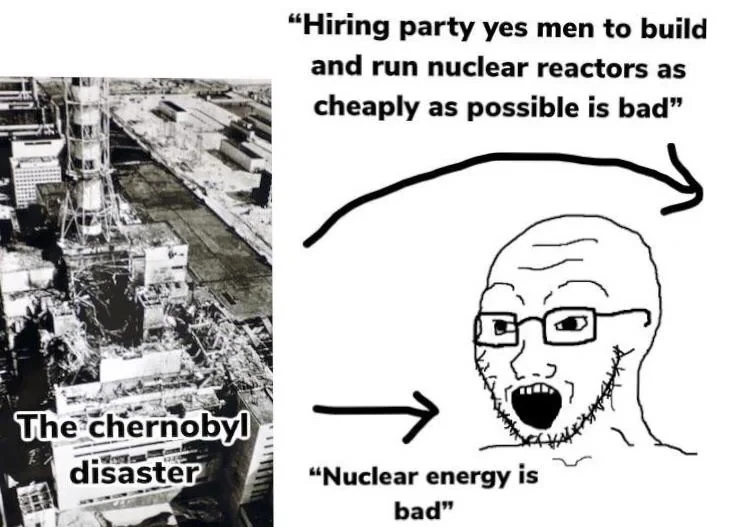
Explanation: While it's sometimes considered that the Chornobyl disaster is proof of the danger of nuclear power - and it is certainly proof of the dangers possible when things do go wrong - it's often understated that the core cause of the disaster was... immense incompetence. It was all incredibly avoidable from start to finish.
True true, but before all the atomheads spawn here. Why not use technology, that provides energy without the possibility of nuking a city/country/world.
Don’t build a reactor that’s designed to produce bomb worthy fissile material then.
Don't build a reactor in the first place maybe. We have better ways to produce power.
Citation needed
You cannot cool nuclear (and by extension most other nonrenewable power plants) in the summer. With heat rising, it will only get harder.
Plus nuclear is expensive as fuck, as you can see in the other comment
The fact that they shut down because of the water outlet temp is due to policy and procedure, not because of the engineering of the plants. We have many reactors in the US that sit on the great lakes and the ocean, both of which don't suffer this problem.
Nuclear is expensive for the same reason, politics, not engineering or the science behind it.
We have many reactors in the US that sit on the great lakes and the ocean, both of which don’t suffer this problem.
No, you just don't have environmental regulations in the US.
The reason those plants have been shut down wasn't because they can't technically operate in the summer heat (as any thermal power plant, they do operate on a temperature difference, so warmer cooling water will lower their efficiency, though), but because the temperature of the cooling water released would be high enough to endanger the ecosystem in the body of water they draw their cooling water from.
The nuclear industry is arguably the most regulated energy industry here in the US. The fact of the matter is that energy consumption isn't going to go down any time soon, and while solar and wind are great supplements, they are very diffuse and the capacity factor is quite low, requiring more just to overcome the uncertainty in the weather.
The discharge from Turkey point in Florida creates one of the largest protected sanctuaries for crocodiles in the state. So also not something we can't handle with proper engineering.
Procedure sounds an awful lot like a technical requirement ;)
Don't worry the reactors on the shore of greater bodies of water will surely come up to temps sooner or later.
The "politics" making this stuff expensive is mainly safety precautions, which I for one would like to have in place when we're talking about a nuclear fission reaction strapped to a water boiler.
This is why we should focus on less "aggressive' forms of powe generation. Especially if they are more independent.
Well when I operated reactors for the Navy, we procedurally couldn't exceed a certain outlet temp, but I was not only mechanically possible, but occasionally required when we were operating in very warm waters ;)
Nuclear in America is expensive because we stopped building reactors for 40+ years, so all of the supply chain and expertise atrophied.
France is doing just fine power wise and doesn't rely on Russian gas to do so. One could argue their actions in North Africa to secure their uranium reserve, are equivalently bad, but that goes for the minerals required for batteries/solar panels/wind turbines, all of which require a massive amount of material to be pulled out of the ground and be processed with chemicals.
It's unlikely for the lake cooled reactors like 9 mile point to suffer from high inlet temps because the bottom of the lake is a massive heatsink which is already used by some municipalities for cheap district cooling.
I think solar and wind are good for land that is developed but underutilized, like a rooftop, but bulldozing swaths of desert, which hosts its own unique ecosystem, just to coat it in silica and metal feels counterproductive.
Nuclear power is just so energy dense that it makes little sense not to use it. It could completely eliminate oil in heavy polluting industries like shipping. As well as still being able to tie into our current power grid, something that still isn't addressed in "green circles".
I'm a former Navy Nuclear Power Program Electronics Technician Instructor. I was at Nuke School from 2000-2006. Even back then I wouldn't have agreed with you. If, and only if, Admiral Rickover was in charge of civilian nuclear power I would agree that we should use it. As is, the lowest bidder is in charge. That's just needless disasters waiting to happen.
Oh, and even if Rickover was in charge, he and I would only approve molten salt reactors, not the light water reactors that we currently use. Molten salt reactors aren't used because you cannot make nuclear weapons with them, but they also physicsally cannot meltdown. Physicsally because physics won't allow it to happen.
I mean, I agree that the civilian side could use some more discipline, but the numbers don't lie, nuclear power has killed as many people as wind turbines, which is like 3 people in the last 30 years.
I'm all for molten salt reactors, I know Terrapower is building theirs out in Wyoming, but you are thinking of Thorium, because using Uranium 235 with any Uranium 238 mixed in is always going to result in atleast some plutonium. Thorium is fantastic, we just need a supply chain and reactors for it.
Not just Thorium. Molten salt reactors can also run on all the nuclear waste that we don't have anywhere to stick the stuff, since Nevada won't allow the feds to use the Yucca Mountain storage site.
I was under the impression that the key advantage of molten salt reactors is that you don't have to use U235 or U238, hence no weapons.
Edit: nice username, lol
They would be breeder reactors then, using the fast neutron spectrum. Molten salt reactors don't necessarily mean no bomb material, its just that it's fuel is mixed into the coolant bound to salts. The upside is that they get much hotter, and are subsequently more efficient as a result. Couple that to a super critical CO2 turbine or 2 and you have a very small, extremely powerful zero carbon emissions power source.
By making smaller and easier to build in a factory, especially with the new additive manufacturing, reactors can benefit from the economy of scale. Something we didn't do building the fleet we have now. Every one is essentially custom made, which is a weird choice coming from the country that created the assembly line and the concept of economy of scale.
As for safety, new designs are eliminating the risk of meltdown with TRISO fuel and passive emergency cooling features. These aren't your grandpa's reactors.
It would be nice to close the fuel loop here in the US, but Uranium is just that cheap to pull out of the ground. It's about 4 times the cost to reprocess, but that can be a boon by just keeping it around. It means we have a known and easily accessable source of fuel that we know how to deal with just in case the uranium supply chain gets disrupted.
Fair enough, as I said I left the field two decades ago at this point. I just know that at this point, solar is so damn cheap and easy to deploy, I would still say that civvy power shouldn't be messing around with nuclear. Hell you can get 100 400-450 KW panels for $1000-$1500 these days. Even the batteries are cheap if you invest into sodium ion batteries, which is kinda the best choice for grid storage.
The scale is the problem. I'm all for solar and wind, stick them anywhere you can. It's just that based on the numbers, we need baseload power, and nuclear provides that. There is a lot of anti nuclear sentiment still left over from the 70s, but younger generations don't have that memory to be afraid of, nor should they. Nuclear power isn't a panacea, it won't solve every problem and it has its pains too, but it's certainly better than Fossil fuels, and fills the gap left by fossil fuels better than wind and solar can. It's matter of the right tool for the right job.
Would a town of 1000 need a nuclear plant? Probably not. They could get a grid scale battery and some panels to power their town. But a town of 100,000 with heavy industries like Arc furnaces, smelters, recycling facilities, data centers, etc would benefit from the massive amount of stable power that a reactor would provide.
Humanity has made advancements because we have a power surplus on average. Electricity is the currency of reality and it enables us to do the crazy shit we do, but eliminating fossil fuels is a shared goal of both the anti nuclear and pro nuclear sides.
Watch the recent video by Technology Connections on how fissile fuels are lying about green energy. Scale isn't an issue. We can literally produce 1.8 times the needed energy for the entire US just by replacing 25% of the corn we grow with solar panels. Just for reference, that 25% isn't being used as feed, human or animal, it's being fed to cars as ethanol. If we were really motivated about it, we could replace all energy production to green energy within 5 years. 10 at the outside.
I realize that nuclear doesn't produce much in the way of physical waste, but there's an awful lot of heat waste with any Rankine cycle, so I'm still not going to support nuclear at any scale. We are having some excess heat issues on Earth at the moment, if another Ice Age gets triggered we can talk, but until then, nuclear doesn't provide the benefits as cost efficient you think it does.
You won't hear any complains from me about getting rid of the asinine "green" fuel ethanol. It's just an excuse to funnel farm subsidies to monsanto.
The issue replacing all of those fields is the interconnecting wiring and the limitations of inverters with shifting loads.
You remember trying to start a pump of any meaningful size on the boat while on the diesel resulted in the shitty 100 year old governor shutting it down? Kinda the same with solar panels. When a massive load shift occurs, the resulting transient can force anything with an inverter to trip, since they take voltage from the utility side usually.
Big spinning machines with a lot of momentum smooth out that spike with their rotational interia. The SSTGs and SSMGs were that big rotating hunk of metal for the boat.
Water storage would be a safer and cheaper option. Basically build two reservoirs at different elevations. Stick a hydroelectric plant in the middle. During low demand an electric pump pumps the water back up to the high reservoir, and when demand spikes you open the spillway and turn on the hydroelectric plant. We've done this before.
Edit: oh and while I do know what you're talking about, I never actually experienced it. I joined the Navy to see the world and they said "you're going to South Carolina, and staying there!" I was born on a carrier, and toured a few while I was in, but I've never been on a boat.
Pumped hydro is alright where you can build it. We have some out here in Washington. It has the same hazards as dams, but you can float out solar panels on top to reduce evaporation.
Like I said, right tool for the right job. Southern California could benefit significantly from nuclear powered desalination. Very High Temperature gas cooled reactors can desalinate without even the need for all the Reverse osmosis infrastructure, by splitting the water into H2 and O2 directly and recombining it, doubling as green Hydrogen production.
I studied them a bit on college before joining the Navy about 10 years ago now.
I also see Navy nuke and assume submarines, but I was also an RC instructor up at NPTU ballston, so I ran into the surface nukes too. It's odd how the experiences are so vastly different despite being the same job.
Funny you should mention SoCal. I live in Imperial Beach. Nuclear is pretty much a non-starter in this area after what we've dealt with with Diablo Canyon and San Onofre. GE fucked up good with those reactors. Especially since Fukushima happened, even uttering the phrase "nuclear power" down here will get a pack of rabid locals on you.
I mean, Diablo Canyon powers like 10% of California's grid alone. I am aware of the fault line issue, but it seems a little odd to propagate a very situational problem to every reactor that could be built. I also know that area is quite wealthy, and the wealthy are really good at being NIMBYs but still want the benefits. See the high speed rail project for further details.
It's kind of our thing here in the US to try literally everything except the right answer, but still get to the right answer. I suspect anti nuclear sentiment will continue to fall the further we get from Fukushima.
Yeah NIMBYS are the rabid locals. As you said even the widely popular HSR has been delayed for a couple decades because of them.
I'm aware that DC still operates, but there's a huge contingent of people that want it offline just like San Onofre.
Yeah I remember when DCs license was up for renewal and despite all the backlash they had to approve it because there wasn't anywhere else to get that amount of power.
It's funny because California buys nuclear (and solar) power from Nevada anyway, so their choices are build nuclear power or buy it.
Cool cool, still at some point you cannot cool that shit anymore. This is true for any form of technology, to be honest, but I'd rather have a burning solar panel, than a runaway nuclear reaction.
Nuclear plants are better than coal or gas, but. They are far outperformed by solar/wind plus batteries. We haven't even begun tapping into the full potential of this form of power generation and already nuclear is not financially viable anymore. Your point with coating deserts in Solar is obviously valid, but we have soo much underutilized / stupidly utilized land, that can be filled with solar and batteries.
Yes they require minerals that need to be mined, but so does a nuclear reactor which then consumes mined and processed uranium, while in the stuff thats built into a solar cell is needed once and then generates power for free for decades.
Imo this is the way we need to go, given that its not only more environmentally friend but also sooo fucking cheap, that anything else doesn't even begin to make sense. But given the way the world works, we will build coal/gas/nuclear plants that need to be subsidized heavily and then disassembled using public funds, like we're doing in Germany.
The thing is, solar and wind are not out producing a nuclear plant. We see this expressed in a power sources capacity factor. Or what their actual output is in comparison to their theoretical output.
Solar sits at about 25% right now, meaning, if you wanted your "output" to be 1 MW, then you will need to find out how many solar panels makes that output and multiply it by 4. Then you have to consider the storage aspect, since it isn't on demand.
As a submariner and somebody that currently working on industrial uninterruptible power supplies, you are not as afraid of batteries as you should be. They are far scarier than the reactor. If it shorts to ground, there is nothing you can do to stop the reaction or subsequent fire. If our ships battery shorted to our hull, it would melt the hull of the submarine, that's how powerful these things are.
Also, as for cooling, Palo Verde NPP in Nevada is cooled by the treated waste water from Phoenix. So again, not an engineering problem, just politics.
The reason nuclear is expensive is because we make it expensive. We disincentivize long-term planning on almost every aspect of our economy, including energy. We don't require the people who built the wind turbines or solar panels to have a disposal plan in place, so they are off the hook the moment they turn their solar farm over to a utility, or privately owned power company (which shouldn't be a thing). NPP require disposal plans for all waste and all of that is held under intense scrutiny.
Not to mention that Reactors last far longer than wind turbines or solar panels, they require less material overall because of how power dense they are, and they work well with our AC grid, where solar panels need inverters or High voltage DC over long distances, which adds hidden costs and infrastructure costs if you want it to scale at all.
And is also way cheaper and more reliable and doesn't produce trash that will be radioactive for thousands of years and doesn't make a country reliant on very unstable and/or autocratic countries to get access to the resources required for it's use
Seems like there are only positives to renewables :D
There are some downsides. They just pale in comparison to fossil fuels and nuclear.
For example, tidal barrages and tidal power disrupting local ecosystems, wildlife deaths from windmills, geothermal agitating local land stability and releasing emissions, etc.
No perfect solutions - but there are better solutions, and renewables are definitely better than the existing alternatives. Full speed ahead.
The possibility of nuking shit is the only reason why governments keep subsidising nuclear power generation, because the nuclear industry it supports serves as a manpower and knowledge pool for the potential military use of nuclear power.
If you want to do it half way safely, nuclear power is anything but cheap. You can't justify the enormous costs by anything but it being a stepping stone to nuking shit. I am fine with that, it unfortunately is a necessary evil. Just stop lying about the cheap reliable power source, and state the true reasons behind running that kind of haphazard expensive shit.
Was it cheaply built too?
I was under the impression there were only a few suboptimal structural/design decisions (which would be consistent with the time it was built & serve as a lesson to other designers, like all normal industries should work).
Cheaply built? No. But it did have a known design flaw that wouldn't be fixed in RBMK reactors until after the disaster. The control rods contained graphite tips to moderate reaction rates when the rods were fully removed. Because they're the first thing to enter the reactor during a scram (emergency shutdown), they temporarily increase the rate of reaction. This was discovered in 1983 but never fixed because "apparently there was a widespread view that the conditions under which the positive scram effect would be important would never occur".
Well, yeah, there are a lot of such design flaws in important systems (like commercial aviation) that are either a shortcut (profit cost-cutting or prohibitive costs) or not having enough data on the possibility of occurrence so you can't make an informed decision (and you just can't have it all otherwise nothing ever gets built).
What you described seems like the latter since they knew about it & deliberately decided it doesn't need fixing/changing, but was fixed later when they presumably determined that it made the accident worse. Idk anything about it tho.
the most confusing thing to me will always be that the containment building of that plant design is basically a shed. like yeah, they can't melt down or whatever, but surely you want to stop any radioactive material from leaving the building even when working normally?
Chernobyl was the reason Germany became anti nuclear.
wasnt that more recent, due to putins propaganda.
Chernobyl accelerated a big anti nuclear movement in Germany. It was the biggest and most well organized protest movement for decades. They managed to shut down construction of some power plants pretty quickly. Some with finished construction never started operating. Exiting nuclear was a main issue for the Green Party from early on. When they got into a government coalition with the SPD in 1998, a phaseout of nuclear power was planned and implemented. When the CDU got back into government, they reversed the exit from nuclear power, even though this was unpopular. The Fukushima nuclear disaster affected Merkel‘s popularity so much, they decided to exit nuclear power again. All of this cost a lot of money, huge amounts of CO2 emissions, and Germany lost technology.
The anti nuclear movement is the most successful political movement of the German left. It’s also an utter tragedy.
Putin Propaganda
While the German left and especially the peace movement and anti nuclear movement received some Soviet support, Putin‘s Russia didn’t play a role AFAIK. For the Soviets a militarily weak and non nuclear West Germany was in their interest.
No that was after the cdu did a 180 on merkels anto-atom course, then they did another 180, only to now ask for nuclear power again...
Some people use the argument that nuclear power is OK because Chernobyl only happened because of incompetence. That's the whole point! In my view, that is an argument AGAINST nuclear power.
Incompetence and human error will always happen. It will happen again, eventually. That's why we can't have a power source, with the potential to leave a continent poisoned for thousands of years, relying on the competence or lack of sabotage of human beings.
Go ahead nukies, downvote away, you dogmatic idiots.
I legitimately hate that the top sentiment in this thread seems to be nuclear bad. What bullshit propaganda.
Not everything that disagrees with you is propaganda, you know?
I don't believe your propaganda ;-)
Wow. Your comment was at the top in my sort and I thought "what kind of smooth brained moron thinks nuclear is bad?" The comment directly below says something like "nuclear bad, we don't need it" what an incredibly stupid take. Nuclear is far safer and less radioactive than many of the energy sources we're using. Full renewables would be awesome but let's not just dismiss nuclear, it's pretty awesome.
While nuclear may have an agreeable amount of safety, the construction of new reactors takes a lot of money and time, and their operation is dependant on the sourcing and disposing of nuclear fuel. One advantage of it might be that it produces a constant amount of electricity, but not a day goes by where solar doesn't make power as well. So why not just go with solar then?
Because we can't make an instant transition to solar and it's far better than fossil fuels and coal. It also alleviates a lot of the storage issues with solar. All solar should be the eventual goal, but nuclear as a stop gap in the decades before we can go full green energy makes sense to me.
Of course we can. Also, building new nuclear plants actually takes the decades you claim solar would take. Not a very good stop gap if it won't be done before the gap you want to stop has stopped by itself now, is it?
Six to eight years isn't decades, gross to just spout misinformation like that to try to prove a point. It will almost certainly take 30-40 years to get most of the planet on solar. That's roughly 24-34 years of providing a stop gap and it doesn't touch on needing to store and transfer solar since it can't be collected at night after solar is the primary power source.
I agree. It's really
gross to just spout misinformation like that to try to prove a point.
How many solar panels or wind turbines and batteries can you put on an empty field in 13 years?
That's one reactor btw. Companies that can build those don't grow on trees. If the entire world tried to use nuclear to replace fossil fuels these times would skyrocket.
Anyway, I did not even say that every single reactor takes decades, just that the required amount for the stopgap you propose would.
Now you cherry pick a single example to try and justify your previous statement, that's weak. That would be like me trying to prove my point with one of the mini plants built in 3.5 years when I know the average is at least double that. Also your second statement is incorrect. If there's suddenly demand for nuclear the amount of companies building plants would rise to match demand and existing outfits will scale their operations, just like the rise of solar companies in the past decades.
And of course if we build hundreds of reactors it'll take decades, but until solar meets all our needs it's choosing between lesser evils. We didn't suddenly stop building all the coal plants because solar exists. Nope, in fact China is still breaking ground on new plants and plans to, until renewables meet all their needs. They are the ones extracting the minerals and building the panels and they know they need a stop gap.
You keep acting like it's nuclear vs solar but it's really nuclear vs coal. Humanity is going to keep building non renewable power plants for at least another thirty years, I would prefer them to be nuclear instead of coal.
What reactor is operational in 6 to 8 years? Can you point to a recent project that went online in that timeframe? Would be interesting how much nuclear capacity cost in comparison to reweables like solar wind or hydro and long range distribution nets or batteries.
This might serve as source for those 6-8 years. It seems more like a global/historical number as the author also notes that there isn't much recent data for the US or Europe.
Terrapower just broke ground on a new reactor in the US, it's expected to be completed in approx 6 years. Even with significant delays it would be under 8 years and almost certainly under a decade.
While not touching on cost, this link shows how much more power generation you can get with nuclear compared to other sources of low carbon energy over a decade of deployment. If you need to generate a lot of energy relatively quickly and don't have amazing hydro options, nuclear appears the most scalable.
https://scienceforsustainability.org/wiki/How_quickly_can_we_build_clean_energy%3F
Oh yeah? What if the sub goes out? ;-)
If you want a more nuanced take: I think nuclear is cool tech, but it's a bad idea for economic reasons and due to the waste issues.
Coal ashn is more dangerous and harder to dispose of.
This sounds so ridiculuous, that I googled this claim. If one can even call it a claim, because you didn't finish that sentence to form a coherent argument.
The thing I found is this: http://large.stanford.edu/publications/coal/references/hvistendahl/
Don't bother reading this piece, because it doesn't even form its general idea very well. Hence the need for a later clarification, the very last paragraph," saying:
"*As a general clarification, ounce for ounce, coal ash released from a power plant delivers more radiation than nuclear waste shielded via water or dry cask storage."
Like, yeah, I don't know if even that claim is true, but I don't have a hard time believing it. But even if we accept that, what kind of apples to oranges comparison is that supposed to be?
If you still want to support that claim, feel free to do so. But you better pick a better source, than the one I found...
Unless you do, I have to assume, that you're just regurgitating some propaganda.
By chance have you ever looked into a CANDU reactor?
The current top comment is that renewables have taken over as our best option, so yay for that
It is great in times of peace, there are issues when it gets bombed.
How many times in human history has that occurred (aside from the hole in Chernobyl's sarcophagus, which is not an active plant), please give examples.
How many times have nuclear countries been at war?
It's something that should be planned for when you build them. Saying war is impossible because it hasn't come home isn't a good excuse.
Once again, I am asking for you to provide examples of the WAR CRIME that you are imagining.
Wow, I straight up didn't notice that, reading through it. I'm glad to see it's nowhere near as bad as it could have been.
I don't have an example of it but I can point to examples of energy infrastructure being targeted:
https://en.wikipedia.org/wiki/Russian_strikes_against_Ukrainian_infrastructure
https://www.nytimes.com/2026/04/23/world/europe/russia-oil-refinery-black-rain.html
Why do you think nuclear is immune to it?
Ok, cool. You listed Chernobyl: Is not an active nuclear plant, and as the whole point of the overarching post is that it was caused by gross incompetents, not war. And secondly/third you listed oil refineries being hit, I say good to that, we need to leave fossil fuels behind.
By mid-2024 the country only had a third of pre-war electricity generating capacity, and some gas distribution and district heating had been hit.
Is this where you got Chernobyl from?
So you understand how replacing oil and gas with nuclear would change the target to nuclear. Correct?
Oh you are right, there's absolutely nothing to do with nuclear power in that fist link, my bad. All of that is just basic power infrastructure.
You just ignored the Zaporizhzhia Nuclear Power Plant mentioned in that article?
Yeah but also, nuclear is bad and we don't need it (anymore).
Yeah but also, nuclear is bad fucking expensive and we don't need it (anymore).
Yeah but also, nuclear is fucking bad and fucking expensive and we don't need it (anymore).
There are some specialized applications (e.g. RTGs for space probes) where nuclear power is still very useful. I agree that "regular" NPPs aren't that great anymore.
There is an arguable case for fast breeders as part of a long-term waste management strategy. That one works by breeding high level waste into a more radioactive form that will take a mere 200 years to decay to the level of natural uranium ore as opposed to 20000 years.
The upside: Disposal is doable with technology that exists today as opposed to technology we may at one point possess in the future. We also don't need to design facilities that last longer than all of recorded history. We don't need much beyond fast breeders and a few guarded and well-maintained warehouses.
The downside: It still involves guarding and maintaining warehouses full of extremely dangerous high level waste for 200 years and breeders inherently pose a nuclear proliferation risk.
It's by no means a panacea but as one of the very few feasible ideas for nuclear waste management I think they're at least worth talking about.
That's very reasonable, which is why it's very unlikely to ever be executed.
Hiring party yes men to run everything as cheaply as possible is literally how the USA is run.
And, well... Let's say we may need to enclose them in a concrete mausoleum before soon.
Hiring party yes men to run everything as cheaply as possible is literally how the USA is run.
It takes decades to strip out the entire apparatus down to things like technical fields. They're trying, though, and if not stopped, they will get us to the level of the Soviet system.
@PugJesus it's not bad and back then it was for some regions the best source of green energy. But now other green energies are cheaper. It does not make sense to build a new reactor, and the maintenance cost of old reactors should also be considered. In case of France it was catastrophic since all of the sudden many reactors had to be maintained and it had to buy electricity from it's neighbors.
Oh, yeah, I agree entirely. I'm all for keeping current nuclear reactors open, since every plant operating is one big chunk of fossil fuels taken out of the equation, but the time for building new nuclear power plants is... pretty much over. Renewables have advanced too far and too quickly for new nuclear reactors to be viable, barring the "Always 20 years away" dream of viable fusion reactors.
And you also need quite a lot of water to evaporate in those cooling towers, so when france had a drought they needed to turn off a few nuclear reactors too.
My problem with nuclear energy is that we should have been using it for the last 60+ years but we didn't and now we don't have enough time to build the reactors. Renewables and batteries are the cheapest and fastest way to replace fossil fuels at this point.
Yep, I agree entirely.
This is kind of why I'm not 100% behind nuclear in general. The technology is pretty sound, and even the waste generated pales in comparison to what's up with atmospheric pollution right now. My problem is with corner-cutting and having failure modes that create disasters in the first place. The standards for success are necessarily incredibly high and must be adhered to without fail over the lifetime of the plant. As they say, learn from history: humanity's track record with those requirements is not good.
There are better options on the horizon though, like thorium reactors that are smaller and don't create big problems when they break. So, the idea of another 3 Mile Island, Fukushima, or Chernobyl may eventually be a thing of the past.
The lesson that people learned from Chernobyl is that these things need to fail safely. Modern reactors will automatically wind down their reactions when a problem appears, without intervention. If someone is dumb enough to build a reactor that has runaway reaction problems like Chernobyl... that's on them
It is not on them, thats the problem, someone else dies cleaning up their mess and the disastercleanup is paid by the taxpayers
Look at how much taxpayer money has been used to clean up oil and gas wells.
It's a lot more money than it has been for nuclear incidents. The only major (and I use that term lightly. Largest?) incident in the US was Three Mile Island. Go look at the cost for that vs all the oil and gas issues.
Im hardly arguing replacing aging nuclear with more gas and oil nor adding more gas and oil to fuel even more meatproduce or datacenterspawns duh...
...that's a good point 🤔 Corporations can never fix the systemic problems they cause
The thing about Three Mile Island is that it was a nothing burger. Hell, Unit 2 was operating up until 2015, and is now being refueled to be restarted. Even when you look at Chernobyl, it's now one of the biggest and best nature preserves in Europe. Life still lives there, just not people. It's not some toxic contaminated wasteland covered in a miasma of chemical filth and devoid of life.
The containment structure did its job, what it was designed to do and contained the partial meltdown. No contamination was released and no meaningful amount of radiation escaped the site. The oil and gas lobby then took it upon themselves to pour resources into anti nuclear crusades, to further ingratiate the fuels they have a financial interest in maintaining the demand for.