People born in the 1900s, what was life like back then?
18d 4h ago by feddit.org/u/unhinged_walnut39 in asklemmy
I was wearing an onion for a belt, as was the fashion at the time.
i understand this reference
Did you keep any of the bees when we got nickels back?
As a belt? Was this popular in Europe? In America we merely wore onions on our belt
late 80s here. We had a nice world before 9/11. there was hope.
It's definitely felt that way. But climate change, the biodiversity crisis, and end-stage capitalism were all already in the pipeline, most of us just weren't being forced to confront them yet.
they might have been in the pipeline, but due to the success we had against CFCs and other pollution issues, we felt like it was just another battle to progress. Then 9/11 happened, and instead of fighting to improve things, we fought to keep things, and then just got kicked in the face repeatedly.
Yeah my children remind me daily how awesome I had it, and I had no clue how just good I had it.
So I've been told. I was born mid to late '90s. I finally got my mom to admit she wouldn't have had me if she knew things would be this bad. I can't remember a time when I had hope.
It was just the 90s though, the 80s sucked too
One of the things I miss the most about the 1900s is that people didn't expect you to be reachable 24/7. Even though cellphones had been around since the 80s very few people had one. That meant that most people could only be reached through the family landline. If you didn't answer people would just assume you were out of the house, thus unreachable. That all started to change in the 2000s when cellphones became common place. Now days I feel like everyone expects me to pick up when they call, and if I don't they expect a better excuse than "I don't feel like talking right now." As a very introverted person who often needs a lot of alone time, it sucks, and sometimes I really wish I could go back to a world without cellphones.
I leave my phone on do not disturb, all of the time. I make it a point to tell people that when I give out my number, so they never expect an immediate answer or response. The phone is there for my convenience, not so others have me at theirs.
I remember meeting up with friends was either you stay together after school or try to guess where they might be at that moment. Maybe they're in this persons basement because they just got an n64, or maybe they're playing ball in the field, etc.
Now it's all very organized and less chances to get lost and find your way back. I sometimes wonder what would happen if the cell network was just gone one day, for whatever reason.
There is nothing stopping you from putting your phone on.. say, a kitchen counter, and leaving it there and only talking on it while in that room and don't take it with you, when you go out.
I had a rotary phone until 2017 (and needed to stay in touch with my grandfather after my grandmother died) so I ported my landline number to a cellphone.
Now that most of my family is gone, I routinely leave the phone at home. I can let it go to voicemail just like I used to let the answering machine take the calls when I was out.
It's only a digital leash if you let it be.
However, it was also normal for people to come and visit unannounced because they were close by. It is rare people don't phone ahead now before visiting. This can be a good or a bad thing, you don't tend to get visitors when it is inconvenient but there is also less spontaneity.
and if I don’t they expect a better excuse than “I don’t feel like talking right now.”
You don't owe them a explanation though. If they demand a answer, you can just lie, joke or tease them a bit. "I was busy, painting a horse" or "I was attempting a new record at standing on my head." Or just reply with "did you want something?" if they keep pushing the issue.
My go to is: I was uh... doing something
My default.. (which often is the actual case)
"Ack.. The phone battery died again."
Or alternatively, have your friends worry about you. Say you unavailable as you were drunk/high/intoxicated out of your mind. As times goes on, cite inebriation by ever-more exotic and illegal substances.
LOL!
How deliciously evil! :)
This and FOMO was very limited.
Everywhere smelled like an ashtray until the late 90s when smoking bans started picking up steam.
Now everyone vapes and smells like Barbie farts instead.
If you went to a bar, or a bowling alley, everything you had on you smelled of smoke until it was thoroughly washed.
Don’t miss that, or trying to get across a dance floor without getting burned …then in 2008 everything changed. Kind of bitter sweet.
All US college campuses had this smell until around 2010 when they began banning smoking even outside. I miss that smell so much.
Ew
Ya it's weird. Ever since I was very little I've loved the smell of second hand smoke, maybe because it was everywhere. One of my earliest memories is playing with a half full ash tray INSIDE a McDonalds.
I graduated in 2k. I rarely smelled smoke. Even at the parties there wasn't that much of it. What I did smell came from the older staff and such taking smoking breaks, which were always outside. And I went to school in a red state.
I graduated in 1988, in a blue state.
I saw things go from smoking everywhere, to there being non-smoking sections, to eventually no smoking inside
While there were still way too many smokers, they were already becoming less common. I saw smoking go from something the “cool kids” did, to individuals saying “come on out with me for a smoke so I’m not alone”
I liked the smell of fresh cigarette smoke. Still do, actually. But yeah, smoking indoors is wild. Can't believe thst was normal when I was a kid.
The problem is it isn’t usually fresh. At the time I didn’t mind that so much either but the lingering smell of stale smoke and ash tray over clothes, hair, buildings, was always a problem.
Now that we don’t live with the constant stench, I realize even fresh smoke was never good. It was only less bad than the stale lingering stench and we didn’t have clean air to compare to
Instead of doomscrolling, I read the newspaper. Having to go out and get it was a nice little nudge towards sociability.
I would hang out at a cafe in the city, reading and having coffee, and inevitably, someone I knew would come along and have a chat, maybe get a cuppa, tell me about something crazy, etc. Like a group chat in real life. We would never really organise to meet there, you would just turn up if you felt like it.
The paper itself being curated was good, too, because while it was definitely skewed by its corporate masters, or the inclinations of its editor, the stories had more time to be well-written and well-sourced within those constraints.
With experience, you could read between the lines to infer what wasn't being said, or know that something was missing and to check by other sources. Since everyone else was reading similar things, you could sometimes talk about the issues in more depth, without having to explain the basic facts.
Oh, and most people agreed on those basic facts.
Also, people were casually racist and sexist and bigoted, and lots of things we care about today were not even acknowledged by the majority as being problems.
A friend of mine got gaybashed (there's a term you might need to look up, hopefully) and it was like he'd just suffered an accident. People just shook their heads and muttered sympathies, like it was an inevitable result of being gay in public, instead of a brutal fucking hate crime. That sort of thing didn't even make the news unless the guy died.
Mostly people miss it... Unless you were gay. Then you probably have some unhappy memories about that time. Of course there's nostalgia for other stuff, but civil rights were way worse for lgbtq.
I'm surprised no one brought this up yet. Being gay in the 90s would be about as controversial as being trans now, and it would not be okay to walk around holding hands with your same sex partner unless you were in a known gay area. it might not be illegal, but it would've attracted attention, probably people would've said slurs at least. The f slur was used in television and movies until around the 90s. People just used it like "nerd" or "dweeb". Cocksucker was a pretty bad insult, insinuating someone was gay being pretty damn insulting at the time.
Things were significantly worse for lgbtq people, and there was the fear of HIV being basically a death sentence, and it wouldn't have been long after people called it the "gay disease". Some people were very uneducated about that stuff. My mom, who believed that gay men were our equals and should have equal rights, told me not to touch my gay teacher or shake his hand or anything because he might have "a disease". Thankfully my father was more medically knowledgeable and told her it doesn't spread like that, even if he had it.
It wasn't until around after the 2000s at least that gay people were proudly saying, "HIV is no longer a death sentence". It used to be a disease running rampant that no one gave a shit about because of homophobia basically. Fucking Reagan.
It was illegal in Texas to be gay actually
I was born in 1999 and am therefore completely qualified to talk about life in the 1900s. It was a lot of milk drinking and shitting in diapers.
man, we used to fill those diapers. Not like the kids these days
The good old days.
Ah I'm glad to hear from a typical 90s kid about it! Lol <- to prove I'm older than that.
Everyone’s saying what was better.
Bullshit, lol.
We were still people, and we still had all the people problems. Misogyny was worse, racism was worse, homophobia was really bad still, and “trans” was just a guy who liked wearing women’s clothes. Not that any man would ever admit that. Schools were super clique-ish, bullying was public and not prevented. Rapes were swept under the rug even worse than today. Pollution was really bad. I don’t think anyone born after 1990 has a clue how shitty the air quality was in cities back in the ‘80s and earlier. I can personally vouch for how amazing the environmental laws are and have improved air quality. Want to buy something that wasn’t available at a local store? Plan on waiting a month or more for it to arrive on order. Cars were more unsafe, often only had lap belts, and wtf is an airbag, lol. Car seats for kids were all but nonexistent. Air travel was crazy expensive, too.
All that said, yeah, there were some good things. We weren’t tied to screens all day. If someone stayed in and watched TV all day all the time you thought something might be wrong with them. We weren’t “on-call” 24-7 with cell phones. Basic jobs were easy to get. All my first jobs were walk in and ask if they needed anyone or just word of mouth, show up, and start working. Mass shootings weren’t the thing they are today. You actually owned the music or games you bought. Local stores had a huge variety of stuff and hadn't been crushed by walmart and big box stores (I actually remember when big box stores were new and touted as sources of better variety for consumers. Lol, that worked out great). Concert tickets to top bands were less than $10. Local radio was great, your DJ told you about local events, and we had Dr Demento and Casey Kasem on weekends. Nobody was forcing you to pay subscriptions for everything, homes and cars were more affordable, so was education, and health care hadn’t gone nuts yet. You could actually talk to your political opponents, you wanted the same things mostly, it was just how you wanted it to happen was different. Crazy wingnuts were just that. Crazy wingnuts and not mainstream. Nobody gave them platforms unless it was “The National Enquirer.”
So yeah. We had plenty of problems. But there was a lot of good shit too.
One other thing that was ubiquitous... Cigarettes, and consequently cigarette smoke; EVERYWHERE!! Doesn't matter whether you smoked or not, you smelled like cigarettes. Every bar, every restaurant, every club.... Bus stops, movie theaters, trains... Cigarettes
You’re right, lol. I completely forgot. “Smoking or non?” was a completely normal question when entering a restaurant, and bars or whatever didn’t bother asking. A night out meant smelling like cigarette smoke when you got home.
How quickly we forget.
In the EU or at least Finland, smoking in bars was still a thing in the 2010's almost. 2007 definitely I was dancing and smoking a cigarette on the dancer floor of a club. Then 2007 they had go get non-smoking sides as well. And then the smoking rooms came in for some years, but you weren't allowed in with a drink. (And you couldn't get special dispensation, even for a bar which sold cigars as their thing, nope, can't have your drink with you in the smoking room.) Idk how long ago the last tobacco rooms got banned as well.
But yeah in the 90's it was fkin everywhere, not just in nightclubs and bars.
All cars were pretty much smoking as well. Any car from the 90's definitely has a cigarette lighter and an ashtray. My -06 Huyndai still has an ashtray.
Pollution was really bad
1970-1980’s was the first environmental movement. We were all excited to change the world. Some of the worst cases of pollution were because people finally cared enough to find them. Some things didn’t work and something’s had backtracking
This was the era of huge successes like the clean air act, clean water act, and bottle deposit laws! Superfund cleanup for the worst of the worst.
Cars were more unsafe
Car safety was becoming a concern and we started doing something about it
Air travel was crazy expensive
But also the rise of discount airlines
No shit. The question was “what was life like?” Not “what changed everything?”
I’m well aware of the things I mentioned because they’re different than today which is what the question asked for.
Pollution was really bad. I don’t think anyone born after 1990 has a clue how shitty the air quality was in cities back in the ‘80s and earlier.
Yeah, 'member leaded gasoline? I wasn't there, but I 'member. Just burning an extremely toxic metal in a city full of people and kids.
And then there was the insane 70's crime/violent crime rate suspiciously about 20 years later...
Pff. I used to wash motor parts off with leaded gas and no gloves when I was young. I’d probably be a goddamn Einstein if it weren’t for that.
I'm not going to sugar coat it. There were good things and bad things, just like in any era.
On the good side, the standard of living was higher, especially for younger people. Wages, though already stagnating, had not reached the unliveability stage yet, and unions were still common. Communities were stronger because people hadn't holed up online yet and local media hadn't collapsed. What existed in terms of an online world was more open and trusting. They didn't even have encryption on the www before '95 if you can imagine? Politicians were as corrupt as ever, but the media in general were more accountable.
On the bad side, there were a lot more incurable diseases. The Cold War was fucked up. Just knowing everything you know and love could end in 20 minutes just because some idiot turns a key somewhere. The air was actually really dirty in a lot of places. I know there are a lot of parts of the world where that's still true, but clean air acts did work where implemented. Also, bars were all smoky as fuck. I couldn't go near one with my asthma.
I could go on, but I'll end on a more positive note. I was thinking just the other day how astronomy has been going through a golden age of discovery all throughout my life. In my childhood, they were sending out probes to give us the first close up looks at planets in our solar system. Then in the 90s we got the Hubble Space Telescope, we discovered our first exoplanets (planets around other stars) and that there is a 2nd ring system in our own solar system: the Kuiper Belt. Then we found a moon of Saturn with active geysers, Pluto sent us a ❤️, and now we have the James Webb Space Telescope joining massive ground-based telescopes that are just bursting with discoveries across the board. I just can't get enough of this stuff!
Earth, 2150:
As the last embers of organized human civilization crumbled in the hothouse Earth catastrophe, a handful of astronomers remain in cloistered study, pouring over the data from the last of the great space telescopes, built at the height of 22nd century science. What have they learned? We are not the outlier. In the light of other Suns we find them. Dead world after dead world. Once bastions of life reduced to wastelands of ruin by technological civilization. The majority of Earth-like worlds around Sun-like stars are tombs, rendered unto sterile husks by the actions of their own offspring.
To firmly tease such a conclusion out of such ephemeral evidence as a stellar spectrum was truly a feat of the astronomical art. It required techniques undreamt of and inconceivable by 21st century scholars. But, the last of this civilization's great astronomer's found a way. And the conclusion was damning.
Intelligent tool-using life is a terminal disease for life on a world. Once a biosphere has dreamed up a species like ours, that world's days are numbered. There are many forms that extinction can take, some more exotic than others. But most are through mundane causes like self-induced ecological collapse. For every one case of a civilization destroying itself in a science experiment gone wrong, there are a thousand cases of simple ecological catastrophe.
We are dying. We are alone. We are surrounded by the dead.
Ooor it could be fine-ish.
But I wanted more cosmic horror!
Cosmic horror is fun. When posted unprompted in response to something factual, it seems like it's trying to be a real prediction, though.
Maybe, but the usual survival strategy in sci-fi is a diaspora. If we had multiple homes, a disaster is less likely to hit all at once.
I don’t know if such a thing will ever be doable, but it is a worthwhile goal to work toward
If you're talking about a true offworld backup to our species, that is a very very long ways away. Even if we were to really take that effort seriously, it would take us millennia before we truly established and independent presence in space.
The key is that it's not possible to have a non-industrial civilization on a place like Mars. Our cultural model for such things is always the Age of Sale and similar exploratory waves by European imperialists. But this cultural analog is flawed. People could sail from England to the Americas and live off the land once they got there. They could build houses, find food and water, and really form a farmstead with the tools and knowledge they already possessed. They could even cut down local trees and repair the ships they used to get there.
But Mars? There's nothing there. You want water? You need to build a water purification plant. You want air? You'll need a huge air cleaning and reclamation system. And all of this will require massive amounts of power. And all of this infrastructure requires vast supply chains to keep, both to build the things and to build the things that build the things.
What this ultimately comes down to is that until you have hundreds of millions of people living on Mars, you can forget any idea of them truly being able to survive without Earth. You could have a million people on Mars. But if Earth collapses, unless Mars is already self-sufficient at that time, the Martians are on borrowed time. Sure, once you start a colony, there will be strong incentives to make Mars as self-sufficient as possible. The transport costs alone will ensure that. But it will be a very, very long time before Mars is self-sufficient in something like, computer chips for example. Every colony would be built from the start with its own water and air systems, but inevitably most of the components for that equipment would be shipped in from Earth. It will be a very long time before such a colony is capable of producing all the tools and equipment it needs to keep operating. And remember, on Mars, going organic farm and returning to the land is never an option. It's full industrial civilization or death. The planet is not capable of sustain life (or at least life like ours) without extensive technological supplementation.
It may never be doable but it’s worth working toward.
We’re at the point where we ought to be able to maintain a small permanent station on the Moon. Think like ISS but farther away and with some gravity. That will let us answer question like is the moons gravity sufficient to live healthily, or what are the effects of radiation on whatever level of shielding we can afford. It will let us develop all the technologies from power to food, to most especially mining. If we can successfully use local resources for shielding and building, water, air, food, and rocket fuel, then we can afford a larger base or bases
Before we can do more than set boots on mars, there’s a lot of self-sufficiency that needs to be automated and is now only a good idea. When your “emergency resupply” takes nine months, you’d better be confident of no emergencies
Well there were a lot more bugs and a lot fewer wildfires, for starters.
There are some very cool videos on YouTube of people from the late 1800's and early 1900's describing the experience, and worth listening to.
As for myself, life in the 80's and 90's was an adventure every fucking day. I grew up on county land with a huge forest behind it, and my brothers and friends and I were there so often that there were trails we'd made from walking so much. If we weren't in the woods we were on bikes zooming around the neighborhood or up to the gas station for snacks and drinks. I gained a love of reading and spent a lot of time at the school and local library picking up books and having more adventures in my head. We had huge video game arcades where you could spend hours with your friends too. We watched plenty of TV and movies, but you actually had to commit to it because streaming didn't exist. (Though VCR's later mitigated this somewhat.) Lots of us have great memories of video stores though, and yeah, I miss them. And without phones feeding you constant dopamine, it was easier to focus on these things and you enjoyed them more.
Most of us had very few rules and weren't as closely-minded by our parents as kids are now. We just had to be home by sundown. We took care of ourselves and figured shit out for ourselves, partly why GenX and elder millenials aren't complainers by nature now.
The downside is, when your friends moved away, they were just gone. You might exchange addresses or phone numbers, but you basically just never stayed in touch because you made new friends to replace the old ones. Long-distance calls were expensive and letters took too long to write when you had shit to do, and with such a big, wide world to explore as a kid, you always had shit to do.
For me, the best way to describe it was that it was just quieter and much more peaceful. It was really nice not being able to read everyone's mind all the time and not knowing everything that was going on in the world. If someone hated certain types of people, they actually had to say it, and most people weren't willing to translate their personal biases and hatred into action without the veil of anonymity.
Most of what you said was true for me as well. However I wasn’t able to provide that for my kids. Part of it is personal electronics, part societal as it is frowned on, but also economic since I have to live where the jobs are and that is not where the land is.
And I’m reminded just last week: ticks. We’re were out in the woods all the time and rarely worried about ticks. Now my kid gets one playing frisbee
Yeah. :(
I don't visit my childhood home anymore because much of that forest gave way to new roads and homes and it just makes me sad to think about how little of it is still there.
Yeah I don’t visit either, but it’s because it’s the land that time forgot. Our major employer left and the town never recovered. It’s exactly the same but a lot more worn and run down.
I last went back for a reunion, and discovered the same with the people. The few who are still in town never moved on from their high school selves
Quick on the bathroom note... Meeting groups was wild. "Okay, everyone's gonna be at the food court at 2." And if you didn't make it we'd hang out and wait until the group decided you'd died or something and we'd hear about it in school in a couple of days.
Also, getting loser drunk in front of your friends was a learning experience, not a thing that would circle the school forever in video form.
I was born in 1979. Growing up, I remember laying on the floor in the summer, seeing the HBO title scene come on before watching Star Wars with my father on our little CRT TV. Then later, growing up in a trailer park, being raised by a single mom, me and my brother raised hell and had tons of friends. We'd ride our bikes, play in the woods, jump off the docks into ponds, sell golf balls we found in the creek back to the golf course to buy some superman ice cream.
Some other things I remember from that time:
- Doritos bags were clear with no foil and me and my brother would try to find the "flavor cube"
- Crush Apple pop was my favorite
- Listening to Michael Jackson's Thriller on a record player
- Renting Pitfall and River Raid for our Atari 2600 for $1 for a weekend at Believe in Music
- Atari games were like $15 for most games, $20 for some
- Playing Smurf Rescue in Gargamel's Castle on our Colecovision or Mindstorm on our Vectrex with our friends
- Pizza Hut and the Book-it program
- The dual-sided styrofoam container from McDonalds that was used for breakfast or the McDLT
- Tato Skins chips
- My first Cherry Coke
- My first TV dinner that had to be baked in an oven - came in a foil tray
- Hi-C Juice
- Mr. T cereal
- My first Cherry 7-Up
- Jello Pudding Pops
- Bannanna Frosted Flakes
- Dialing phone numbers with a rotary dial
- Cartoons before school, such as Thundercats, GI Joe, Voltron, He-Man, Teenage Mutant Ninja Turtles
- Pepsi A.M.
- Keebler Pizzaria Chips
- Getting my first Sony Walkman to listen to Micheal Jackson's Bad album on casette
- Short Circuit, Flight of the Navigator, D.A.R.Y.L. movies
- Mtv music videos and seeing Michael Jackson Thriller Video for the first time
- Seeing and playing Super Mario Bros. on our new Nintendo for the very first time was such an amazing experience
- NES games were like $20-30 at the time
- Our brand new NES was $250 - my mom and step-dad almost got a divorce over my step-dad buying one
- Going to Muzzy's or Ole Taco in West Michigan
- Muzzy's was a burger chain that had "drippy cheese" and firedogs, which were spicy chili dogs
- Ole Taco was a fast food mexican restaurant before Taco Bell and had by far much better food. The rice there was amazing!
- The first time I saw an Apple IIe computer and coding my very first line of code
- Seeing the Karate Kid, Goonies, Ghostbusters II and Back to the Future movies in the theater
- Seeing The Wizard in the theatre and then playing Super Mario Bros. 3 for the first time
- Saturday morning cartoons
- ABC always had a marathon of cartoons from first thing in the morning until noon
- Saving money up to purchase a Super Nintendo with Super Mario World and Final Fight
- Satellite TV - having to change satellites for different channels
- Trying to see porn on the distored/scrambled cable channels
- Saving money up to purchase a Nintendo 64
- My very first Commodore 64 computer
- Clear Pepsi
- Salsa Rio Doritos
- Mr. Phipps Tater Crisps
- Sharkleberry Fin Kool-Aid
- Crunch Tators
- Viennetta Ice Cream
- Peanut Butter Boppers
- Whatchamacallit candy bars
- Shocktarts
- Skittles Bubble Gum
- Chips fried in Olean (olestra)
- Our first phone with push button numbers to dial phone numbers
- Party phone lines
- Your entire neighborhood would share a "party line"
- You would have your own unique phone number, but only one call in your neighborhood could occur at a time
- So you could listen in on other people's conversations and you had to wait for their call to complete before you could make or receive a call
- Our first cordless phone
- Drawing the Stüssy logo on everything
- Sobe drinks
- My very first CD player
- Listening to and buying CDs from Musicland/Sam Goody
- Porn on VHS tapes
- Shopping/hanging out at the mall with friends
- Getting online for the first time with our 56k modem
- Renting games from Blockbuster
- Encino Man, Clueless, Cruel Intentions, Don't Tell Mom the Babysitter's Dead
- Drinking and playing Mario Kart 64 and Goldeneye with my friends all night long
- Watching Beavis and Butthead with my friends
- Playing Quake Arena on dial-up
- Watching porn pictures online download one line at a time
- Surge pop - so much sugar and caffiene - was practically the first energy drink
- Installing a Sony DiscMan in my car
- Black ganster movies became more popular: Menace II Society, Boyz N The Hood, South Central, Dead Presidents
- Napster and Limewire to download MP3s
- AOL Online
- ICQ messenger
- MSN messenger
- AOL messenger
- Preparing for Y2K
- I had a paranoid roommate who stocked up on bottled water, sterno, canned goods, toilet paper, etc.
- Nothing ended up happening and we didn't have to get groceries for the next 3 months
- Burning my first music CD
- Playing Ridge Racer, Siphon Filter and Final Fantasy on Playstation
- Pagers and sending codes to my friends
- Building my very first custom PC that ran Windows 98, then later Windows 98 SE and eventually Windows ME
- Installing my Nvidia Riva TNT II graphics card
- Getting our first cable internet connection with 1Mbps speed
- Splitting up Warez rar file downloads for Windows 2000 between friends, meeting up to extract and burn the ISO, then being disappointed when the operating system didn't even have support for sound cards or games
- Using Netscape Navigator to browse the web
- Installing a 50 CD disc changer in my car
- My first Nokia cellphone
- McDonald's Arch Deluxe and Chicken Fajitas
- DSL internet with speed up to 5Mbps
- Using Yahoo search, then later Google for the first time
- The very first time YouTube started up
- My first Motorola flip phone
- My first Vanilla Coke
- Building my first computer that ran Windows XP
- Building my first computer that ran Windows Vista with 2 GTX 260 on SLI
- My first cable modem with speeds over 20Mbps
- Downloading my very first torrent
- My first Compaq iPaq smart phone
- Burning my first DVD
- My first HP iPaq smart phone
- Subscribing to Netflix to get DVDs by mail
- Redbox movie rentals
- My first iPhone
- Movie streaming through Netflix
Bottom line, as a kid in the 80s and 90s we actually wanted to leave the house and do stuff all the time. Staying at home was boring. Even if it was just riding our bikes around with friends. Or riding a bike to a friends. Even as a teenager, staying at home was lame. There was the mall, arcade, pizza place, other friend's houses.
The Internet really had a huge impact on society in a way you cannot imagine. Life before the Internet was much less stressful. You had many more "real" connections with a lot more people. You may have had a computer, but you only really used it at home for homework or games and that's it.
Yes, I may be younger, but I also feel that some things were lost because of the internet. It now seems to me that the oversupply of content has, unfortunately, led to a decline in the appreciation of content—or rather, in the value attributed to it.
It’s a bit like Christmas for kids: you look forward to it for a long time, and finally the day comes when you get presents. Today, however, every day is Christmas, and the presents aren’t as special anymore because there are so many that you don’t even have time to really appreciate them—you can binge-watch one series after another and somehow lose your sense of proportion and the feeling of when enough is enough, or so it seems to me.
This is certainly a nostalgic impression, yet it seems to me that “more” is only positive to a certain extent, since this “more” can easily turn into “too much,” which is more of a burden than a joy.
Veinetta mentioned!!
The marketing worked on me for SURE but not my parents so I only had this like once at a friends house.
Splitting up Warez rar file downloads for Windows 2000 between friends, meeting up to extract and burn the ISO, then being disappointed when the operating system didn’t even have support for sound cards or games
eh, I didn't have many problems, but opengl was MUCH faster than dx. Windows 2000 supported multiple processors (dual and quad) and gobs more memory than 9x.
Back then it was boring, but the trade off was you could be someone without being the best in the world. What used to be "let me tell you about my friend" became "let me show you this internet video." You didn't have to be the top player in the world to be the top player at the arcade. You didn't have to be a prodigy to have people think your art was cool. The internet moved the goal posts out of reach and we were all suddenly nobody, consumers, wannabe influencers at best. The technology thought to allow everyone to find an audience put us in our place and we're all nobody now. You get zero views, zero interest, the famous get a billion.
Things were getting better and people still had some hope.
There were a lot of parallels to today, where there was increased awareness of problems and a large societal movement to fix them
Some of the most fundamental changes from back then had lasting effects, but the broader movement seemed to fade after the successes
Today we are living in the backlash, where regressives are rolling back the fixes, even the fixes from back then. I’m not just depressed with them fighting EVs and renewables from this time period, but them fighting the clean air act and clean water act that were the centerpiece of the earlier mivement
Grew up in the 70s and 80s.
After school, kids would roam around on bikes. We'd go to grocery and convenience stores to play the latest arcade games.
Alternately we'd find an empty lot and make our own bike parks out of dirt and whatever scrap wood we could find.
No mobile phones, so nobody knew where anyone was, we'd just agree to meet some place at an agreed time.
Parents didn't care. "Come home when it gets dark." When the street lights kicked on, you knew it was time to head home.
You had to think for yourself, because nobody was there to help you. If you wiped out on your bike, blew a tire, got attacked by a dog, or threw a chain, you fixed it yourself or dealt with it yourself, nobody was coming to save you.
Same here. When we weren’t outside in the yard or the pool, we were out in the woods.
My parents installed a large bell that my Mom could ring for dinner time, that we could hear from far away.
The only time my parents objected was when we described the fort that some neighbor kids had built, “you know they stole that material from our house under construction, right?”
It's funny to hear my childhood years described and it feels like this when past times were described when I was a kid:
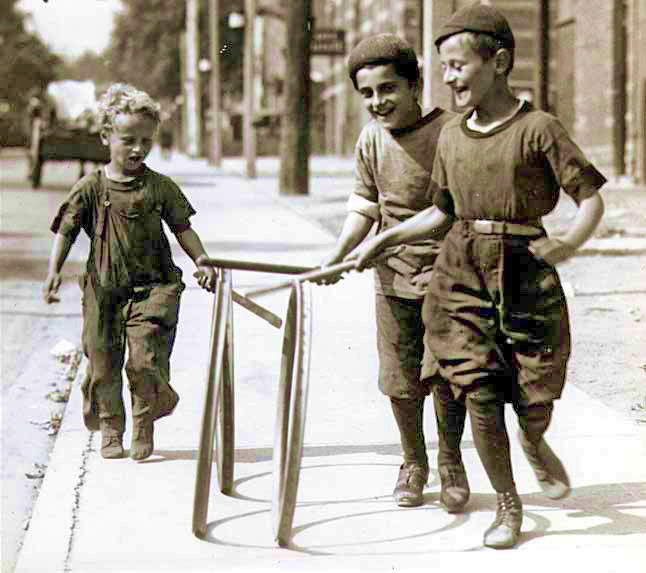

This depended entirely on where you lived. My parents were divorced and one lived in the country and one lived in the suburbs. I could ride freely around the neighborhood in both places, which was literally within sight of my house, but beyond that were dangerous roads and nowhere nearby to go anyway.
Neighboring kids were hard to find. In the country, there were 5 houses on our road and only one had kids my age. We were kinda friends but they were kinda weird.
The suburban neighborhood had 25 homes, and all the kids were older or younger. I never met anyone my age in that neighborhood.
Hanging out with friends meant you called them to see if they could come over. If both parents agreed and one was available to drive, you had a friend for the day.
If you wiped out in your bike
This was in the late 1990’s. I fell off my bike and got myself scraped up pretty badly. I was nowhere near home, so my friends and I knocked on a random woman’s door and she patched me up. Headed home and freaked my mom out when she saw my arms.
Back when neighbors could post up signs that told kids "Hey, if you're in trouble, this is a safe house."

It was always fun calling your friends house on the land line and their dad picks up. You sheepishly ask if your friend is home and immediately hear their name shouted across their house through the phone.
You think of something you'd like to know. You check your encyclopedia set but it's not in there. Now you just can't know that thing. You make a mental note of it for the next time you're in a library, which you later forget. If you're feeling extra adventurous you ask Billy Bob down the street if he knows. Invariably he passes along some bullshit he heard someone say once.
You reminded me of this:

We had the Internet, but it was for dorks. We didn't have touchscreen phones yet, so if you wanted to "surf the web" as we called it, you had to have a dedicated desktop PC, and you connected via "dial up" where you plugged in the phone line¹ and it literally dialed up the Internet. Long story short, it was an obscure hobby for nerds, like D&D or birdwatching².
Anyway, they used to mail you a lot of CDs back then. Some people got on the Internet using a CD that came to your house like junkmail or a phone book³ That's how Netflix got their start actually. You'd surf to their webpage, set up a queue of movies you wanted to watch, and they'd mail DVDs to you one at a time like a mail order Blockbuster⁴.
Anyway, you put this CD you got in the mail into your desktop computer, and it would call the Internet, or as we called it the "information superhighway" on the phone. Once you got there, you were mostly doing what we're doing now; sharing silly pictures about Star Trek on message boards with anonymous nerds around the world. The whole Internet used to basically this, but with cheesy gifs.
Honestly the Internet was better when people would make fun of you for spending all your time on it. Normies ruined the vibe.
¹ Back then, a phone was an integrated appliance/utility in your home. It only did voice calls, and it was physically connected to the wall of your house by a wire. You'd push little buttons or twist a little dial (which is why it's called "dialing") in one part to to enter a phone number, and then pick up this other part that looks like the "phone" app icon, which was attached to the first part by this tight curly wire.
² Oh, back then, D&D wasn't streaming and there weren't birdwatching apps, so those were obscure hobbies for nerds.
³ A phone book was a big book with super thin pages that was periodically sent to your house, and it had the names, addresses, and phone numbers of basically everyone in town, and then there was a second one with the same but for all the businesses in town.
⁴ Blockbuster was a business that rented out VHS tapes⁵ and eventually DVDs. Like Netflix that you had to physically drive to and browse rows of physical movies. Then you took them home, watched them, and then returned the tapes when you were done like a library.
⁵ VHS tapes were little plastic boxes with a pair of spools inside wrapped in magnetic tape. You'd put them into special devices that plugged into your television⁶ that would physically turn the spools so it could read the magnetic data on the tape, playing the film on the screen. If you've ever heard the phrase "Be Kind, Rewind", it was a message printed on Blockbuster tapes reminding you to run the spools in reverse after watching the film, so that it would "rewind" to the beginning for the next renter to watch. That's where the word "rewind" comes from, you had to re-wind the tape around the first spool.
⁶ TVs back then were these huge glass tubes with a little particle accelerator in the back and phosphorescent powder in the inside of the screen. The screens were much smaller, but the device itself was massive, almost a cube. You couldn't wall mount them, you needed a sturdy piece of furniture, "entertainment centers" we'd call them.
Older-ish millennial here. We got just a taste of the 'fuck around' era, enough to mourn its loss and really appreciate how increasingly miserable the 'find out' era we live in today really is.

there was no expectation to be constantly immediately available. you didn't have the world at your fingertips, so there was no pressure to immediately resolve all situations.
it was nice. slower. less pressure.
oh and the lower level of blatant exploitation and theft by mega corps and the uber wealthy was nice. not good enough still, but better than now
Hyper capitalism of the 1980's would be considered quant, by today's standards
Anybody can trade like they're a registered broker on Wall Street, so that's new, and gig work with no employee protections is increasingly the norm. Antitrust regulation is old-fashioned, while it was still kicking in the 80's. Whether monopolies are more or less capitalistic is up for debate, but we all know they're not good.
On the other hand, the financial markets are still much more regulated than before the Recession (or, we hope so), and you can't get away with money laundering or creative accounting quite as easily. There's also more environmental regulations, especially outside the US.
Born in 1967. I remember as a kid during the summer that pretty much every afternoon 10-20 neighborhood kids would get together to play games like hide and seek or kick the can. We were in a semi-rural neighborhood so kids could live up to a mile away or so. The parents were more than happy for us to be somewhere random with a bunch of other kids.
When parents had to call kids home for dinner they’d use bells, whistles, or other noisemakers. Pretty much every kid recognized the different sounds and knew which kids it applied to.
My grandparents lived in New Hampshire. Their telephone was on a party line shared with 4 or 5 neighbors. We learned to answer it only if it rang twice in quick succession.
Ha!
I lived at my dad's farm in N.H. through the last three years of high school, and he also had a party line. One long ring was for our place.. also, the town we lived in was on a mechanical lata code switcher, so if we wanted to call our friends, as long as they were in the same 942- range, we only needed the last 4 digits. IIRC, talking to my step-mom about it, she told me the phone company actualy didn't change out that mechanical switch until 1988.. and by then I was long gone.

We walked to school in the snow. Uphill. Both ways!
Now get off my lawn!
Jokes aside, I think one thing we had pretty good was not having to live in constant fear of every stupid thing we did likely being put online immediately. And there not being an "online" where your mistakes would haunt you forever. I did a lot of stupid stuff in my late teens and early 20's. And there is thankfully very little evidence of any of it. Kids these days don't often have that luxury. We're all young and stupid at some point. As you get older, that stupid stuff should be something you and your friends laugh about over beers, not something you fear a current employer is going to find at the top of the results when they google your name.
That said, the easy access to media and information is insanely cool. If I want to learn about the mating habits of marmosets, there is likely an in-depth Wikipedia article with way, way too much information. And it's likely up to date and well edited. Compare that to whatever blurb might be in the encyclopedias at your local or school library, plus anything you could dig out of the periodicals and microfiche, and it's not even in the same universe of information availability. Sure, there's a lot more to sift through online. And it's getting easier and easier to get lost in a sea of misinformation. But, you still stand a much better chance today of finding more, faster, than what we had back then. It's funny to think back about instructors making a big deal about not using Wikipedia when it first came out. Now, it's likely recommended as the first stop in researching something.
Also, I have a fucking computer in my pocket with more processing power than the entire world had available when we sent men to the moon. And I can use that computer to communicate with nearly anyone in the world instantaneously. And that computer can access that insane wealth of knowledge I just mentioned above. Again, almost instantly, from most places I am likely to be. I can be taking a shit in the woods and reading up on marmosets fucking while chatting with someone shitting on Twitter. It's the goddamn future over here.
Sometimes you'd wait a year for a TV show to come back and it didn't.
Only a year? Cries in Silo, Severance, Pluribus, etc.
It was a fucking paradise. Especially in the school summer holidays. Endless long summer days (it didn’t get dark until 10 at night) and nothing to do but play with friends. I grew up in rural SW Scotland, so we had woods, forests, beaches, hills, rivers, streams, farmland etc. at our disposal. Our parents were all at work so we had total freedom - as long as we were home in time for dinner we’d be good. Our bikes were everything, we’d meet up and decide what we were going to do and where we were going to go. Sometimes it would be someone’s house for video games (Commodore 64 or Spectrum), or building a camp in the woods, or fishing a stream up in the Galloway Forest, or cycling to the nearest beach and swimming in the sea.
If you replace Scotland with the midwest US and the sea with lakes and rivers, we had very similar childhoods. I thought free range 80s kids was just a US thing.
I think free range kids was a rural thing.
All the suburban kids I know grew up like this in the 80s.
Southern NZ here, sounds like our summer hols, minus computer games (not invented yet). We had endless freedom, roaming the hills until dinnertime, damming streams and lighting fires. I remember biking eight miles to the beach and back with a friend - our parents had no idea. The only time I got into trouble was one time I stepped in deep mud and came home minus a wellie.
We were five miles from the beach, but otherwise sounds about the same!
Also, nice user name.


Ambassador, you filthy bitch!
You could be unreachable and your job would have to accept that fact. There was typically a single landline per house so if it was busy or you weren't there then they had to suck it up.
You weren't pressured by society that you must be efficient in your leisure time. Play a game, best become the best at it otherwise you're a loser now. Painting something? You best be Van Gough in quality or it's shit. Feels like people forgot you're not supposed to monetize your hobbies, there were there to get away from work.
As someone born in the 90s, life is definitely simpler back then, and it's not nostalgia, it's REALLY simple, as in technology isn't as abundant and advanced and people aren't min-maxing everything they do. Street have less car so kids can run around without supervision and go to the nearest playground to basically doing kids stuff. It's also simpler because we don't have socmed blasting every issue to us and blow everything out of proportion. News are slow to travel, which also mean fakenews and misinfo are not readily available 24/7.
Also all gadget have philips screw, nowadays it's all clip on or glued on, no one can fix that, no one can tinkering that.
Slower. Funner.
I think the biggest difference was having/getting to discover things for yourself. No internet to look up whatever. We had to mail order cheat books for our video games if we got stuck. You had to actually watch the movie to see what happened instead of a highlight reel on youtube. For good or bad, it was different.
I had a bike that I would ride on the side of the highway to get to town and spend the $8 I got for my allowance on some soda and whatever toy struck my fancy at the Eckerds. Sometimes my parents would let me rent a video game from the Blockbuster, which would always be Chrono Trigger. On Friday nights we would go to Pizza Hut and I would get a plastic cup that was a tie in to whatever kids movie was out at the time. Usually I'd have some Book-it stars to turn in to get my free personal pan pizza, which was always pepperoni.
There always seemed to be a fair at the fairgrounds. When I was old enough, I started working the parking lot in exchange for a free ride bracelet, and then I'd go in and ride The Zipper till I puked up my nachos. My friends would all meet me there, though we had no way to communicate where we'd be, we always found each other. Sometimes there would be a girl I liked, and I'd walk next to her and make small talk and that would be good enough.
I didn't watch a lot of TV. Sometimes a show like Sliders would come along and the family would all settle in to watch it, but for the most part, visual entertainment wasn't a big part of my life. There were free weekends where you'd get premium channels like HBO or Showtime and I would use blank VHSs to record movies. Some of them had 8 hours worth of recording time on them, so you'd have to label them with really small writing so you could read Captain Ron, Ghostbusters II, Backdraft, and Power Rangers Movie. I read more than I watched, and I played outside more than inside. Goosebumps and Animorphs over The Hardy Boys and The Babysitters Club. Encyclopedia Brown is still the goat, though.
The Florida summers were hot, and the winter's temperate. I wore shorts with cargo pockets because no one really cared, and I could carry extra stuff that I always seemed to have a reason to drag around.
Church was something you did because it's what you did, but no one really took it that seriously. That would change in my teens, but for most of my childhood it was really just something to do on a Sunday to have an excuse to socialize. I used to volunteer to clean up after the whole bread and wine thing we did once a quarter because the bread was fresh and the wine was welch's grape juice, and I could eat all of the bread and drink all of the juice. My pastor liked black people.
We had swimming classes, which were put on by professionals that, when I look back on it, were probably 16 year old kids with their lifeguard permits. I remember someone jumped into the pool and landed on a girl that was swimming under the water, and her collarbone broke. That was the only time those 16 year olds were put to the test. We just kept swimming while Christine was taken to the hospital.
All in all, it was different, but the same. I have good memories, and bad, and some that make me feel a certain kinda way. I don't wish I could go back, but I'm happy I got to enjoy them the first time around.
Book-it stars
Wowza, that dredged up a memory I haven’t accessed in… maybe ever
That sounds intense, I hope Christine made a full recovery?
Yeah, Christine was tough as shit. She did just fine.
What 1900s? Oh, you mean the 20th Century?
Anyway, there was all sorts of bad stuff going on, but at least there was optimism and when they discovered things like, say, the hole in the ozone layer, they did something about it instead of pretending it wasn't happening.
If you want an example of how far shit has fallen...
My dad, as a recent college grad on his first job, was able to afford a house, support himself, my mother, and 4 kids, and purchase 2 nice used cars.
My family was considered relatively poor at the time. Not poverty poor, but definitely at the bottom of middle class.
This was in the mid 90s.
The streets were paved with gold and everyone said "hello" to strangers in the street with a smile. Getting a job was a matter of walking up to a person in a suit and giving them a firm handshake. VAR wasn't a thing in sports because the referees got every decision right. Cats and dogs got along fine with each other. Everyone had enough friends to play Goldeneye on N64 multiplayer. People didn't gain weight despite eating no vegetables. They hadn't invented 2nd hand smoking yet so everyone was free to smoke inside without it affecting anyone else. Musicians did drugs but never OD'd, just produced classic albums on demand. People read books constantly and you could expect to strike up a conversation with a petrol station employee about Satre where you'd get caught for hours marveling at their insight. You could have 3 pints at lunch during the working day with your boss. Concorde took you across the Atlantic in a matter of hours. Everyone had a tamagotchi and none of them starved.
This is what they took from us.
The not gaining weight despite a shitty diet thing is kinda real, at least.
and the weed was better too. That might just be the high tolerance speaking though.

High times top strains 1977.
Led lights have done amazing shit for weed growers. Granted the 90's already had good buds despite people having to use HPS lamps ans whatnot but LED has still been awesome for homegrowing, especially in countries where you can't grow outside. Also autoflowers just came in like early 00's. Well they technically existed in the 90's but first successful commercial strain was Lowryder in 2002. (That shit was good smoke too, very creative high.)
I'm guessing you mean the 20th century in general rather than 1900-1910? Because not many of us are going to be that old.
It was... wonderful and fucking awful in equal amounts. The details have changed between then and now, but the ratio is probably about the same.
For the US, my experience:
-
Way more smoking (which people also mentioned last time this was asked). Cigarette butts everywhere.
-
Government was more dignified.
-
Houses were smaller.
-
Cars were smaller. And more colorful -- the last decade or so has really favored colors between white and black. Oh, and a wider variety of interior upholstery.
-
Telecommunications were much more expensive.
-
People smashed trees into pulp, bleached it, rolled it into sheets, and then put their messages on them.
-
Libraries were more important.
-
Store selection was way, way more limited, and if you lived somewhere rural, even more so. Amazon and similar let you have anything delivered anywhere today.
-
I kinda miss some of the styles, like 1980s denim jackets, but there were also things that I disliked compared to today. Oh, yoga pants were not typically worn in public. Or flannel pajamas pants --- that seems to be a thing where I am now. If you were female, you were a lot more likely to be wearing a skirt or dress than today. Clothing was more formal, in general.
-
On that note, the necktie was still a thing. It's pretty dead today.
-
Carpeting in houses was more popular.
-
People spent a lot more time staring at the TV, which I think is a lot more mindless than Internet use today. Oh, and you had far fewer channels than you do on a TV today.
-
Lighting was yellower, because of the use of incandescents. Nighttime in houses was darker and yellower.
-
The logistics of communication and navigation were more complicated without GPS-equipped smartphones. One typically kept maps in the car. Asking for directions was a thing. You might even have a car compass. Finding payphones was a thing.
-
Much less omnipresent surveillance, like the security cameras and automated license plate readers of today.
-
If you had a computer, it was much more likely not to be connected to a network, so software couldn't rely on network access. It couldn't phone home or transmit information about you.
-
Video games were much less mainstream, especially before the 1990s. Not many adults playing them.
-
Way more handwriting done. The fancy pen was more of a thing.
-
Flashlights and penlights were more prominent, since everyone wasn't carrying a smartphone that could act as a flashlight.
-
I'd say that probably the majority of people wore a wristwatch.
-
Computers were much more expensive than they are today, and became obsolete far faster. The rate of computation speed increased such that about every 18 months, computers ran software twice as fast as before. This has a huge impact on other industries, since that constantly made new things viable.
-
Lots of devices with disposable batteries.
-
Dedicated portable music players with far less battery life were much more common. You carried around much less music.
-
Cars, IMHO, looked more interesting. Certainly more varied. Mileage was worse.
-
You certainly didn't omit spare tires in cars. Much harder to get roadside assistance.
-
I'd say that woodworking skills were more common. A lot of guys could and would do basic projects.
-
People spent more time outdoors.
-
People were thinner.
-
Motor noise was more obnoxious along roads. Cars are quieter today.
-
Airline security was way less obnoxious. Didn't have all the security screening stuff that 9/11 spawned. Air travel was more expensive.
-
More casual conversations with strangers that one sat near, I'd say. Smartphones severely degraded the custom of chatting with strangers.
-
Magazines and newspapers were much more common.
Born 1981. Suburban parents but my grandparents still had a small farmstead so I got the best of both worlds. Like a lot of kids of that era, plenty of free reign to wander neighborhoods, explore the woods and creeks, and when I went to my grandparent’s place I learned how to ride horses, pull lambs, garden, how to care for chickens, and that a gun isn’t a toy or fashion accessory but to be handled responsibly. Got a Nintendo the first Xmas they dropped and was the envy of all my classmates a few years later when I got a Powerglove, which was cool for about 5min until we realized it looked way cooler than it was. If you were lucky you or a friend had an older sibling who’d find a way to grant you access to R-rated movies, which were pretty much guaranteed to contain at least a few boob shots but mostly practical effects violence so over-the-top it was cartoonish. Everybody knew about the scenes in Robocop and Batmania when ‘89 dropped was a big deal.
In elementary school we had an annual Idaho history jamboree where reps from the tribes and mountain men reenactors would come to school and we’d spend a day outside grinding corn, being shown how to flint knapp, skinning a deer, tanning hides with deer brains, throwing hatchets, and the mountain men would do black powder demonstrations. In high school the rednecks would hang their rifles in the back window of their truck at school. I’m the same age/grade as the Columbine murderers, watched that real time in class as the normal school day ended that day. That day was the end of normal as we had accepted it and the change came overnight.
There’s all the fun stuff. The bad stuff. We were drilling for nuclear annihilation like kids now drill for mass shootings. The atomic holocaust never came but it’s still rather terrifying to subject kids to that, particularly when as an adult you know that desk isn’t going to do much to save your ass from the bomb. The AIDS crisis was also terrifying because it was so deliberately mishandled because politics and bigotry ignored it to achieve their own goals; then suddenly it wasn’t just gays and druggies who could get HIV, anyone could, but people didn’t understand how and why due to misinformation. Despite nostalgic takes on the 80s/90s, racism, bigotry, misogyny, “16 is old enough”, homophobia, and poverty were normalized to varying levels and each had folks working hard to address those in various ways. Nothing got “solved” or “fixed”, but I do think the progress of that era and the contributions of the activists and artists had an impact on the youth of that era. It’s why so many people my age have cut their hateful boomer parents off. They were so busy indulging themselves and ignoring their kids they failed to notice we weren’t adopting their mindset but that Captain Planet, Tupac, Rage, Philadelphia, X-Men, and a lot of other quietly (or not so quietly) coded media was pushing us to reject their worldview.
We still had a lot of access to Holocaust survivors, WW2 vets, Civil Rights/Vietnam vets, and as queerness broke out of the closet, the old guard who had been forced to hide for most of their lives. We got to talk to the people who’d lived through “when shit was really, really bad”. I think that too was a root of the boomer/X-Mil split. Talking to people who lived the shit of history makes one realize that the American Dream narrative is fiction.
It was a pretty good run and the hype that the last few decades of the 1900s were a great era to be a kid in the US aren’t without merit, but they’re fast becoming the new 50s/60s nostalgia fantasy of “it was the best”, so if we don’t want to become boomers we can’t forget that not all of us got that experience, not all of us were that safe & secure, and we definitely hadn’t “solved” American hate and bigotry.
Edit: fixed a formatting issue.
Captain Planet
So this is how I find out that Ted Turner has died this May.
We all wore onions on our belts, which was the style at the time.
More srsly by the 1990s we were about as internet addicted as we are now. There just weren't smartphones, so you were offline when you went out of the house away from your computer. You usually did have a voice cell phone, initially analog (AMPS) but later digital with SMS messages. Also, when you were online, the web didn't suck as badly as it does now. There was less bandwidth for megabytes of javascript bloat, etc.
Most people you'd meet in real life were still jerks, but there was less existential dread. It was more "you win some, you lose some" and less "humanity is doomed and the human condition is irredeemable."
Products were designed to last.
Most of the people you'd chat with on the internet were curious, benevolent nerds, not narcissistic political hacks.
You have a lot of answers to go through so there’s just one thing I will focus on: bees and clover.
Where I grew up, nearly every space with grass - so backyards, parks, etc - had at least some amount of clover in it. And more importantly, there were honeybees all over that clover. I distinctly remember as a kid being more afraid of honeybees than most kids. And walking through a field of grass with clover scared me because I knew there would be honeybees all over.
Nowadays, I don’t know if there’s less clover but there are so much less honeybees around. More often than not when I see clover I don’t see bees on it, and that’s very different from when I was a kid.
I think you mean wild bees, since honeybees are fairly rare apart from beekeepers.
But otherwise I agree. We're so much more obsessed with lawns of monoculture grass nowadays it's ridiculous. Fuck Monsanto.
Clover seed is cheap and you can sow it wherever you go. You can't tell it's there until it's already growing and it would be a pain to seperate it out.
I've been overseeding my lawn with it to let it take over. It's going great.
So you don't have to take the grass out first? I have clover seed but thought I had to dig up the lawn.
Clover is more drought-resistant than standard lawn grass. I wouldn't be surprised if it could get a foothold during drier summer months, but I'm no expert so I could easily be wrong
It does.
No, you can overseed spring, fall, and winter. I have clover sprouting all over from spring seeding. Fall and winter let them work into the soil and germinate more.
Excellent, thanks! I'll be sowing those seeds in autumn.
Yes, thank you, I meant wild bees.
Model 1964 human here.. Life in the past was a lot more free if you were a kid.
After school we'd be out the door with rocket boosters on and not come back inside until it got dark. Parents didn't know where we were, and usually didn't care as long as we did not get into trouble.
Rode bikes everywhere and played at the parks or would go to friends houses that had color TVs and watch afternoon cartoons. The closest we'd got to electronics would be a small AM/FM transistor radio. (If you got one of those, you were super lucky! I had this model.)
If you got 50 cents from the parents you were set for the day. Could get a can of Coke and a candy bar.
For the grownups, politics could be just as harrowing, Vietnam was a super hot topic and as kids, yeah you'd see lots of fucked up vets..
It's easy to look back and say "Ah, the good old days.." esp. if you were a kid - since mom and dad were doing the heavy lifting, but things were slower and the speed of stuff today seems to be down to the fact that people do not understand that they CAN slow down.
When we got internet in 1999, we bailed on the cable TV - having both was too costly. In the 27 years we're not had a TV (attached to cable service - I do game on a 50-inch 4k WalMart special (not-so) smart TV..) it's been a real show, watching friends and family get sucked up and into the maw of the mainstream media. Shit's poison.
You really want to slow down and touch grass, kick as much of the commercial-driven media as you can, to the curb.
Exactly that: growing up in freedom. I remember as a kid of 10 or 12, we roamed the area from after breakfast to about dinner. Without adult supervision at all.
Lunch was not needed, as the area was full of abandoned orchards that provided more than enough food over the summer.
Born in the late 80s, making me a 90s kid.
My siblings, neighbors, and I would play in the woods behind our neighborhood. There were trails and a creek that flowed through it. My older brothers and their friends would build bridges over the water (which vandals would destroy, so they rebuilt several times.) My parents allowed me to go play there as long as I didn't go alone. There was evidence of past generations playing in the same place, like platforms from old tree houses that had mostly fallen apart and strings along the tree line from old cup+string "phones" that kids in the past used to communicate. I'd also pick wild blueberries and climb trees. My siblings would fish and just chill.
We were among the last families to give their kids such freedom. One of our neighbor families had early "helicopter parents," so the kids lived very different childhoods from us. I remember other parents talking about that family, almost always disparagingly about how the kids were always stuck at home and were being raised on video games. It was like most adults saw adventuring outdoors with other kids as a typical way to spend childhood. I learned to navigate on my own, walking and bike riding around town without any way to contact my parents for hours on end. It was normal, it was expected, it was even seen as important for a child's budding independence.
Some kids would use payphones to make prank calls. There was one trail behind a park where somebody left a bunch of porn magazines, because it seems every town had a random "porn mag" patch somewhere. It was the first time I saw adult content, and I remember us kids treating it like it was funny.
I spent a lot of my childhood outdoors. My first kiss was on a nature trail in my home town. There was even a tire swing that the boy pushed me on, before we walked to the edge of the inlet for that first kiss moment.
When indoors, I played NES and SNES games. My family also played board games and my siblings and I made up our own creative games to play together. Car rides were great, too, with plenty of time to stare out the window and let my mind wander. At one point my mom bought a van and it came with a heavy-ass TV for the back, but my parents got rid of it. It only played VHS tapes and although at first I thought it would've been so cool to have a TV in the vehicle, I look back on it now and am glad that we didn't keep it. Even when we drove for 25 hours to get to Florida, I didn't miss having a screen. I brought books, a portable CD player, and toys, then spent most of the time gazing outside anyway. I remember seeing the full moon in the sky and thinking about how cool it was that it was always there, no matter where I went...
Thanks for the walk down memory lane. I often think about the shitty parts of my childhood, so it's nice to remember the parts that didn't suck. I'm really glad I got to enjoy the outdoors as much as I did, without being treated like a delinquent for having a childhood that mirrored all the generations of children that came before me.
I was born in the late 70s so I can comment on the 80s onwards.
It was ok. It's better now though. Some stuff got worse. A lot got better. We know more, have better toys, live longer, cheaper travel and so on.
The major thing that's worse is the internet blasting every negative thing into your brain 24/7
The Internet was slow and weird (in a good way).
The food wasn't great.
And the music was distressingly square.
That all changed when the Arcade Fire attacked.
I love so much about this comment.
I was mid-late teens when the internet started to become widespread. I didn't like the idea, had a bad feeling about it. Then I relaxed a bit and the more I used it, became comfortable with it.
Social media is what I was initially worried about, though I wouldn't have been able to know it back then. I"d want the pre-internet world back if I had one wish.
People were generally more respectful and forgiving to one another. There was a sense of we're in this together that has steadily eroded. We had our problems mind you, but I was sure my generation and I would make things better. By and large the only people saying everything's fucked were the "end is nigh" crazies in the streets.
Maybe my perspective was just more idealistic back then (excluding the internet), and the world was just as grim as it seems today.
But having college graduates reject AI--that gives me a little hope.
I wouldn't say I want the pre-internet world but I would definitely want the early-internet world. It used to be the best of both worlds before corporational greed and governmental control took over the entire internet. The internet was just this useful communication tool that happened to have some other niche uses like forums and archives.
I remember accepting candy from a man in a white van when I was six years old, in 1968. Afterwards I went and played with my friend. No rape at all, just candy. Life was simple and good.
One year the school bus stop happened to be next to a guy who filled vending machines, so his garage was filled entirely with candy and snacks. Occasionally a group of us kids would go ask if we could pick some candy, which would have seemed more weird if the family wasn't one we saw at church.
One of our neighbors did something similar for a job. He'd have boxes and boxes of Mr. Goodbar we could have.
It was just easier. I grew up after the Vietnam war and before the gulf one.
There was more help for people from the government. There was more freedom in daily life.living was easier. A 17year old could get a roommate and support themselves living independently working part time at fast food places. Simply having a job was enough to live.
There was a difference between being poor and being in poverty.
College was something you could get a job and work through with minimal debt.
Computers were just getting popular when I was young and it was easy to get a job based On what would now be basic technical skills.
The internet made noises and was crunchy.
People still struggled but I was easier for my generation than it is for the current kids.
140 WPM on the resume
More specific questions would help. The biggest changes I notice are related to Internet and communication. The fundamentals were about the same. Now there's more focus on convenience, less on doing things yourself. I mean the store didn't sell bags of pre-grated cheese and pre-shredded lettuce - those things would have seemed stupid (well I mean they still are, but somehow they don't seem like it).
It’s so weird too. I also buy preshredded cheese but it is noticeably less good and shredding isn’t that difficult so I don’t understand it.
I mean now that I need a bit of shredded cheese to get my dog to eat, I’m not dirtying a grater every meal for a small biteful
Similar to pre-shredded lettuce. I do buy it and it does help me eat it more frequently, but buying a head would be much cheaper and better, and it’s not like shredding it is time consuming. I don’t understand it
Dogs don't need bribes to eat. If your dog won't eat it means your dog isn't hungry yet.
People need dogs to be on a reasonable schedule. It makes it much easier to predict when they’ll need to go outside and more importantly to control when they’ll can be left home while everyone is at work
Sure dogs will eat when they’re hungry, but some dogs will “graze” throughout the day. … then I come home to find dog shit on my floor
Sure dogs need mealtimes, but once they're house-trained no dog I've ever had has shat on the floor unless they're sick. It works if you give yourself time to feed the dog and go outside for a little play and a shit before rushing off to your day.
Totally. People would debate facts in arguments because you couldn't just Google it. Okay, I know you might say it's the same today with MAGA or whatever. But I mean like silly things like which car is faster, which country is bigger etc, who sang a certain song or played a certain character in a movie.
Ready access to the facts is a huge loss. These conversations used to drive a lot of social interactions that no longer exist.
Realistically is it more important that we know who played a certain character in a movie or that we had a a group of friends spending time together discussing it?
Instead of conversation we now have contentious arguments about whatever randomly scrolls in front of us.
And even better now that it’s written down and we have a moment to think before responding, our witty repartee can include complaints about grammar, typing and autocorrect, etc. we can hound someone mercilessly with ridicule and follow them online, where in real life they could have just left
We also get to assume whoever we're enaging with is the dumbest or most vile human being that ever wasted oxygen, and dump all the frustrations of our lives onto them, which they richly deserve for making that typo or misusing that semicolon!
One thing that's missing is the sense of wondering about something. "I've always wondered..." is kind of an anachronism, now that it's trivial to look up almost anything we wonder about. "I've always wondered" has become, "For some reason I've never asked this extra brain I carry around all the time."
People were a lot less emotionally literate or aware of mental health issues. Autism and ADHD went undiagnosed if you were able to compensate half decently (you were just treated like you were being difficult on purpose). And kids were more brutal to each other.
The music was on point, though. I still enjoy me some Goldfinger.
Get offa my lawn
Lots of ppl have happy memories but all my memories sucked on the day to day living:
Wanted to learn something new or fact check it? Nope not happening unless it was in a library. Wanted to see a cat in a frog hat? Not happening.
Central Air was way less common
Everything we ate was super unhealthy unless your family made it. See movie super size me for reference.
TV had no pause. In fact you had read news paper to figure out what was showing when. Then you had to rent physical copies and sometimes fight for it like black friday for 2 day rental or have to wait until next week.
Wanted to pirate a song? You had to wait for it to be on air to hit record. So you miss a bit.
Nothing small portable anything. Cell phones and some tvs had radiation. Walkmen with radio were size of a thick sandwich.
Internet was slow when it first came out and you couldn't be on it for long as it was expensive and used up the phone.
Ppl listen into your call from another phone in house.
Rotary phones hurt my finders.
No cordless anything. Wires everywhere.
Smog was everywhere.
Acid rain was everywhere.
Being bullied was standard thing.
And the clothing options! What a joke.
Being bullied was standard thing.
Yeah, but they actually had to do it to your face, and that risk meant that there were significantly fewer bullies. (At least in my experience.)
I'm a weightlifter from age 13 though, so my build may have dissuaded bullies a tad.
Better in a lot of ways
Imagine life with no internet, no cell phones, and personal computers were both very rare and very few people knew how to use them.
Them dang Krauts stirred up trouble not once, but TWICE! then some idiot teli personality with dementia up his hoohaw became president in the USA and things went to shit, also kind of TWICE! And now the same thing looky be happening again. At least this pandemic wasn't as bad as that Spanish Flu.
I miss the onion belts...
We can’t bust heads like we used to, but we have our ways. One trick is to tell them stories that don’t go anywhere, like the time I caught the ferry over to Shelbyville. I needed a new heel for my shoe, so, I decided to go to Morganville, which is what they call Shelbyville in those days, so I tied an onion to my belt, which was the style at the time. So, to take the ferry cost a nickel, and in those days, nickels had pictures of bumblebees on ‘em. Give me five bees for a quarter you’d say. Now where were we? Oh yeah! The important thing was I had an onion on my belt, which was the style at the time. They didn’t have white onions, because of the war. The only thing you could was those big yellow ones.
Books and CDs/casettes were much more important and impressive. Kind of like magical in a way. You can say they still are, but imo it's not the same. Back then you had to buy them or risk forever losing that piece of media. You liked two songs but you got the whole CD anyway, you got that book just in case and if you were into collecting images you would buy loads, on stuff you didn't even care about, just because the photos were interesting.
Video rental places had an energy similar to a candy shop. You wanted to taste all of them.
In a way all those media now feel maybe valuable, collectible, but not really essential. They aren't as special anymore. I think it's easy to imagine what it was like but if you didn't live through it you wouldn't fully get it, it's like explaining doing drugs or giving birth, one of those things that you can easily understand logically but only when you experience it you grasp the concept entirely. Crazy to think that probably most things from our cultural past are exactly like that and no matter how much we study them we will never truly understand them.
Something I'd like to mention, money was still mostly cash. I remember when credit cards became a thing. Getting credit and loans was rare. If you didn't have the cash, you didn't get it.
You could actually feel and count what you spent and realize how many hours of work it took to make. Now it's just a fuzzy digital idea of how much youve earned and how much you owe.
Interestingly though... There was still the concept of "bad money, blood money, or filthy lucre." If you thought someone was buying something with money they'd gotten from drugs, or whoring women or hurting people, you had the option of not taking it. Black balling that person and not dealing with them.
Now it's so digital, and there is no concept of dirty money. The goal is get it anywhere and everywhere at all costs, and that's wrong. The morality has gone out of trade and economics. And as crazy as that sounds, yes, there used to be morality in economics.
Certainly more than there is since the start of the new millennium.
Now it's so digital, and there is no concept of dirty money.
Dude's never heard of crypto.
Like 80% of what drove the rise of Bitcoins value was the drugmarket, ie dirty money. I myself had more than 120 Bitcoins for a few hours. I never invested in any crypto, just to make it clear. I just went to an anonymous automat in a mall, inserted cash, wrote in a crypto wallet address, went home and purchased drugs online.
Had I been a bit smarter I prolly would've invested a few euros into bitcoin, but to be fair I've not been in a financial situation where I've would've justified waited for it to grow for 10 years. I would've def cashed out at a few k.
Other than that yeah I feel your comment. I remember when all the adults had proper credit cards and kids had Visa Electrons, meaning it needed verification of funds before allowing a purchase, unlike a credit card you could just charge without verification. With one of these.. Dad had one, as he had a taxi. They don't call it a "click-clack" for nothing. Using it felt like being an actionhero and loading a shotgun.
Are coin pockets even still a thing on jeans btw?
I've heard of cryptocurrency/bit coin and spice road, but real physical money and face to face exchange was a different feel.
Rule #3 Internet is anonymous.
It's the way it is... But it's different.
I never mentioned anything about a spice road, so either that's shitty sarcasm or shitty lying.
Edit sorry just bad reading by me I read "I've never heard of.." instead of "I have heard of". Apologies.
Yeah cash is different, but dirty money isn't always cash. If you believe that then you're probably not aware how larger scale crimes work.
I am kinda annoyed with stores being allowed to not accept cash nowadays. When I was younger and drove a taxi I always had to have my own change on me, and sometimes I was broke when going to work and couldn't break a 50 or a hundred and I'd just have to lower the fare to a sum I was able to break. Luckily hundreds were pretty rare and not being able to break one wasn't a big deal. But breaking a 50 was assumed and once you were somewhere 20km from the nearest atm, the only choice for me was to just lower the price. Sometimes they'd tip the difference, but more often than not I had to round down like 5-10€.
I am kinda annoyed with stores being allowed to not accept cash nowadays.
I’m more annoyed they’re not required to accept something electronic. I almost never carry cash anymore.
- electronic works any time, anywhere
- electronic works for any currency
- electronic immediately updates your account, compared to checks where you had to track pending purchases
Yes it means I can’t be anonymous, yes it makes it too easy to spend money I can’t afford. But the advantages really make up for the disadvantages (at least for me)
Either way, fees have gotten out of hand. If I need cash, I need to pay $3-$6 to get access to my money and save the bank from having to pay more tellers. But the rise of higher credit card fees is more annoying these days. I know the blame is usually put on rewards cards and agree that’s all a bit of a scam that needs to be pulled back, but part of it also is now we’re locked into using it
The law where I live pretty much says you have to accept all the most common forms of payment. Or used to, but after covid they've used hygiene as a reason to save on the costs of cash.
Yeah electronic is usually much easier, but unfortunately I have quite a few things which I need and/or get cash from. Which isn't ideal, but since not doing it would mean worse things, I do do it, while waiting for my society to improve.
But Visa Electron doesn't do all those things perfectly, btw. Better today, but I remember having overdrawn my account a bunch of times as a youth, because when I was broke I'd shop at small stores I knew that their machine didn't properly verify funds before placing a pending purchase, even when it was supposed to not be able to do that.
Also I don't have to pay fees to my banks or ATM's here, not yet at least. Forex is pushing ATMs here though, with lots of ATM's for foreign currency. Who is enough of a dipshit to use an ATM for foreign currency in their home country before going on a trip? Scams, the lot of them.
Here there is no such law. They have to accept cash but even so can place limits such as not all in coins or no unusually large bills
However electronic payments is up to their card processor. So far the major processors have mandated that you have to accept all: credit and debit processed by them (I no longer see places that don’t accept tap to pay so maybe that’s included now. American Express used to be excluded because of high fees and they are neither visa nor Mastercard, but I have no idea what the current situation is. Costco is the only place I know that only accepts visa or only accepts Mastercard, I forget which
But ….. some credit cards lean in on various types of rewards back to sell a lot more cards. From the user point of view, it’s money for nothing. However that’s paid for by higher fees to merchants. As part of recent rollback of consumer protections, merchants are now allowed to charge a different price for cash vs cards and those higher fee rewards cards mean they really want to push all those fees back to the customer.
So if you have a rewards card in the US, thank you for extracting more money from the merchant, driving them to charge the rest of us more. Your cash back is funded by higher prices to me
If you were a woman, you might not be able to get a credit card, either. I don’t think women regularly being able to get their own credit became a thing until the ‘70’s.
This might be the worst possible way to get a genuine feel for what life was like. For whom?
Industrialization and telephones were ubiquitous. We'd witness the rise of automobiles, flight, antibiotics, DNA, nuclear power, computers, space exploration...
A massive shift towards urbanization. Life expectancy jumped up. Migration took off. Society became more consolidated, diverse, and aged.
Human rights started getting more institutionalized. Civil rights and feminist movements made great gains. Globalism and mass consumer culture similarly boomed.
A great depression and two world wars generated a sense of unity from people coming together to get through hard times and overcome common enemies, but it deteriorated quickly under the pressure of rapidly shifting cultures and lifestyles.
A person's experience of this depends on a lot. People in different demographics would have drastically different stories to tell.
Imho the best way to get a broad feel is to track the technology. People were able to call each other, travel long distances with relative ease, get effective medicine for common maladies, and pop into the corner store to buy handy items.
But it was a lot harder to access information generally, and a lot less was available before everyone was carrying around gps enabled cameras all the time. It was a lot easier to believe in urban legends and a lot harder to understand how advanced technology worked.
Not 90s but the 2000s in the middle east (keep in mind the same technology was released here at a similar time but adoption was slower due to prices and companies at the time not knowing how to market their products in non-western markets)
I have older siblings and younger siblings and I want say me and my friends in the same age group exist in this weird transitional generation. We are too young to have embraced the optimism and hope of the older generations but we are too old to have just accepting the current status quo as how we found the world to be.
As a child I have used the entire progression of the telephone. I have used landline, dumb Nokia phones, blackberry, smart Nokia phones, and Samsung smart phones. I remember watching both satellite TV and YouTube Minecraft let's play as a kid. My dad used to take family pictures using both a film camera and a digital camera. I remember when we had to go out I would schedule the VHS recorder (or whatever it's called in English) to record my favourite cartoon tv show.
But what I believe is the most impactful aspect is the politics. I can clearly remember the Arab Spring (a series of revolutions in 2011). I was too young to understand it at the time but I sure have felt this feeling hope, optimism, and freedom in everyone around me just to realise when I grew up that we've lost.
Also LLMs and AI became a thing while I'm in the middle of university so I have seen how the concept of education slowly change from who learnt the skills better to who can make it the fastest with least tokens spent.
I'm also an introverted nerd so the moment I had internet access I was totally invested. I have seen how it turned from wholesome (and totally not wholesome) forums, chatrooms, and personal blogs, to these gated gardens, to brainrot and then AI slop. And I miss just hanging around uninvited in a small niche online community and talking to people.
I think what would resonate with my age group and some older folks is the feeling and promise that certain things and the future will be ours when we grow up, just to loose it all before we had the chance to.
Understand that most people’s comments here are about their youth or childhood, which means their perception of the 1900’s is completely different than now.
And MTV and VH1 were tight and we all know it’s disgusting now, but if you stayed up late enough you could see Girls Gone Wild commercials on TV.
In the US in the 1980s there was still existential dread from the cold war... nuclear war was very much a concern, although less because, well, it just hadn't happened. We also had a terrific "war on drugs", which was used to oppress minorities and in general stoke up fear and funnel money to militarized police. We had massive inflation at the start of the decade. Iran had just had a religious revolution, and the Soviet Union invaded Afghanistan. Trump declared war on unions and basically ended the successful policies preventing the worst excesses of capitalism that were put in place after the Great Depression (which Clinton gleefully continued). The AIDS epidemic began, and we had no idea in the beginning how bad it might become. It stoked already rampant homophobia.
As far a daily life in the US, we had the dominance of malls as a place where people went to buy stuff. It led to a lot of neighborhood businesses dying, and eliminated any place where people could meet without a commercial purpose. And because they were private property, people could be controlled. No protests allowed on private property.
We did have a few good things of course! The split of AT&T meant cheap phone calls and the ability to buy cool phones, like a hamburger phone of whatever. Computers got cheap enough that there were 8-bit microcomputers, like the Commodore 64 or the Apple II. Piracy was rampant - you could go over to a friend's place with a box of blank floppies and come home with 20 new cracked games. We got rap and break dancing and synthesizer music and music videos.
The Internet was only available at a few universities, so if you wanted knowledge you went to a library. Urban myths and misinformation were everywhere, but unamplified by any algorithm. You could shop by calling a shop or even sending a fax.
the house had one telephone line, but often there were two or three phones sharing it. an incoming call could be for anyone, and would ring all of the phones, and any or all of the phones could answer it or join it just by picking up.
so if one was quiet enough, one could easily eavesdrop on the phone conversation in the kitchen by using the basement phone.
if a call came in while someone was on the line, busy signal. MAYBE call waiting where you put one on hold and answer the incoming.
and of course dialup internet coexisted with all of this. your massive download could get corrupted if someone picked up a phone while you're connected.
Lived through this world
- my grandparents were on a party line for ast my college graduation
- my parents built their house when AT&T started being opened up, so it was a new thing that we had many phone jacks throughout the house without having to pay them
- my parents had a single phone line, shared among multiple phones and dialup
- in the 80s I started knowing people with multiple phone lines, for dialup and voice.
- about 1990 I got my own ISDN connection for high speed internet (arguably before internet existed) so I didn’t have to block my voice line
To be complete, dsl in the late 90s, then fiber in early 00s, gigabit fiber in 2020
Born 1972.
Life was simpler, 1 TV in the house, 1 corded phone. So technology didn’t dominate our lives like it does now. As kids we were more active than kids today are.
While some would say life was better then, that is not necessarily the case. People still struggled to pay their bills, they were scared of the Cold War, AIDS and the hole in the ozone layer. They were more likely to die of cancer, heart attacks and other illnesses that modern medicine is better at dealing with.
If life seems worse now, in many respects it’s because of the media, in all its forms, which mainly focuses on the negative, and it’s much harder to avoid than it was in the 1900’s
Life was simpler for you because your parents took care of you. For men graduating high school in 1970, the draft and the Vietnam war loomed large.
In the 70s gas prices were insane, heavy industry manufacturing started to collapse and between 1973 and 1975, there was an average of five terrorist bombings, every day in the US.
Mortgage interest rates were in the high teens
Mortgage interest rates were in the high teens
And it kept the price of houses affordable. The interest rates today are stupid low and are what caused the shit market we have now.
Sure pal.. houses were not any more affordable. The cost of the property where low but the monthly payments were completely out of reach..
No they were not, that was the last time most younger people were able to afford homes.
https://www.thezebra.com/resources/home/housing-trends-visualized/
The median house of 1960 would cost just $104,619 in 2020 dollars, far below the actual cost of $240,500, meaning housing costs have increased by 129%.
Homes have become less affordable: In 1960, approximately 68 out of 100 Americans could afford a home, but now only around 43 out of 100 can afford one.
Among 18 to 34 year olds, nearly twice as many people live at home with their parents in 2020 than in 1960.
Even in the 90s when the rates were in the teens more people owned homes.
The average age for first time home owners has gone up a lot as well.
Low rates do not equal more affordable housing, they end up pricing people out of the market at a much greater rate.
Our TV picked up ABC, NBC, CBS, PBS, and one or two independent TV channels from New York. Our antenna was on a rotator so that you could point it in the optimal location for each.
Oh man.. antenna rotors were the best!
After my dad divorced wife #2 and traded up to wife #3, he moved into her place for a few years in the mid-80's.. They were on a high ridge halfway between Concord, N.H, and the seacoast. House had a 40 foot aerial with a rotor and one of those huge channelmaster antennas. It was absolute gold for TV reception.
Get this:
WGBH - 2 out of Boston WCAX - 3 out of Burlington, Vt. or point the antenna southwest and get WFSB - 3 out of Hartford, Ct. WBZ - 4 and WCVB - 5 out of Boston, WCSH - 6 out of Portland, Maine, WHDH - 7 out of Boston, WMTW - 8 out of Portland, WMUR - 9 out of Manchester, N.H, WCBB - 10 out of Portland Maine, or WJAR - 10 out of Providence, R.I. (that was early mornings mostly) WENH - 11 out of Durham NH, WPRI - 12 out of Providence, R.I. (also only early mornings) WGME - 13 out of Portland Maine WNHT - 21 out of Concrd, NH (it didn't last long..) WXNE - 25 out of Boston (Now it's a Fox channel, WFXT) WMEA - 26 out of Portland, Maine WHLL - 27 out of Worchester, Mass, that went adult after hours.. If you had an analogue pulse cross generator you could watch the naughty films.. otherwise it was scrambled - I remember my younger brother madly trying to watch the fuck films while the picture danced and shook! LOL! WSBK - 38 out of Boston.. Red Sox games anyone? WGBX - 44 off of Cape Cod (mornings mostly) WNDS - 50 out of Manchester, NH. (had Al Kaprelian, a local meterologist, who was actually the ONLY weatherman to call out that "perfect storm" in 1992 (the one that a movie was made about) and warn people about it.. Short dude who was kinda goofy but absolutely knew his shit..) WLVI - 56 - had the Creature Double Feature monster movies on Saturady afternoons in the 70's.. WVJV - 66 - aka "v66" which tried to be an MTV clone but lasted 4 or 5 years and is now a spanish network channel.. WQTV - 68 out of Boston..
More TV channels on that spot than anywhere I'd lived, including the Bay Area in California.
Our TV got 1-5 channels depending on the weather. Our antenna rotator was one person outside turning the tube that held the antenna and one person inside saying "A little more! A little more! No, go back! Go back!"
I remember visiting a rich person's home and his son showing me his cable TV. He was bragging that he could watch Dukes of Hazard on the regular channel at 4pm and a cable channel also had the Dukes at 7pm.
Two Dukes of Hazards in a day?! That's how rich folks live!!
Dukes of Hazard...
Fck'n Cletus!
LOL!
To counteract all the rose colored glasses looking back decades and the doom and gloom now …….
We also had the Cold War. Mutually Assured Destruction. And you never knew whether anyone would be M.A.D. Enough to end the world. Later on we found out they were, and at least one time the world didn’t end because of a Russian specialist disobeying launch orders
Yup. Climate change is going to suck, but actual existential risk is way lower now. And before the 20th century people did the same end-is-nigh thing on supernatural grounds.
If you're thinking of the submarine, it wasn't a specialist, it was an admiral who just happened to be on the right boat and belayed the captain and political officer's order. One of the same guys that was on K-19, interestingly. There was also an armed nuke the French just kind of dropped on themselves by accident. Here's the list of known close calls on Wikipedia.
That was it,thanks
My lovely 3 bedroom detached house cost 4x my salary.
People treated gay people like they treat trans people now, but it started getting better, not worse.
Most people blamed the government when it underinvested in public services instead of blaming immigrants.
Unmetered internet was something that happened to other people unless you were at a university.
I'm from 1990 so I just barely eek in but man. Things were so much quieter. Physically in the moment I mean. Everything was so much quieter.
Best 2 weeks of my life
I’m a little earlier, mid 80s. Can’t recollect exact years so the order will probably be wrong but here are a few things I remember:
I grew up when vinyls were on the way out but we still had some and I was listening to old children’s stories on it. Newer ones on cassette.
I used to record songs on cassette from the radio. Annoying hosts kept talking over it.
I also secretly recorded the movie Halloween over a bought VHS of The Little Mermaid, which my parents were furious about.
I didn’t have my own stationary gaming console until the N64 because we didn’t have a lot of money. So I visited friends to play. But I did have a game boy. With a transparent case, it was awesome. Kids with money had a bunch of attachments for it, like a magnifier, light, better speakers. One friend (who had everything) owned a Sega Game Gear. It was huge and had a color screen but it ate batteries like crazy, so it was always attached to the outlet. Sega was always weird to me.
Console games often didn’t have any way to save progress, so some of them showed you a code after each level, which you would write down so next time you could begin at that point. Some games didn’t have that either so you had to play through it in one sitting. But they were also much shorter. Later we also had memory cards.
My second Gameboy was the Color and I also got the Gameboy Camera attachment. It had such a bad quality but somehow it was fun. It had little games on it as well. I still have both in a drawer somewhere.
Computers were much larger in the beginning and software would come on multiple (!) floppy discs. The installation would take FOREVER and make make loud noises. Later it was on CDs.
People used to buy gaming magazines with CDs included to play the hottest new game demos and sometimes full versions. Games also came bundled with computers.
Games also had huge instruction manuals which were fun to read on their own.
In dial-up internet times we could only either be online OR use the landline phone (which was just „the phone“ because there was no mobile). It was also extremely expensive, billed by the minute. To get the cheapest we used a list of dial up numbers with prices on it which would get updated weekly or so. I think it was in the newspaper or TV guide magazine? So internet time was rare.
Before everyone started to be glued to computers 24/7 we used to roam around town and in the woods a lot.
Personally I was big into Lego. I had a huge box full of it and just emptied it on the floor to build whatever came to my mind. I could get lost in it and I was so much more creative back then. I also had some action figures, mostly He-Man and Ninja Turtles.
I had my own first computer when I was around 18 or so. That was Windows XP time (or was it Vista already?). Before that I always used my parent’s to play games or go online. And I was one of the first to own an LCD screen then. This was not ideal for Counterstrike because refresh rates were low, but it was a good trade off in my opinion. I had less weight to carry around to LAN parties, which was a thing back then. Just us friends in the basement or big events with hundreds of people. We all connected our computers together and it usually took an hour or so to even get it working and then everyone needed special patches and software to be compatible with each other.
Game patches… that was a crazy time. Nowadays games update automatically and frequently. Back then you would get instructions on what files you need to open in a hex editor to fix some bug. The patches would need to be implemented one by one in the right order, or everything was fucked. Or you just got complete new files from somewhere to replace existing ones. Then later patch programs would do that for you but they only worked half the time.
Ok I should stop now, new memories keep popping up.
I’m a little earlier, mid 80s.
Unless OP changed the post title, you're not. They're asking about the 1900s and it doesn't sound like you mean the 1850s or so! Haha
Damn you’re right, I read 1990 somehow.
Hah, still enjoyed your comment quite thoroughly
It was the free-est, most affordable, and happiest days that the world will be in my lifetime.
Anyone born in the 1900's would be at least 117. You'll struggle to find anyone from back then.
Presumably they meant the century.
No shit.
Remember when the 1900's were called the "20th century?" Pepperridge farm remembers.
The 1900's used to be call the 20th century, they still are, but they used to.
Mid of the 80s in Europe.
When I was in primary school a corruption scandal wiped out our political class and this gave us 20 years of tycoonism.
Everything was in black and white.
The 90s was the last good decade.
Perhaps it’s just nostalgic romanticization, but I seem to recall that product quality used to be far more important: Manufacturers vied for customers’ favor and therefore focused on offering the best value for money or innovative products to outdo the competition.
This seems to me to have been lost to a large extent due to the fact that unbridled capitalism—likely exacerbated by the Internet’s tendency toward centralization—has led to increased monopolization, so that providers have now shifted to exploit their customers to the maximum, since they no longer have the option of switching to any provider other than perhaps two or three gigantic corporations that dominate their respective business sectors unchallenged.
This seems to me to be a development that was certainly already in the making in the 1990s and early 2000s, but which has intensified—largely due to the internet’s trend toward globally centralized platforms—to such an extent that now even fewer, even more unscrupulous billionaires can abuse their unrestricted market power not just nationally or at least to some extent locally, but internationally.
It seems to me that this development has to do with the fact that the internet represents a global market, but there are simply no global authorities that could counteract the formation of monopolies on an international level.
It seems to me to be the logical consequence of the predominantly U.S.-led cutthroat capitalism that has essentially lost its social function of distributing goods in favor of becoming an instrument of power for the multi-billionaires who have become far too powerful. The result, it seems to me, is a kind of new monarchy of billionaires who have become so powerful that they have been able to place themselves above the community and the law—with fatal consequences for the general public.
Of course, these immensely influential private individuals with their boundless greed already existed in the 1990s, but in my opinion, their influence wasn't quite as far-reaching back then.
Born in 1979. I've seen rotary phones, touch tone phones, cordless phones, pagers cellphones, PC computing pre windows (DOS anyone,) floppy discs (they didn't just used to be a save icon,) the internet before the internet when it was just hyperboards you dialed up manually and then put the receiver into a baud modem, cassette tapes, CDs, MP3s and ipods, car windows that had to be manually rolled down. I had a TV where you had to get up and manually change the channel.
I'm in that weird space where I could be a millenial, or could be gen x. I was a latch key kid and had no parental supervision. As an 9 year old, I came home from school and cared for my 4 y/o sister. We played outside, in the street, we walked to the park. I'd ride my bike and put my sister on the seat and we would go get ice cream, or go to the comic shop. It was normal to just be a kid doing your own thing and for your parents to have no idea where you were or how to contact you.
If you didn't know where you were going, you had to purchase a map/atlas and learn how to read it to get directions.
I lived through the contra scandal/Iraq Iran war, the war on drugs, desert storm, the war on terror, and whatever the fuck this new Iran straight of hormuz war is. I've seen lived through lots of genocide, (I'm not a victim, just got to see it play out in the news;) Sabra and Shatila massacre, Anfal campaign, Isaaq genocide (somali), Bosnian genocide, Rwandan genocide, Massacres of Hutus during the First Congo War, DRC and ethnic cleansing of Pygmies from the Congo's eastern region, Darfur genocide (2003–2005), Yazidi genocide, Ukrainian genocide (via Russia and still ongoing,) Persecution of Uyghurs in China, Rohingya genocide, and Gaza genocide. We have always been at war.
Pre-internet, there was tons of news you would never hear of, or if you did you got the propaganda version because there was no way to access the facts. The newspaper and TV news were still considered reputable. Now with smartphones and cameras everywhere, people can share information with each other directly and we can all call bullshit on misreporting and propaganda, for all the good it does.
Life was hard then, and it's hard now. It's just hard in different ways.
I'm seeing a lot of nostalgia glasses here so just going to say some things were markedly worse (90s perspective): it was much harder to verify information whether that be for scientific research (the hole in the ozone layer was a big one at the time), directions, movie/game reviews or even geopolitical situations
The smell of vehicle exhaust was more common as many vehicles on the road predated the requirements of catalytic converters and you can bet there were a lot more people who would claim seat belts are more dangerous because they can trap you in a drowning vehicle (no matter how far inland they lived)
Buying batteries on a regular basis from the grocery store was a normal occurrence as rechargeable ones were either prohibitively expensive, unavailable or had iffy chargers and you needed them for a lot of stuff smartphones do today: clocks, answering machines, CD/cassette players, etc
Answering machines (though largely digitized by the late 90s) generally required tiny tapes to record voicemails while vacuums almost always required bags. Neither were large expenses but both were recurring as was using payphones but that's a topic unto itself
There was a monoculture that we took for granted which I feel was both the best and worse part. Basically all your classmates and coworkers likely watched the same shows/movies as you which legitimately helped the community bond as a whole but those shows seldom challenged (or even could challenge) the status quo with "dangerous ideas" like same sex parents or non-white superheroes but I'm not gonna pretend I don't miss the phenomenon of people excitedly going "hey, did you see Friends last night?" or the energy of Pokemania
I'm not trying to say it was strictly better or worse but the rise of the internet, smart phones, rechargeable batteries and widespread adoption of international standards (USB, various EU policies, Bluetooth) undoubtedly democratized many things previously held behind gatekeepers
Sometimes those gatekeepers were legitimately excellent at their craft, sometimes they were out of touch, sometimes they were manipulating the lack of info gathering tools at the time, or even (often) some combination of the three but that friction between us and the next piece of media made it easier to appreciate the 15th rewatch of The Mask on VHS while simultaneously helping to enforce the college textbook scam so well-known today
Slower computers, slower internet, and you had to record shows to skip ads. On the plus side, video games and consoles would actually get cheaper over time. So that was nice.
No social media. All the stupid stuff I did and said as a kid stays where it belongs, haunting my memories as I lie awake at 3 AM.
Better in some ways. Worse in others. About like any time really. And that "better" can easily be tinted by nostalgia.
Really missing the pre 2005-2010ish internet though. Can't really pinpoint where everything died for the internet.
I think it was around 2014, but it's been a slow downhill ever since. I used to visit many sites in my nightly rounds, but it became just Imgur, YouTube, Reddit, and NewGrounds, for the most part around then. I just lost Reddit to a perm Suspension, and I swore of Imgur after it got to woke to post jokes and dark humor/observations. (and they IP banned me for 6 months)
I was five.
AAA games were actually good.
Two words: Pussy Everywhere.
Before video games and cable TV, I read a lot of books. I can remember reading Call of the Wild and White Fang in elementary school, "childrens" classics like Tom Sawyer, Robinson Crusoe, Adventures of Huckleberry Finn, 20000 Leagues. Encyclopaedia Brown was a favourite childrens series of mine.
It sucked ass!
I genuinely have learned a lot of useful things from threads like this, though. Reddit/Lemmy gets you that firsthand experience stuff you can usually only get from your small collection of IRL friends.
I had to watch out for dinosaurs on the way to school. My first dog actually was a tiny t-rex I called Murphy. I think he got lost hunting for brontosaurs.
Also my first phone was made from stone and worked by chiseling in the text message i wanted to send and then throwing really hard.