I'm convinced honestly
5d 2h ago by piefed.social/u/PugJesus in roughromanmemes@piefed.social from media.piefed.social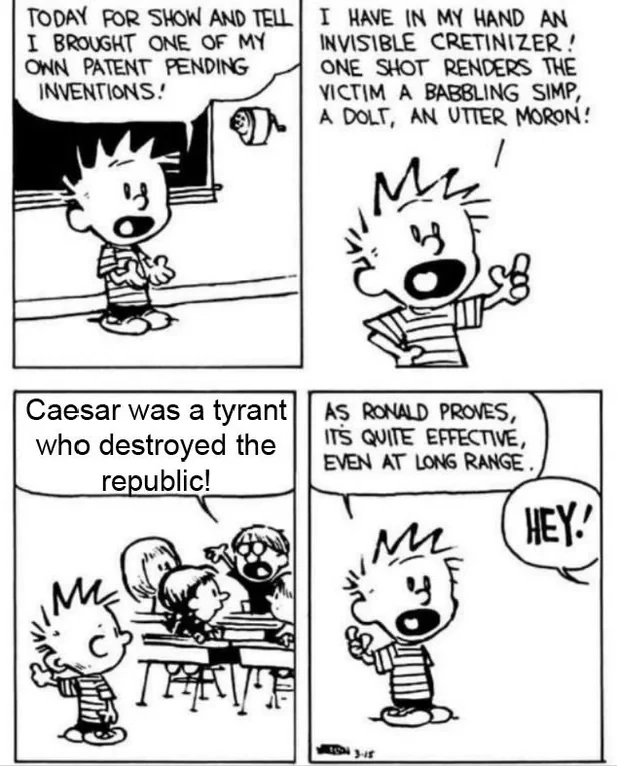
Explanation: The importance of Julius Caesar's actions in the fall of the Roman Republic remain hotly debated, including his intentions, the political context which triggered his actions, and the value of the increasingly aristocratic and plutocratic Republic itself.
Intense partisanship can rear its head even amongst academics over whether Caesar was a tyrant or a reformer at heart.
Hey Calvin, what a coincidence — I have an invisible reginiser! It points out the next king of Rome. Guess who it is? It is you!
Okay, serious now. Personally I see Caesar as the last straw breaking the camel's back, but the Republic was dying since at least 133 BCE, due to things like this:
- Tiberius Gracchus going for an illegal second tribunate
- Gracchus' opponents killing him
- Sulla creating laws against marching into Rome, but showing at the same time it was okay if you were victorious;
- Cicero and his "patres patriae" killing Catiline without due procedure;
- etc.
Note the pattern — all of those show a culture of bending and violating rules, resorting to violence if needed. "Our goals are worth it." The law degraded, from backbone of Roman peace and prosperity to a mere formality.
And without this degradation, Caesar would've probably never taken the actions he did. And, if he did, he'd be crucified on the spot. But instead his actions were seen as normal, positive even. As well as Octavian rising to the throne later on.
I would argue that Caesar's actions being seen as a positive has more to do with why Tiberius going for a second tribunate was seen as a positive - not because norms had been eroded (though certainly norms were eroded by Caesar's time) but because it had become apparent that the disconnect between the reality of the Republic after the Second Punic War, and the norms that served the government before it, were crushing the great mass of ordinary Romans in a way that they did not in the mid-Republic.
When the system appears designed to fuck you over, you become less attached to the norms of the system. The equilibrium that was maintained by the ~3rd century BCE Republic was obliterated by the growth of the city of Rome - both in population and wealth - and the inability and unwillingness of the aristocracy to make new accommodations without being forced.
When people are desperate, they turn to dangerous men, like Caesar. Sometimes it works out for them. More often, it doesn't. Which outcome Caesar counts as... depends on one's reading. :p
I think both are two sides of the same coin. Or rather, parts of the same vicious loop: as the norms fail to address reality, people look for ways outside those norms to keep on living, so the norms get further and further detached from reality, and people are more willing to accept others break those norms.
But either way, I think even without Caesar (or even Octavian) the Republic would've fallen. So as fun as it is to say "hey Caesar, Stabby McStab is coming for you~" and "sic semper tyrannis!", I do agree it's a bit unfair to blame the fall of the republic specifically on him.